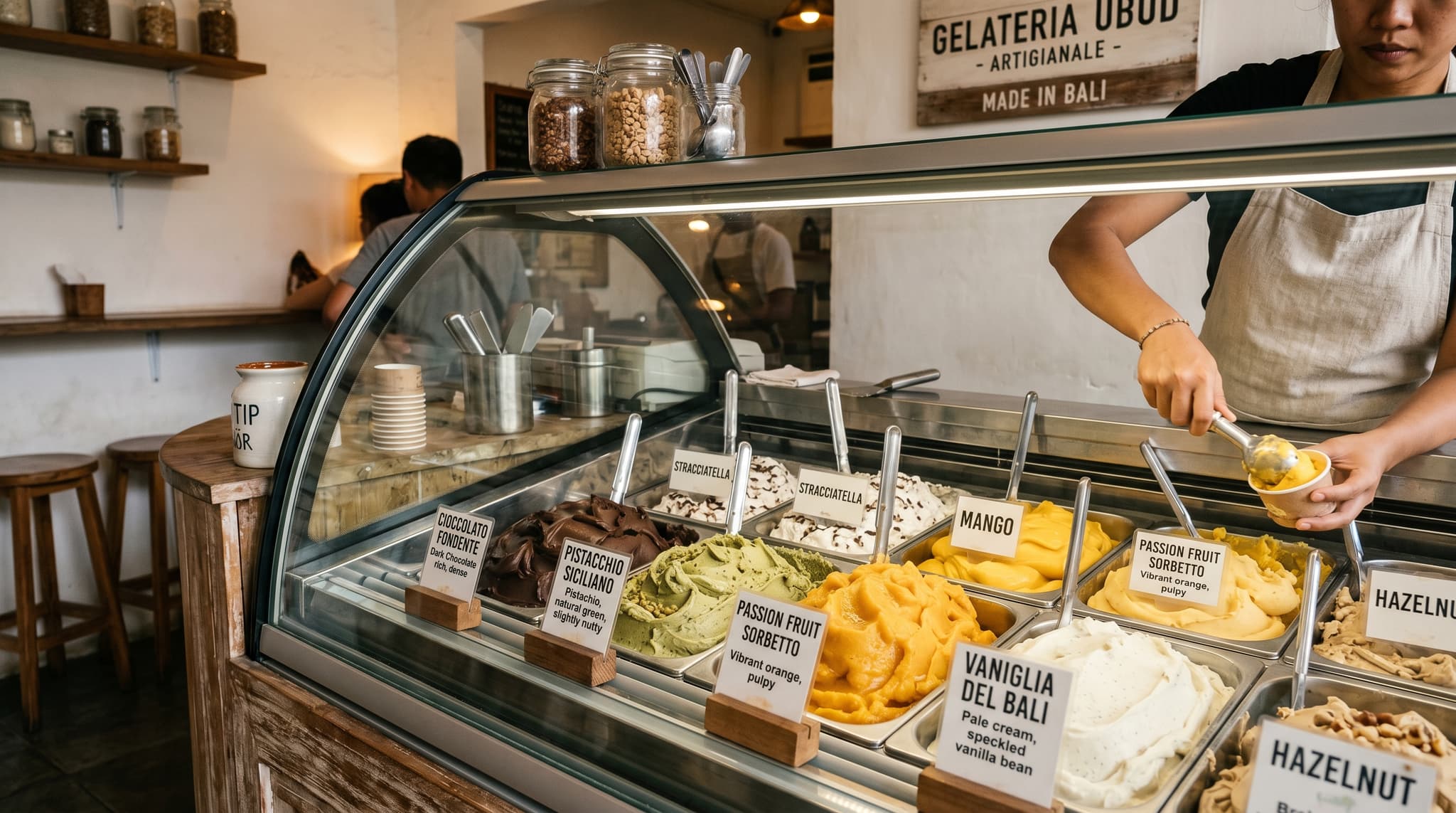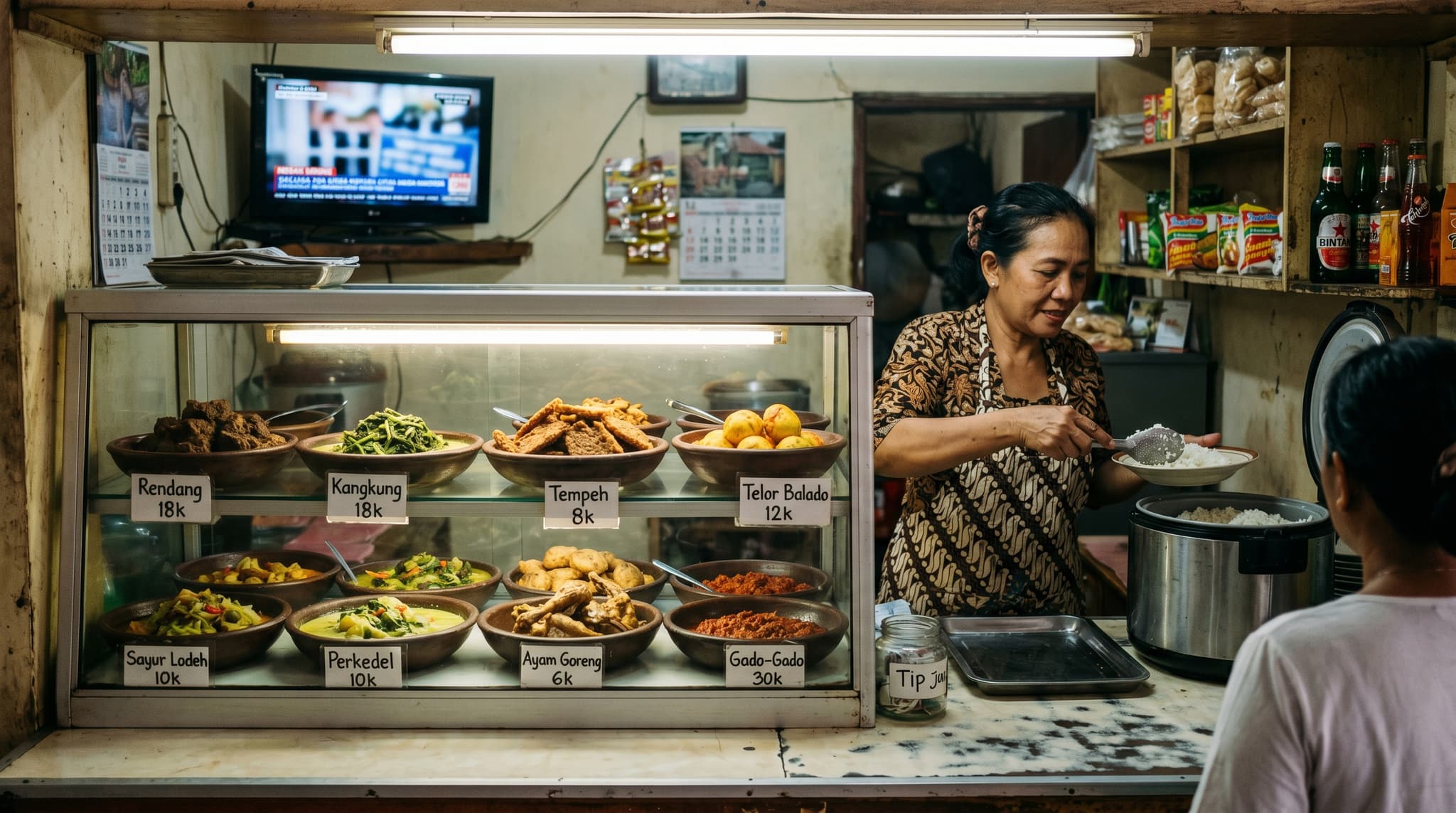
The fluorescent light is unflattering. The glass case holds a dozen dishes you cannot identify — brown things in sauce, green things in coconut milk, something fried that could be fish or tofu or both. There is no English menu. The woman behind the counter is waiting. You point at something. She puts rice on a plate without asking.
This is how most people first encounter Indonesian food, and the disorientation is part of it. The country spans roughly 5,000 kilometers east to west — wider than the continental United States — and contains hundreds of ethnic groups, each with their own culinary logic. There is no single Indonesian cuisine. But there are shared threads: rice as the foundation of nearly every meal, the bumbu (spice paste) as the engine that drives flavor, and coconut milk as the ingredient that ties much of the archipelago's cooking together.
This guide is organized by region rather than by dish, because Indonesian food only makes sense when you understand where it comes from and why. A plate of rendang and a plate of gudeg are both Indonesian, but they come from food cultures that share almost nothing except rice and a mortar and pestle.
What Makes Indonesian Food Indonesian
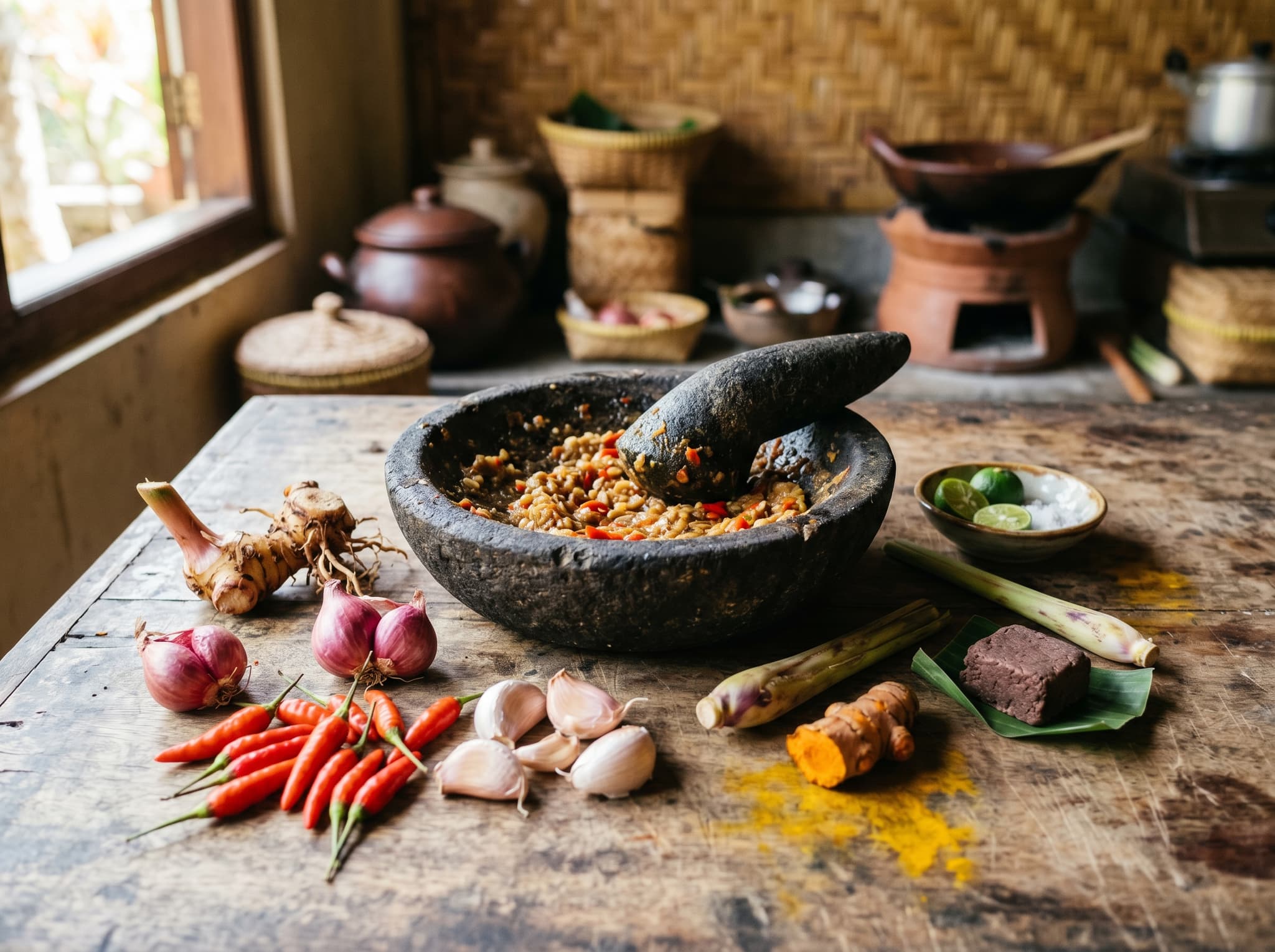
The base palette repeats across regions with local variations: chili, shallot, garlic, galangal, turmeric, lemongrass, and terasi (fermented shrimp paste). These ingredients are ground together — traditionally in a stone mortar called a cobek — into the bumbu that forms the foundation of most dishes. The specific ratios, the additions, the technique: that is where regional identity lives.
Trade routes shaped everything. Indian merchants brought spice traditions and curry-like preparations. Chinese immigrants introduced soy sauce, noodles, and the wok. Arab traders brought kebab-style grilling that evolved into satay. The Dutch and Portuguese left behind croquettes, layer cakes, and a taste for sweetness that persists in Javanese cooking. All of this arrived over centuries and was absorbed, not copied.
For visitors, it helps to understand three tiers of eating. Home cooking is the most complex and personal — you will rarely encounter it unless invited. Warung food (small, often family-run eateries) is what most travelers eat daily: pre-cooked dishes displayed in glass cases, served at room temperature over rice. Street food is the most spontaneous — carts and stalls selling single dishes, often at night. The warung is where you will spend most of your eating life in Indonesia, and learning to navigate one is the single most useful food skill you can develop here.
Nasi Goreng and the Dish Everyone Knows First
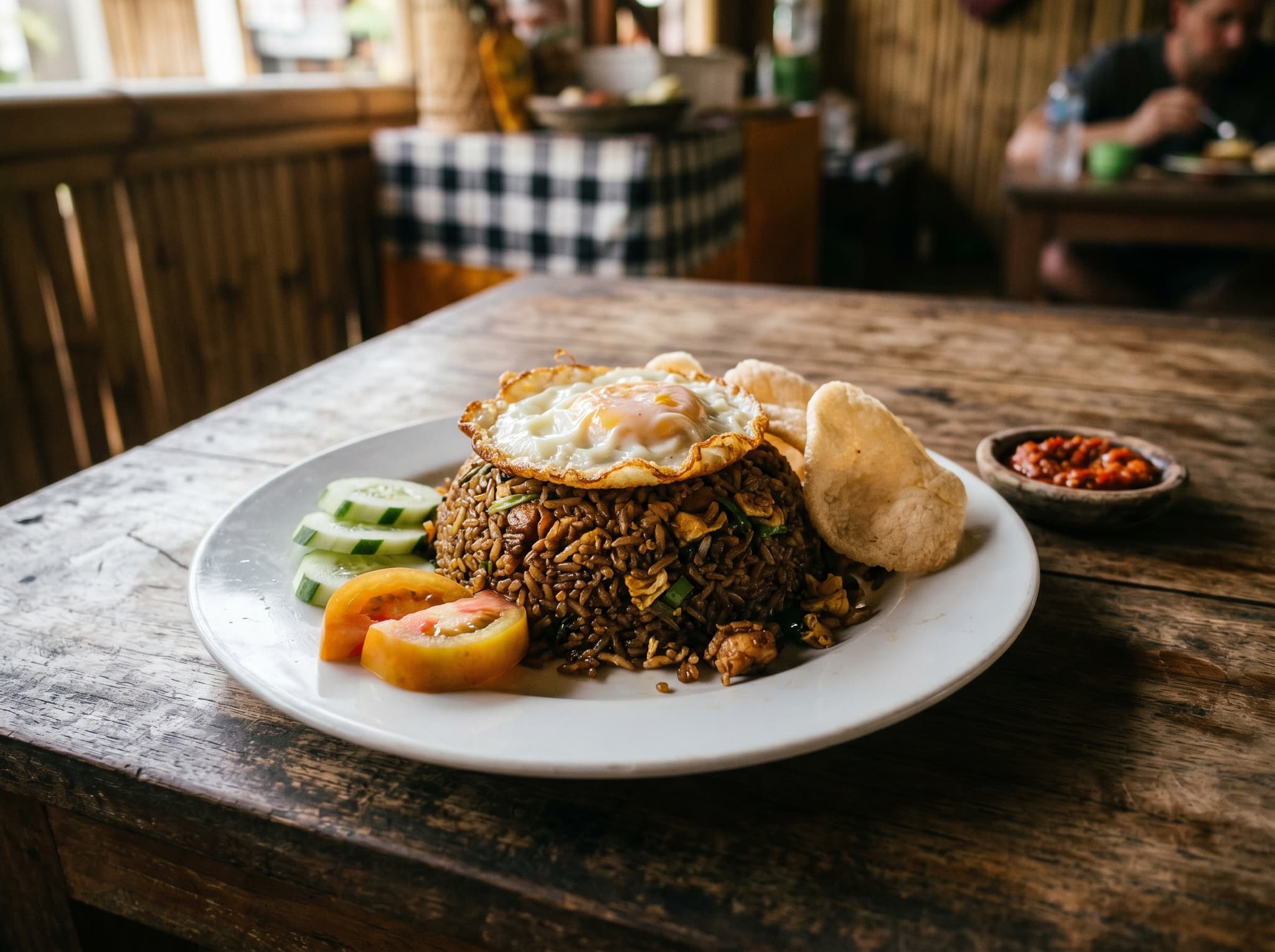
Every cuisine has a gateway dish — the one that shows up on every menu, the one you order when nothing else makes sense yet. In Indonesia, that dish is nasi goreng.
At its core, nasi goreng is fried rice. Day-old rice (freshly cooked rice is too wet), kecap manis (sweet soy sauce), shallots, garlic, chili, and an egg — cracked on top or stirred through. The simplicity is the point. The flavor that catches most visitors off guard is the kecap manis: dark, thick, molasses-sweet, and the signature note that makes nasi goreng taste like nasi goreng rather than Chinese fried rice or Japanese chahan.
Nasi Goreng Essentials
Key Ingredient
Kecap manis (sweet soy sauce)
Rice
Day-old, cold — never freshly cooked
Warung Price
Approximately IDR 15,000–25,000
Tourist Restaurant Price
Approximately IDR 40,000–80,000
Protein varies by region and religion. Beef nasi goreng is common across Java and in tourist areas throughout the archipelago — a safe, widely available version. Pork nasi goreng appears in non-Muslim regions: Bali (Hindu majority), Manado (Christian majority), parts of Flores, and Chinese-Indonesian warungs that serve a mixed clientele. Seafood versions dominate coastal towns. The variation is not random — it maps directly onto the religious and cultural geography of the country.
The quality range is enormous. The best nasi goreng comes from a hot wok, made to order, with enough heat to get wok hei — that slightly smoky, charred edge. The worst comes from buffet lines where it has been sitting under heat lamps for hours, turning oily and flat. If the wok is cold, the nasi goreng will be too.
A note on the search for healthy nasi goreng: some warungs and tourist-facing restaurants now offer versions with brown rice or extra vegetables, and these are fine. But traditional nasi goreng is not built around nutritional optimization. It is a dish designed to make leftover rice delicious, using oil and sweet soy sauce as primary tools. The healthiest version is the simplest — less oil, more vegetables, fresh ingredients, a cook who cares. Asking a warung to make it less oily (kurang minyak) is reasonable and usually respected.
The Dutch Connection
Nasi goreng traveled to the Netherlands through colonial history and became, improbably, a Dutch national dish. If you have encountered a nasi goreng recipe with Dutch roots, you have tasted a different branch of the same tree — often sweeter, sometimes served with peanut satay sauce and krupuk (shrimp crackers) on the side, adapted over generations to Dutch pantries and palates. It is not a lesser version. It is what happens when a dish migrates and puts down new roots, which is what dishes have always done.
Javanese Food: Sweet, Subtle, and Everywhere
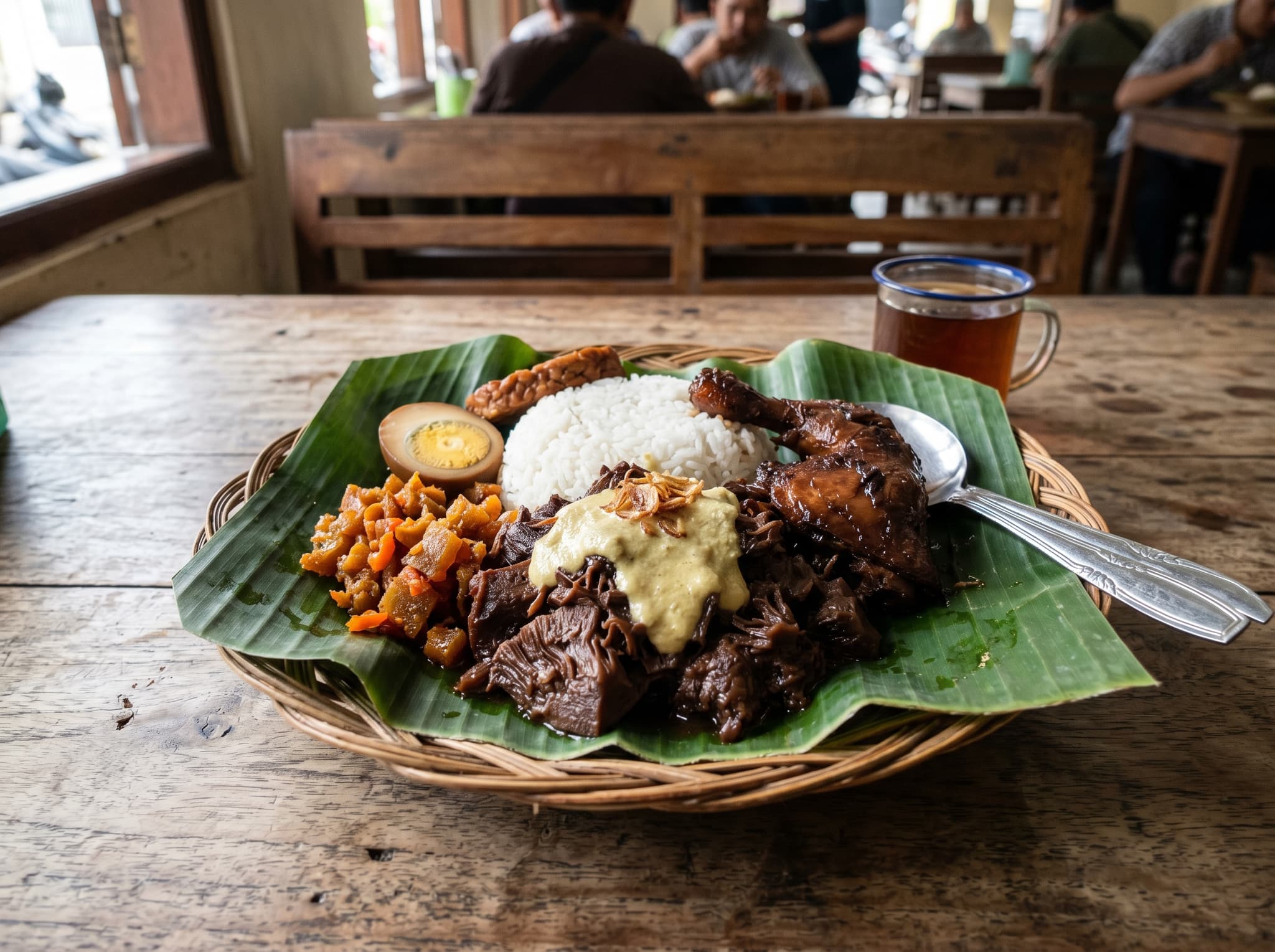
Java is home to more than half of Indonesia's population, and its food culture dominates the national palate. Most "Indonesian food" that visitors encounter outside Indonesia — in Amsterdam, in Sydney, in Los Angeles — is Javanese-inflected. If you have eaten Indonesian food before arriving, you probably ate Javanese food without knowing it.
The surprise is the sweetness. The Javanese palate leans toward palm sugar and kecap manis in quantities that startle visitors expecting fire. Central Javanese cooking in particular is mild, sweet, and built on slow-cooked coconut milk preparations that prioritize depth over heat.
Gudeg is the signature dish of Yogyakarta: young jackfruit stewed for hours in coconut milk and palm sugar until it turns deep brown and almost caramelized. It is served with rice, chicken, egg, and a thick coconut cream called areh. The sweetness is intense and deliberate. Gudeg is not trying to be anything other than what it is.
Rawon is its opposite in temperament — a black beef soup from East Java, darkened by keluak nuts (the same ingredient used in Peranakan cooking in Singapore and Malaysia). The color is startling, nearly black, and the flavor is earthy, slightly bitter, and deeply savory. Nothing else in Indonesian food tastes quite like it.
Soto ayam is the great comfort food: chicken soup with turmeric-yellow broth, rice vermicelli, hard-boiled egg, fried shallots, and lime. It exists in dozens of regional variations — soto Betawi in Jakarta uses coconut milk and becomes richer; soto Lamongan in East Java is lighter and cleaner. Every version is worth trying. Soto is the dish that Indonesians eat when they are tired, sick, homesick, or just hungry at 7 a.m.
Tempeh originated in Java and remains central to daily eating here. It is not a meat substitute in the way Western vegetarian cooking uses it — it is its own ingredient with its own identity, fried crisp in thin slices or simmered in sweet soy sauce. Alongside tahu (tofu), it appears on virtually every warung plate as a matter of course.
Javanese Dishes to Know
Gudeg
Sweet jackfruit stew — Yogyakarta
Rawon
Black beef soup — East Java
Soto Ayam
Turmeric chicken soup — everywhere
Tempeh Goreng
Fried tempeh — daily staple
Padang Food: The Spice Hits Different
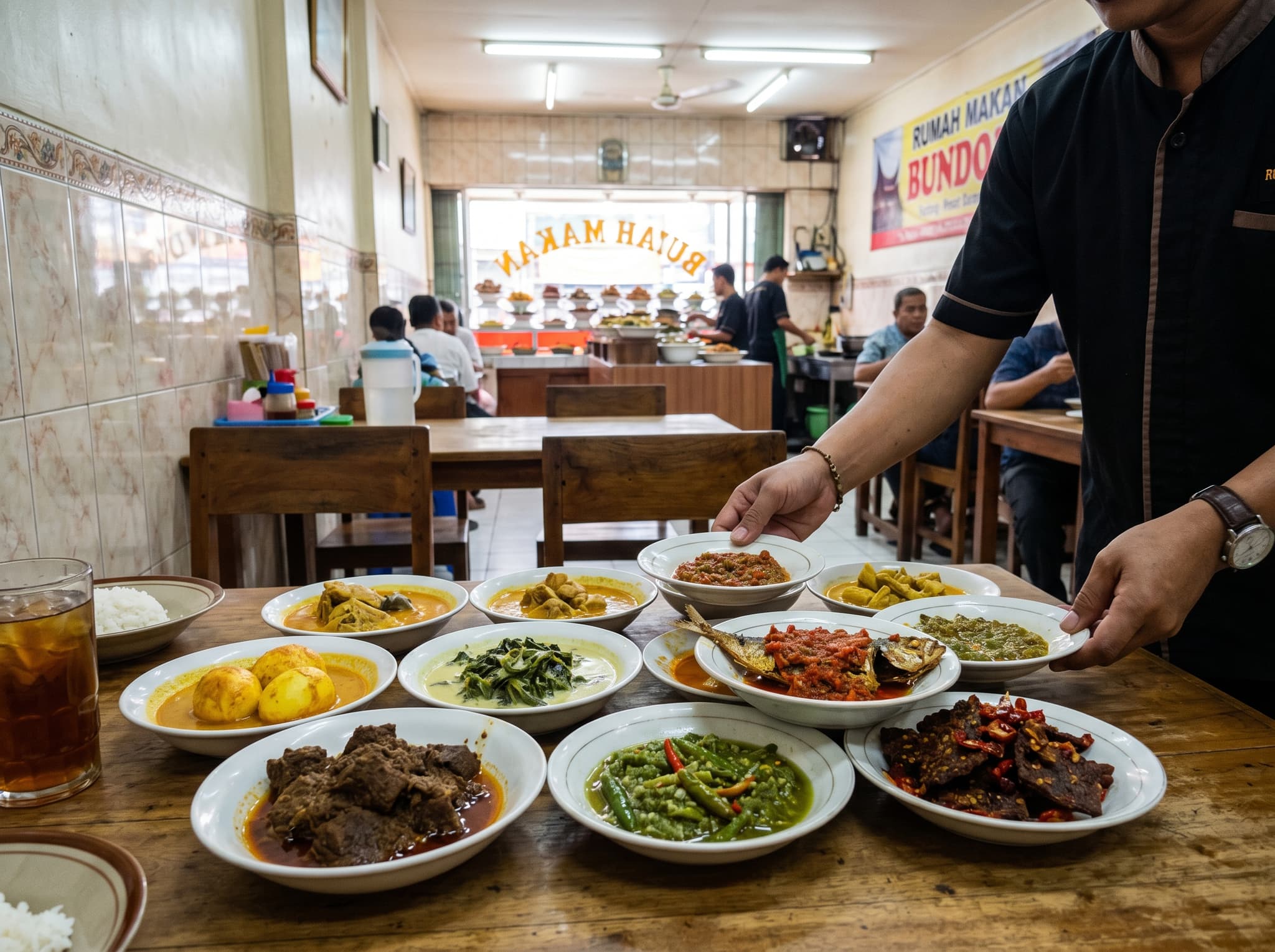
If Javanese food is sweet and subtle, Padang food is its opposite in every dimension — fiery, coconut-rich, and unapologetically intense. It comes from the Minangkabau people of West Sumatra, and it has conquered the entire archipelago through one of the most successful restaurant formats in Indonesian history: the rumah makan Padang.
The experience is disorienting the first time. You sit down. You do not order. Within minutes, a server arrives carrying a tower of small plates up one arm — ten, twelve, sometimes more — and sets them all on your table. Rendang. Fried fish. Curried eggs. Cassava leaves in coconut milk. Chili-fried lung. Green sambal. You eat what you want. When you are finished, you pay only for the dishes you touched. The untouched plates go back.
Rendang is the dish that made Padang food internationally famous. It is not a curry and not a stew, though it gets called both. Beef is cooked slowly in coconut milk and a dense spice paste — galangal, turmeric, lemongrass, chili, shallots — until the liquid evaporates entirely and the meat absorbs everything. The result is dark, dry, intensely concentrated. The flavors are layered in a way that rewards slow eating. Rendang has appeared on widely cited international "best foods" lists, and for once, the ranking is not wrong.
Ayam pop is the sleeper — pale poached chicken that looks unimpressive and tastes better than it has any right to. Dendeng balado is crispy dried beef hit with a bright red chili sauce. Gulai is the wet counterpart to rendang: coconut curry, looser and saucier, applied to fish, eggs, or jackfruit. And sambal hijau — green chili sambal — appears on every Padang table and goes on everything.
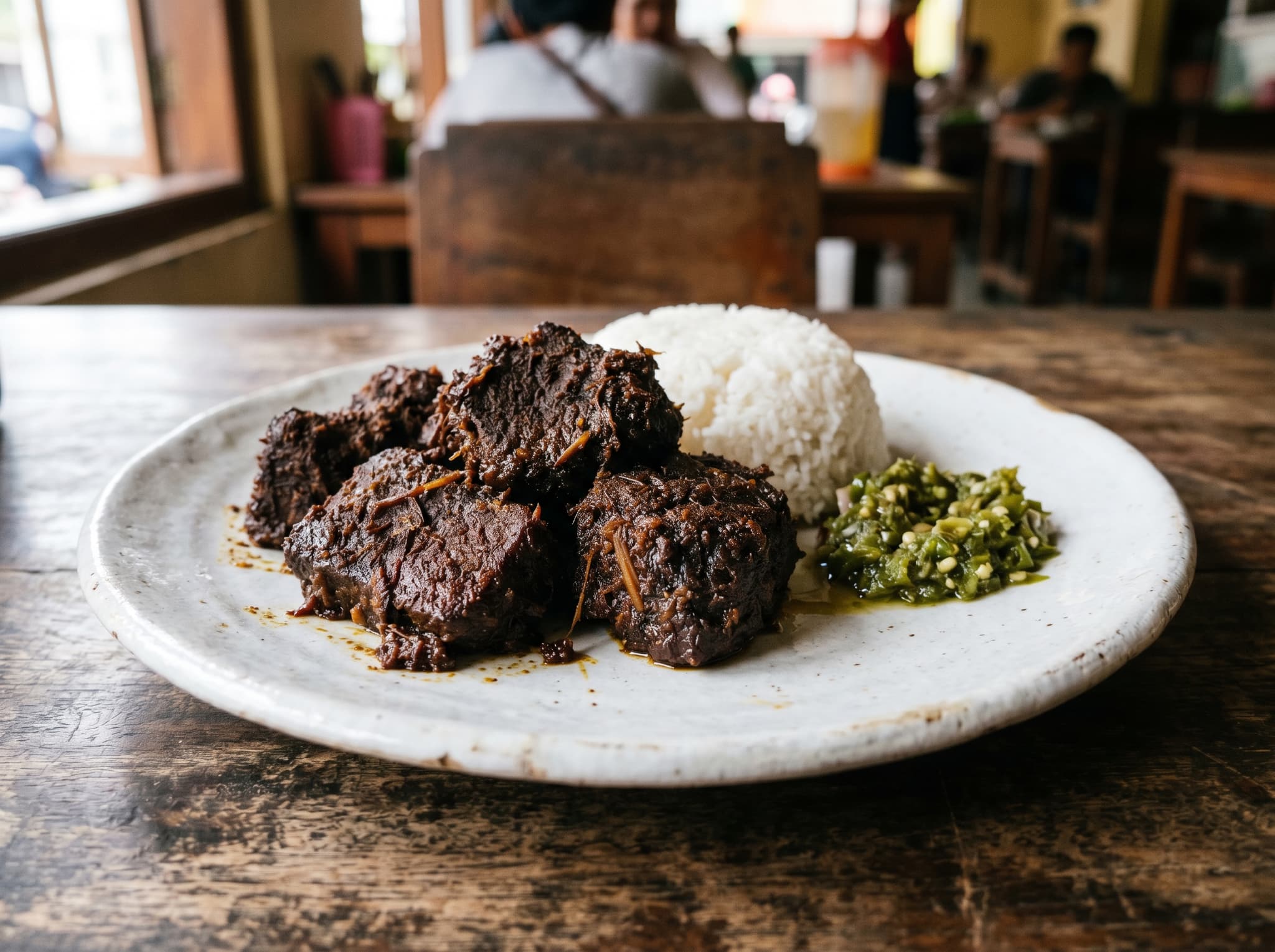
The contrast between a Javanese warung meal and a Padang meal tells you more about the breadth of Indonesian food than any list of dishes ever could.
Balinese Food: Beyond the Tourist Menu
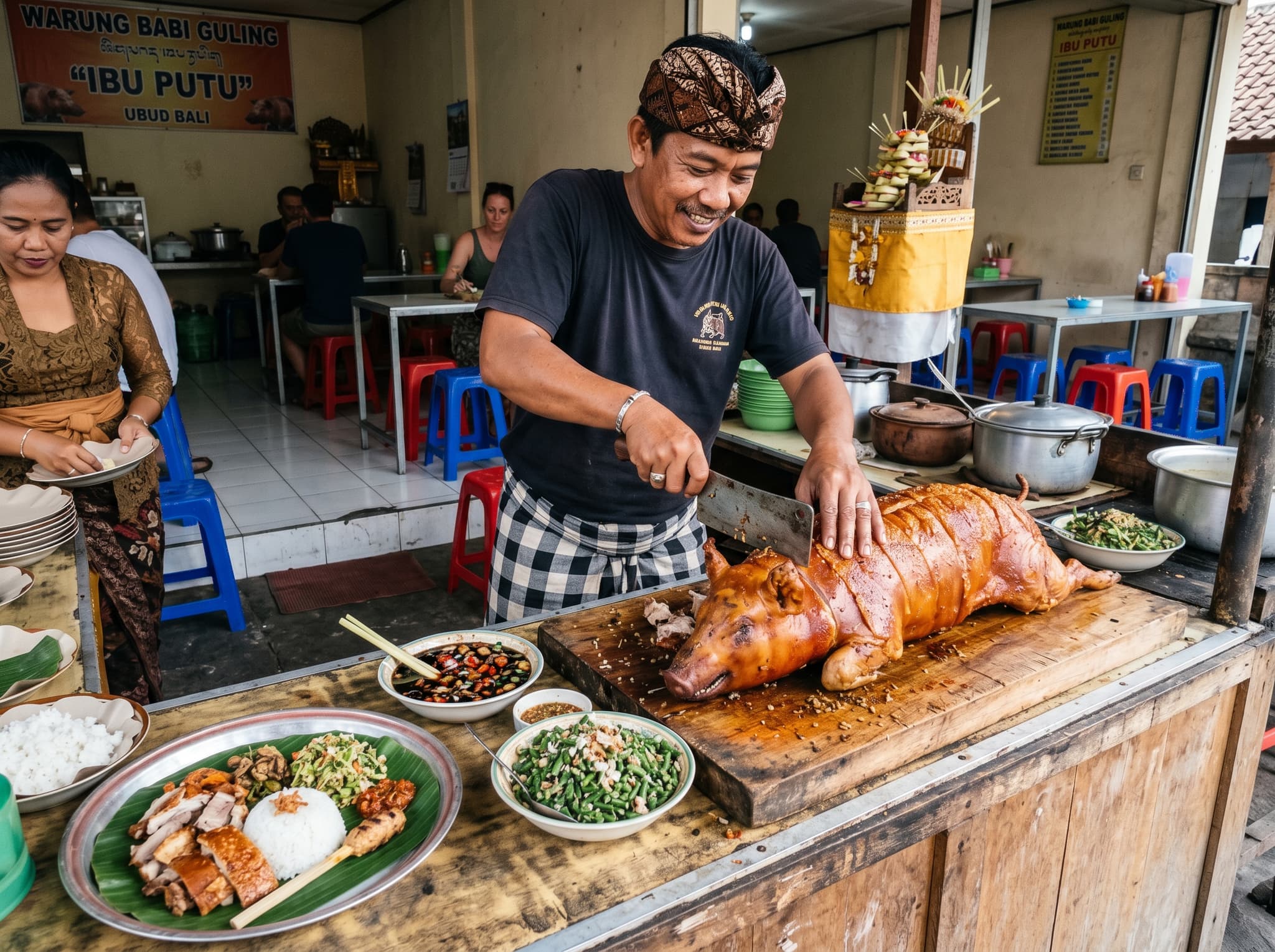
Most visitors to Bali eat Indonesian food at tourist restaurants — nasi goreng, mie goreng, satay — and never encounter actual Balinese cuisine. This is understandable. The smoothie-bowl-and-avocado-toast economy in areas like Canggu and Seminyak has created a parallel food universe that has little to do with what Balinese people cook and eat. But Balinese food is its own tradition, distinct from anything else in Indonesia, and it is worth seeking out.
Bali's Hindu majority means pork is not just permitted but central. Babi guling — spit-roasted suckling pig — is the signature dish. The whole pig is stuffed with a paste of turmeric, lemongrass, chili, garlic, shallots, and lesser galangal, then roasted over wood or coconut husks until the skin turns glass-crisp. It is served communally: sliced skin, mixed meat, rice, lawar, and sambal. The best babi guling often comes from places that also prepare food for temple ceremonies, because the technique and the care are the same.
Balinese Dishes to Know
Babi Guling
Spit-roasted suckling pig — the signature
Lawar
Chopped meat, vegetables, coconut, spices
Sate Lilit
Minced meat pressed onto lemongrass sticks
Betutu
Slow-cooked chicken or duck in banana leaves
Lawar is a finely chopped mixture of meat, vegetables, grated coconut, and spices. Traditional versions sometimes include fresh blood, which gives the dish a dark color and mineral depth. Tourist-oriented versions typically omit this. Sate lilit looks different from the skewered satay most visitors know — the minced meat (often pork, chicken, or fish) is pressed directly onto lemongrass sticks, giving it a fragrant, slightly looser texture. Betutu is chicken or duck rubbed with spice paste, wrapped in banana leaves, and slow-cooked for hours until the meat falls apart.
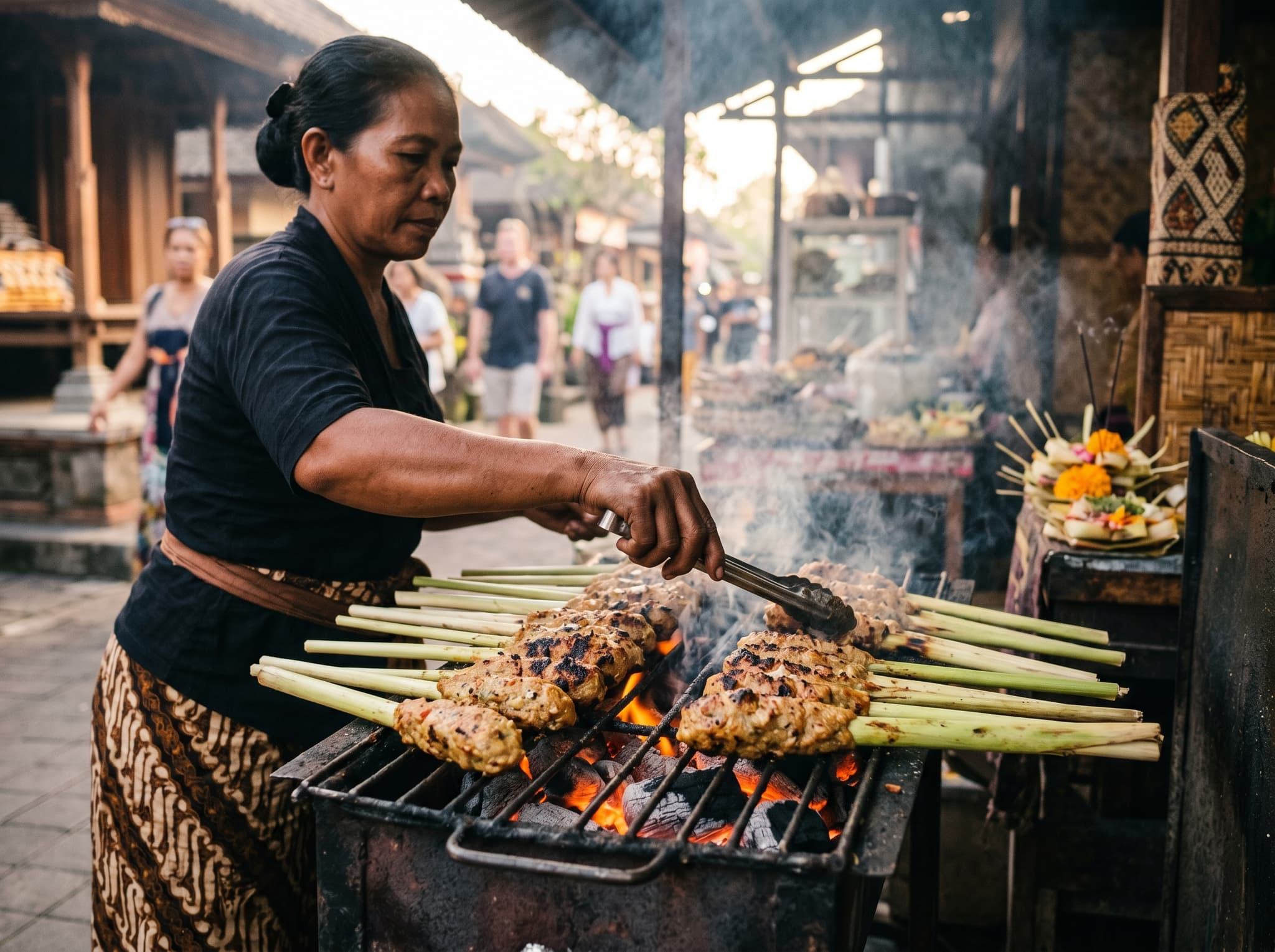
What ties all of this together is the base genep — the Balinese spice paste. It is more complex and aromatic than a standard Javanese bumbu, built on turmeric, galangal, lesser galangal (kencur), shallots, garlic, chili, candlenut, shrimp paste, and black pepper, among other ingredients. The base genep is what makes Balinese food taste specifically Balinese, and it is the reason a plate of babi guling does not taste like roast pork from anywhere else.
Manado and Eastern Indonesia: The Food Most Visitors Miss
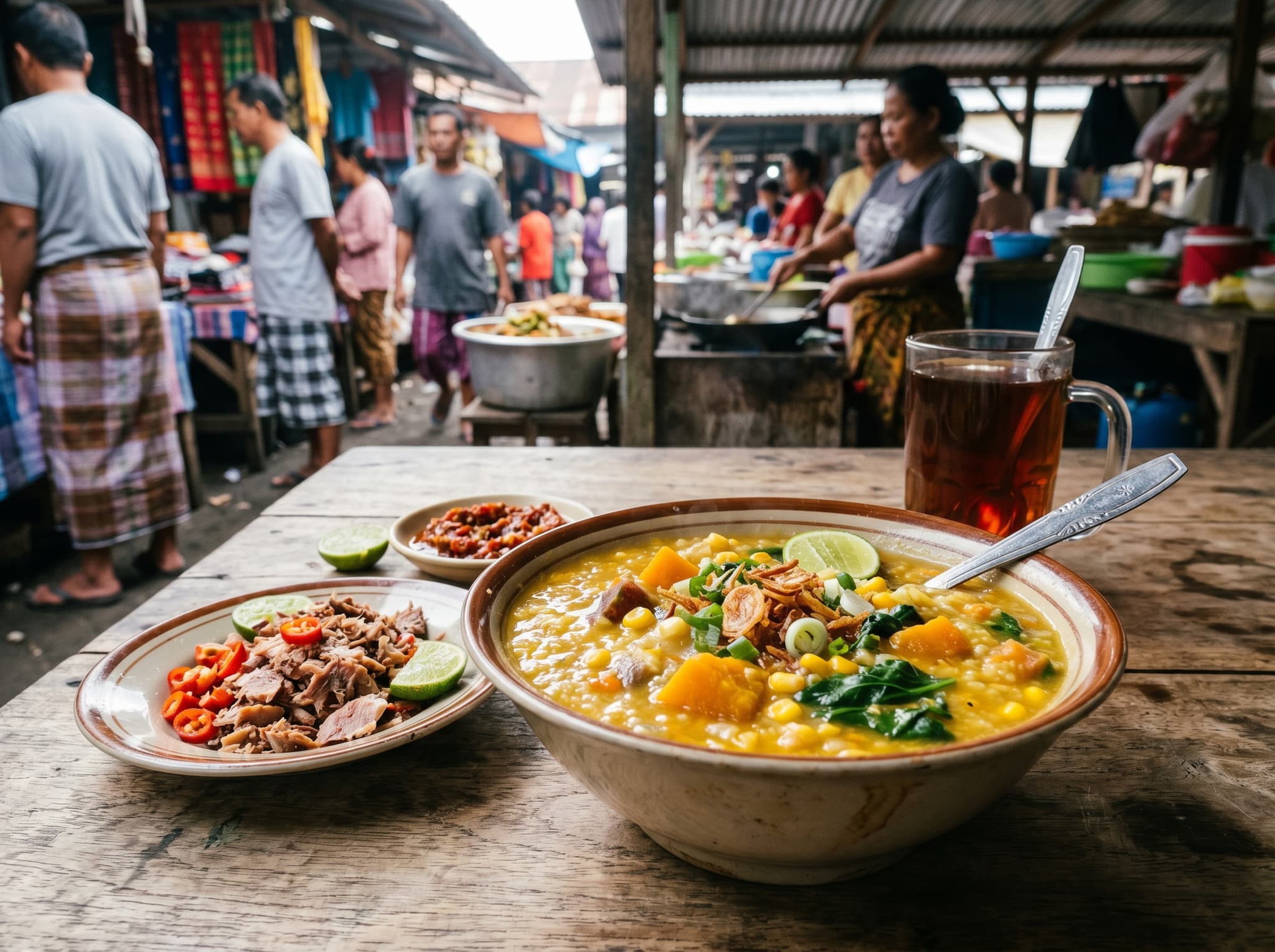
North Sulawesi sits roughly 2,000 kilometers northeast of Bali, and its Minahasan cuisine is one of Indonesia's most distinctive food traditions. The Minahasan people are predominantly Christian, so pork is common, and the chili levels are extreme — not the slow burn of Padang food but a direct, bright, uncompromising heat.
Tinutuan is the Manado breakfast staple: a thick porridge of rice, pumpkin, corn, sweet potato, and greens, served with dried salted fish and sambal. It is humble, nourishing, and unlike anything else in Indonesian food. Rica-rica is a fiery chili preparation — bright red, heavy on bird's-eye chili and tomato — applied to chicken, pork, or fish. Cakalang fufu is skipjack tuna smoked over coconut husks, a preservation technique tied to Manado's fishing culture that gives the fish a dense, woody flavor.
Minahasan cuisine also includes a broader range of proteins than most Indonesian traditions — a reflection of the region's geography and food history. The breadth of what appears on the table is part of the culinary identity.
Further south, Makassar in South Sulawesi offers its own distinct food culture. Coto Makassar — a beef organ soup with peanut and spice — and konro — beef rib soup, dark and aromatic — are reminders that every island, every city, every ethnic group in this country has built something different from the same basic ingredients. Eastern Indonesia in general leans less on coconut milk and more on direct heat, smoke, and the flavors of the sea.
Sundanese Food and the Vegetables Nobody Expects
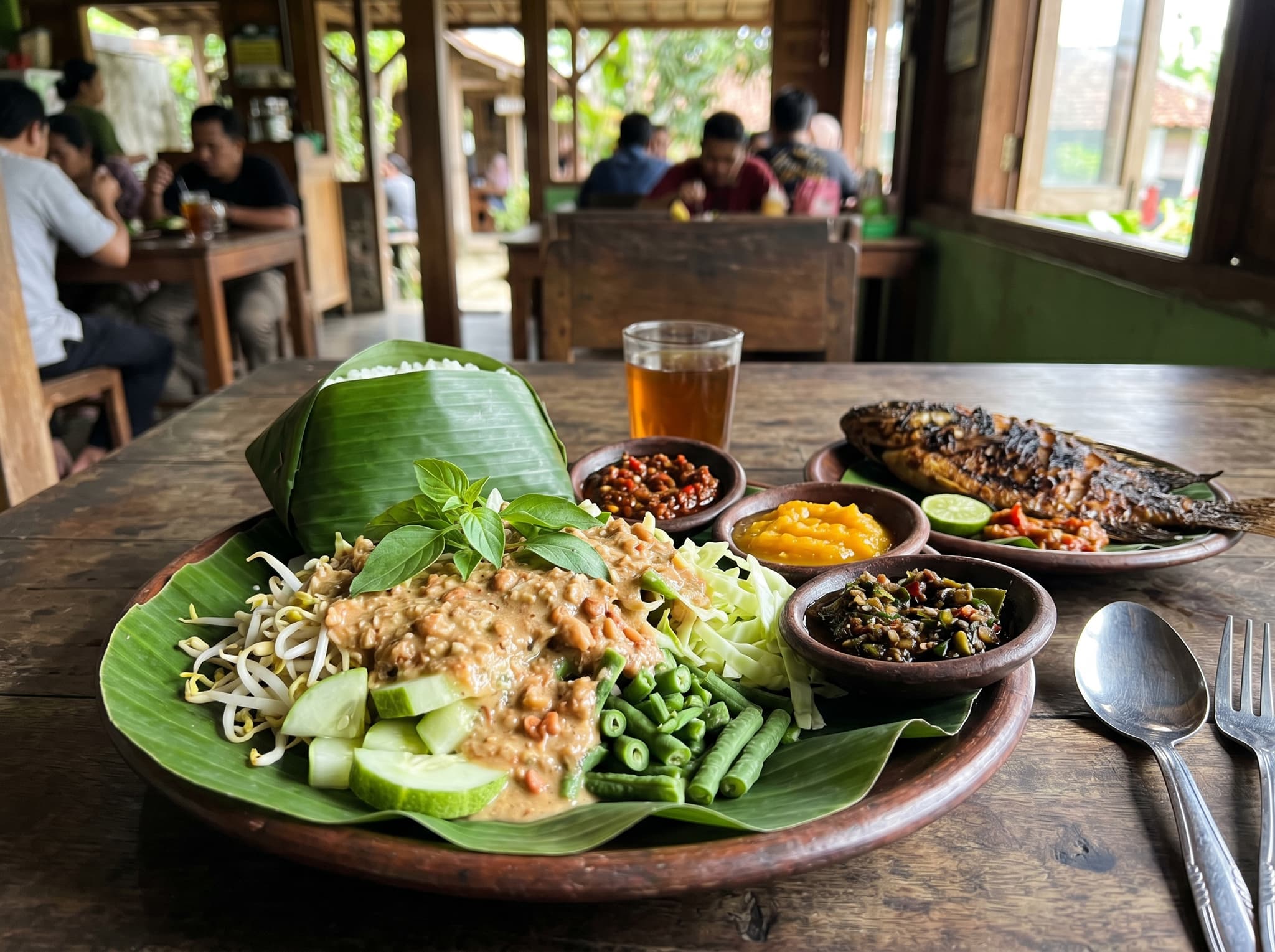
If your experience of Indonesian food so far has been fried rice, rendang, and coconut curries, Sundanese cuisine from West Java will recalibrate your assumptions. It is the freshest, most vegetable-forward food tradition in the archipelago — a counterpoint to the richness of Padang and the sweetness of Central Java.
Karedok is the dish that makes the case: raw vegetables — cucumber, bean sprouts, long beans, cabbage, Thai basil — dressed in a peanut sauce made with kencur (lesser galangal) and chili. It resembles gado-gado but everything is uncooked, crunchy, and bright. Lalapan takes the raw vegetable principle further: a plate of fresh cucumber, basil, cabbage, and long beans served as a standard accompaniment to grilled fish or chicken. It is not a garnish. It is half the meal.
Sayur asem — tamarind vegetable soup with corn, peanuts, melinjo, and chayote — is the Sundanese comfort dish. Nasi timbel — rice wrapped and steamed in banana leaf — is the standard format, giving the rice a faint herbal fragrance.
Sundanese Essentials
Heartland
Bandung and surrounding West Java
Signature
Karedok — raw vegetable salad with peanut sauce
Key Feature
Multiple sambals served with every meal
Format
Nasi timbel — banana-leaf-wrapped rice
The sambal tradition in Sundanese cooking deserves special attention. Meals often arrive with three or four different sambals — each with a different chili, a different base, a different purpose. The sambal is not a condiment here. It is a core component of the meal, and choosing which one to pair with which bite is part of how Sundanese people eat.
What to Order When You Don't Know What to Order
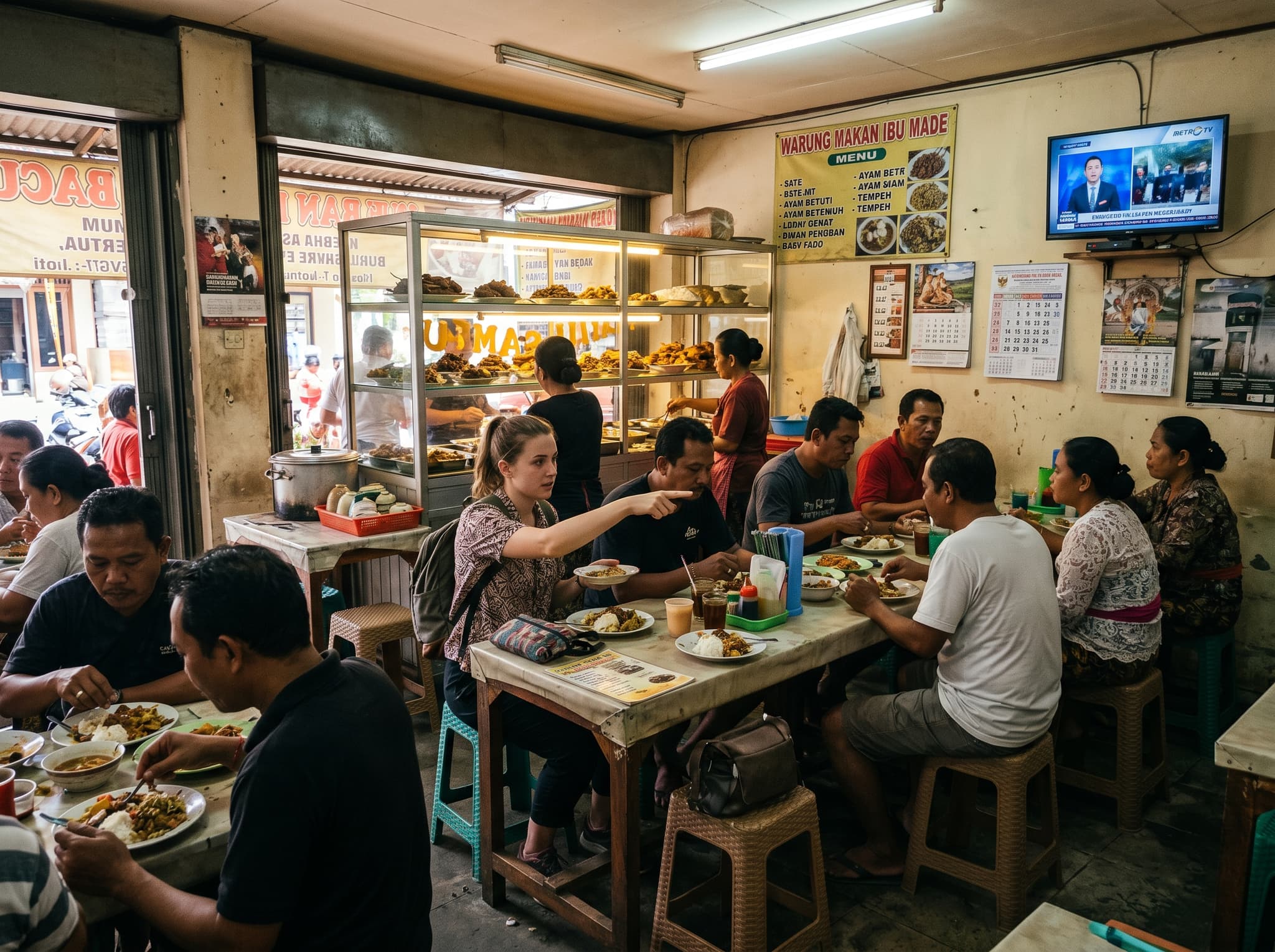
You have sat down at a warung. The glass case is full. Nobody is speaking English. Here is what to do.
Nasi campur (mixed rice) is the single best introduction to Indonesian food. Point at the rice, then point at three or four dishes that look interesting. The cook will assemble a plate. You will get variety, balance, and a sense of what that particular warung does well. If nothing else on this list sticks, remember nasi campur.
Five reliable orders that work almost anywhere:
- Nasi campur — mixed rice plate, the safest and most varied option
- Nasi goreng — fried rice, universally available, hard to get badly wrong
- Mie goreng — fried noodles, the nasi goreng principle applied to egg noodles
- Soto — soup, always warming, always available, always good at 7 a.m.
- Sate with rice — grilled skewers with peanut sauce, familiar enough to feel safe, Indonesian enough to feel like discovery
Drinks: Es teh manis (sweet iced tea) is the default drink at most warungs — sweet, cold, and roughly the cost of nothing. Es jeruk (iced citrus drink, usually lime) is the refreshing alternative. Kopi tubruk is traditional Indonesian coffee: grounds poured into a glass with hot water and sugar, left to settle. You drink it slowly and stop before you reach the bottom.
On food safety: Eat where locals eat. Eat where turnover is high — if the food is being made and consumed quickly, it is fresh. The warung with a crowd at lunchtime is safer than the empty one with food that has been sitting since morning. The paranoia about street food in Southeast Asia is mostly overblown if you apply basic judgment: busy stalls, cooked-to-order where possible, and trust your instincts about cleanliness.
Practical Phrases for Eating
Tidak pedas
Not spicy
Tanpa daging
Without meat
Kurang minyak
Less oil
Mau nasi campur
I want mixed rice
Berapa?
How much?
Frequently Asked Questions
The best meal in Indonesia will probably cost less than a cup of coffee in the city you flew in from. It will arrive on a plate that nobody designed for Instagram, in a room lit by fluorescent tubes, with a television playing in the corner. You will not have planned it. That is usually how it works here — the food rewards curiosity more than research.