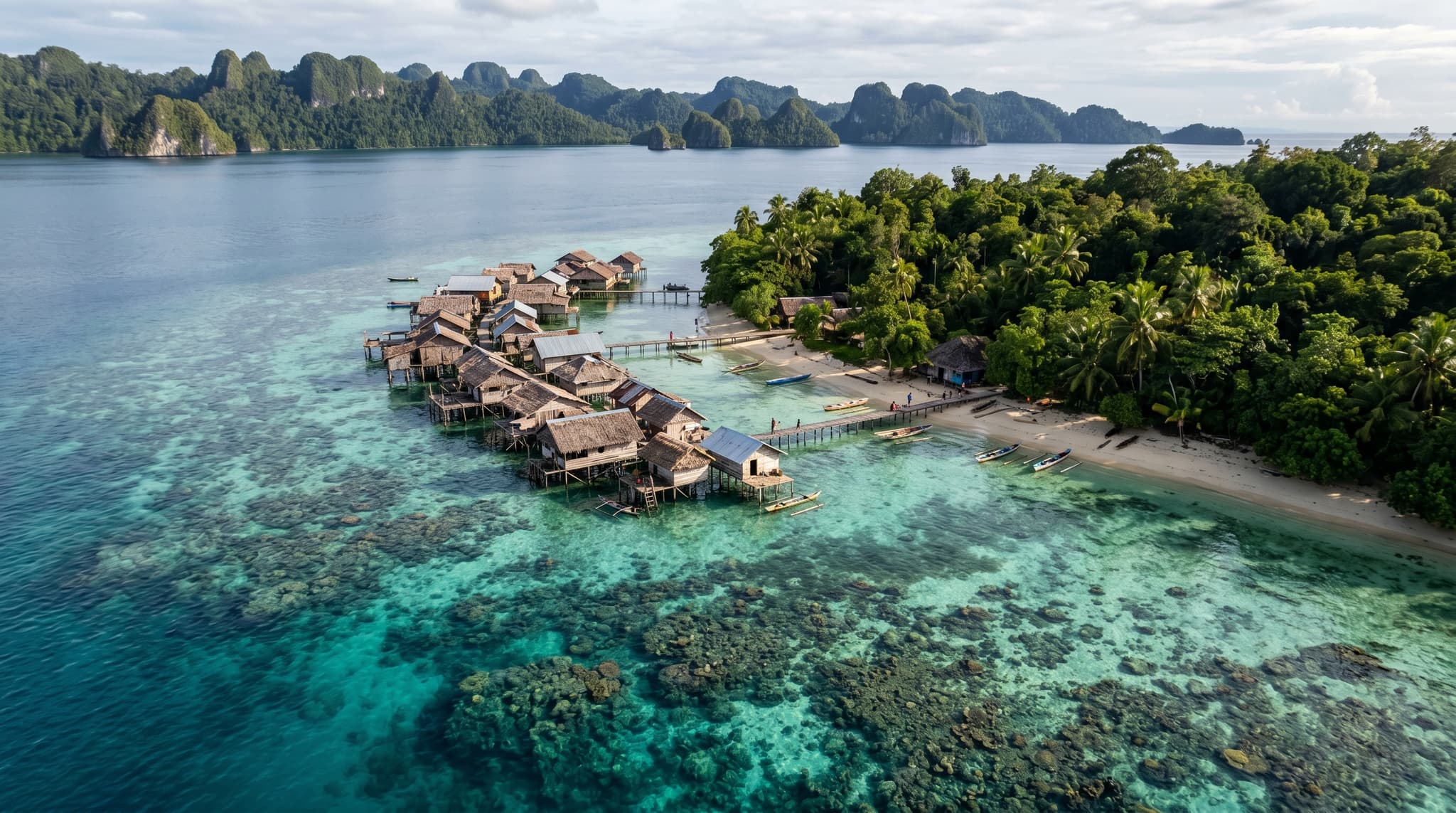
Here is the question that keeps people from booking: is Raja Ampat worth it if you don't dive? The short answer is yes, and it's not even close. Raja Ampat's reef biodiversity is concentrated in shallow water — 1 to 5 meters in many of the best sites — which means manta rays, sea turtles, wobbegong sharks, and coral gardens that divers pay thousands to reach are sitting right at the surface, waiting for anyone with a mask and a snorkel.
This guide is built entirely around the non-diver's trip. Not a paragraph tacked onto a dive article. Every snorkeling site is ranked by skill level with specific navigation instructions, current conditions, and access details. The logistics — ferries, permits, gear, accommodation — are broken down so you can plan the trip without guessing.
Is Raja Ampat Worth It for Snorkelers?
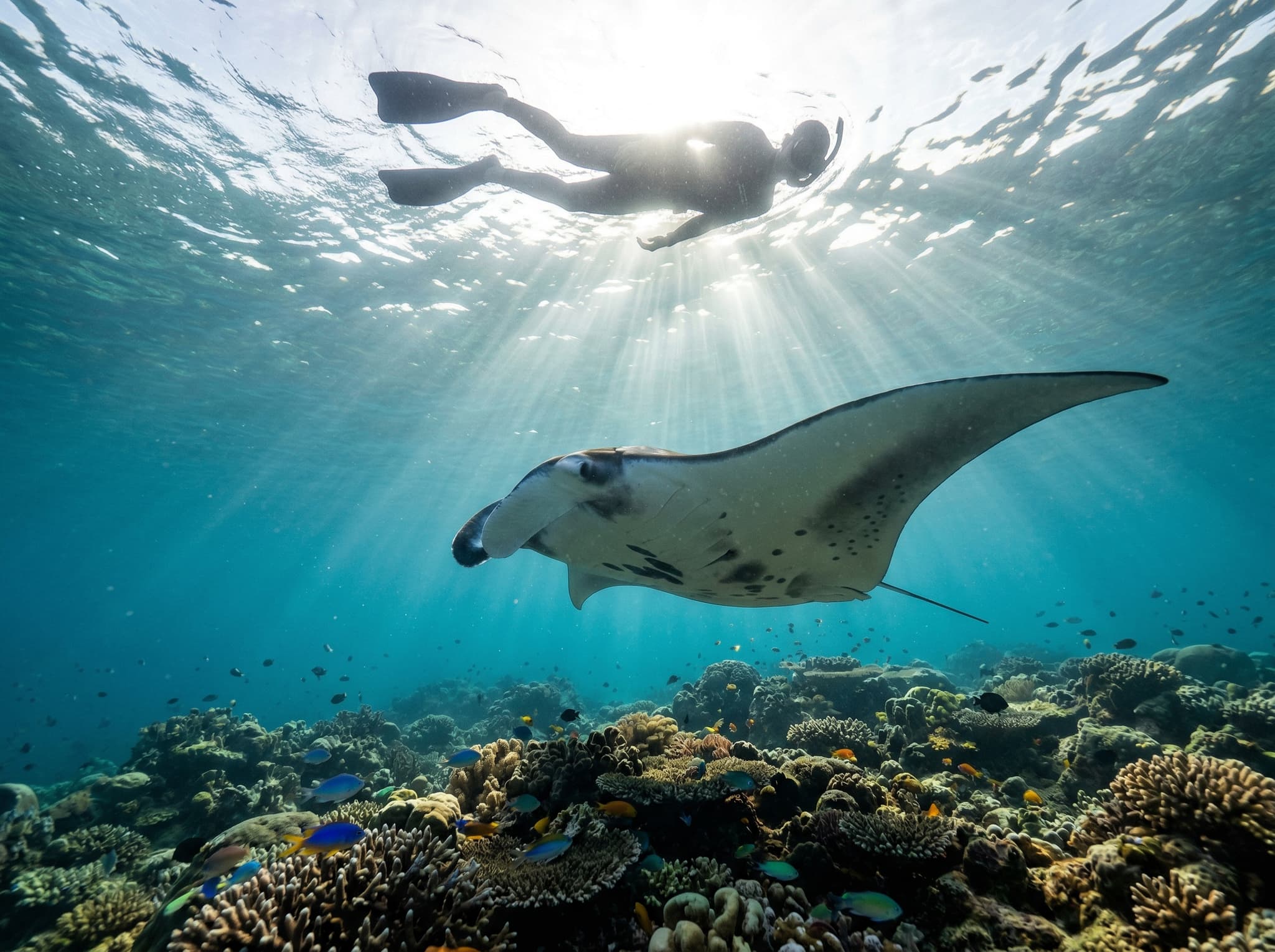
Most world-class snorkeling destinations offer a diluted version of what divers see below. Raja Ampat is different. The reef systems here start shallow and stay shallow, with hard coral coverage beginning at depths you can touch from the surface. The overlap between the best snorkeling sites and the best diving sites is larger here than almost anywhere else on the planet.
From the surface, snorkelers regularly encounter manta rays, sea turtles, eagle rays, dolphins, wobbegong sharks, and hundreds of reef fish species that marine biologists are still cataloging. Many resorts have house reefs accessible directly from shore — no boat, no guide, no schedule. Step off a jetty and you're in it.
A non-diving trip should plan for 7 to 10 days to experience the full variety: snorkeling multiple sites, kayaking through mangrove channels, exploring islands on foot, and visiting Papuan villages. Shorter trips are possible but feel rushed given the travel time to get here.
The honest caveat: some sites are off-limits without a dive certificate. Deep walls below 10 meters, cave systems, and certain manta cleaning stations at depth remain diver territory. But the gap between what snorkelers and divers experience is narrower in Raja Ampat than virtually anywhere else. That's the reason this trip makes sense.
Best Snorkeling Sites Ranked by Skill Level
Each site below is classified by skill level (beginner, intermediate, or advanced), current strength, access method, and standout marine life. These aren't arbitrary labels — current strength and entry method are what determine whether a site is enjoyable or stressful for a given swimmer. Read the ratings honestly and pick accordingly.
Arborek Jetty and Reef — Best Starting Point
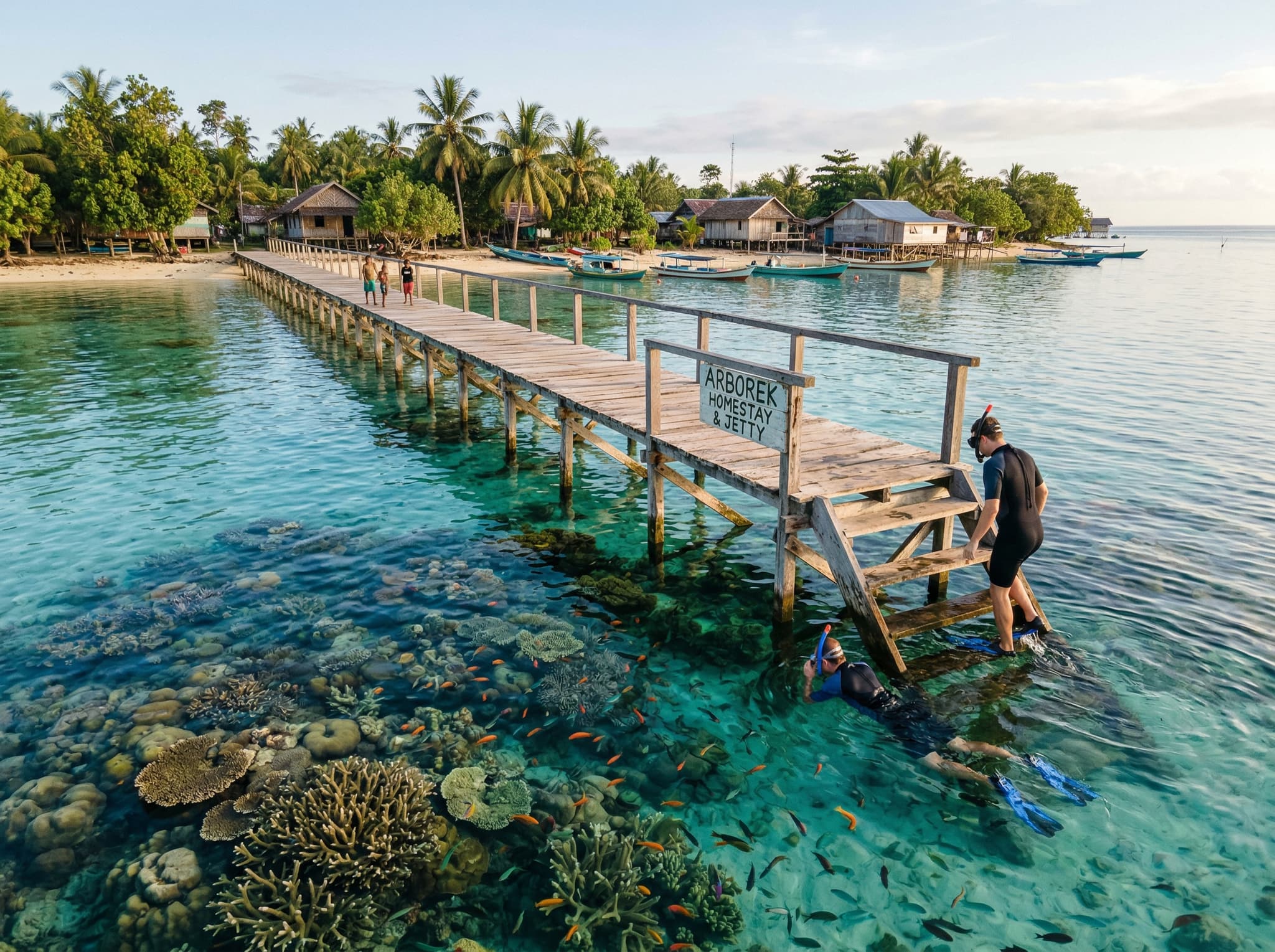
Skill level: Beginner (suitable for all levels) Currents: None to mild Access: Directly off the Arborek jetty or from the beach — no boat needed
Arborek at a Glance
Depth Range
3–35m (best snorkeling in shallows)
Current
None to mild
Access
Jetty or beach entry
Best For
First-time Raja Ampat snorkelers
Arborek is the site to start with. The jetty extends over a reef that drops into deeper water, but the snorkeling action happens in the shallows where the coral is densest and the fish are most concentrated. You step off the end of the jetty, put your face in the water, and the reef is immediately there — no swimming out to find it, no waiting for something to appear.
The navigation is straightforward: follow the reef eastward from the jetty across a small channel. The channel is shallow enough to cross comfortably, and the reef on the other side is where the variety opens up. Stick to the shallows on either side of the channel and you'll see more than enough without venturing into deeper water.
The village on Arborek island is small and welcoming. Homestays here put you directly above the snorkeling, which means early morning sessions before the light gets harsh and late afternoon drifts when the reef fish are most active. Biodiversity Nature Resort on nearby Pulau Gam offers walk-in reef access and serves as a base for boat trips to surrounding sites, including Melissa's Garden in the Dampier Strait.
Kabui Bay — Best Scenery, Intermediate Skill
Skill level: Intermediate Currents: None to strong (variable — check conditions before entering) Access: Boat
Kabui Bay at a Glance
Depth Range
1–20m
Current
None to strong (variable)
Coral Stretch
~1.5km
Best For
Confident swimmers who want scenery above and below
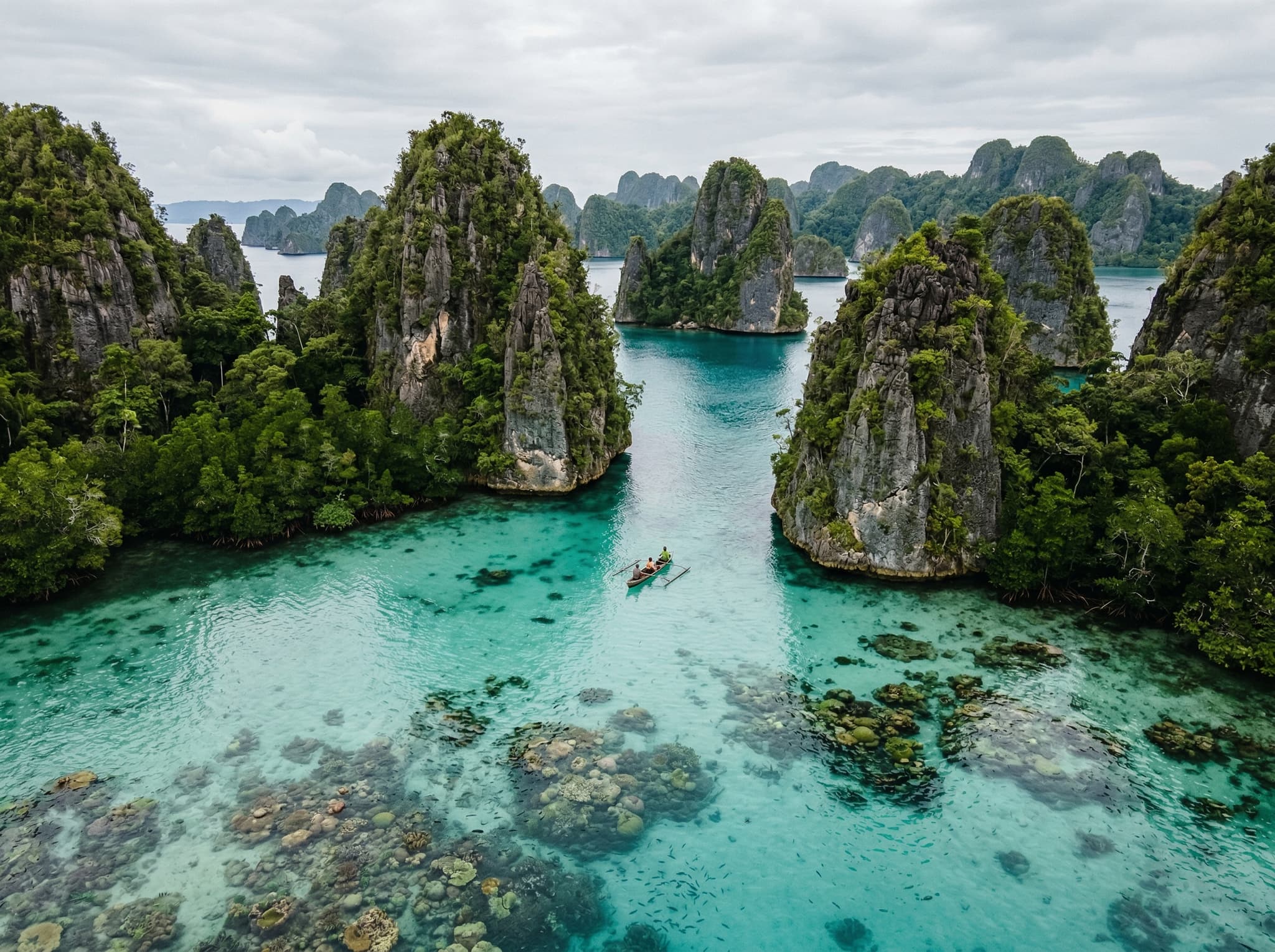
Kabui Bay is where the landscape above the water matches what's beneath it. Limestone karsts rise vertically from the surface while coral gardens spread across the seafloor below — the combination is visually staggering in a way that photographs struggle to capture.
The best coral runs along a 1.5-kilometer stretch concentrated at the bay's southwestern opening. Navigation tip: keep the mangroves to your left as you enter. A northern entry point allows you to circle limestone outcrops where fish aggregate around the rock formations.
Timing matters here more than at other sites. Avoid low tide — the corals in the shallows become dangerously close to the surface, making entry difficult and risking damage to the reef. The currents are the other variable. On calm days, Kabui Bay feels gentle and manageable. When the current picks up, it can push you across the reef faster than you'd like. This is why it earns an intermediate rating: the snorkeling itself isn't technical, but the conditions are unpredictable enough that beginners may find it stressful.
Cape Kri — The Walls
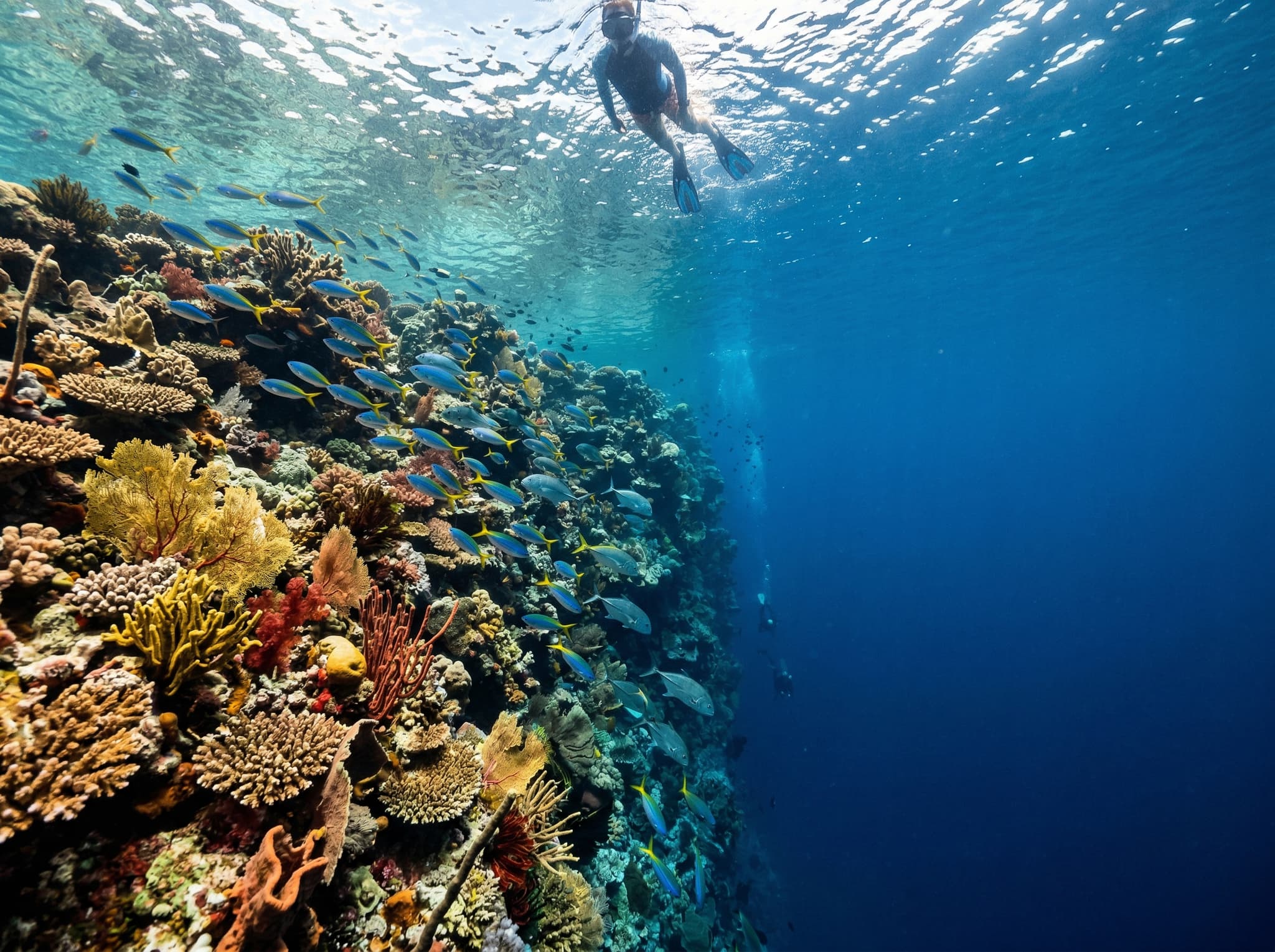
Skill level: Intermediate Currents: Moderate Access: Boat trip from Dampier Strait resorts
Cape Kri at a Glance
Depth Range
Surface to 40m+ (best snorkeling top 5–8m)
Current
Moderate
Access
Boat from Dampier Strait resorts
Best For
Snorkelers who want dramatic wall topography
Cape Kri is one of Raja Ampat's most famous dive sites, and the good news for snorkelers is that the walls start shallow enough to appreciate from the surface. "Walls" in this context means vertical reef faces dropping away beneath you — you float at the surface and look straight down into a canyon of coral, sponges, and fish moving along the cliff face.
The experience is genuinely dramatic. The wall disappears into blue below you while reef sharks, schools of fusiliers, and trevally patrol the edge. Divers go deeper along the wall and into overhangs that snorkelers can't reach, but the top 5 to 8 meters of the wall — visible from the surface in Raja Ampat's clear water — hold enormous density of marine life.
This is a boat-access site. Most resorts in the Dampier Strait area run trips here, and the boat ride is short. It's not a site where you linger for hours — the current moves you along the wall, and a 45-to-60-minute session covers a significant stretch.
Pianemo — Drift Snorkel, Not for Beginners
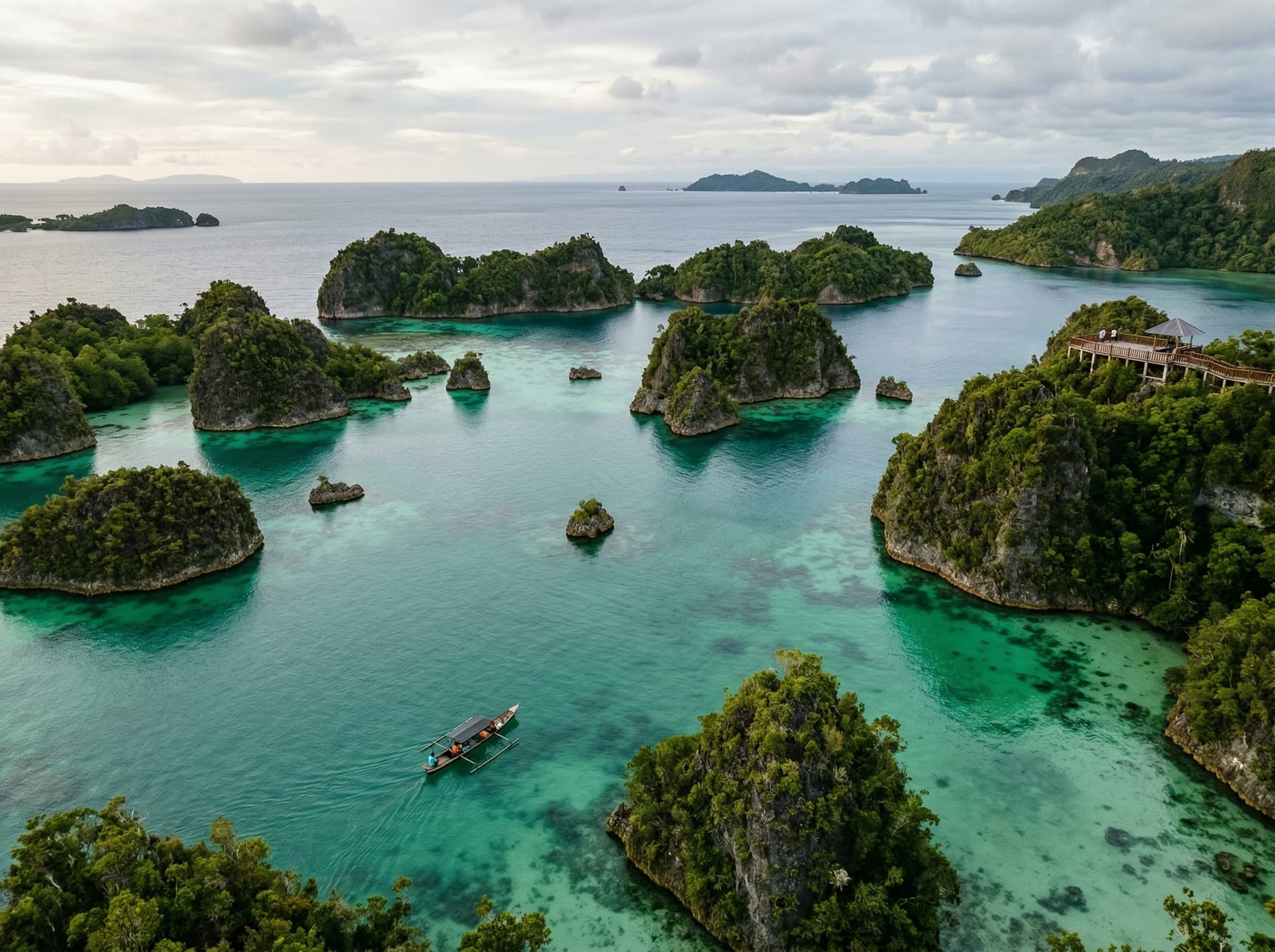
Skill level: Intermediate to advanced Currents: Moderate to strong, running across the reef Access: Dinghy entry and exit only — no shore access
Pianemo is famous for its above-water viewpoint — the Instagram-ready panorama of mushroom-shaped karst islands dotting turquoise water. Most visitors climb the viewpoint, take the photo, and leave. The snorkeling beneath those karsts is genuinely underrated.
The format here is a drift snorkel: the current carries you across the reef while you watch the bottom pass beneath you. It's exhilarating when conditions are right, but it demands confidence in open water. You enter from a dinghy, drift with the current, and the dinghy picks you up downstream. There is no option to stand, rest, or swim to shore.
The marine life beneath the karsts includes healthy hard coral, reef fish, and occasional pelagics passing through the channel. The combination of the dramatic karst landscape above and the reef below makes Pianemo one of the most visually complete snorkeling experiences in Raja Ampat — provided you're comfortable in moving water.
Melissa's Garden and Aljui Channel — Worth the Boat Trip
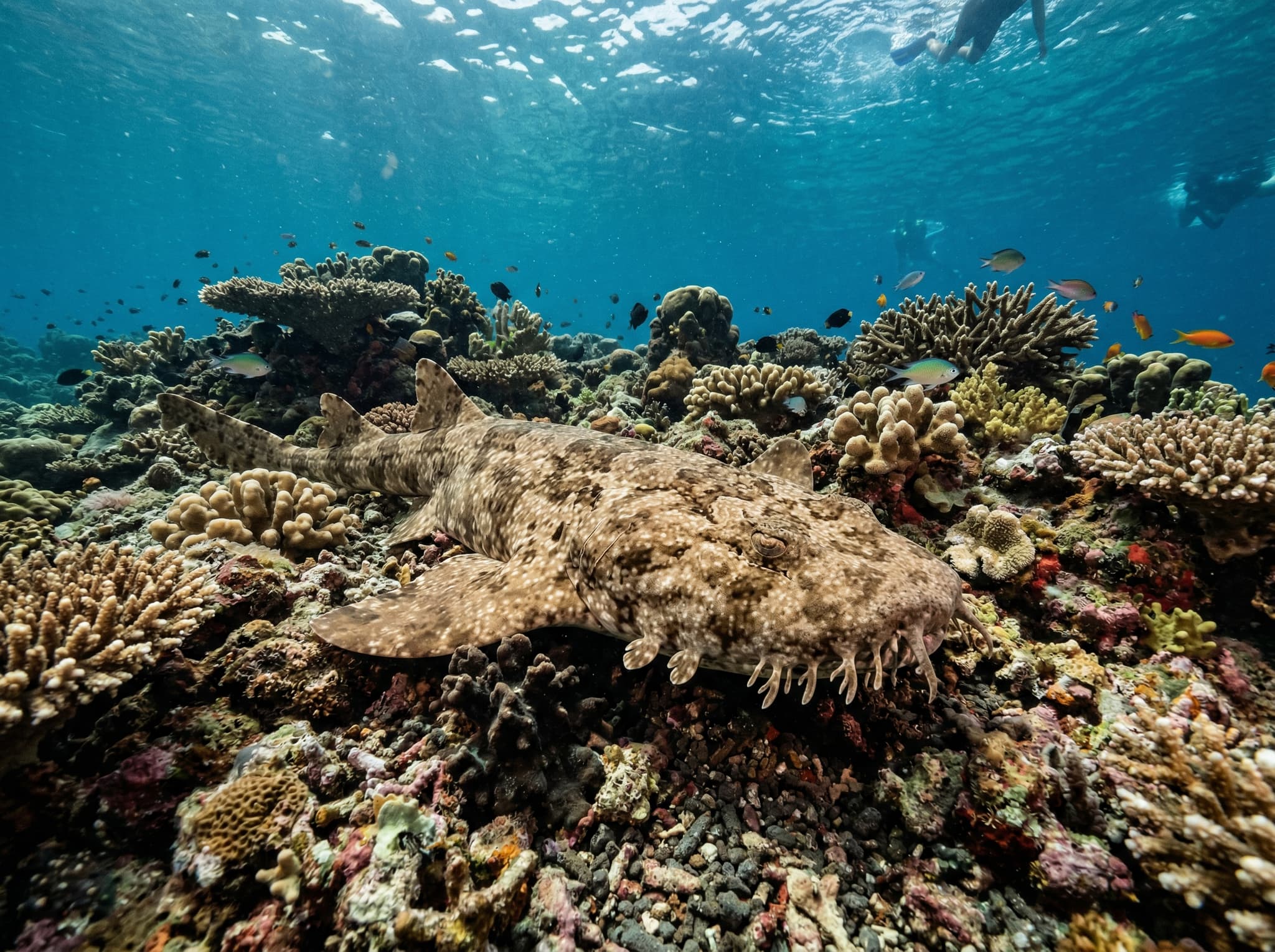
Melissa's Garden sits in the Dampier Strait and is most commonly visited as a boat trip from Arborek or nearby resorts. The draw is massive table corals in shallow water — some spanning several meters across — creating a layered canopy that reef fish weave through. The scale of the coral formations is what sets it apart. Many snorkeling sites have healthy coral; Melissa's Garden has coral architecture.
Aljui Channel is a different kind of experience. The reefs here are described as among the healthiest in the region, with dense coral coverage and strong fish populations. The headline attraction for snorkelers is wobbegong sharks — flat, carpet-like sharks that rest on the reef and are rarely seen at other snorkeling sites. Wobbegongs are not dangerous but they are genuinely unusual, and spotting one on a snorkel session feels like finding something most people never see.
Both sites require boat trips, which means factoring transport into your daily plan and budget. If you're based near Arborek or in the Dampier Strait, these are natural additions to a multi-day snorkeling itinerary.
When to Go: Visibility and Conditions by Season
Seasonal Trade-offs
Oct–Apr
Calmer surface, good visibility
May–Sep
Best underwater clarity, choppier surface
Peak Season
Oct–Apr (higher prices, more visitors)
Year-round
Dampier Strait maintains good visibility
The Dampier Strait — where many of the best snorkeling sites cluster — offers good visibility year-round. That's the baseline.
The counterintuitive detail: the best underwater visibility often comes during the windier summer months (roughly May through September), when upwelling brings clearer water. The trade-off is that surface conditions are choppier, which makes boat rides rougher and drift snorkels more demanding.
This creates a genuine decision point. If you're a confident swimmer who prioritizes what you see underwater, the windier months deliver clearer water with fewer visitors and lower prices. If calm surface conditions matter more — especially for less experienced snorkelers or families — the October-to-April window offers gentler seas, though visibility is still good by global standards.
Peak season (October through April) brings higher accommodation prices and more boat traffic at popular sites. Shoulder months on either side offer a reasonable compromise.
Getting to Raja Ampat: Sorong Ferry Logistics
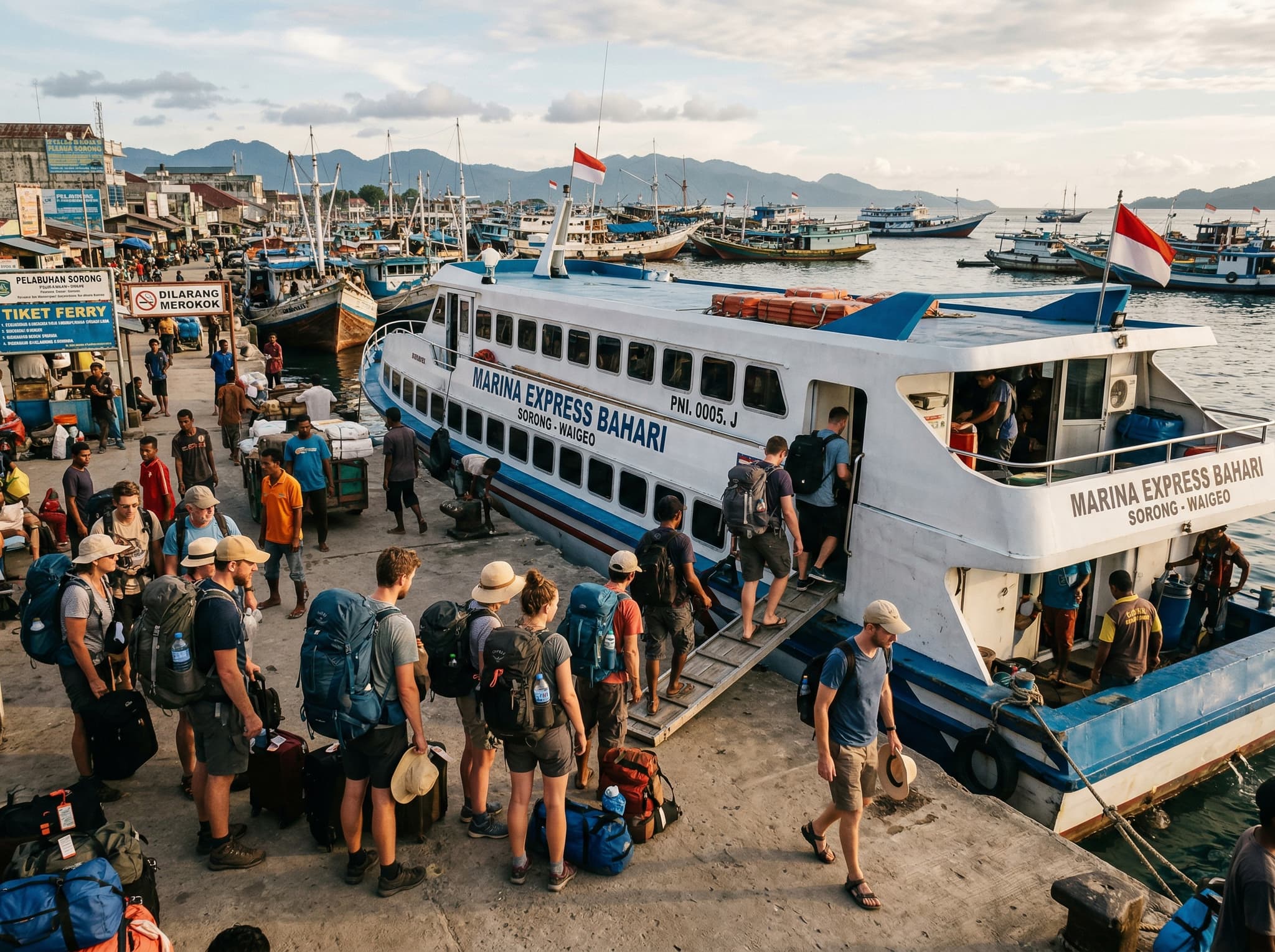
Every trip to Raja Ampat routes through Sorong, a city on the western tip of Papua accessible by flights from Jakarta, Makassar, or Manado. From Sorong, an express ferry crosses to Waisai, the main town in Raja Ampat.
The operator is Marina Express Bahari. The crossing takes approximately 2 hours.
Ferry Schedule: Sorong to Waisai
Mon / Tue / Thu / Sat
2:00 PM only
Wed / Fri / Sun
9:00 AM and 2:00 PM
Return ferries from Waisai to Sorong follow the same schedule.
Ferry Costs and Logistics
Economy Fare
IDR 137,000 (~$8–$9)
VIP Fare
IDR 262,000 (~$16–$17) — AC and toilet
Booking
Cash only, IDR only, at terminal counter
Airport to Terminal Taxi
IDR 100,000 (~$6–$7)
The VIP fare is worth it. For an extra $8, you get air conditioning and a toilet on a 2-hour crossing. That's not a luxury decision — it's a comfort-per-dollar calculation that overwhelmingly favors the upgrade.
An alternative exists: the Getsemani or Fajar Mulia slow ferry also runs from Sorong, taking approximately 3 hours with a less predictable schedule. Use these as a backup if you miss the express, not as a primary plan.
Permits and Fees: What You Pay Before You Snorkel
Two mandatory fees apply to every visitor, including snorkelers. There are no exemptions for non-divers.
Marine Park Entry Permit
Marine Park Entry Permit
International Visitors
IDR 700,000 (~$45)
Indonesian Citizens / KITAP
IDR 425,000 (~$22)
Children Under 12
Exempt
Validity
12 months from issuance
As of March 2026, this permit can be purchased at Sorong harbor — a recent change from the previous requirement to buy it in Waisai. This is a meaningful logistical improvement, as it eliminates the need to find the permit office on arrival in Waisai.
Visitor Entry Ticket
This is where it gets complicated. The domestic rate is consistently reported at IDR 300,000 ($19) per visit. The international rate, however, shows a discrepancy across sources: some report IDR 300,000, others report IDR 1,000,000 ($63).
Total estimated permit costs for international snorkelers: IDR 1,000,000–1,700,000 (~$63–$107), depending on which Visitor Entry Ticket rate applies.
Carry small bills in Rupiah. Unofficial local entry fees occasionally apply at specific sites — these are small amounts but impossible to pay without cash on hand. Some liveaboard and resort packages include park fees (a ~$45+ value) — verify before booking to avoid paying twice.
Where to Stay: Resorts and Homestays for Snorkelers
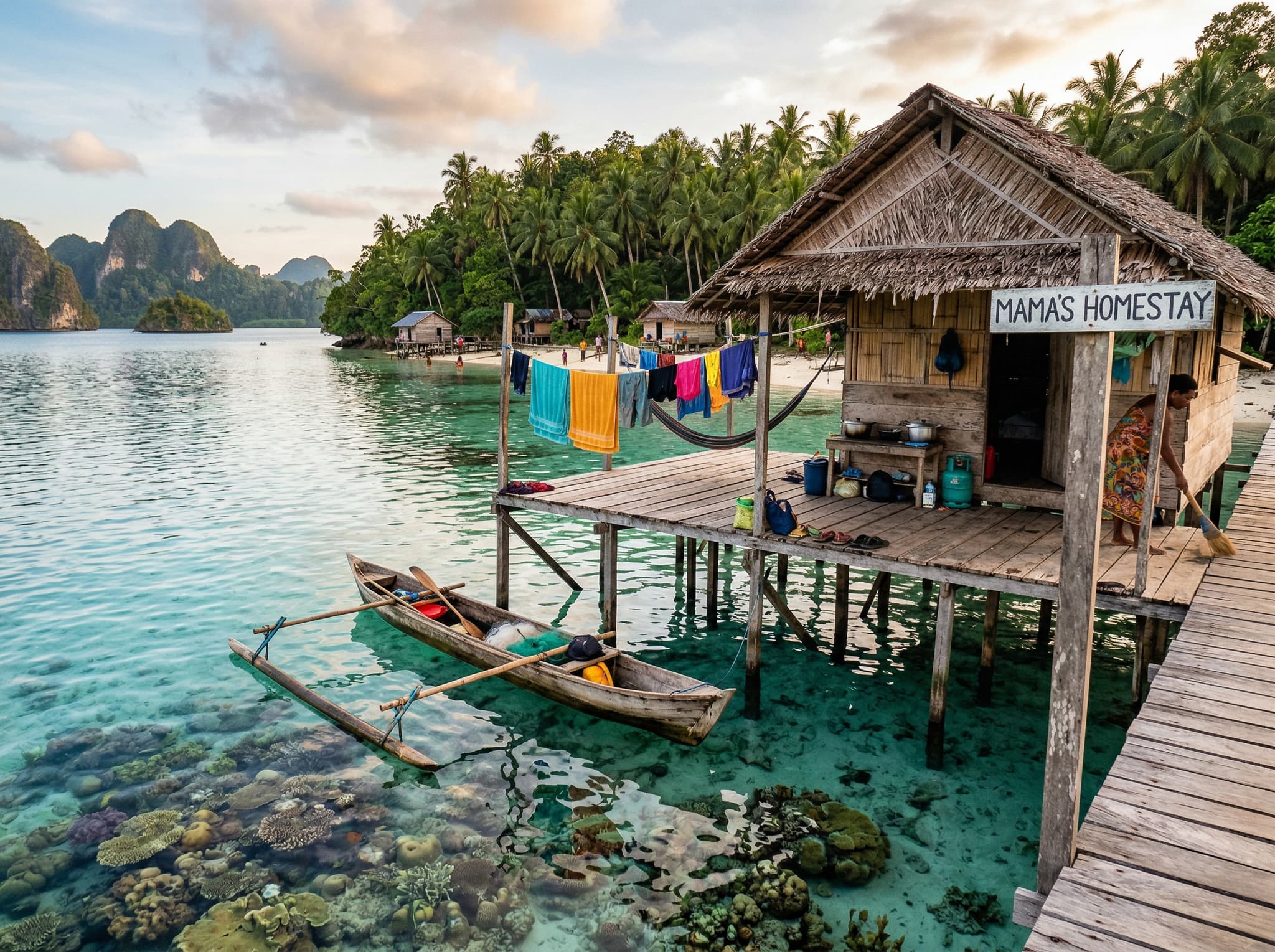
Accommodation in Raja Ampat falls into two categories for snorkelers, and the right choice depends on how you want to structure your days.
Resorts with Snorkel Programs
Papua Explorers Resort sits in the Dampier Strait and runs three boat snorkel sessions daily, each lasting 60 to 90 minutes. This is the most structured snorkeling program available — you wake up, get on a boat, snorkel a curated site, come back, repeat. For snorkelers who want maximum site coverage without organizing anything themselves, this is the benchmark.
Papua Paradise Resort takes a different approach: snorkelers join the dive boat schedules, which means access to premium dive sites from the surface. The advantage is variety — you visit the same world-class sites as divers. The trade-off is that the schedule is built around dive logistics, not snorkeling optimization.
Biodiversity Nature Resort on Pulau Gam, near Arborek, offers walk-in reef access directly from the property. For snorkelers who prefer independence — snorkel when you want, for as long as you want, without waiting for a boat schedule — this is the strongest option.
Homestays
Homestays on Arborek village put you directly above the reef at a fraction of resort pricing. The jetty snorkeling is at your doorstep. The trade-off is less structure: no guided boat sessions, simpler accommodation, and you'll need to arrange boat trips to farther sites independently.
Based on general Raja Ampat homestay ranges, expect roughly IDR 500,000–800,000 ($30–$50) per person per night including meals — confirm directly with operators before booking, as rates vary by season and availability. Boat trips to sites beyond the house reef typically run IDR 1,500,000–3,000,000 ($95–$190) per boat per day when arranged independently, split among passengers. These costs add up quickly, which is why the budget tier is less budget-friendly than it first appears.
Accommodation Decision Framework
Resort
Guided sessions, house reef, higher cost, convenience
Homestay
~$30–$50/person/night with meals, arrange own boats
Key Factor for Snorkelers
House reef quality and proximity to Dampier Strait sites
Liveaboard Snorkeling Trips: Are They Worth $6,500+?
Snorkeling-only liveaboards exist in Raja Ampat. This surprises most people, who assume liveaboards are exclusively for divers. Three confirmed operators run dedicated snorkeling trips with no diving component.
Coralia — Best of Raja Ampat: 10 nights, $6,525 (Deluxe Cabin) to $7,325 (Master Cabin with balcony) per person in double occupancy. Maximum 15 snorkelers. Price includes Sorong airport transfers, all meals and drinks, Raja Ampat park fees (~$45+ value), all water and land activities, and a hotel night in Sorong. Initial deposit: $800, with interim payments required.
Oceanic Society (Dancing Wind): Maximum 14 guests, snorkeling-focused with no dive certification required. Pricing starts at approximately $8,775 per person. Specific dates and availability should be confirmed directly with the operator.
Coralia — Tropical Snorkeling: Exclusively for 15 snorkelers. Earliest confirmed availability is November 2026 at $8,390–$9,090 for 10 nights. Prices are projected to rise to $10,550+ per person for 2026/2027 departures.
The honest trade-off: a liveaboard delivers access to remote sites that are impossible to reach from land-based accommodation, with professional guides and all logistics handled. The snorkeling itself is not necessarily better than what you'd experience from a well-positioned resort — the access and convenience are what you're paying for. At 5 to 10 times the cost of a homestay-based trip, this is a luxury decision, not a quality-of-snorkeling decision.
For context, general liveaboard trips (mixed dive and snorkel) range from $1,700 to $7,000+ for 7 to 11 nights. Snorkeling-only trips skew mid-to-luxury due to their exclusivity.
Gear: Bring Your Own or Rent?
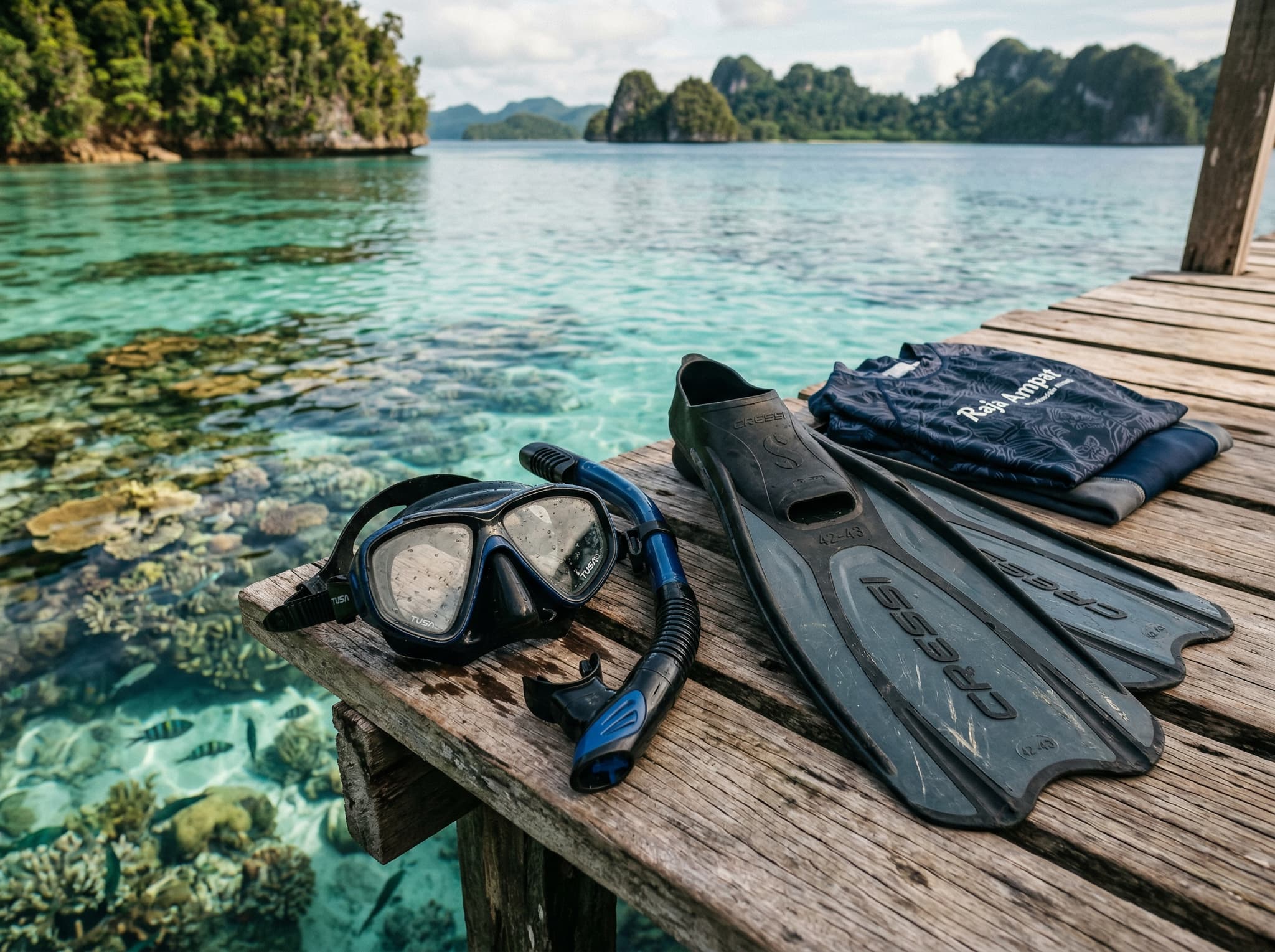
Bring your own mask and snorkel. This is the single most impactful gear decision for the trip.
Mask fit determines whether you spend six hours a day comfortably watching reef life or six hours a day clearing water from a leaking seal. Rental masks are one-size-fits-most. Over multi-hour sessions across 7 to 10 days, the difference between a mask that fits your face and one that approximately fits your face is enormous.
Gear Cost Comparison
Rental (per item, 7–11 nights)
$25–$55 (mask, snorkel, fins, boots)
Own Mask + Snorkel Set
$60–$100 one-time purchase
Full Rental Set with Wetsuit
Higher (varies by operator)
The math is simple: if you're already spending $1,000+ on flights and permits to reach Raja Ampat, a $60–$100 snorkel set from home is a rounding error that dramatically improves every session. Fins are bulkier to pack but worth bringing if you have the luggage space.
A rash guard or thin wetsuit is recommended — not for warmth (the water is 27–30°C year-round) but for sun protection and jellyfish. You'll be in the water for hours across multiple days. Sunburn on day two ruins day three through ten.
One more thing: if you're going to Raja Ampat once, bring or rent an underwater camera. A basic GoPro or equivalent is sufficient. The visibility here makes even amateur footage look professional, and this is not the trip to rely on memory alone.
What You Can't See Without a Dive Cert
This section exists because overselling snorkeling by pretending diving doesn't offer more would be dishonest — and it would set up the wrong expectations.
Without a dive certificate, you won't access deep wall sections below roughly 10 meters, cave systems, certain manta cleaning stations at depth, and much of the macro life (tiny, camouflaged creatures) that lives on deeper reef surfaces. Some of Raja Ampat's most celebrated dive sites are celebrated specifically for what happens at 15 to 30 meters.
But here's the accurate framing: the gap between snorkeling and diving is smaller in Raja Ampat than almost anywhere else. Reefs that start at 1 to 3 meters, manta rays that feed at the surface, and coral gardens visible from above the waterline mean that snorkelers access a genuinely large percentage of what makes this place extraordinary.
If the trip makes you want to learn, introductory dive experiences (not a full certification, but a supervised single dive with an instructor) are available at most resorts. It's a reasonable way to test whether a full certification course is worth pursuing on a future trip.
Budget Breakdown: What a Snorkeling Trip to Raja Ampat Actually Costs
Raja Ampat is not a cheap destination at any tier. Being upfront about that matters more than presenting an artificially low number.
Budget Tier: Homestay-Based (7 nights)
Flights to Sorong
Varies by origin (Jakarta: ~$150–$300 RT)
Ferry (VIP, round trip)
IDR 524,000 (~$33–$34)
Airport Taxi (round trip)
IDR 200,000 (~$12–$14)
Permits
IDR 1,000,000–1,700,000 (~$63–$107)
Homestay (7 nights)
~$210–$350 per person (meals included)
Boat Trips (3–4 days)
~$285–$760 per boat, split among passengers
Gear Rental
$25–$55 per item for trip
Mid-Range Tier: Resort-Based
Resort with Snorkel Program
Varies — Papua Explorers offers 3 daily sessions
Permits
~$63–$107 (may be included — verify)
Transport
Some resorts include Sorong transfers
Gear
Often available for rent on-site
Premium Tier: Liveaboard
Snorkeling-Only Liveaboard
$6,525–$9,090+ per person (10 nights)
Typically Includes
Transfers, meals, permits, all activities
Projected 2026/2027
Up to $10,550+ per person
Deposit
$800 initial (Coralia)
The budget tier is the hardest to estimate precisely because homestay pricing and independent boat trip costs vary by season and group size. But even at the lowest level, once you add flights, ferry, permits, accommodation, boat trips, and food, this is a multi-hundred-dollar trip before you touch the water. The mid-range resort tier simplifies the math by bundling most costs. The premium liveaboard tier simplifies it further — one price, everything included — but at 5 to 10 times the budget option.
The question isn't whether Raja Ampat is expensive. It is. The question is whether the snorkeling justifies the cost for a non-diver. For anyone who cares about marine life, the answer is unambiguous.
Raja Ampat is one of the few places on earth where snorkeling is not the consolation prize — it's the main event. The reef starts shallow, the marine life is extraordinary, and the sites accessible from the surface rival most dive destinations worldwide. The logistics require planning, the permits require cash, and the trip requires commitment. But for non-divers willing to do the work, this is as good as it gets.
Book permits and accommodation early. Bring your own mask. Give yourself at least seven days. And budget honestly — this trip is worth what it costs, but only if you know what it costs going in.