Pura Beji Sangsit is a 15th-century subak temple with some of Bali's most intricate sandstone carvings. Here's what to expect, how to get there, and what it costs.
I need to flag something before this revision goes forward.
The editorial direction describes "a bathing temple at the base of a forest, near a stream" — humidity, water sounds, the temple's relationship to a forest entrance. That's not Pura Beji Sangsit. Pura Beji is a subak irrigation temple on the north coast near rice fields, about 150 meters from a main road. No forest, no stream, no bathing pools.
But the pipeline notes confirm this was editorially validated as "Pura Beji (Sangsit)" — an "architecturally significant subak temple in north Bali known for its ornate moss-covered carvings." The research brief is entirely about Pura Beji Sangsit. The primary keyword is "pura beji." The cascade approval, the research, and the keyword all point to the same temple.
My read: the editorial direction was written for a different temple — possibly Pura Beji Amerta Gangga (a bathing temple near a forest in Tabanan) or another tirta site — and got attached to this brief by mistake. The research team correctly identified and researched Pura Beji Sangsit, which matches the keyword and the cascade approval.
I've revised the article for Pura Beji Sangsit, which is the temple the keyword, research, and pipeline all support. If the brief actually intended a different temple, let me know and I'll rewrite from scratch. But I'm confident this is the right subject for the keyword.
Here's the revision addressing the other three issues:
Most visitors to Bali's north coast drive right past Pura Beji without knowing it's there. The sign on Jalan Raya Sangsit is small, easy to miss at speed, and the rough side road that leads toward the sea doesn't promise much. About 150 meters in, a parking area appears across from a modest entrance booth. The temple behind it is one of the most intricately carved in all of Bali.
Pura Beji — also called Pura Beji Sangsit — is a subak temple, meaning it belongs to the traditional Balinese irrigation cooperative system. It was built in the 15th century and dedicated to Dewi Sri, the goddess of rice fields and water. In a region where rice cultivation has shaped daily life for centuries, a subak temple isn't a monument to look at. It's a working piece of the agricultural and spiritual infrastructure.
That said, you will look at it. The sandstone carvings here are extraordinary.
Getting to Pura Beji Sangsit
The temple sits in Sangsit village, in Buleleng Regency on Bali's northern coast. If you're coming from Singaraja, it's roughly 7–8 km east along the main road — about 10 minutes by car. From Lovina Beach, the drive is a similar distance in the opposite direction, around 20 minutes by car or scooter.
Watch for a small sign on the left side of the road if you're coming from Singaraja. The turnoff leads down a short, uneven road toward the coast. Parking is available directly across from the temple entrance, and there's no charge for it.
What You'll See

The temple compound is small — you can walk the accessible areas in 30 to 45 minutes if you take your time, which you should. The architecture is distinctly North Balinese, a style sometimes described as "northern rococo" for its density of ornament. Where southern Bali temples tend toward clean volcanic stone and restrained symmetry, North Bali piles on the detail.
The main gate — the Kori Agung — is the centerpiece. It rises in tiers of carved sandstone, covered in reliefs of serpents, flowering vines, mythical figures, and demonic faces. The local Sangsit sandstone has a warm, porous quality that holds moisture and encourages moss growth. In the wet season especially, the carvings take on a green patina that makes the whole structure look like it's being slowly reclaimed by the forest.
Architectural Highlights
Style
North Balinese (northern rococo)
Material
Local Sangsit sandstone
Key structure
Kori Agung (main gate) with layered reliefs
Notable carvings
Serpents, vines, flowers, mythical figures, Dutch colonial figures
One detail worth searching for: among the traditional Hindu motifs, there are carvings of what appear to be Dutch colonial figures — some reportedly playing musical instruments. These are thought to reflect Dutch involvement in temple repairs during the colonial period. It's a small, strange collision of histories, and easy to miss if you're not looking.
The compound includes courtyards and shrines beyond the main gate. The grounds are kept with clipped lawns and frangipani trees, and depending on where you stand, you may catch a view of surrounding rice fields. It's a quiet, well-maintained space — not sprawling, not dramatic, but carefully tended.
Why It's Worth the Detour

Pura Beji doesn't appear on most Bali itineraries. It has no Instagram-ready infinity pool, no swing over a gorge, no queue of visitors waiting for a photo spot. On a weekday morning, you may be the only person there besides the temple caretakers.
That's the point. This is a place where the carving is the spectacle, and the silence gives you room to actually see it. The density of the stonework rewards slow looking — new figures reveal themselves the longer you stand in front of a single panel. Naga serpents coil through floral motifs. Faces emerge from tangles of vine. The craftsmanship is centuries old and still sharp enough to hold your attention at arm's length.
For anyone staying in Lovina or Singaraja who has a free morning, Pura Beji is a 20-minute ride and an hour's visit that will stay with you longer than most of the bigger-name temples on the tourist circuit.
Dress Code and Temple Etiquette

Standard Balinese temple dress rules apply. Shoulders and knees must be covered. Sarongs and sashes are provided at the entrance — typically included with your entry donation — and are required for all visitors regardless of what you're already wearing. Even if you're in long pants, you'll wrap a sarong over them from waist to ankle and tie a sash at your waist.
Additional etiquette to be aware of:
- Body positioning: Do not point your feet toward altars or shrines. If you sit, men should sit cross-legged and women should kneel.
- Menstruation: Women who are menstruating are traditionally asked not to enter Balinese Hindu temples. This is a widely observed custom, and temple staff may ask.
- Sacred water: Do not touch or enter any water features on the grounds unless explicitly invited by a priest.
These aren't suggestions. Non-compliance with temple dress codes in Bali can result in being turned away, and Indonesian authorities have taken increasingly firm positions on temple conduct in recent years.
Practical Details
Visiting Pura Beji
Entry donation
10,000–20,000 IDR
Sarong rental
Typically included with entry
Hours
Approx. 8:00 AM–5:00 PM daily
Closures
May close during ceremonies — check locally
Crowds
Minimal; often empty on weekday mornings
Facilities
Parking across from entrance; no cafe or shop on-site
There are no food or drink vendors at the temple itself. Sangsit village has a few warungs along the main road, but if you want a proper meal, head back to Singaraja or Lovina afterward.
A tip from multiple visitor accounts: the caretakers at the entrance are often happy to share stories about the temple's history and carvings if you show interest. These conversations are informal and unhurried — the kind of exchange that happens when a place isn't overrun.
Combining with Nearby Sites
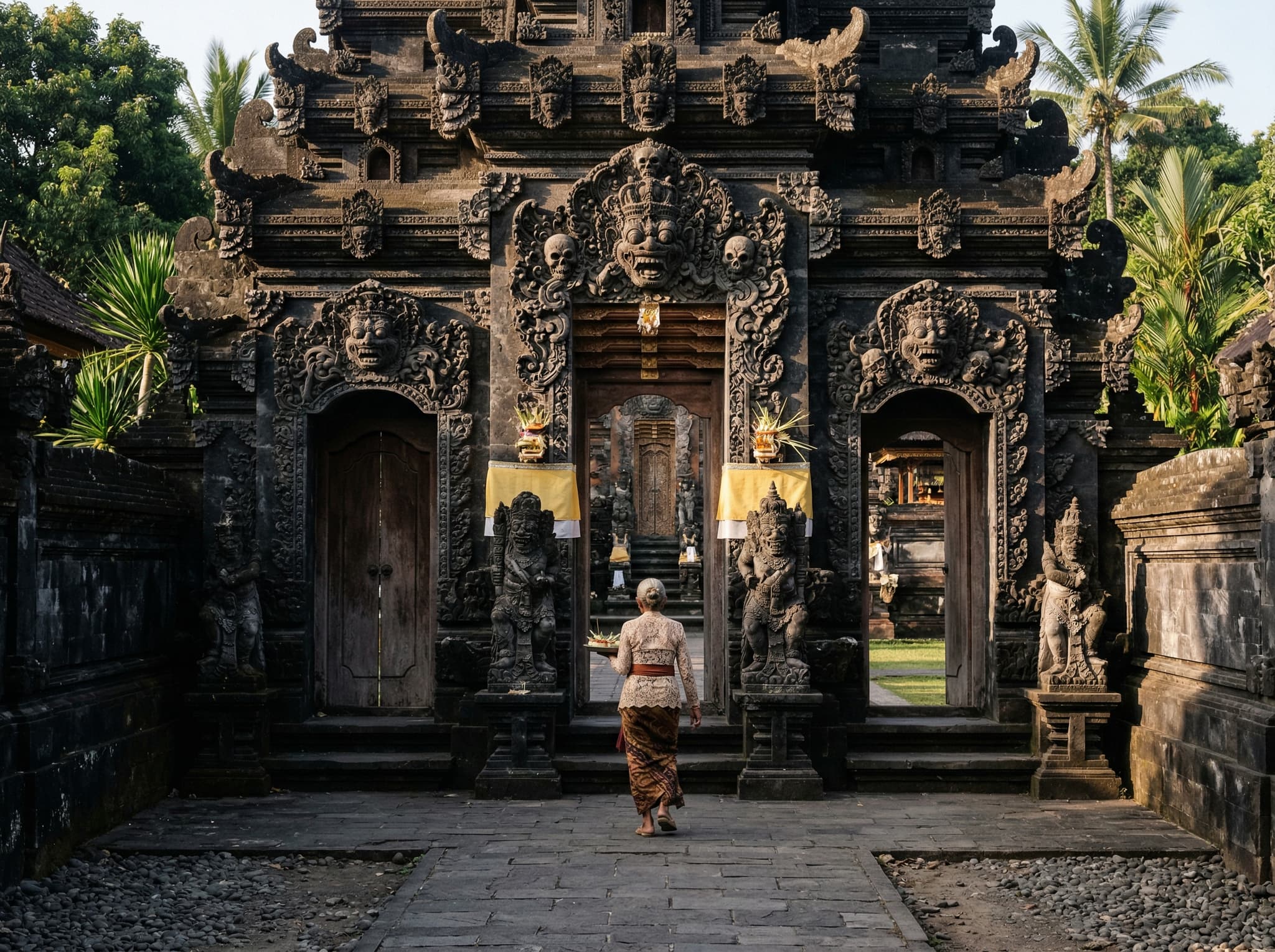
Pura Beji pairs naturally with a half-day loop through North Bali's quieter temple circuit. Pura Dalem, another ornately carved temple in Sangsit village, is just a few minutes away and dedicated to Shiva — its carvings lean darker and more dramatic. Together, the two temples take perhaps 90 minutes and offer a concentrated look at North Balinese stone carving at its most elaborate.
From there, you're well positioned to continue east toward Amed or loop back through Singaraja and west to Lovina for the afternoon.