Saga is a hillside Lio village south of Ende where thatched-roof clan houses, stone altars, and ikat weaving traditions remain part of daily life.
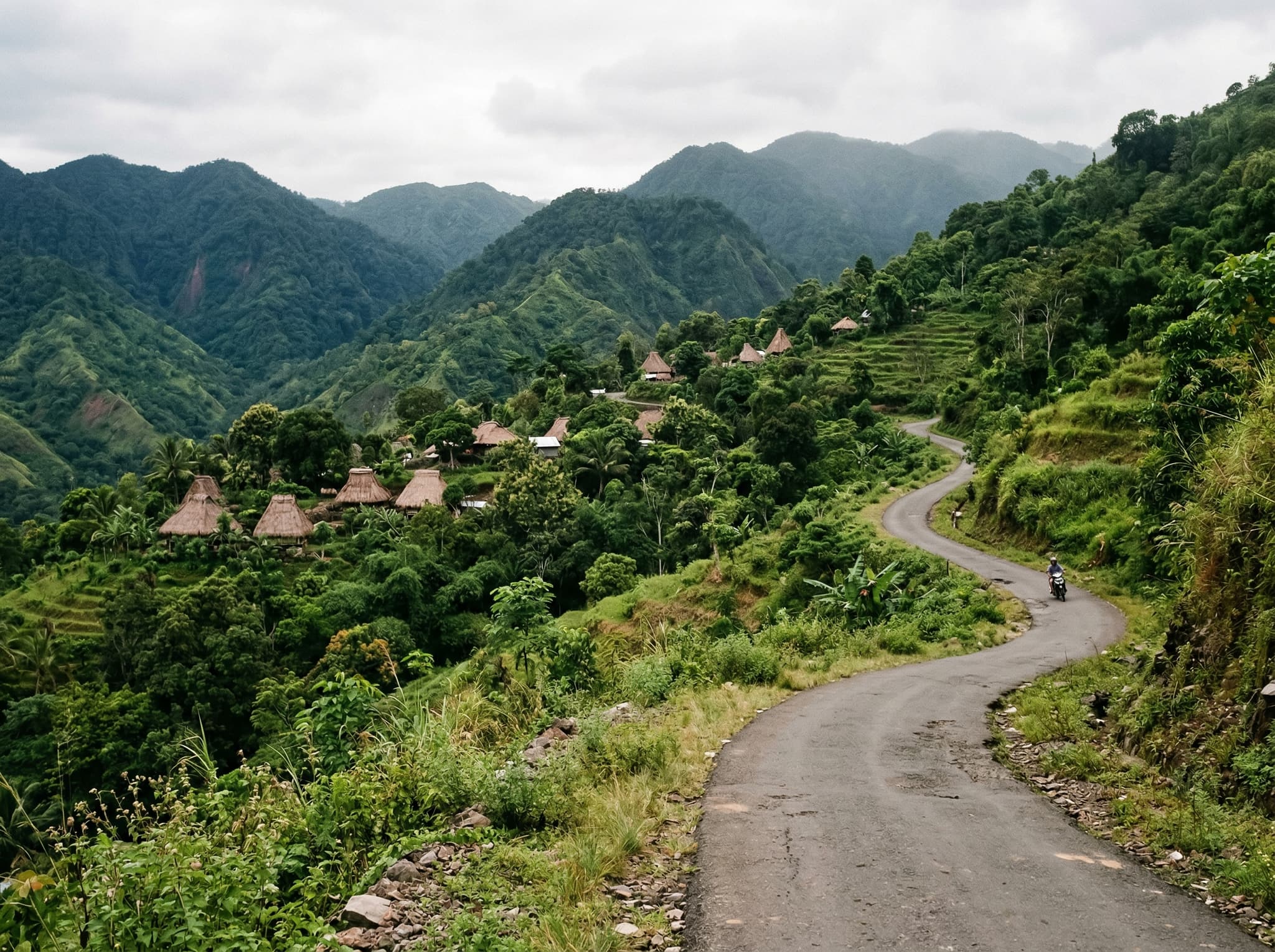
Saga sits on a hillside about 15 kilometers south of Ende, the main town of central Flores. It's small — a cluster of high-peaked thatched-roof houses arranged around a central ceremonial space — and a visit here takes an hour or two at most. But what makes Saga worth the detour isn't its size. It's the fact that the village is still actively lived in, still organized around the same spatial logic and social structures that have defined Lio communities on Flores for centuries. This isn't a museum reconstruction. People sleep in these houses, tend gardens on the surrounding slopes, and maintain the ritual calendar that gives the village its rhythm.
What Makes Saga a Traditional Village

On Flores, "traditional village" — kampung adat — has a specific meaning. It refers to a settlement that maintains customary law, architecture, and ceremonial practices tied to ancestral tradition. Saga is one of several such villages in the Ende regency, alongside better-documented sites like Wologai and Djopu. Each has its own clan lineages, its own ritual obligations, and its own relationship to the landscape.
What they share is a spatial grammar. Traditional Lio villages are organized around a central open area — a plaza of packed earth or stone — that functions as the communal and ceremonial heart of the settlement. Houses face inward toward this space. Their placement isn't random; it reflects clan hierarchy and social role. The house closest to a particular stone or altar belongs to the clan with a specific ritual responsibility. The village layout is, in effect, a social map.
In Saga, this is legible even to an outsider. The houses are arranged in two rough rows facing each other across the central space, with stone altars and a tubu musu (a sacred stone formation) marking the ritual center. The architecture is distinctly Lio: steep thatched roofs that rise to a narrow peak, bamboo and timber frames, and raised floors. The roofs are the most striking element — they dominate the structure, making the houses look like they're wearing hats several sizes too large. This isn't decorative. The steep pitch sheds rain efficiently in a climate that alternates between months of downpour and months of dry heat, and the high interior space allows smoke from cooking fires to circulate and cure the thatch, extending its life.
The Hillside Setting
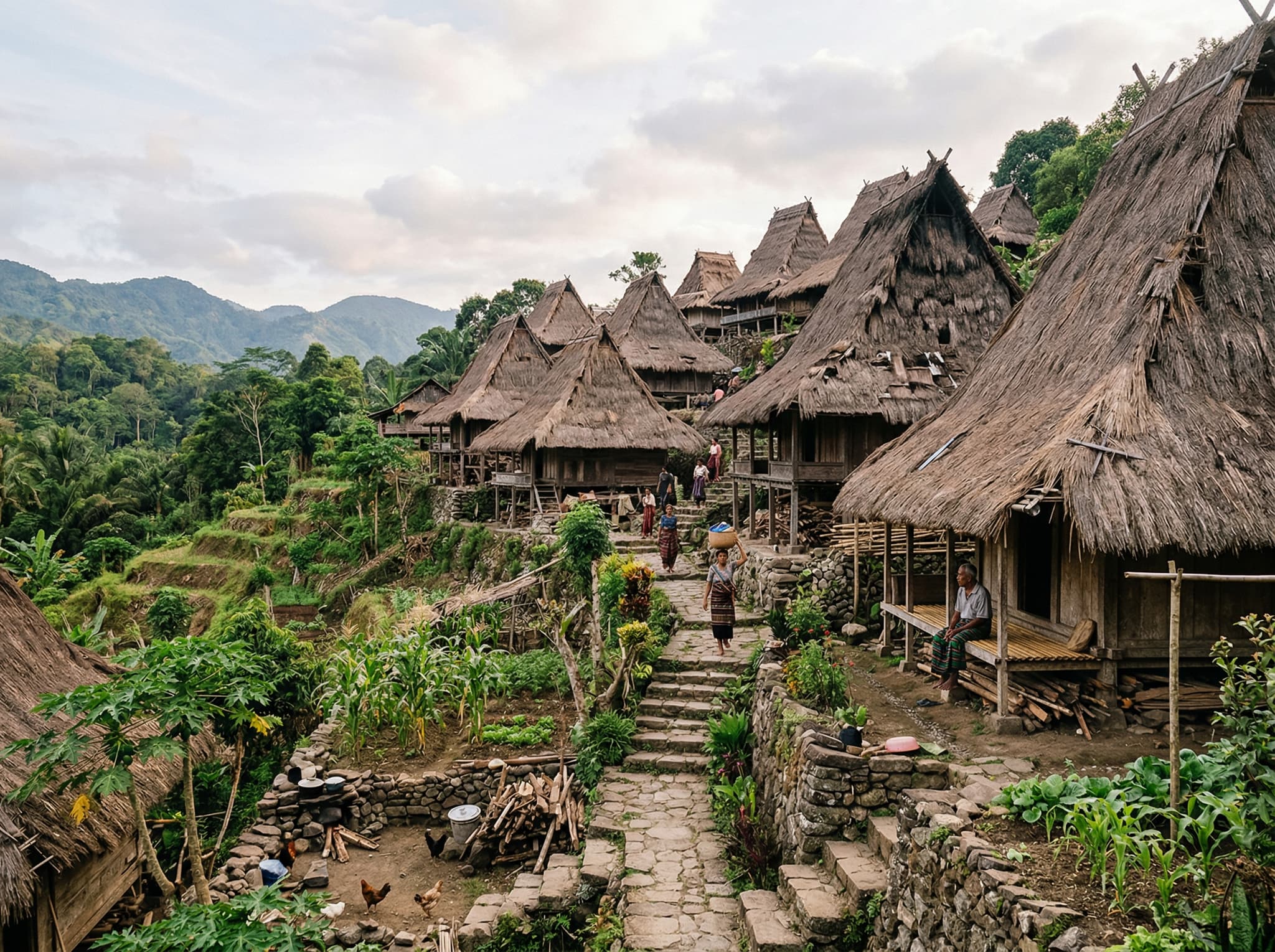
Saga's position on a slope matters more than it might seem. The terraced arrangement means the village reads differently depending on where you're standing — from below, the rooflines stack against the sky; from within, the central plaza feels enclosed and intimate despite being open-air. The surrounding hillside is planted with crops and bordered by forest, and on clear days the views extend toward the coastline.
The elevation also shapes daily life. Water management, foot traffic, drainage during the wet season — the village's infrastructure is adapted to gradient in ways that flat-ground settlements don't need to consider. Stone retaining walls and stepped pathways connect the houses, and the whole layout has a compactness that feels deliberate, like a village that's been edited down to essentials over generations.
Getting to Saga
From Ende town
~15 km south, 30–40 min by motorbike or car
Road condition
Paved to the turnoff, then a short unpaved section
Transport
Ojek (motorbike taxi) or private hire from Ende
Visiting with a Resident Guide
There's no ticket booth at Saga. When visitors arrive, a resident — often one of the village elders or a younger family member who speaks Bahasa Indonesia fluently — will typically greet you and offer to walk you through the settlement. This isn't a formal tour operation. It's closer to being invited into someone's home and having them explain how the household works.
The difference between visiting with a guide and wandering alone is significant. Without context, Saga is a photogenic cluster of traditional houses. With a guide, the stone formations in the central plaza become specific — this one marks a particular clan's founding, that one is where offerings are placed during harvest ceremonies. The guide can explain which houses belong to which clans, what the carved motifs on certain posts represent, and how the village's ritual calendar intersects with the agricultural year.
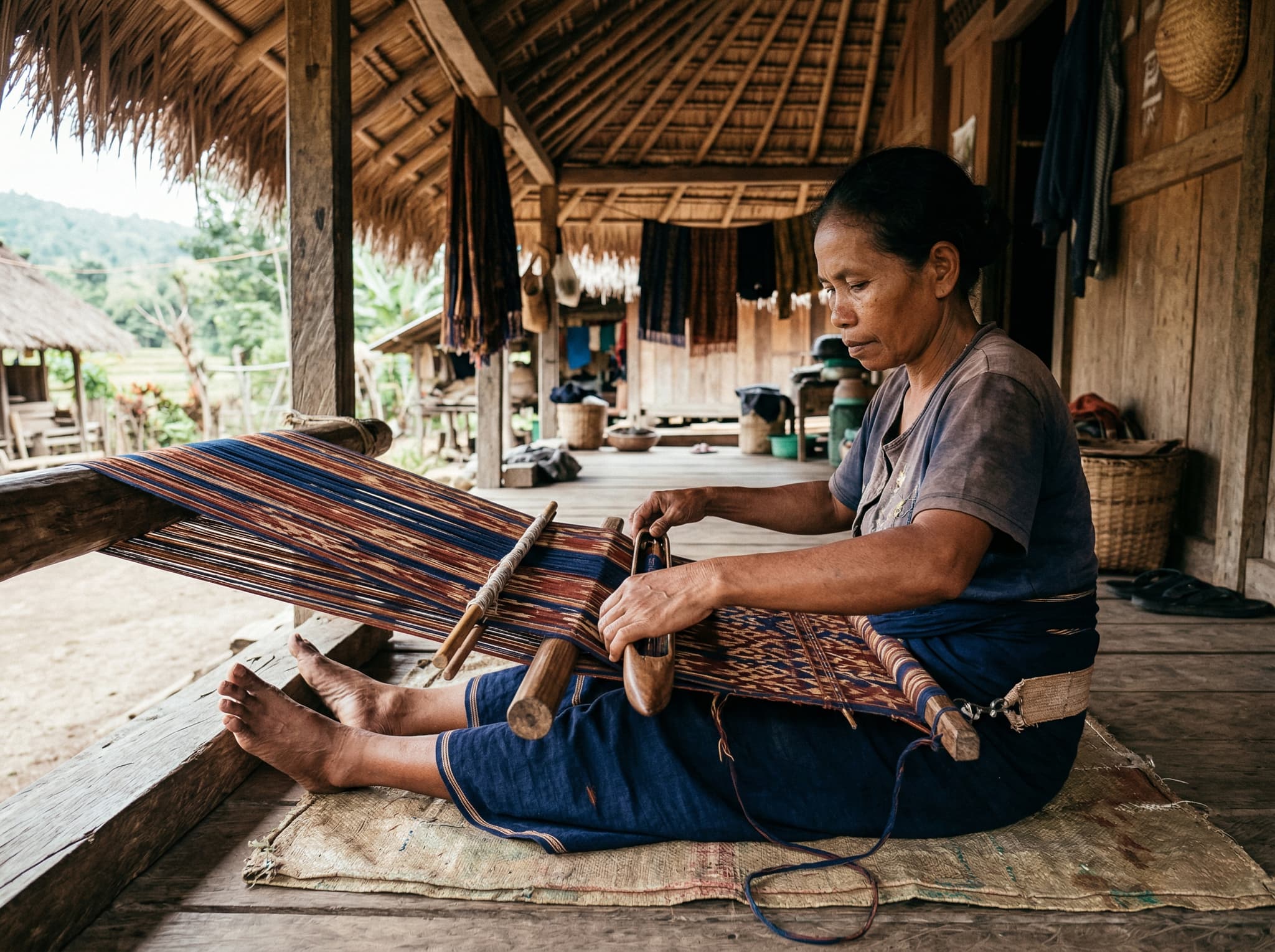
Guides will also often demonstrate or explain ikat weaving, the textile tradition that's central to Lio culture. The naturally dyed fabrics produced in villages like Saga aren't souvenirs — they're ritual objects with specific social functions, used in ceremonies, exchanges, and as markers of status. If a weaver is working during your visit, watching the process is one of the most genuinely interesting parts of the experience.
How Saga Fits the Broader Ende Region
Ende is not a tourist hub. Most travelers pass through on their way to or from Kelimutu, the tri-colored crater lake about 50 kilometers to the east. But the Ende regency has one of the densest concentrations of living traditional villages in eastern Indonesia, and Saga is part of a cultural landscape that rewards slower exploration.
Wologai, about 45 minutes east of Ende toward Kelimutu, is the most visited of these villages and has a more established tourism infrastructure. Djopu, closer to Ende, is smaller and quieter. Saga falls somewhere between — less trafficked than Wologai, but with enough of a visitor routine that guides are accustomed to explaining things to outsiders.
Nearby Traditional Villages
Wologai
~45 min east of Ende, larger and more visited
Djopu
Closer to Ende, smaller and quieter
Visiting two or three of these villages in a day is feasible with private transport, and doing so actually deepens the experience — you start to see the shared architectural and spatial principles while noticing the variations that make each village distinct.
What to Expect
Saga is not a polished tourism product. There are no information boards, no gift shop, no set visiting hours. The village is someone's home, and visiting it requires the kind of basic social awareness that should be obvious but sometimes isn't: dress modestly, don't enter houses without being invited, don't touch ritual objects, and be mindful that the central ceremonial space is not a backdrop for selfies.
The visit itself is quiet. There's no performance element, no staged ceremony for tourists. What you get is a chance to see a living settlement that's organized around principles most of the modern world has abandoned — communal space over private space, social architecture over individual expression, a built environment that encodes memory and obligation into its physical form.
That's worth an hour of your time. It's worth more if you let it be.