Gili Trawangan's nightly seafood market serves fresh grilled fish at a fraction of restaurant prices. Here's what to order, what to skip, and how it works.
Every evening on Gili Trawangan, the same transformation happens. As the afternoon heat loosens its grip, a row of stalls along the eastern edge of the island — close to the main boat landing and the central mosque — begins setting up folding tables, plastic chairs, and charcoal grills. By the time the light turns amber, the smoke is already rising. This is the Gili Trawangan Night Market, and for most visitors, it's the single best reason to eat on the island.
The promise is simple: grilled seafood at a fraction of what the beachfront restaurants charge. That promise holds up. But the experience requires a little understanding of how the market works, what to order, and what to skip.
The Setup

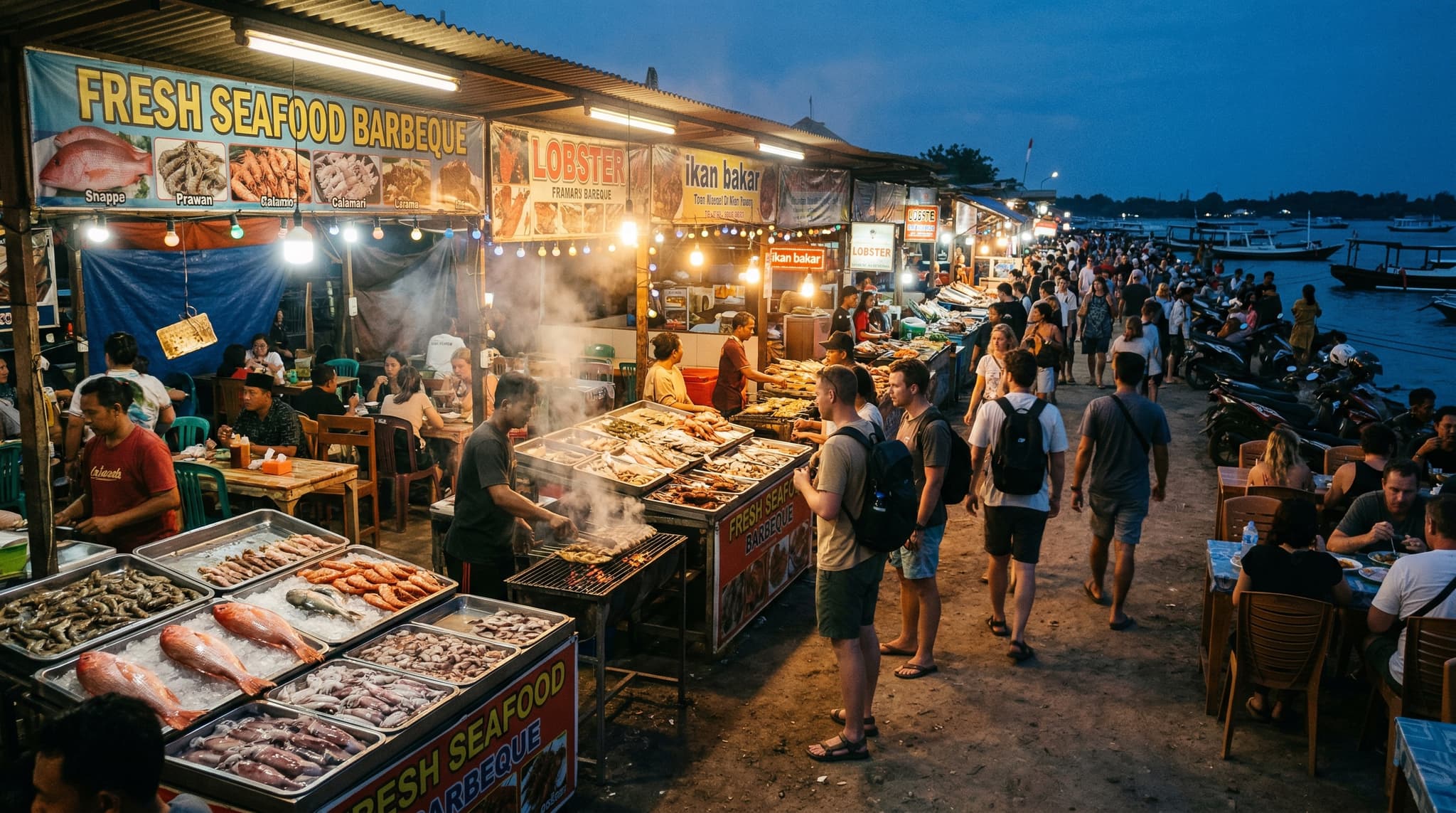
The market occupies a stretch of the main road near the harbor, not on the beach itself. Depending on the season, you'll find somewhere between a dozen and twenty stalls, each with its own display of the day's catch laid out on ice. Whole red snapper, squid, prawns, lobster tails, barracuda — arranged in rows, sometimes under fluorescent lights that make everything look slightly more dramatic than it needs to.
Each stall operates on roughly the same model. You walk up, point at what you want, negotiate or confirm the price, choose your sides, and sit down at the tables that belong to that stall. The food is grilled to order over coconut-husk charcoal. Most stalls include rice, a simple salad or plecing kangkung (water spinach in chili sambal), and a few condiments as part of the price.
What to Order

The red snapper is the anchor of the market. A whole grilled fish — enough for one hungry person or shareable between two with sides — typically runs in the range of IDR 50,000–80,000, depending on size and stall. It arrives charred and smoky, usually with a sambal matah (raw shallot and lemongrass relish) or a squeeze of lime. When it's fresh and the grill is hot, it's genuinely good — not refined, not complex, but satisfying in the way that simple food cooked over live fire tends to be.
Prawns are the other reliable order. A skewer or small plate generally falls between IDR 60,000–100,000. Squid is cheaper and cooks fast, though it's easy for stalls to overcook it into rubber.
What to Expect to Pay
Whole grilled snapper
Approx. IDR 50,000–80,000
Prawns (plate/skewer)
Approx. IDR 60,000–100,000
Grilled squid
Approx. IDR 40,000–60,000
Lobster
Approx. IDR 150,000–300,000+
Sides and rice
Often included with mains
The lobster deserves a note of caution. It's the most prominently displayed item at nearly every stall, and it's the one the touts will push hardest. Prices can reach IDR 300,000 or more, which is still cheaper than a restaurant lobster dinner — but the quality is inconsistent. Small, sometimes frozen, occasionally overcooked. If you see a genuinely large, clearly fresh specimen and the price feels fair, it can be worth it. But the snapper-and-prawn combination is the more dependable meal.
What It Costs Compared to the Restaurants
This is where the night market earns its reputation. A grilled seafood dinner at one of Gili Trawangan's beachfront restaurants — the ones with cushions on the sand and cocktail menus — will typically run IDR 150,000–350,000 per person or more, before drinks. The same general meal at the night market costs roughly a third to half of that. The fish may not be plated as carefully, and you won't get a sunset view, but the ingredients are often coming from the same morning catch.
For budget travelers and anyone staying on Gili T for more than a night or two, the night market is where you eat well without watching the numbers climb. A full meal with a fresh juice from one of the adjacent drink vendors can come in under IDR 100,000 — roughly $6–7 USD. That's hard to beat anywhere in the Gilis.
The Scene
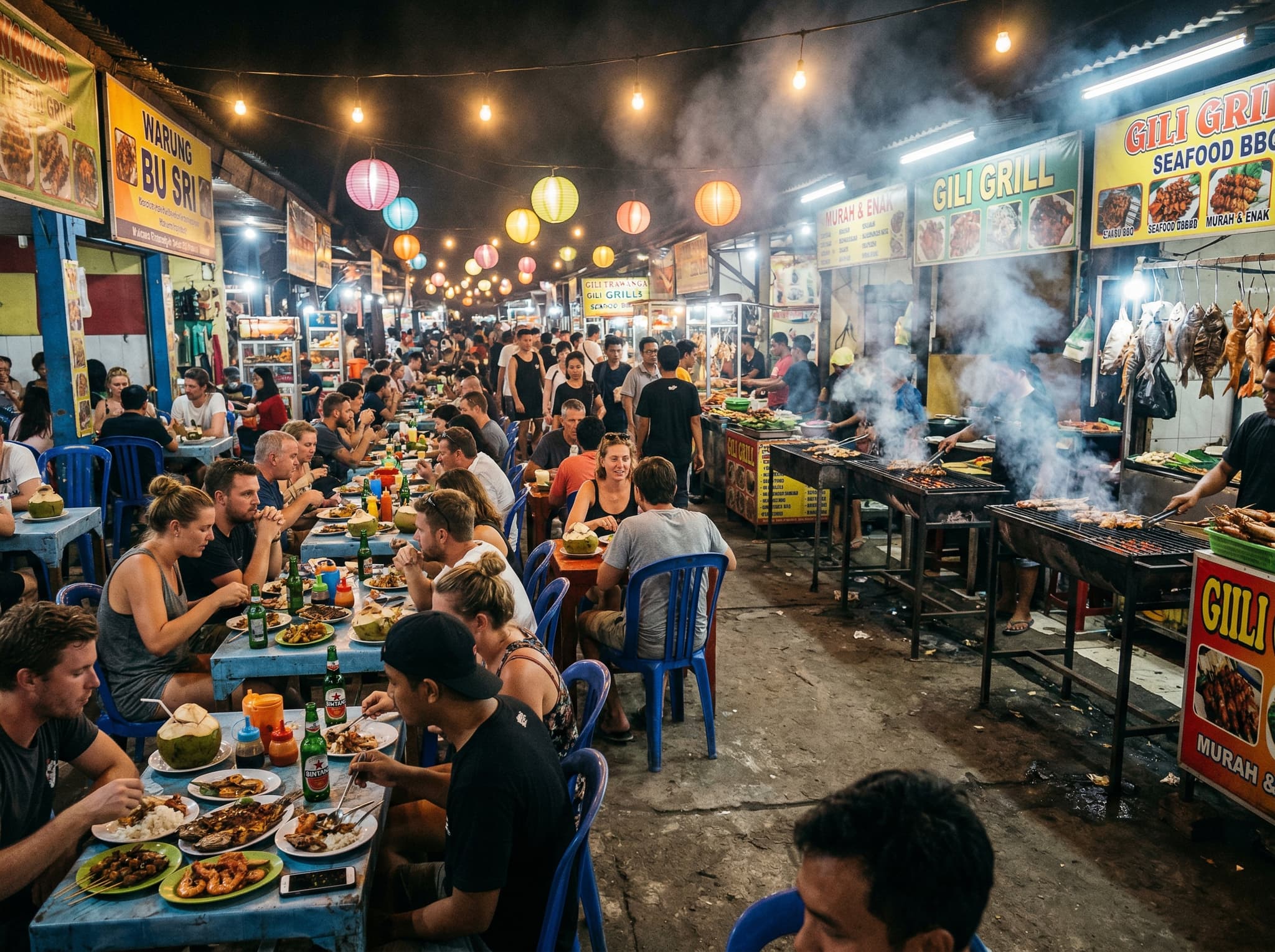
The market is loud, smoky, and a little chaotic. Touts from competing stalls will call out to you as you walk past, which can feel pushy if you're not expecting it. A polite "still looking" usually works. The atmosphere loosens once you sit down. Tables are communal by default — you'll end up elbow to elbow with other travelers, which is either part of the appeal or not, depending on your temperament.
The smoke from the charcoal grills drifts across the road and settles into your clothes and hair. You'll smell like a barbecue afterward. This is not a complaint, just a fact worth knowing if you're heading somewhere after dinner.
By around 8 or 9 PM, the market is at its peak — full tables, steady turnover, grills working hard. Earlier in the evening, around 6 to 7 PM, you'll have more room to browse and the touts are slightly less persistent. Later, past 9:30 or so, some stalls start winding down and the selection thins.
A Few Things to Know
Drinks are usually purchased separately from juice or smoothie carts nearby, or from small shops along the road. Most stalls don't serve alcohol, though some of the adjacent warungs do. Fresh lime juice or a young coconut pairs better with the food anyway.
There's no fixed address — the market is visible and obvious from the harbor area, and anyone on the island can point you to it. If you're staying on the west or north side of Gili T, it's a 10- to 20-minute walk, or a short cidomo (horse cart) ride.
Frequently Asked Questions
The Gili Trawangan Night Market is not a hidden gem — it's probably the most-recommended experience on the island, and it has been for years. What keeps it worth recommending is that the core of it hasn't changed. The fish is fresh, the charcoal is hot, the prices are fair, and you eat outside on a small island in the Lombok Strait with smoke in the air and strangers at your table. Some things don't need to be more than what they are.