Jalan Malioboro is more than Yogyakarta's shopping street — it's a ceremonial road turned cultural hub. Here's what to buy, eat, and know before you visit.
Every Javanese royal city was built along a cosmic axis — a north-south line connecting the spiritual and the earthly. In Yogyakarta, that axis runs from Mount Merapi in the north through the Kraton (the sultan's palace) to the Indian Ocean in the south. Jalan Malioboro sits on this line, and that's not an accident. Long before it became the shopping street tourists know today, Malioboro was a ceremonial road — the path royal processions took between the palace and the world beyond its walls.
That history still shapes the street. Walk Malioboro from south to north and you're tracing the same route Yogyakarta's sultans used for centuries. The difference now is that the procession includes batik vendors, street food carts, and several million visitors a year.
More Than a Shopping Street

Malioboro's reputation as Yogyakarta's main commercial strip is accurate but incomplete. Yes, the stalls lining both sides sell batik fabric, wooden puppets, silver jewelry, and the full spectrum of Indonesian souvenirs. But the street also functions as the city's public living room — a place where university students, street musicians, becak drivers, and families from across Java all converge, especially after dark.
The batik trade here deserves a moment. Yogyakarta is one of the historic centers of Javanese batik production, and Malioboro has been a marketplace for it since well before Indonesia's independence. The quality varies enormously — mass-printed fabric sits alongside hand-drawn (batik tulis) pieces that take weeks to produce. Knowing the difference matters if you're buying. Hand-drawn batik has slight irregularities and richer color depth. If a piece looks perfectly uniform, it's almost certainly printed, and should be priced accordingly.
Pasar Beringharjo and the Southern Anchor
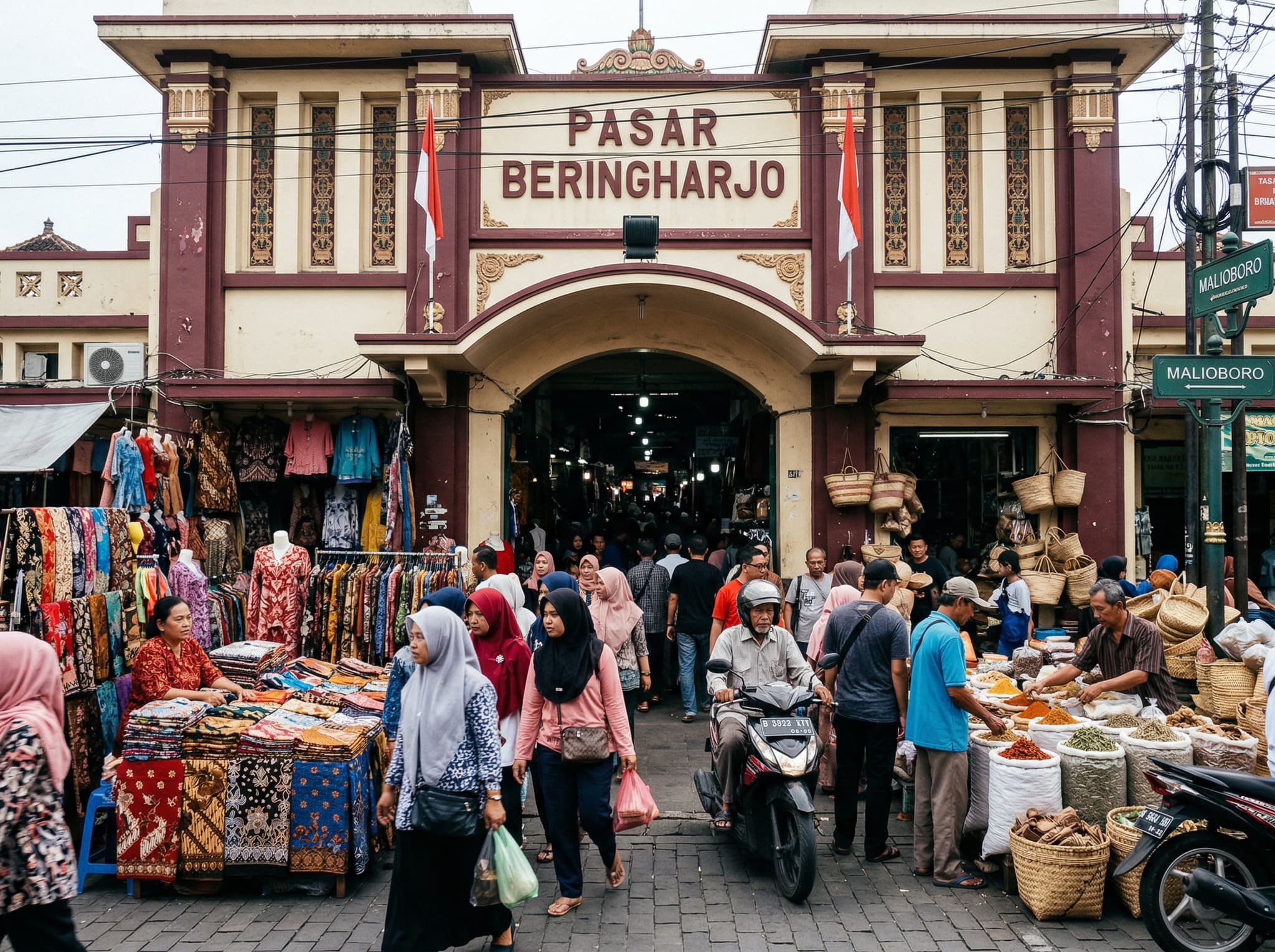
Malioboro flows naturally into Pasar Beringharjo, the traditional market that anchors its southern end. This is where the street's commercial energy concentrates — a dense, multi-level market selling batik, spices, jamu (traditional herbal drinks), and dried goods. The batik selection here is the widest along the Malioboro corridor, though quality remains inconsistent. Compare several vendors before buying, and bargain — starting offers are routinely inflated. Aiming for 30–50% below the asking price on souvenirs and printed batik is standard practice, not rude.
Bargaining Guide
Printed batik
Bargain to 30–50% off asking price
Hand-drawn batik
Less room to negotiate — quality commands higher prices
Souvenirs & crafts
Always negotiate; compare across stalls first
The Evening Transformation

Malioboro changes character after 6 PM, when vehicles are cleared and the street becomes pedestrian-only. This is when the lesehan vendors appear — street food sellers who set up mats directly on the sidewalk, where you sit cross-legged and eat. It's one of the most distinctive food experiences in Yogyakarta.
The staples are Javanese comfort food: gudeg (young jackfruit stewed in coconut milk), nasi goreng, satay, and wedang ronde (a warm ginger drink with glutinous rice balls). Prices are low — most dishes cost well under Rp 25,000. The atmosphere is the real draw: buskers play, the heat of the day breaks, and the street fills with a mix of local and visiting Indonesians that far outnumbers foreign tourists.
Selasa Wage and the Javanese Calendar
Every 35 days — on the convergence of Tuesday (Selasa) in the seven-day week and Wage in the Javanese five-day cycle — Malioboro hosts a special event. During Selasa Wage, the street goes fully pedestrian from 6 AM to 10 PM, vendors are cleared, and the road fills with traditional performances and cultural activities. It's a window into the Javanese calendar system that still structures life in Yogyakarta, even as the city modernizes around it. If your visit coincides with Selasa Wage, expect larger crowds but a richer cultural atmosphere. If you prefer a quieter shopping experience, check the date and plan accordingly.
What's Changed
Since 2012, Malioboro has undergone significant revitalization as part of a broader UNESCO World Heritage Site preparation initiative. The road was converted from two-way to one-way traffic, historic arcade architecture along the shopfronts has been restored, and green elements have been added along the covered walkways. The city trialed a full 24-hour pedestrian closure on October 7, 2025, coinciding with Yogyakarta's anniversary — a signal that full pedestrianization may be the long-term direction.
Getting There and Combining Visits

Transport to Malioboro
From YIA Airport
~25 min by taxi, Rp 100,000–150,000
Local bus
Lines 1A, 3A, 3B, 8, 15 stop at Halte Malioboro 1
Bus fare
Approximately Rp 3,000
On foot from Kraton
~15 min walk south to north
Malioboro sits within easy walking distance of Yogyakarta's other essential stops. Fort Vredeburg, the Dutch colonial fortress turned museum, is at the street's southern end. The Kraton (sultan's palace) is a 15-minute walk further south, and Taman Sari — the royal water garden — is just beyond that. A logical half-day route starts at Taman Sari, moves through the Kraton, passes Pasar Beringharjo, and finishes with an evening walk up Malioboro.