Everything you need to visit Prambanan — the largest Hindu temple in Indonesia. Entry fees, transport from Yogyakarta, Ramayana Ballet, and what the ruins reveal.
Prambanan is the largest Hindu temple complex in Indonesia and one of the most significant in Southeast Asia. Built in the mid-9th century during the Mataram Kingdom, it sits on the volcanic plains east of Yogyakarta — 240 individual temples spread across a landscape that, even in partial ruin, communicates an ambition that's hard to overstate.
What makes Prambanan remarkable isn't just its scale. It's the fact that it was built during a period when Hindu and Buddhist kingdoms coexisted — and sometimes overlapped — in central Java. Borobudur, the massive Buddhist monument, sits just 40 km to the northwest and was completed only decades earlier. The two complexes represent one of the most concentrated expressions of religious architecture anywhere in the world, built by rival dynasties that shared a geography, a labor force, and likely many of the same artisans.
What You're Actually Looking At
The complex is organized in concentric squares. The inner compound — the part most visitors photograph — contains eight main temples arranged on a raised platform. Three are dedicated to the Hindu trinity: Shiva (the tallest, at 47 meters), Vishnu, and Brahma. Facing each of these are three smaller temples for their respective vahanas (divine mounts): Nandi the bull, Garuda, and Hamsa the swan.
The Shiva Mahadeva temple dominates the complex. Inside, you'll find four chambers housing statues of Shiva, his consort Durga, the sage Agastya, and Ganesha. The Durga statue is locally known as Roro Jonggrang — "Slender Maiden" — tied to a Javanese legend about a princess who was cursed to stone. It's a folk story, not history, but it's so embedded in the site's identity that the evening ballet performance is named after it.
The real showpiece, though, is the relief panels. The inner walls of the Brahma and Vishnu temples carry carved narratives of the Ramayana and Krishnayana epics — 42 panels on the Shiva temple alone. These aren't decorative flourishes. They're sequential visual storytelling, meant to be read by walking clockwise (pradaksina) around each temple. The carving quality rivals Angkor Wat, which wouldn't be built for another three centuries.
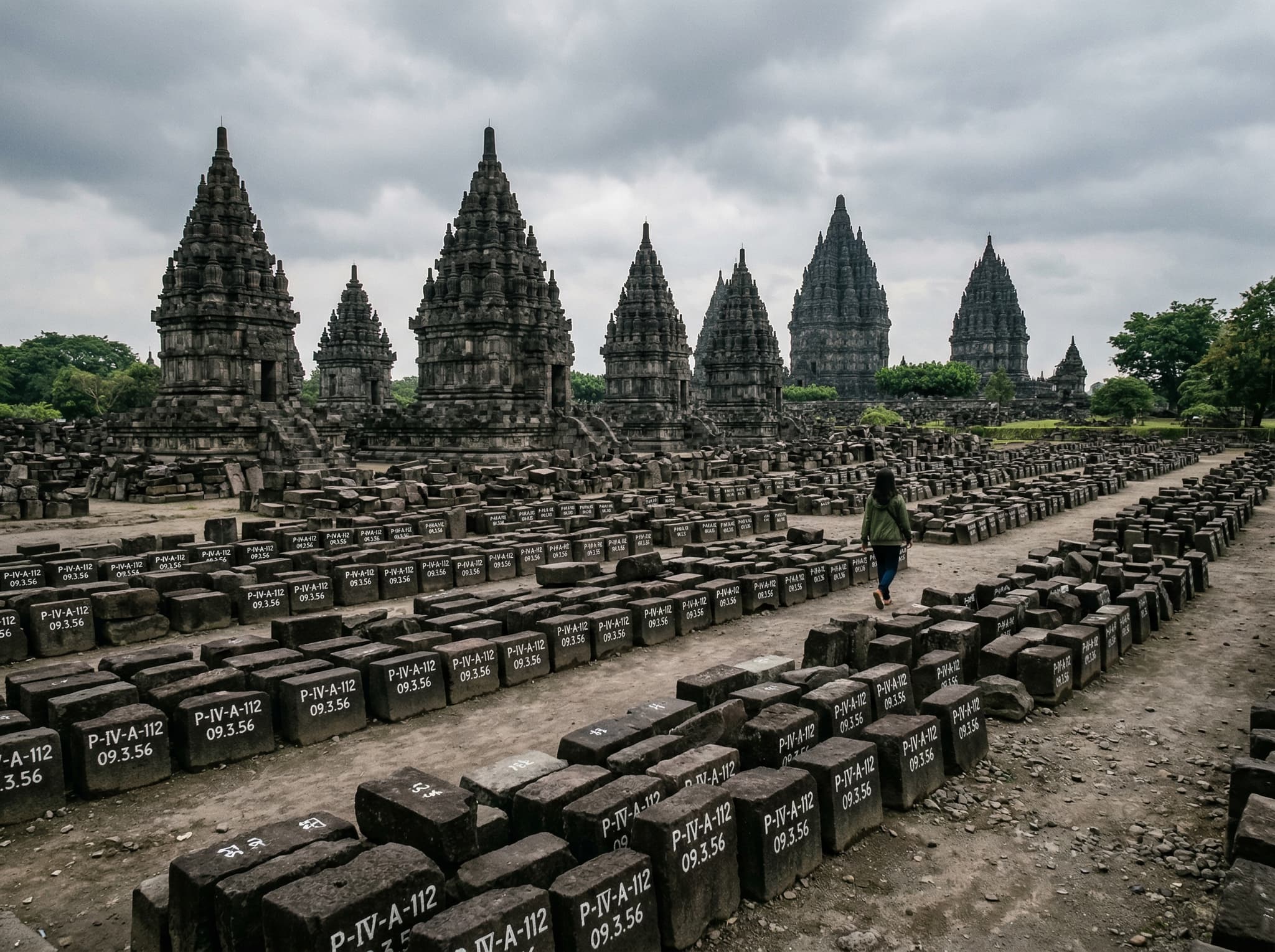
Beyond the main eight temples, the outer compounds originally held 224 smaller perwara (subsidiary) temples. Most of these are still in various stages of ruin — piles of carved stone blocks awaiting reconstruction. In March 2026, India and Indonesia launched a joint restoration project targeting these perwara temples, using anastylosis — a technique that rebuilds structures from their original stones, adding new material only where structurally necessary. Early phases focus on cataloging thousands of scattered stones, with AI-assisted identification tools under consideration. No visitor restrictions have been announced related to the restoration work.
Getting There

Prambanan sits about 17 km from central Yogyakarta — close enough that getting there is straightforward by any method.
By commuter train (fastest and cheapest): The KRL commuter line runs from Yogyakarta Lempuyangan Station to Brambanan Station in 22–38 minutes for around IDR 8,000. From Brambanan Station, it's a 9-minute walk to the temple entrance. Frequency is limited — roughly 11 departures daily from Yogyakarta stations combined — so check the schedule before heading to the platform.
By TransJogja bus: Route 1A departs from stops along Jalan Malioboro every 10–20 minutes, costing IDR 3,500–4,000 per ride. The journey takes 43–60 minutes to Terminal Prambanan, then a 15-minute walk to the ticket booth. Air-conditioned but can get crowded.
By Grab/Gojek or taxi: The most convenient option. A ride-hailing car costs IDR 80,000–130,000 one-way (roughly 15 minutes from the city center). Standard taxis run IDR 60,000–100,000.
Transport Comparison
Commuter Train
IDR 8,000 — 30 min + 9 min walk
TransJogja Bus 1A
IDR 3,500–4,000 — 45–60 min + 15 min walk
Grab/Gojek
IDR 80,000–130,000 — ~15 min door to door
Taxi
IDR 60,000–100,000 — ~15 min
Hours and Tickets
The ticket counter opens at 6:30 AM. The main complex opens at 7:00 AM, with last entry at 4:30 PM. Visitors already inside can stay until 5:00 PM.
Buy tickets online at borobudurpark.com to avoid the queue. If you're also visiting Borobudur (and you should — the two are arguably inseparable), the combination ticket saves real money: IDR 652,500 (~USD 45) for foreign visitors versus IDR 625,000 buying separately. For domestic visitors, the combo drops from IDR 100,000 to IDR 75,000.
Local guides are available at the entrance for IDR 150,000–250,000 per group per hour. For a first visit, they're worth it — the relief panels and architectural details carry meaning that isn't obvious without context.
The Ramayana Ballet

On select evenings, the Ramayana Ballet transforms the temple grounds into an open-air stage. Over 200 dancers perform episodes from the Ramayana epic with the floodlit temples as a backdrop — one of the most dramatic performance settings in Southeast Asia.
Indoor season (November–April): Performances at the Trimurti Stage on Tuesday, Thursday, and Saturday, 7:30–9:30 PM. Outdoor performances at the Amphi Theatre run on Saturdays only (January–April), 5:30–6:30 PM.
A shorter version — the Roro Jonggrang show — runs Fridays year-round at 7:30–8:30 PM indoors.
Gates open at 6:30 PM; the ticket box opens at 5:00 PM at the west entrance. Book through the official site — performances sell out, especially on weekends. If rain starts before the outdoor show, it moves indoors. If rain hits after 45 minutes of performance, no refunds are issued.
What the Ruins Tell You
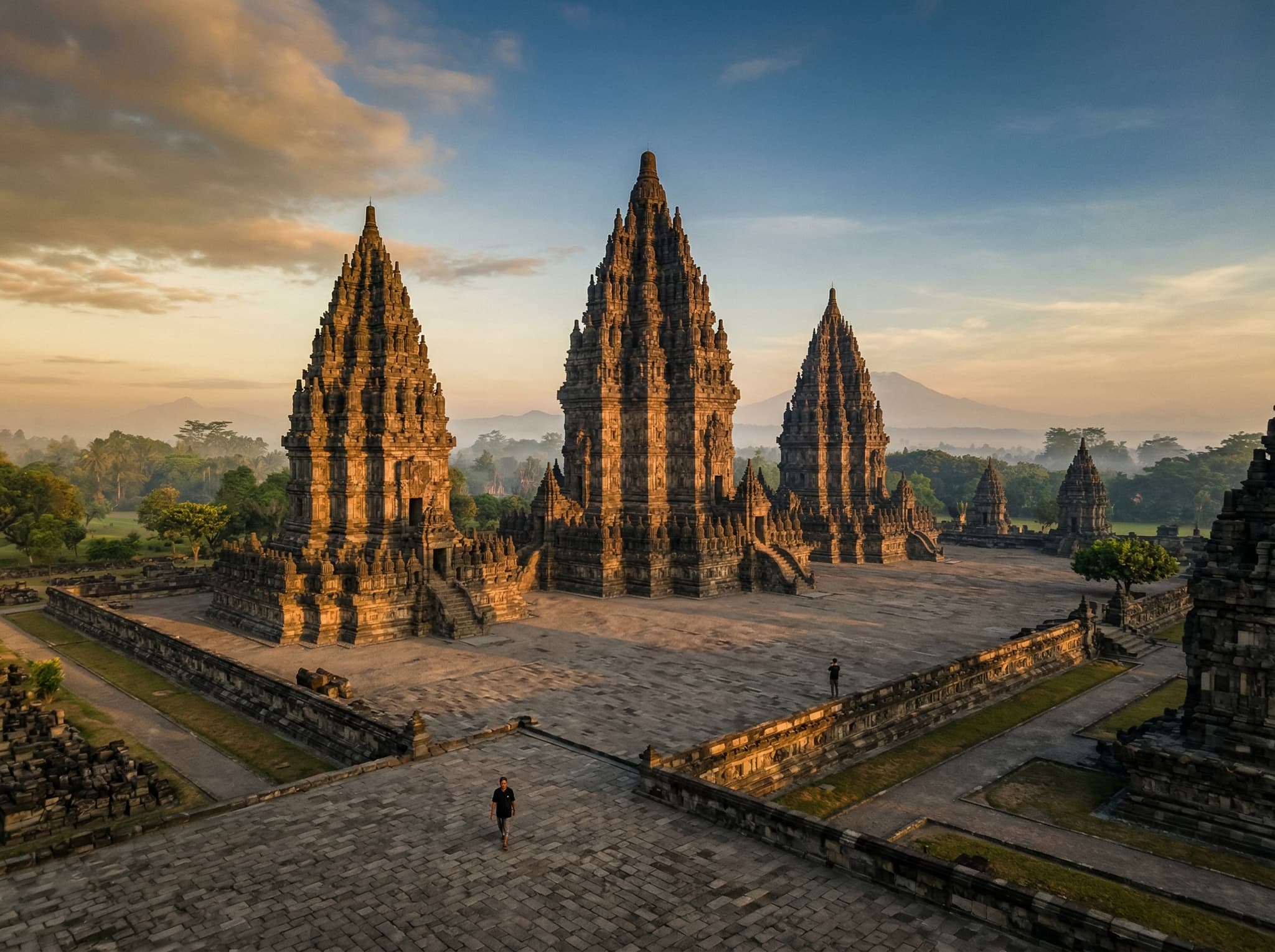
Prambanan was largely abandoned within a century of its construction — likely due to a combination of volcanic eruptions, earthquakes, and the eastward shift of Javanese political power. The 2006 earthquake caused further structural damage, collapsing walls and scattering stonework that had survived a millennium.
What you see today is the result of ongoing restoration that began in the early 20th century under Dutch colonial archaeologists. The eight main temples have been substantially rebuilt. The 224 perwara temples have not — most remain as organized stone piles, which is actually one of the most striking things about the complex. You can see the reconstructed spires rising above fields of numbered blocks, each one a puzzle that restorers are still solving.
That tension — between what's been recovered and what hasn't — is what gives Prambanan its particular character. Borobudur feels complete, monumental, resolved. Prambanan feels like a place still emerging from the ground. Both are extraordinary. Together, they're one of the strongest reasons to spend time in Yogyakarta.