Once a year, an island of 4.3 million people — one of the most visited tourist destinations on Earth — goes completely dark and silent. Not as metaphor. Not as aspiration. As enforceable reality. No flights land or depart. No cars move on any road. No lights are visible from any building. The cosmology behind this practice traces to the Saka calendar, which dates to 78 AD. The enforcement mechanisms — village patrols, legal penalties, a fully shuttered international airport — are thoroughly modern. Together, they produce something without parallel anywhere in the world: a 24-hour mandatory stillness observed by millions.
This is Nyepi day in Bali, the Balinese Hindu New Year, and understanding what it actually means requires looking past the list of tourist restrictions that dominates most coverage online.
What Nyepi Is — and What It Isn't
Nyepi is not a celebration. It is an observance — a day of complete stillness rooted in the belief that 24 hours of enforced silence will trick the bhuta kala, malevolent spirits, into believing Bali is uninhabited so they pass over the island and leave it cleansed for the new year.
The name comes from the word sepi — quiet, or empty. The practice follows the Saka lunar calendar, a Hindu calendrical system dating to 78 AD that governs much of Balinese religious life. Because it is lunar, the date shifts each year, typically landing in March or April.
But the spiritual logic runs deeper than demon-tricking. Balinese Hindu philosophy frames Nyepi as a day of alignment between the bhuana alit (the individual, the microcosm) and the bhuana agung (the universe, the macrocosm). The silence is not deprivation. It is discipline — a collective act of introspection, fasting, and meditation meant to reset the relationship between self and cosmos at the turn of the year.
This distinction matters because Bali is approximately 87% Hindu within Indonesia's overwhelmingly Muslim majority. Nyepi is a distinctly Balinese expression, not a national Indonesian holiday. It reflects a religious and cultural identity that the island has maintained for centuries, and the seriousness with which it is observed — down to closing the airport and patrolling every road — is itself a statement about what Bali considers non-negotiable.
The four restraints that govern the day are called the Catur Brata Penyepian: no fire, no work, no travel, no entertainment. They are not symbolic guidelines. They are the operational framework for shutting down an entire island, and they apply to every person on it.
The Arc of Nyepi: Purification, Spectacle, Silence, Renewal
Nyepi is often described as a single day, but it is better understood as the climax of a multi-day cosmological sequence — a narrative arc with four distinct movements. Purification ceremonies begin days before. A night of spectacle and noise immediately precedes the silence. The silence itself lasts 24 hours. And the morning after brings renewal, forgiveness, and the return of fire.
Each phase exists in relationship to the others. The silence means more because of the chaos that came before it. The renewal means more because of the stillness it follows.
Melasti: The Purification Before the Silence
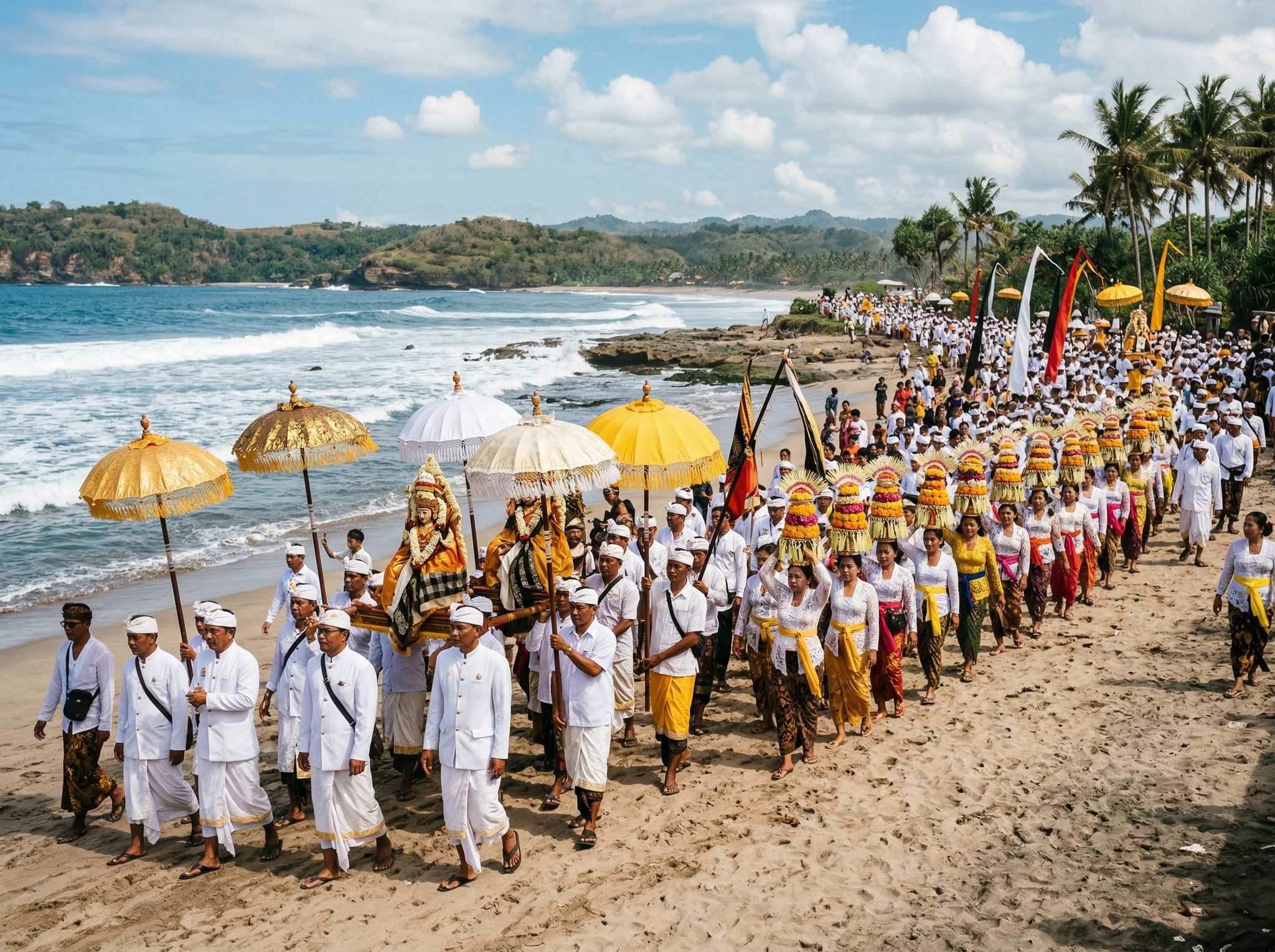
Three to four days before Nyepi, communities across Bali carry sacred objects from their temples to the sea. This is Melasti — also called Mekiis — a purification ritual in which both people and the physical instruments of worship are cleansed of accumulated impurity before the new year begins.
The processions are large and deeply communal. Entire villages walk in ceremonial dress, carrying temple artifacts — pratima (sacred effigies), barong masks, offerings — to beaches or sacred springs where priests perform the ritual cleansing.
For travelers, Melasti is the most accessible part of the Nyepi sequence. The processions move through public streets and along public beaches. Respectful observation from a distance is welcomed. This is a chance to witness Balinese communal religious life at its most visible — the color, the music, the sheer number of people moving together with shared purpose.
Ogoh-Ogoh: The Night Before Everything Stops
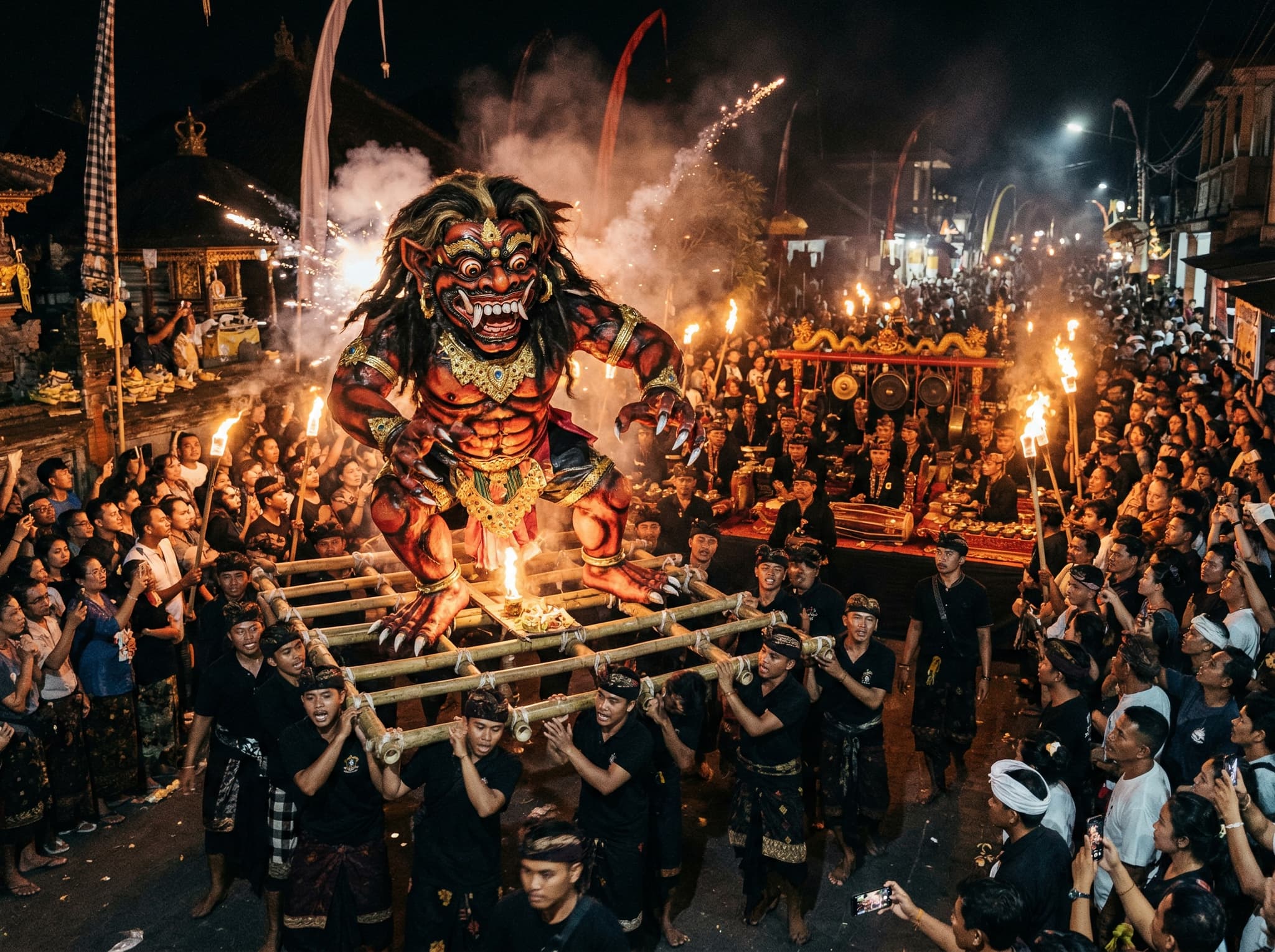
The evening before Nyepi is the loudest night of the Balinese year.
Communities parade massive papier-mâché effigies — ogoh-ogoh — through the streets. These are towering demonic figures, often three meters tall or more, built over weeks by banjar (village neighborhood associations) and carried on bamboo platforms by dozens of young men. They represent the bhuta kala, the malevolent spirits that Nyepi aims to banish.
The atmosphere is everything the next day will not be: booming gamelan drums, firecrackers, torchlight, shouting crowds, controlled chaos. At major intersections, the effigies are spun violently on their platforms — a deliberate act meant to disorient the demons. By the end of the night, the ogoh-ogoh are burned. The symbolic logic is precise: draw the evil spirits out with noise and spectacle, destroy their physical forms, then go silent so any that remain find nothing to attach to.
Ogoh-Ogoh Parade Viewing
Denpasar
Puputan Square and Patung Catur Muka intersection — largest, most elaborate processions
Ubud
Near Ubud Palace — known for artistic quality and craftsmanship
Kuta
Competitive village displays, large crowds
Seminyak and Canggu
Significant parades in both areas
Sanur
Popular and accessible viewing
Timing
Parades begin at dusk and run several hours
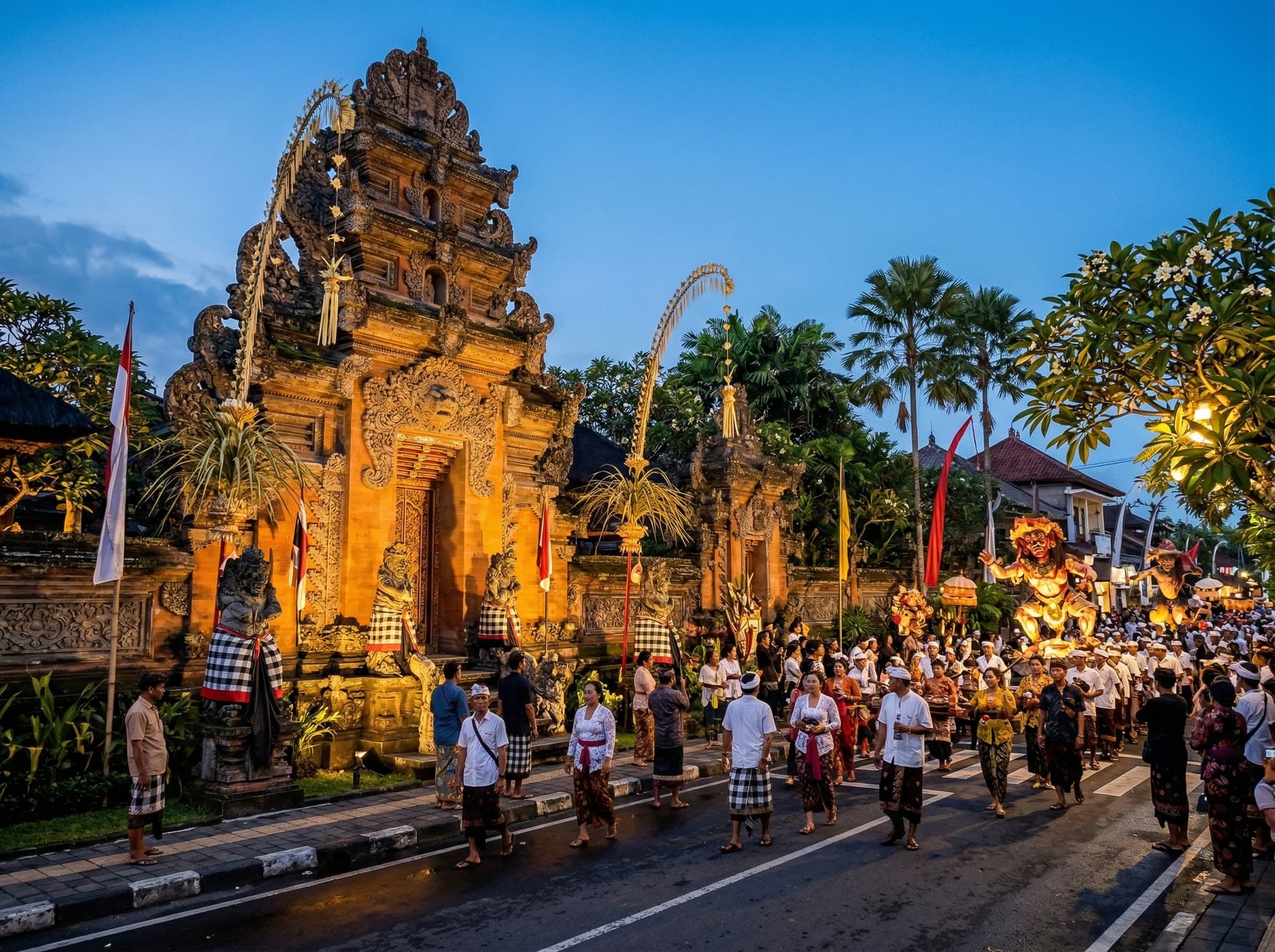
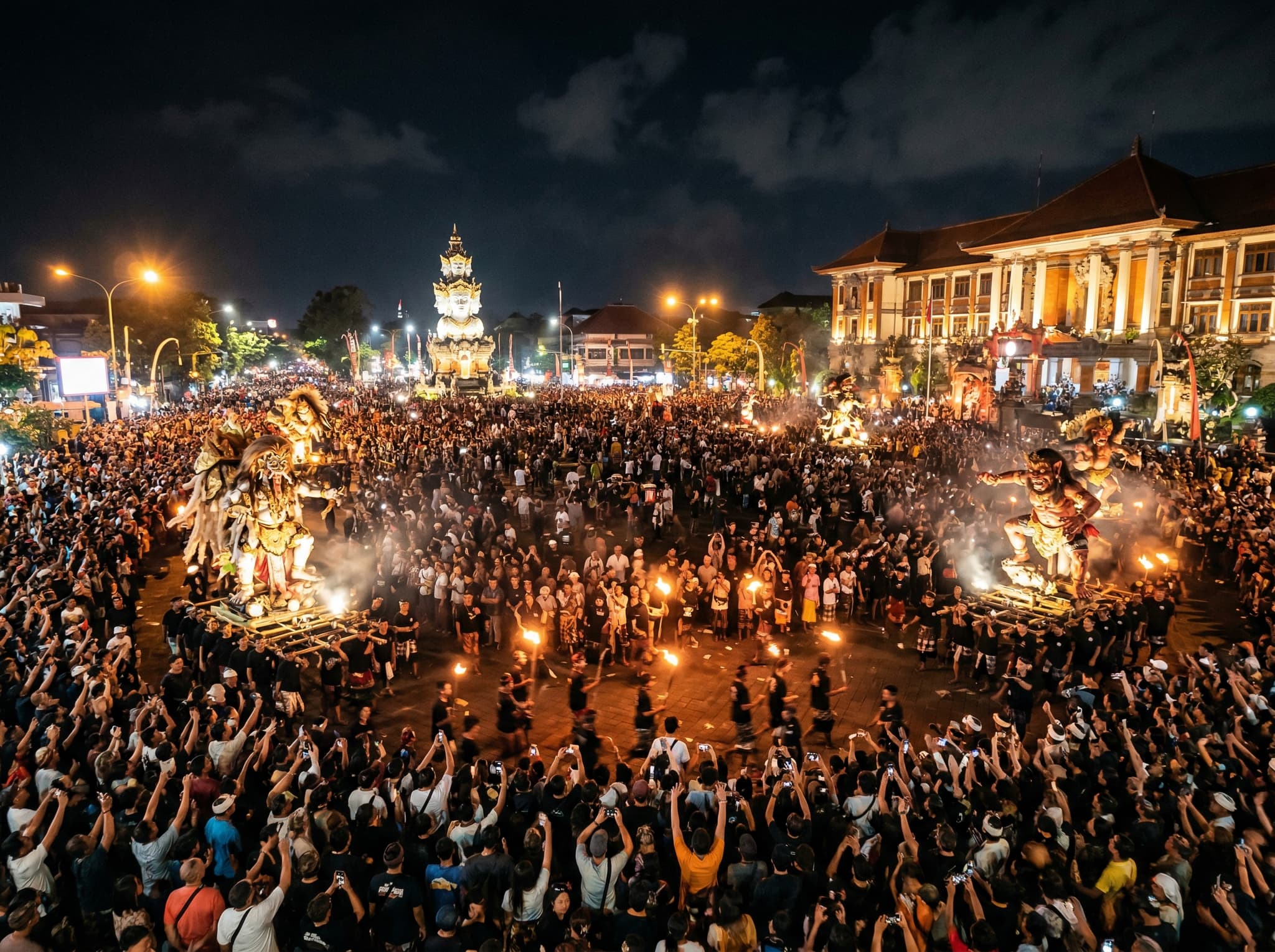
The Denpasar parades — particularly around Puputan Square and the Patung Catur Muka statue — are the largest on the island. Ubud's are often considered the most artistically accomplished. But every banjar in Bali builds its own ogoh-ogoh, and some of the most striking are in neighborhoods that no tourist guide mentions. The parade is not a performance staged for visitors. It is a village-level religious act that happens to be spectacular.
The Silence: What Happens During Nyepi
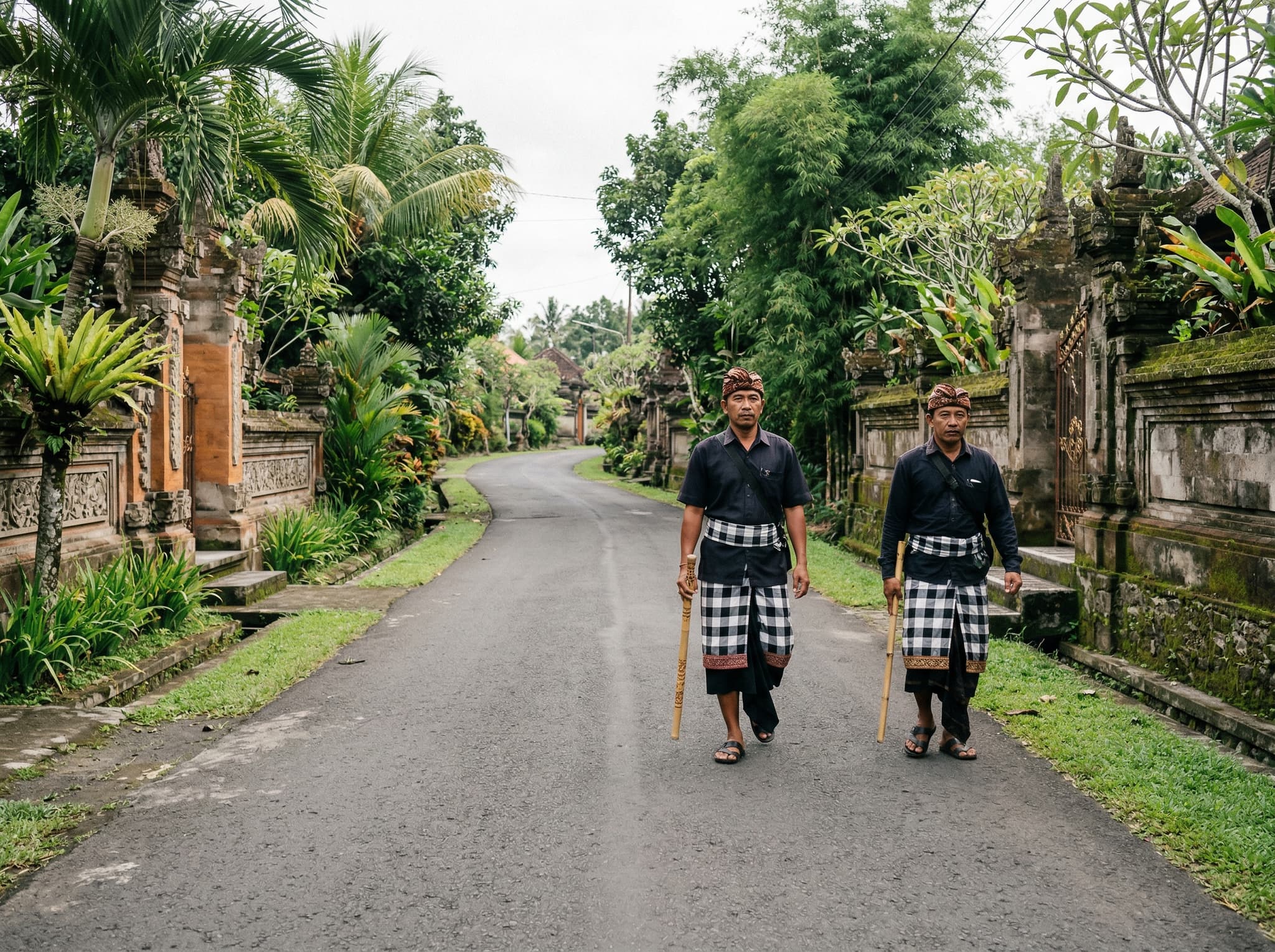
At approximately 6:00 AM on Nyepi morning, the island stops.
The Catur Brata Penyepian — the four restraints — take effect simultaneously and remain in force for a full 24 hours, until 6:00 AM the following morning. These are not suggestions. They are enforced by Pecalang, traditional village security officers who patrol every road, beach, and public space on the island. Violations carry legal penalties and are taken seriously by both village authorities and local law enforcement.
The four restraints:
Amati Geni — No fire, no light. No cooking, no open flames, no outdoor lighting of any kind. After sunset, curtains must be drawn. Only dim indoor light is permitted — enough to move safely through a room, not enough to be visible from outside.
Amati Karya — No work. Every business, shop, restaurant, market, and service on the island closes. No deliveries, no tours, no commerce of any kind.
Amati Lelungan — No travel. No vehicles move — no cars, no motorbikes, no bicycles. No walking outside. Roads, beaches, sidewalks, and all outdoor spaces are closed and patrolled.
Amati Lelanguan — No entertainment. No music, no television at audible volume, no loud conversation, no indulgence. The day is meant for meditation, fasting, and quiet introspection.
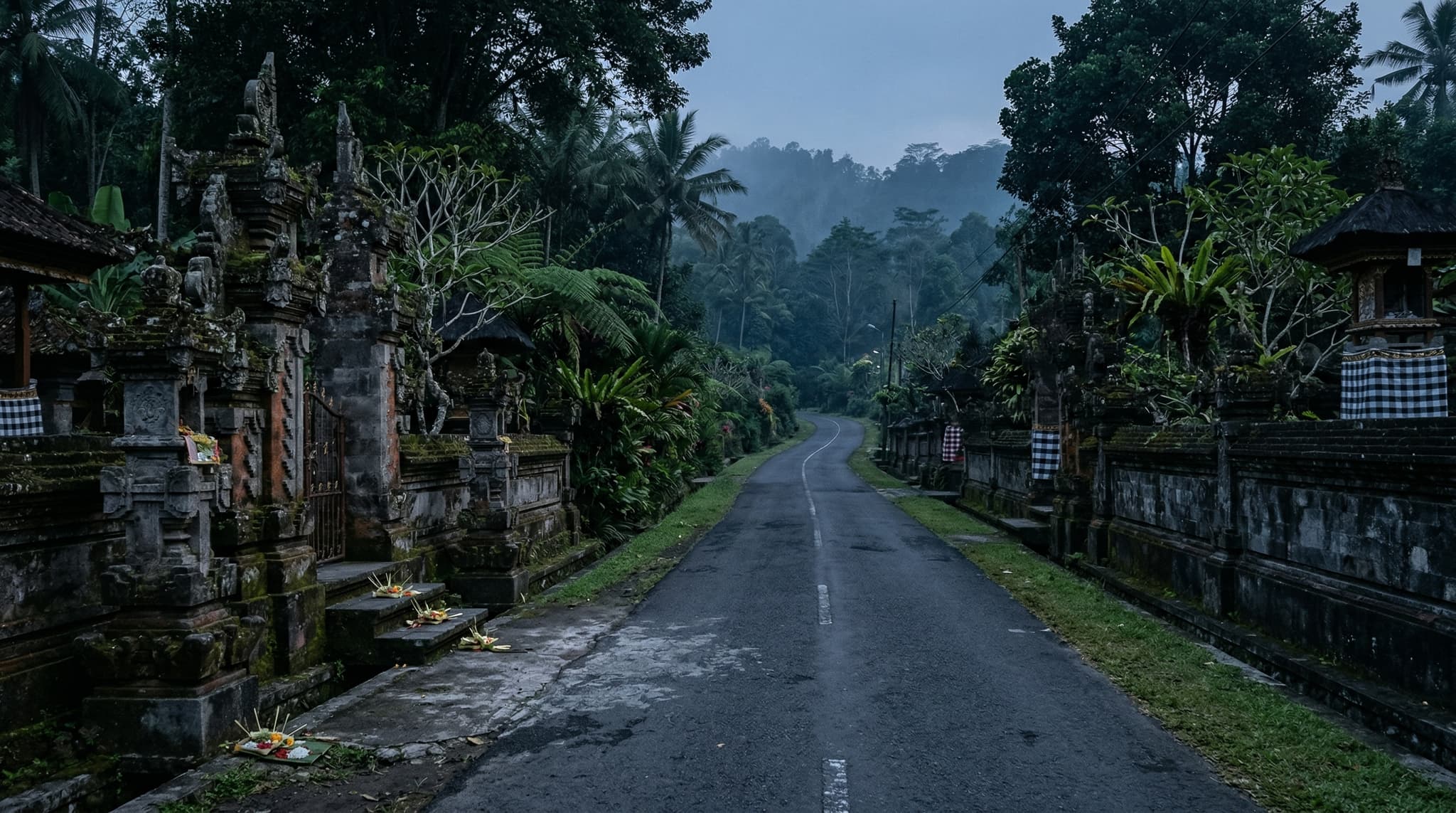
The result is unlike anything else in the modern world. An island of millions in total darkness. No artificial light visible from the air. No engine noise, no music, no human movement on any street. The silence is not partial or symbolic — the airport's 100% compliance record across every year of implementation reflects the seriousness of the commitment, and enforcement on the ground is equally rigorous.
For Balinese Hindus, this is the spiritual center of the new year: a day of tapa brata, of self-discipline and inner reflection. The silence is not endured. It is practiced.
Ngembak Geni: The Morning After
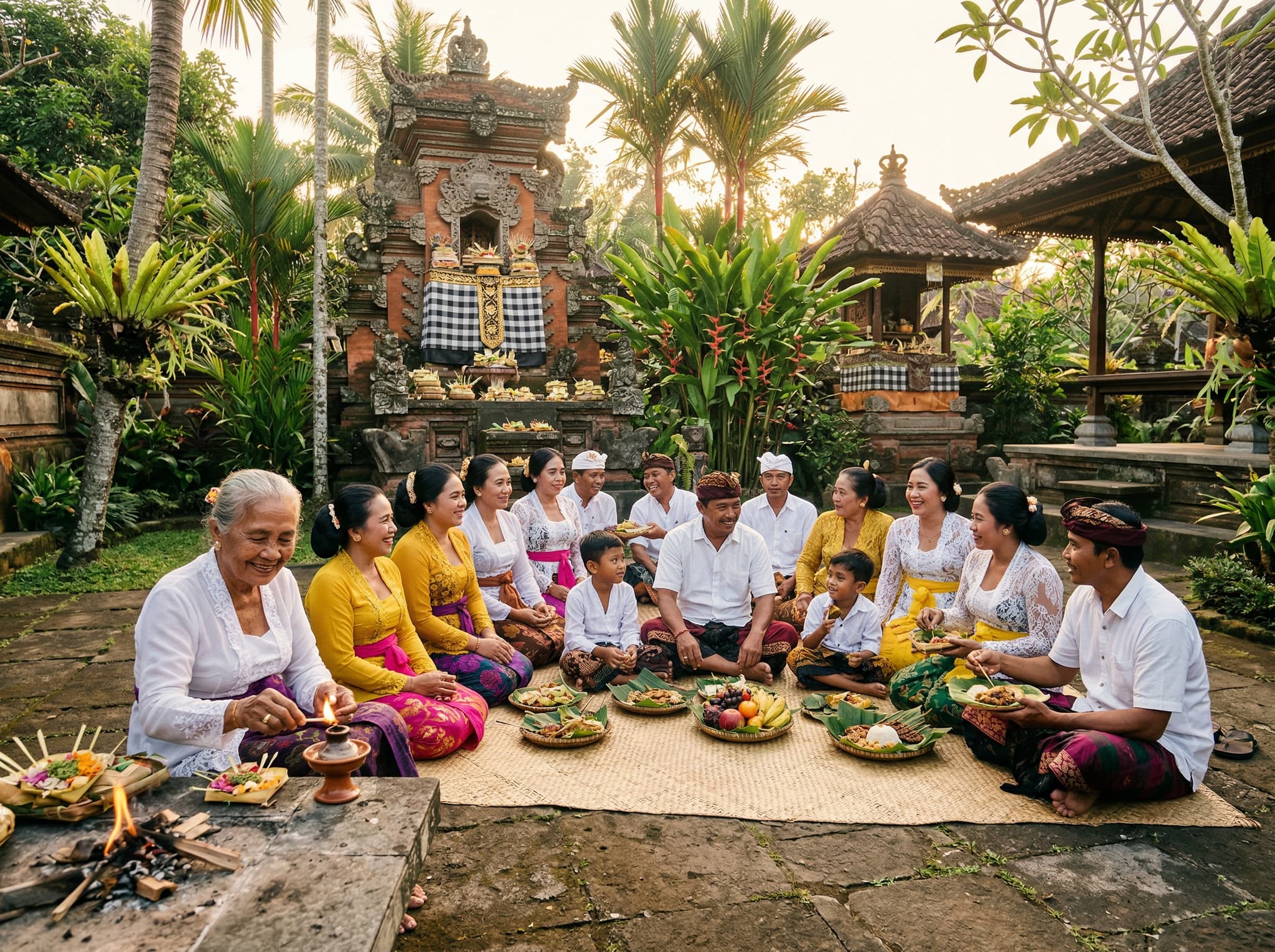
At 6:00 AM the morning after Nyepi, the Catur Brata lift. The first fires are lit. The first sounds return.
This is Ngembak Geni — literally, "lighting the fire." Families visit one another. Forgiveness is asked and given. Meals are shared. The communal life of the island reassembles itself in a matter of hours.
The contrast is the point. Balinese cosmology does not treat silence and activity as opposites to be balanced — it treats them as a sequence. The stillness makes the return of life feel earned. The darkness makes the first light of the new year feel significant.
Ngembak Geni: Post-Nyepi Timeline
Restrictions lift
6:00 AM
Domestic flights resume
7:00 AM
International flights resume
8:15 AM
The island returns to normal operations quickly. But for those who observed the silence — whether as Balinese Hindus in prayer or as travelers sitting quietly in a hotel room — the emotional residue of 24 hours without noise, light, or movement does not dissipate as fast as the restrictions do.
What Travelers Need to Know
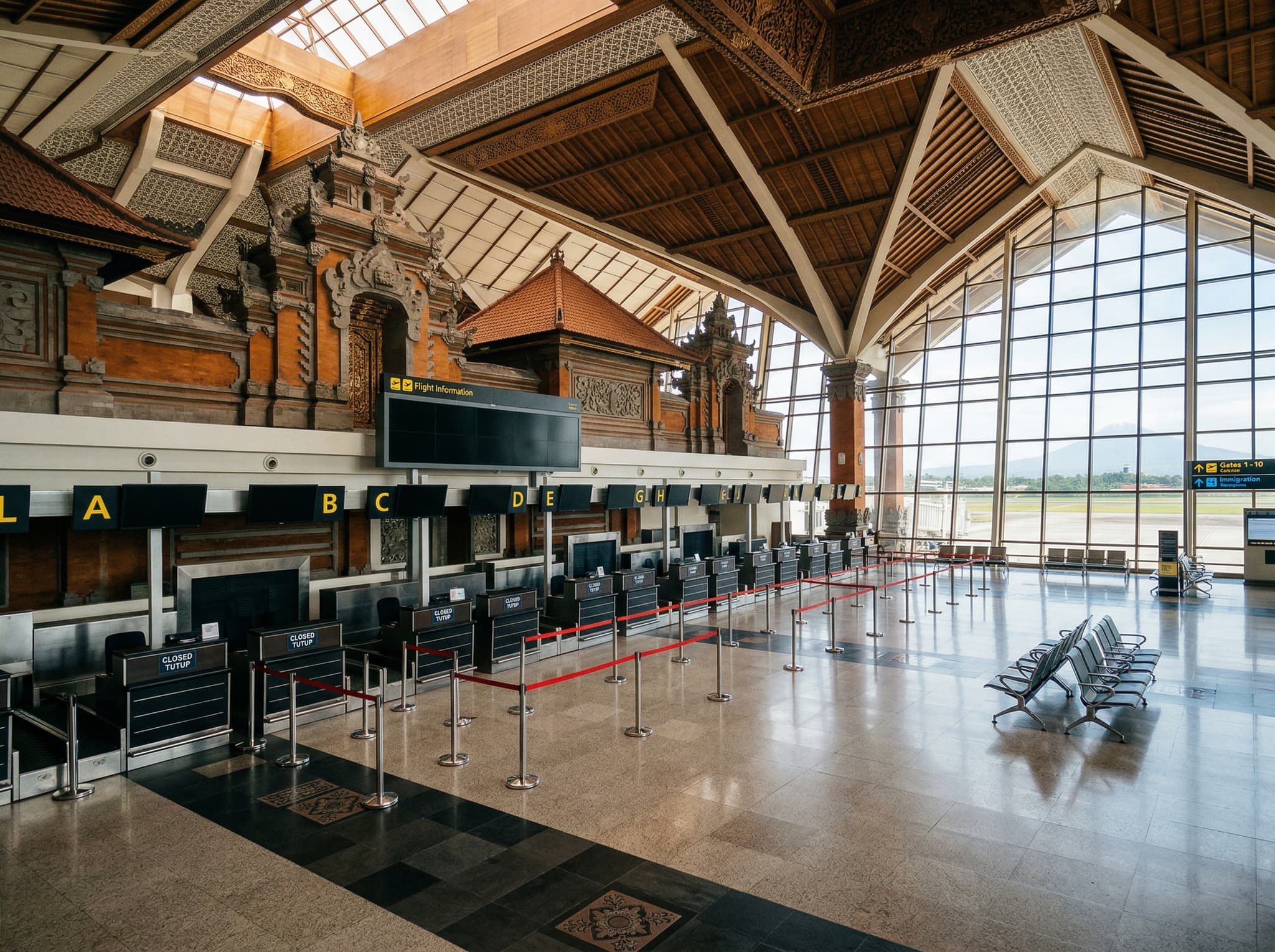
The practical implications of Nyepi are significant and non-negotiable. This section covers what matters for trip planning.
Confinement
All travelers must remain inside their accommodation for the full 24-hour period. This is mandatory and enforced by Pecalang patrols. There are no exceptions for tourists, foreign nationals, or non-Hindus. Stepping outside — onto a street, a beach, or even a hotel's outdoor grounds beyond designated areas — risks enforcement action.
Airport Closure
Ngurah Rai International Airport closes completely during Nyepi. No commercial flight has ever been granted an exception — the compliance record is 100% across every year of implementation.
2026 Airport Closure Details
Closure window
6:00 AM March 19 to 6:00 AM March 20
Flights affected
Approximately 440 (231 domestic, 209 international)
Passengers affected
Approximately 40,000
Aircraft parked overnight
19
Last domestic departure
March 18, 11:10 PM
Last international departure
March 19, 1:30 AM
Domestic resumption
March 20, 7:00 AM
International resumption
March 20, 8:15 AM
Major carriers — including Garuda Indonesia, Qantas, and Singapore Airlines — typically offer fee-free rebooking for passengers who provide at least 14 days' notice. Plan arrival and departure dates around Nyepi, not through it.
Hotel Operations
Hotels and resorts remain open but operate under significant restrictions. Front desk and emergency services stay operational throughout. Pools, restaurants, bars, and spas often close — some as early as 7:00 PM the evening before Nyepi.
Meal arrangements require advance planning. Some properties offer pre-ordered meal packages or limited room service during the 24-hour period. Confirm arrangements with the specific property well before arrival. Stocking snacks, water, and supplies the day before is standard practice.
Lighting and Noise
After sunset on Nyepi, curtains must be drawn in all rooms. No balcony lights, no outdoor lights, no light visible from outside the building. Minimal indoor lighting — enough to navigate safely — is permitted. Noise must be kept to a minimum at all times during the 24-hour period.
Communications
Temporary mobile data and internet restrictions are possible during Nyepi. This has been inconsistently applied in recent years, but travelers should not count on reliable connectivity. Download reading material, entertainment, and any essential information before the silence begins.
What to Do
Reading. Journaling. Meditation. Sleep. Quiet conversation at low volume. Some hotels offer children's activities such as crafts or storytelling — confirm availability with the property in advance. The day is an opportunity for genuine stillness in a world that rarely offers it, but only for those who prepare for it rather than being caught off guard.
Date Planning

The Nyepi date shifts every year with the Saka lunar calendar. In 2025, Nyepi fell on March 29. In 2026, it fell on March 19. There is no fixed pattern — the date must be verified against the current Saka calendar before booking any travel to Bali in March or April.
Nyepi is the only day of the year when Bali belongs entirely to itself. No commerce. No tourism. No engine noise or flight paths or restaurant chatter. The island that gives so much of itself to the world — its beaches, its temples, its ceremonies, its hospitality — takes 24 hours to turn inward. The cosmology behind it is ancient. The commitment to enforcing it is contemporary and unwavering. Whether a traveler experiences Nyepi as an inconvenience or as something more meaningful depends entirely on whether they understand what they are inside of — not a shutdown, but a sacred pause that an entire island has chosen to protect.