Ubud Palace (Puri Saren Agung): The Royal Heart of Bali's Cultural Capital
Ubud Palace is the historic seat of Bali's Sukawati dynasty — a free-entry courtyard by day and the best traditional dance venue in Ubud by night.
Ubud Palace — known locally as Puri Saren Agung — sits at the intersection of Jalan Raya Ubud and Jalan Suweta, which is both a geographic fact and a symbolic one. This is the center of Ubud in every sense: the crossroads where the town's royal history, its artistic identity, and its modern tourism economy all converge. If you spend any time in Ubud, you'll walk past it repeatedly. The question is whether you'll walk into it — and what you'll understand when you do.
A Palace Built on Patronage
Puri Saren Agung was established in the early 1800s as the seat of Ubud's royal family, the Sukawati dynasty. But the palace's significance extends well beyond political power. In the early twentieth century, the ruling lord Tjokorda Gede Agung Sukawati began inviting foreign artists — most notably the German painter Walter Spies and the Dutch artist Rudolf Bonnet — to live and work in Ubud. That decision, more than any single building or decree, is why Ubud became Bali's cultural capital.
Spies and Bonnet didn't just paint here. They collaborated with Balinese artists, helped establish the Pita Maha cooperative in 1936, and fundamentally shaped how Balinese art was perceived internationally. The palace was the hub of all of it. The royal family provided patronage, space, and legitimacy. In return, Ubud became synonymous with art, dance, and ceremony — a reputation it trades on to this day.
Understanding this context changes how you see the palace. It's not a grand architectural monument in the way that, say, the kraton in Yogyakarta is. It's a compound — a series of courtyards, gates, and pavilions that reflect Balinese spatial philosophy more than imperial ambition.
What You'll Actually See
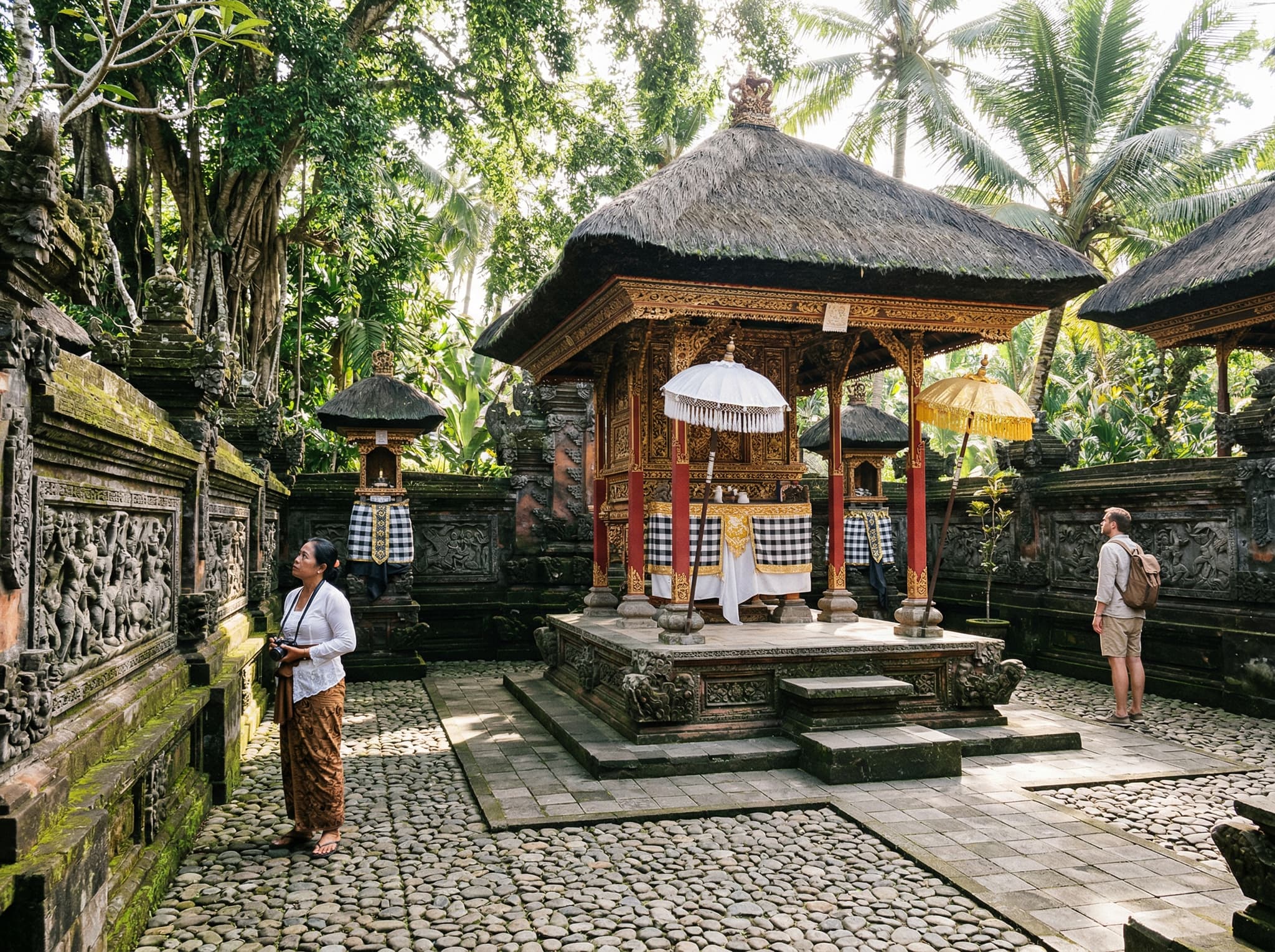
The palace is partially open to visitors during the day. You can enter the front courtyard without a ticket, which makes it one of the few genuinely free attractions in central Ubud. What you'll find is a compact space defined by kori agung (ornate split gates), stone carvings darkened by moss and age, and several open-air pavilions with intricate woodwork.
Visiting Details
Daytime Hours
Approximately 8:00 AM – 6:00 PM
Inner Compound
Closed to public (royal family residence)
Photography
Permitted in open courtyards
Dress Code
Modest clothing; sarong recommended
The inner compound remains the private residence of the Sukawati family, so you won't see the full extent of the palace. What's accessible is relatively small — first-time visitors sometimes express surprise at the scale. But the craftsmanship rewards close attention. The stone carvings around the main gates are some of the finest in Ubud, depicting scenes from Hindu epics and guarded by elaborately carved demon figures. The gardens, while modest, are well maintained and offer a pocket of calm just meters from the busiest street in town.
The Evening Performances

For many visitors, the main reason to come to Puri Saren Agung isn't the architecture — it's the nightly traditional dance performances held in the main courtyard. These typically begin at 7:30 PM and run about an hour.
Dance Performances
Schedule
Nightly, approximately 7:30 PM
Ticket Price
IDR 100,000 (~$6.50)
Ticket Purchase
At the gate from late afternoon, or through local vendors
Common Performances
Legong, Barong, Ramayana Ballet
The most frequently performed styles include Legong (a refined court dance traditionally performed by young women), Barong (a dramatic narrative dance featuring Bali's iconic lion-like creature), and episodes from the Ramayana. The performers are typically members of local village dance troupes, and the quality is generally high — these aren't watered-down tourist shows so much as real community performances staged in a setting that happens to accommodate an audience.
The palace courtyard, lit by torches and framed by those carved stone gates, is arguably the best venue in Ubud for watching traditional dance. The setting adds a dimension that purpose-built stages can't replicate. Seats are first-come, first-served — arriving 20 to 30 minutes early secures a better position.
The Palace in Context
Puri Saren Agung works best not as a standalone destination but as the anchor of a walk through central Ubud. The Ubud Art Market (Pasar Seni Ubud) sits directly across the street — a dense, two-story maze of stalls selling textiles, carvings, and paintings that ranges from genuine craft to mass-produced souvenirs. A few hundred meters south along Jalan Raya Ubud, Pura Taman Saraswati (the Water Palace) offers a lotus-pond setting that's one of the most photographed scenes in Bali. And the Ubud Museum (Museum Puri Lukisan), a ten-minute walk west, houses a collection that traces the artistic revolution the palace helped catalyze — including works by artists from the Pita Maha era.
Together, these sites tell a coherent story: how a small royal court's investment in art and culture turned a Balinese hill town into an international destination. The palace is where that story starts.
Practical Notes
The palace is centrally located enough that most visitors staying in Ubud can reach it on foot. There's no dedicated parking — if you're arriving by scooter or car, use the public parking areas along Jalan Raya Ubud or near the market. The surrounding streets are Ubud's busiest, particularly between 10:00 AM and 4:00 PM, when traffic in central Ubud can slow to a crawl.
There's no strict dress code enforced for the daytime courtyards, but covering shoulders and knees is respectful and consistent with what's expected at Balinese temples and sacred sites generally. For evening performances, casual clothing is fine.