Batuan village sits between Denpasar and Ubud with a 1,000-year-old temple and Bali's darkest painting tradition. Here's what to see and how to visit.
Most visitors drive through Batuan without realizing it. The village sits directly on the main road between Denpasar and Ubud — Jl. Raya Batuan — and unless you're paying attention, it looks like another stretch of Gianyar Regency shopfronts. That's a mistake. Batuan is one of Bali's oldest artistic communities, home to a painting tradition that's been alive since the 1930s and a temple that predates most of what tourists line up for elsewhere on the island.
Here's what you need to know, and what's actually worth stopping for.
The Paintings: What Makes Batuan Different

Bali has several painting traditions, and they're not interchangeable. The Batuan style is the dark, dense, slightly unsettling one. Where Ubud-style paintings tend toward bright colors and pastoral scenes, Batuan paintings fill every square centimeter of canvas with overlapping figures, gloomy tones, and a kind of organized chaos that rewards close looking.
The subjects range from Hindu epics — Ramayana, Mahabharata — to daily village life, market scenes, agricultural rituals, and invisible spiritual forces rendered visible. The compositions are deliberately crowded. Demons share space with farmers. Ceremonial dancers overlap with mythological creatures. The effect is less "peaceful Balinese landscape" and more "the entire spiritual and material world crammed onto a single surface."
The style emerged in the 1920s and 1930s, when Western artists Walter Spies and Rudolf Bonnet arrived in the region and introduced canvas, ink, and modern paint to artists who had been working with natural pigments on wood and cloth. But the Batuan painters didn't simply adopt Western techniques — they absorbed them into something distinctly their own. The dense, action-packed compositions and dark palette are pure Batuan.
The tradition passes through teacher-pupil lineages, and several families in the village have been painting for generations. I Desak Putu Lambon, notably, broke gender barriers in the 1930s by painting legong dance performances — worth knowing because the art world here, like most art worlds, has historically been male-dominated.
Where to See the Art

Galleries and home studios line Jl. Raya Batuan. These aren't galleries in the white-wall, track-lighting sense — most are ground-floor rooms attached to family homes where painters work and sell directly. You can watch the four-step process (outlining, detailing, shading, finishing) if you visit during working hours, which is most of the day.
Prices vary enormously. Small pieces from younger artists start around IDR 200,000–500,000 ($12–$31). Larger, more detailed works from established painters run into the millions of rupiah. The quality gap is real — spend ten minutes looking before you buy, and you'll start to see which pieces have genuine density and craft versus which are produced quickly for tour-bus traffic.
Pura Puseh Batuan

This is where most visitors concentrate, and fairly so. Pura Puseh Batuan (also called Batuan Temple) dates to the Warmadewa Dynasty era — we're talking 11th century — and it's one of the more visually dense temple complexes in Bali. The stone carvings are intricate, layered, and share the same horror-vacui aesthetic as the paintings: every surface is covered.
The temple is an active place of worship, not a museum. During Balinese Hindu festivals and ceremonies, certain areas are restricted to worshippers. On a normal day, you're free to explore the courtyards.
Visiting Pura Puseh Batuan
Hours
8:00 AM – 6:00 PM daily
Entry
Donation-based (IDR 10,000–50,000 typical)
Dress code
Sarong, sash, and covered shoulders required
Payment
Cash only (IDR)
A note on pricing: sources conflict on whether entry is technically free with a voluntary donation or a fixed fee of IDR 30,000–50,000. In practice, you'll be asked for a contribution at the entrance, and a sarong and sash are provided with it. Bring small bills — IDR 50,000 notes are fine, but don't expect change from a IDR 100,000.
Dress code is non-negotiable. Sarong covering the knees, sash tied at the waist, shoulders covered. This applies to everyone regardless of gender, even if you're wearing long pants. No tank tops, no beachwear. Hats and sunglasses come off in prayer areas. These rules are codified under Bali Governor Regulation No. 28/2019, and enforcement has tightened with rising tourism. The temple provides sarongs and sashes at the entrance, so you don't need to bring your own — but wearing your own is a small gesture of respect that locals notice.
Getting There
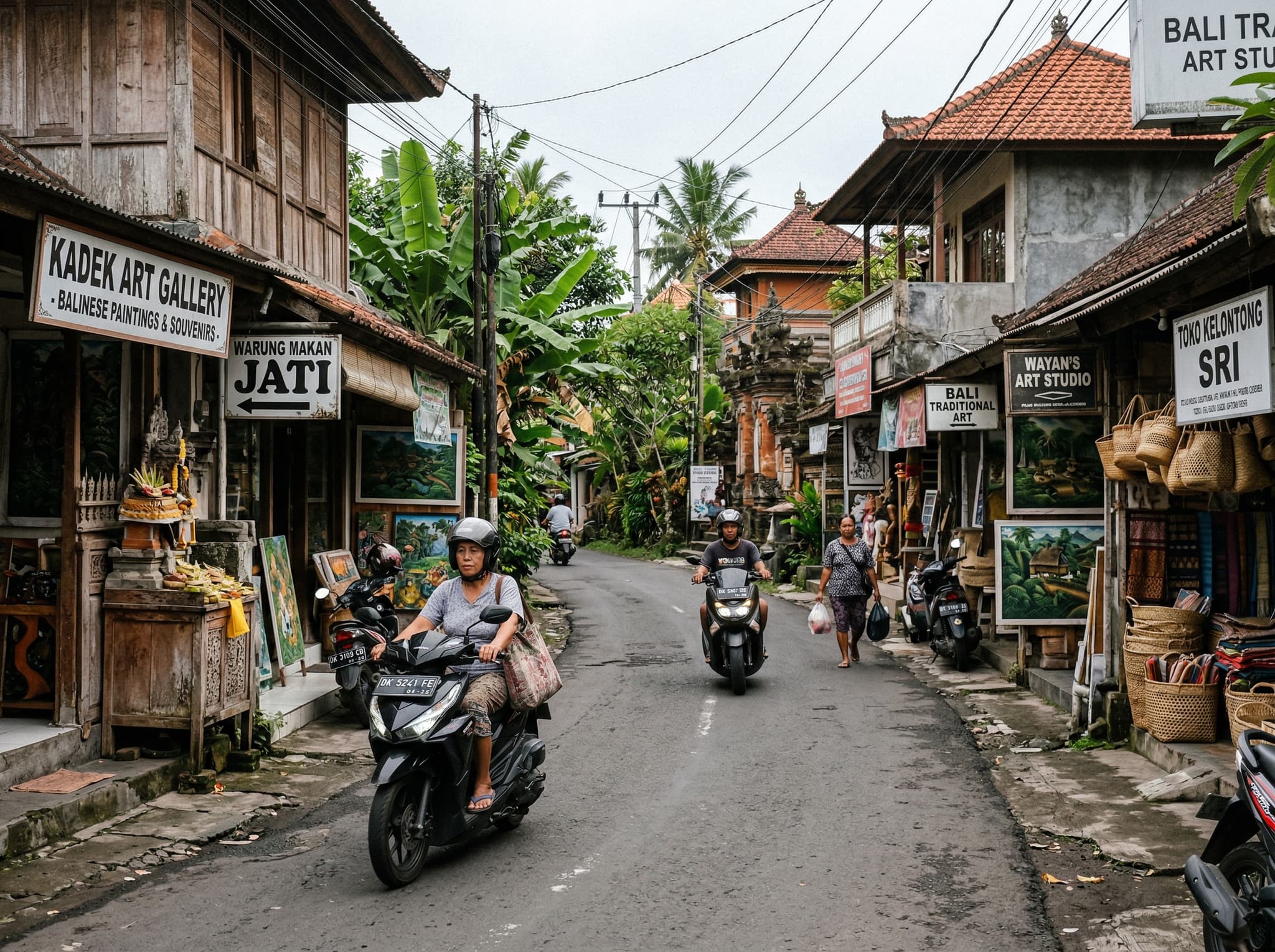
Batuan sits directly on the Denpasar–Ubud road, which makes it one of the easier cultural stops in Bali to reach without a complicated route.
Travel Times to Batuan
From Ubud
20–30 min (10 km south on Jl. Raya Ubud)
From Seminyak
~1 hour (24 km via Jl. Bypass Ngurah Rai)
From Kuta
~1.5 hours, traffic-dependent
Scooter is the fastest option from Ubud — straightforward road, no complex turns. Grab or Gojek work fine for a one-way trip; getting a ride back can take a few minutes since driver density is lower here than in Ubud center. Car with driver makes sense if you're combining Batuan with other stops along the corridor (Celuk for silver, Sukawati for the art market, Mas for woodcarving — they're all on the same road). A half-day car and driver from Ubud covering this route typically runs IDR 400,000–600,000 ($25–$37).
There's a public bemo (minibus) from Batubulan terminal, but the schedules are unreliable and the route is slow. I wouldn't recommend it unless you're specifically committed to local transit as an experience in itself.
How Long to Spend
Be honest with yourself about your interest level. If you're here primarily for the temple, 30–45 minutes is enough to walk the courtyards and take photos. If you want to visit a painting studio or two and browse the galleries along the main road, budget 1.5–2 hours.
Batuan doesn't have much in the way of restaurants or cafés geared toward tourists — facilities here are still in an early stage of development. Eat before you come or plan to eat after, back in Ubud or at one of the warungs along the road in Sukawati.
Is It Worth the Stop?
Yes, with the right expectations. Batuan isn't a full-day destination. It's a focused stop — a temple that's genuinely beautiful and less crowded than Tirta Empul or Tanah Lot, and a painting tradition you can see at the source rather than in a Ubud gallery with a markup.
The village works best as part of a half-day route south of Ubud, combined with one or two other stops. On its own, it's a short visit. But what you see here — the temple carvings, the paintings in progress, the density and darkness of the Batuan style — sticks with you in a way that another rice terrace selfie doesn't.
Most people drive through. You should stop.