A 1,000-year-old water temple where visitors can join Balinese purification rituals — if they know what to expect and when to arrive.
There's a moment at Tirta Empul that catches most visitors off guard. You've read about the purification ritual. You've seen the photos — people standing waist-deep in a pool, water arcing from stone spouts over bowed heads. But when you're actually standing in the spring, the water hitting your scalp is startlingly cold for the tropics, and the Balinese worshippers beside you are so focused, so clearly somewhere else entirely, that the Instagram impulse dies in your throat. For a few minutes, you're just present.
That's the thing about Tirta Empul. It's one of Bali's most visited temples and one of the most meaningful things to do in Bali — tour buses line the parking lot by 10 AM — and yet it still manages to be genuinely affecting if you approach it with some awareness of what you're walking into.
A Thousand Years of Sacred Water
Tirta Empul was founded in 926 AD during the Warmadewa dynasty, making it one of the oldest and most important temples on the island. The name translates simply: tirta means holy water, empul means spring. According to Balinese Hindu mythology, the god Indra created the spring by piercing the earth to produce amerta — the elixir of immortality — to revive his warriors after they were poisoned by the demon king Mayadanawa.
That origin story matters because it explains why this isn't just a temple you look at. Tirta Empul is a temple you use. The spring feeds a series of purification pools where Balinese Hindus have performed melukat — a water purification ritual — for over a millennium. The water is believed to have curative and spiritually cleansing properties, and the practice is woven into the rhythms of Balinese religious life in ways that go far beyond tourism.
The temple complex sits in a lush river valley near the village of Tampaksiring, about 30 minutes north of Ubud, making it one of the most rewarding day trips from Bali's cultural heartland. Above it, perched on the ridge, is the former presidential palace built by Sukarno in 1954 — a modernist pavilion that Indonesia's first president used as a retreat and, reportedly, as a place to impress visiting dignitaries with the view. You can glimpse it from the temple grounds, a reminder that Tirta Empul has been drawing powerful people for a very long time.
What You'll Actually See
The complex is divided into three courtyards, following the standard Balinese temple layout of nista mandala (outer), madya mandala (middle), and utama mandala (inner, most sacred).
Most visitors spend their time in the middle courtyard, which contains the two rectangular purification pools fed by the sacred spring. The pools are lined with 30 stone spouts — 13 in the first pool, 17 in the second — each with a specific name and spiritual purpose. Some are used for purification, others for specific blessings, and two are reserved exclusively for purifying the dead. (Balinese worshippers know which is which. If you're participating, follow the local lead and start at the leftmost spout of the first pool.)
Behind the pools, in the inner courtyard, the actual spring bubbles up from black volcanic sand in a crystal-clear pool. You can't enter this pool, but you can watch the water rising from the earth — a quietly mesmerizing sight that most visitors rush past on their way to the purification pools. Don't.
Temple Layout
Outer Courtyard
Entrance, ticket counter, sarong station
Middle Courtyard
Purification pools (2), changing areas
Inner Courtyard
Sacred spring source, main shrines (limited access)
Participating in the Purification Ritual

Non-Hindu visitors are welcome to participate in melukat, and many do. The temple provides sarongs at the entrance. You'll change into the sarong, enter the first pool, and move from left to right, pausing at each spout to let the water flow over your head. Most people press their palms together in prayer, bow their head under the stream, and move on. The whole process takes 15–20 minutes depending on how crowded the pools are.
A few things to know:
It's a religious ceremony, not a spa experience. The Balinese people in the pool with you may be there to mark a life transition, seek healing, or fulfill a spiritual obligation. Match their energy. Silence is appropriate. Selfies in the pool are not.
Bring a change of clothes. You'll be soaked. The temple has basic changing rooms, but they're small and often crowded. Wear a swimsuit under your clothes and bring a dry set in a bag.
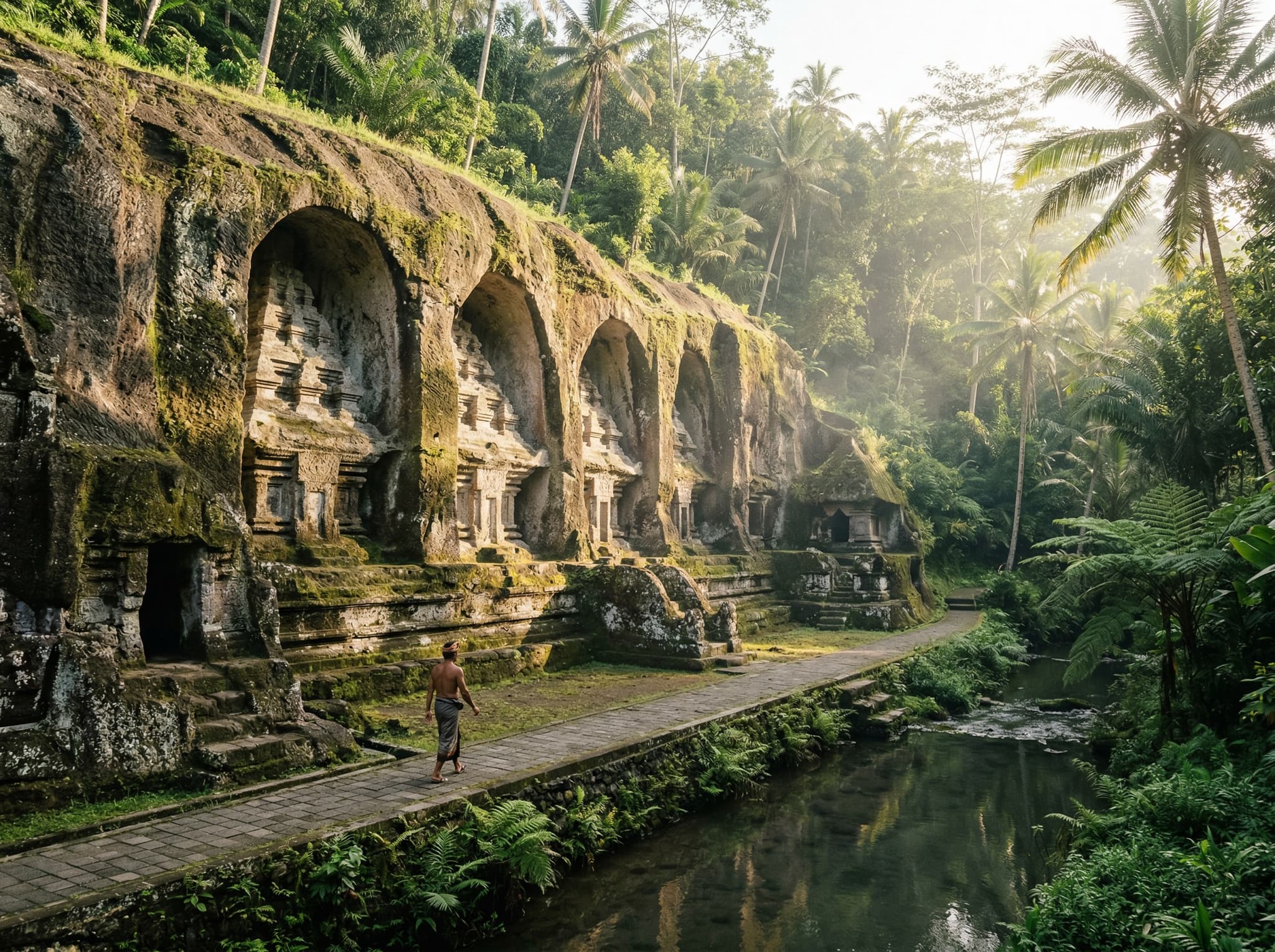
Go early. By 10:30 AM, the pools can have 20-minute waits at each spout. Arrive when the temple opens at 8 AM and you'll share the water with mostly Balinese worshippers — a fundamentally different experience than shuffling through with a tour group at midday.
The Honest Assessment
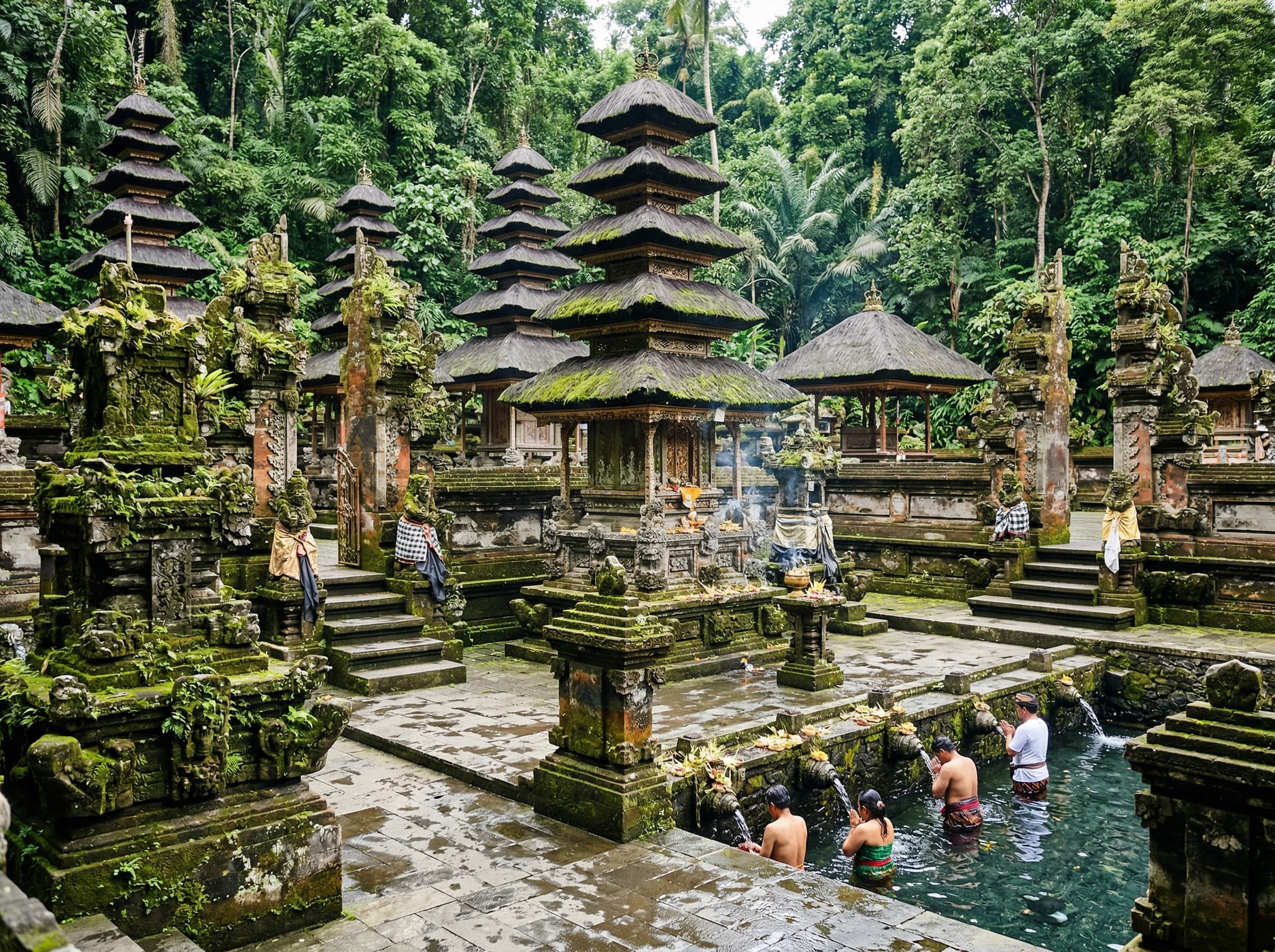
Tirta Empul is genuinely worth visiting — it's one of the few heavily touristed temples in Bali where the spiritual function hasn't been entirely overwhelmed by the foot traffic. The spring is real, the rituals are ongoing, and the architecture is beautiful in the restrained, mossy, deeply Balinese way that doesn't photograph as dramatically as it deserves.
But it is crowded. Midday visits during peak season (July–August) can feel more like queuing at a water park than participating in a sacred rite. The souvenir market you're funneled through on exit is aggressive. And the presence of the presidential palace above — occasionally used for government functions — means sections of the complex are sometimes closed without notice.
Come early. Come with some understanding of what the water means to the people who've been coming here for a thousand years. And when that cold spring water hits the top of your head, let yourself be surprised by it.