Celuk is Bali's centuries-old silver village, where artisan workshops line the main road and hands-on jewelry classes let you shape Sterling Silver yourself.
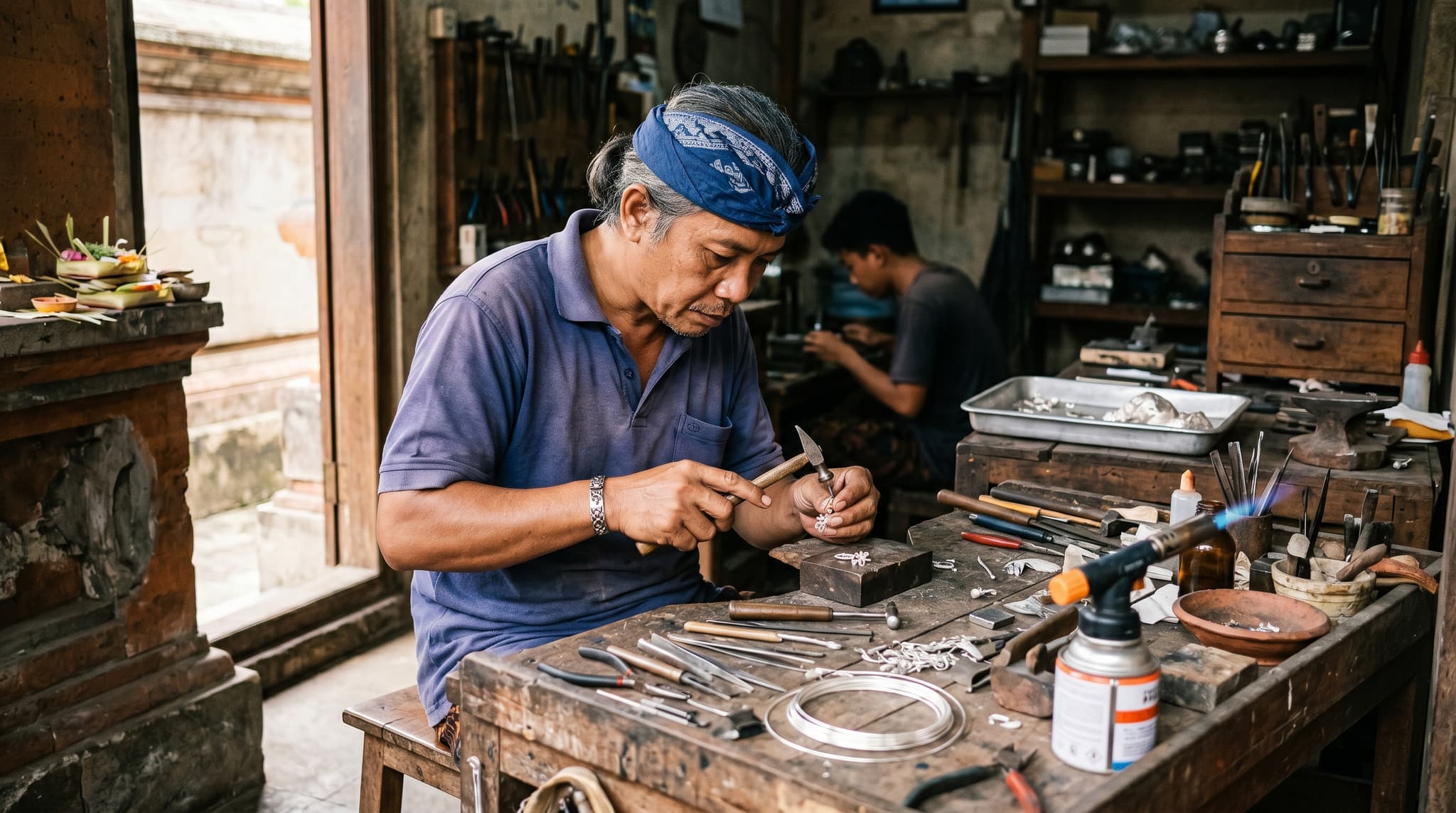
You hear Celuk before you understand it. From the road — Jalan Raya Celuk, a stretch of shopfronts and open workshops between Sukawati and Batubulan — the sound is a thin, persistent tapping. Not rhythmic like construction. Irregular, deliberate. It's the sound of a small hammer shaping silver wire against a steel block, and it carries through the open doors of nearly every building on the street.
This is what Celuk has been for decades. The village gained its reputation as Bali's silver center in the 1970s, when tourism turned what had been an agrarian community into an artisan one. But the craft goes back further than that. The Pande clan — a caste traditionally associated with metalwork — had been forging prayer accessories and ceremonial objects here long before anyone thought to sell a ring to a visitor. What changed wasn't the skill. It was the audience.
What the Village Looks Like Now
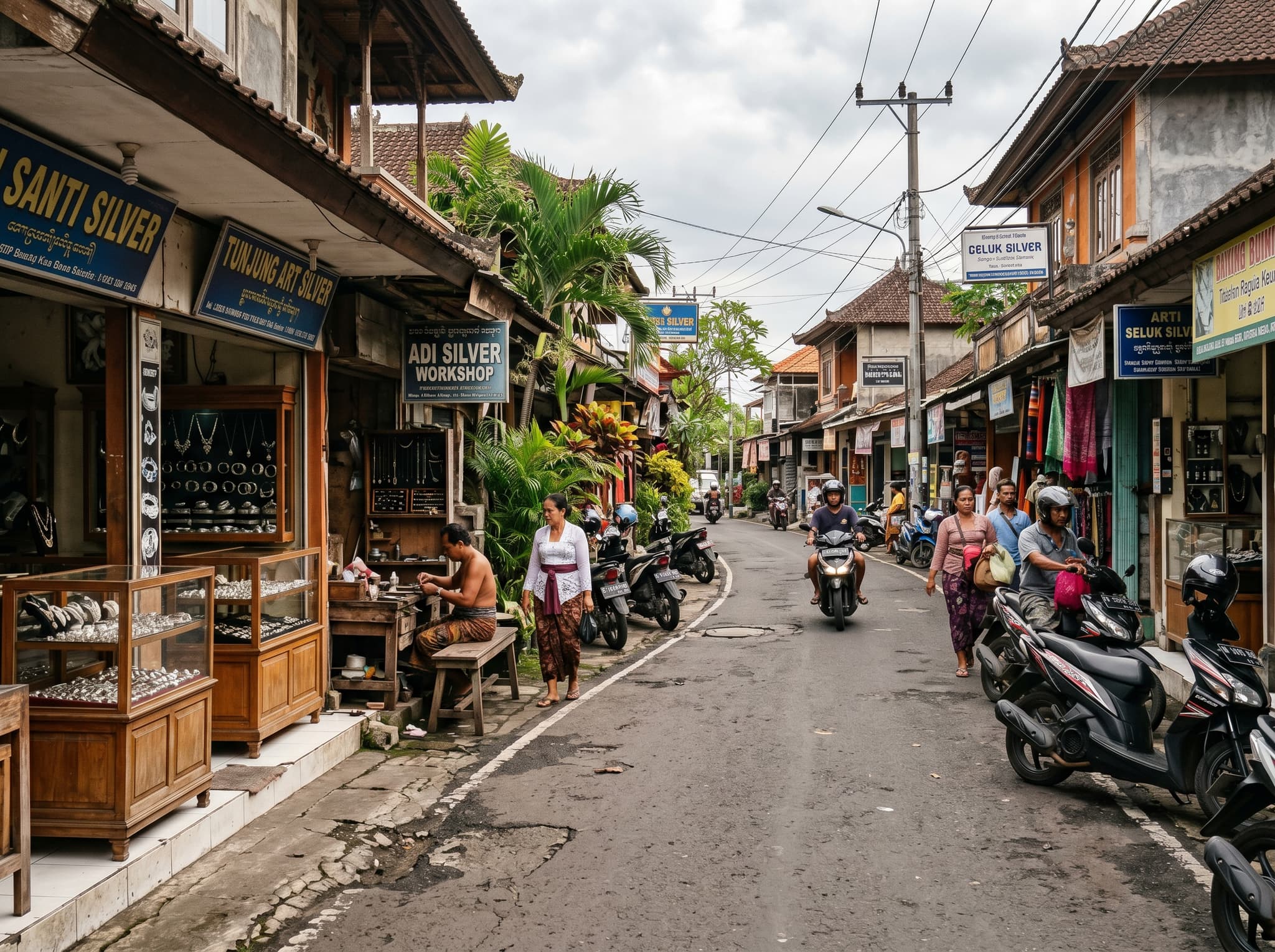
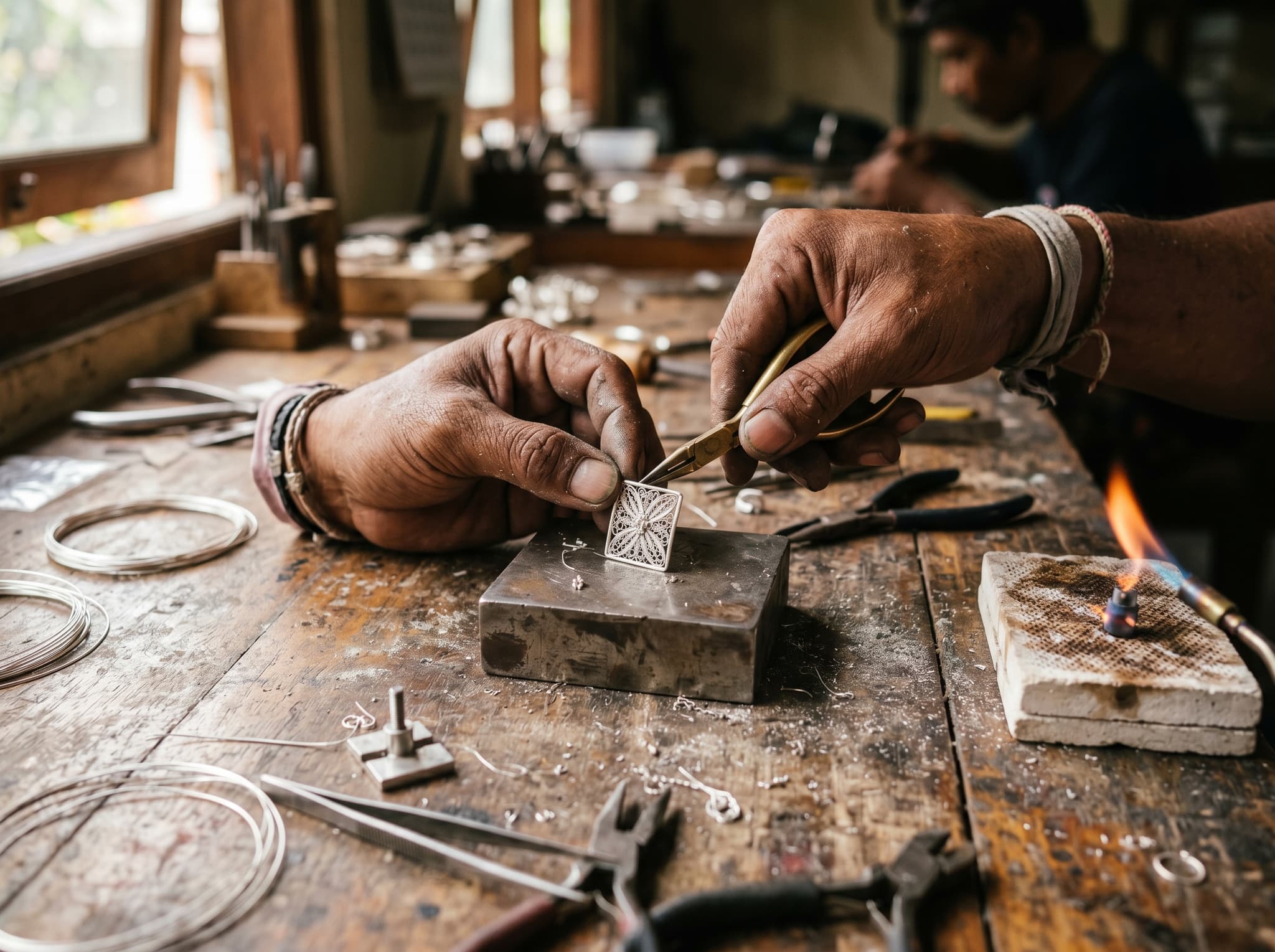
Celuk is not a museum or a curated experience. It's a working village stretched along a single main road, where the line between shop and workshop is often just a curtain or an open wall. In the front room: display cases of rings, bangles, earrings, brooches, and necklaces in silver and gold. In the back, or sometimes just a few steps behind the counter: a workbench, a gas torch, a tray of fine tools, and someone bent over a piece no larger than a thumbnail.
The work itself is quiet and small-scale. Artisans use traditional techniques — hand-drawing wire, soldering filigree, setting stones — with tools that haven't changed much in a generation. Children in some families still learn from watching, the way they always have. The pieces range from simple bands to intricate Balinese motifs: flowers, animals, repeating geometric patterns drawn from Hindu temple carvings.
What You Can Actually Do
Most visitors come to Celuk for one of two things: buying jewelry, or making it.
Buying is straightforward but requires attention. The shops along Jalan Raya Celuk range from small family operations to larger showrooms. Prices are often unmarked, and bargaining is expected — particularly in the smaller shops. Larger stores may have fixed prices and accept cards, but the smaller workshops deal almost exclusively in cash (Indonesian Rupiah). The quality varies. Tourist-facing shops near the road's entrance tend to stock mass-produced pieces alongside handmade work; the further you walk, the more likely you are to find artisans selling directly from their own benches.
Shopping Tips
Payment
Cash (IDR) preferred at smaller shops; some larger stores accept cards
Bargaining
Expected and accepted — start at roughly 50–60% of the asking price
Products
Rings, bangles, necklaces, earrings, brooches, hairpins; custom commissions available
Notable Workshops
Anom, Yani, and Asmana are frequently recommended by repeat visitors
Making your own piece is the more interesting option, and the one that justifies the trip for most independent travelers. Several workshops along the road offer hands-on silver jewelry-making classes. A typical session runs 1 to 3 hours. You work with Sterling Silver 925 — 92.5% silver, 7.5% copper — using 5 to 7 grams of material, guided step by step by a local silversmith. You design a ring or pendant, cut and shape the silver, solder it, polish it, and take it home.
Silver Class Details
Duration
1–3 hours
Price
From ~$31 USD (silver); from ~$47 USD (gold-plated option) [VERIFY — 2026 listing prices]
Includes
Materials, tools, instructor, drinks, WiFi; you keep your piece
Capacity
Up to 25 people; suitable for individuals, families, and kids
Booking
Walk-in or pre-book via Klook, GetYourGuide, or Tripadvisor
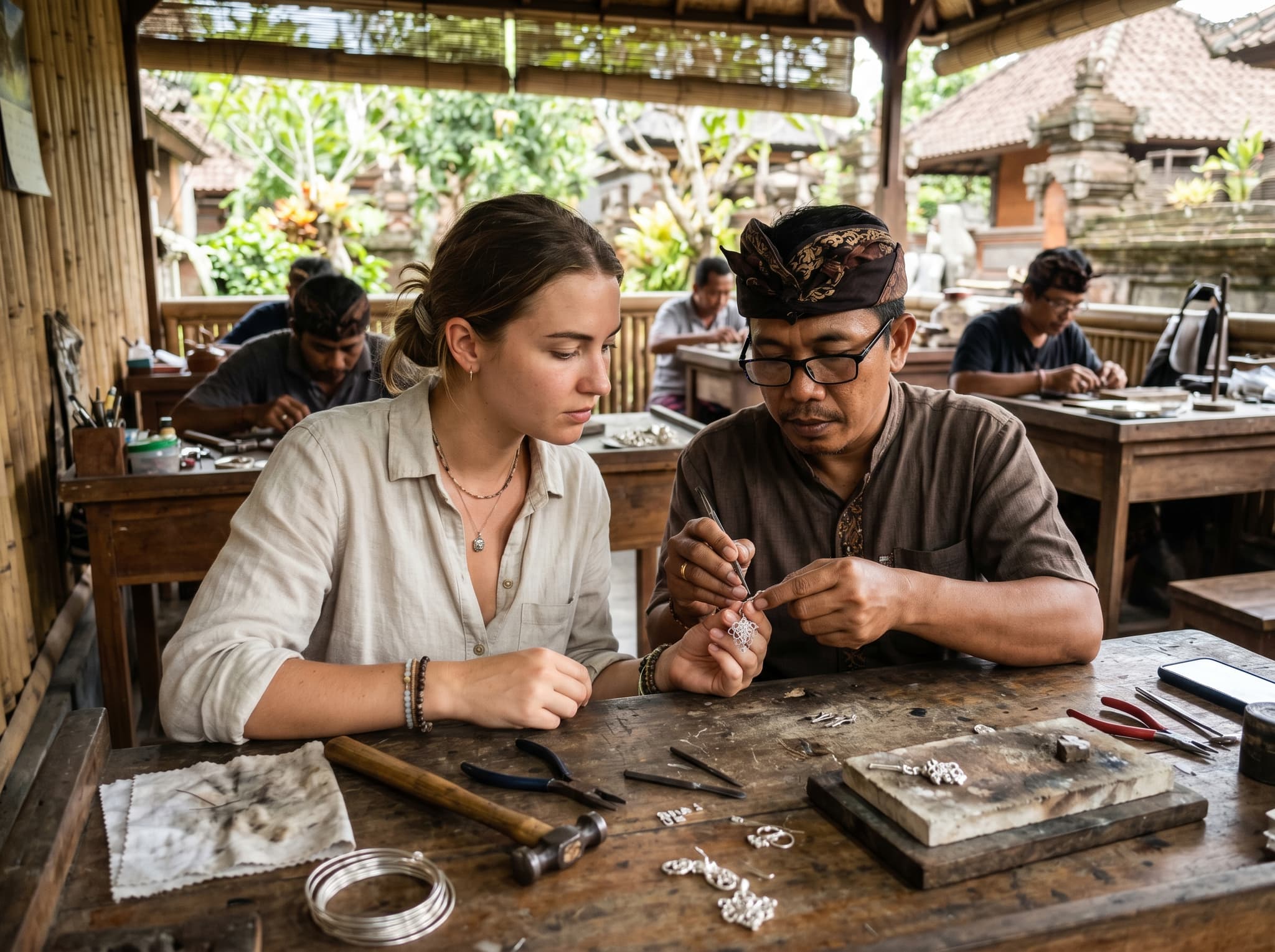
The classes are not difficult. They're designed for beginners, and the instructors do the precise work — the soldering, the tricky bends — when needed. But there's something clarifying about sitting at the same kind of bench, using the same kind of tools, that the person next to you has used every day for thirty years. It makes the price tags in the showrooms make more sense.
Getting There
Celuk sits on the main road between Denpasar and Ubud, which makes it easy to reach but also means traffic.
Transport from Key Areas
From Ubud
~14 km south, 20–30 min by car
From Kuta
~20 km, 50 min–1 hour
From Seminyak
~25 km, 1–1.5 hours
Private driver (Seminyak)
IDR 400,000–600,000 round-trip [VERIFY]
Ride-hail (Grab/Gojek)
IDR 300,000–500,000 one-way from Seminyak [VERIFY]
Bemos — Bali's colorful shared minibuses — run along the Kuta–Celuk and Ubud–Celuk routes, though schedules are unreliable. For most travelers, a Grab or a hired driver is the practical choice.
Eating Nearby
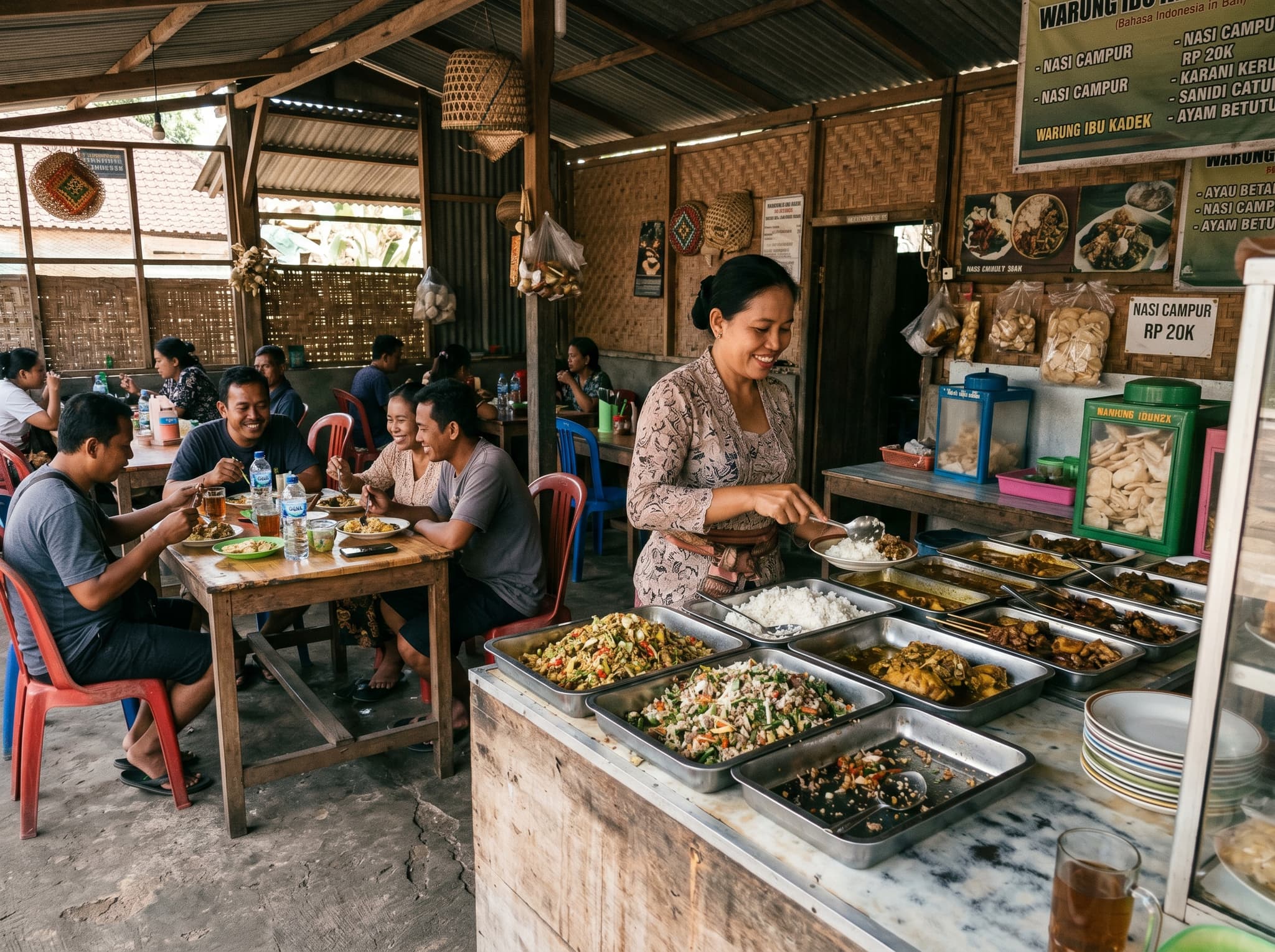
Celuk itself doesn't have much in the way of restaurants. Warung Lawar Plek Rengazzz, a short drive away, serves solid rice dishes with lawar — a traditional Balinese mix of minced meat, vegetables, and grated coconut. Pie Susu Dhian is the local stop for Bali's ubiquitous milk pies, worth grabbing a box as an edible souvenir.
The Honest Version
Celuk is not untouched. The main road is lined with shops that cater to tour buses, and some of the larger showrooms — Artika is frequently cited — charge prices that don't reflect the local market. The village has been absorbing tourism for fifty years, and parts of it show the wear of that arrangement.
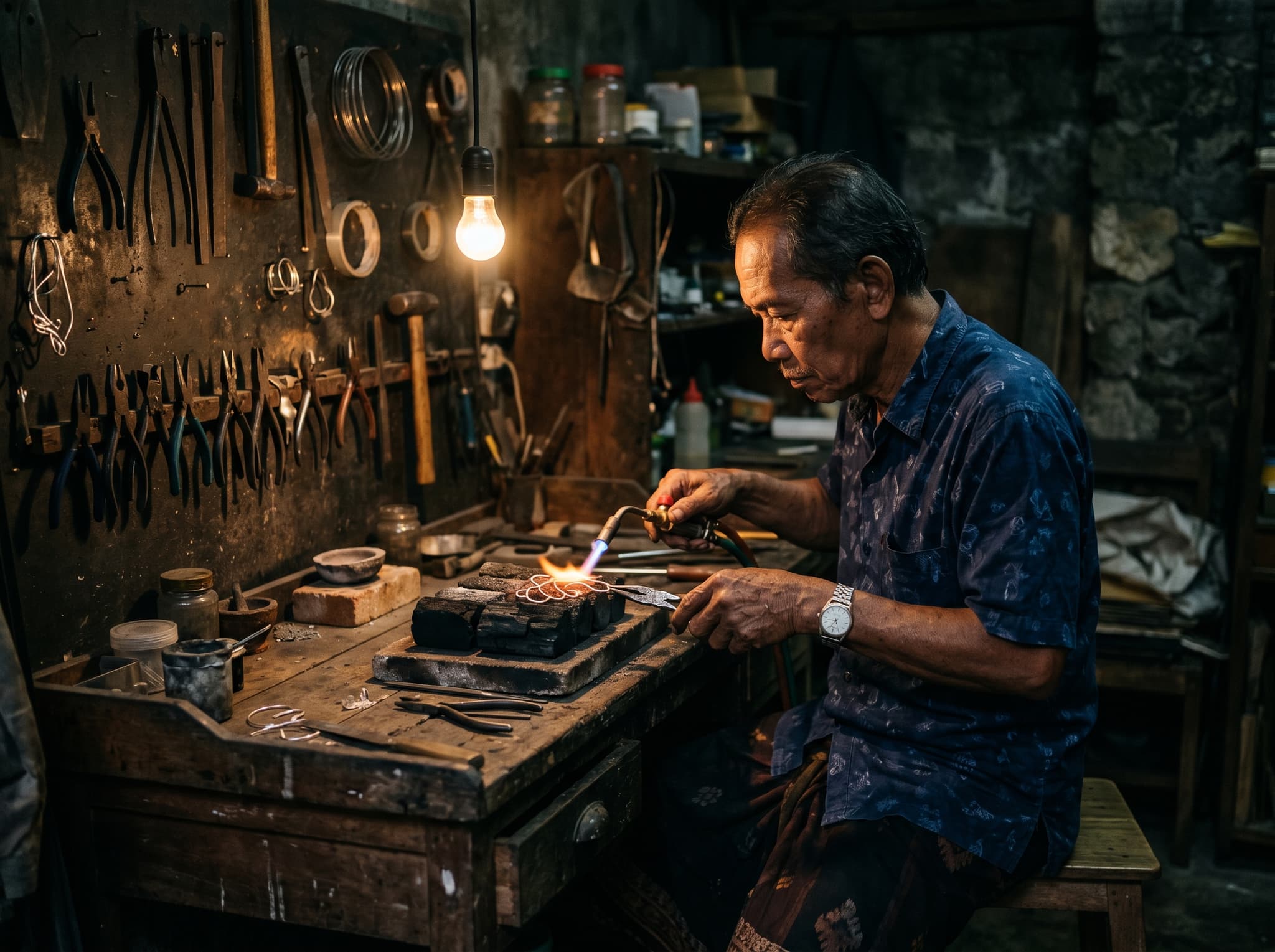
But walk past the first cluster of shops. Step into a back workshop where someone is drawing silver wire by hand, heating it over a small flame, bending it into a pattern they learned from their father. That version of Celuk is still here. It's just quieter than the one facing the road.