Tenganan Pegringsingan is a Bali Aga village near Candidasa where double ikat geringsing cloth takes five years to weave. Here's what to expect.
Most visitors to Bali encounter the island's Hindu-Balinese culture — the canang sari offerings, the temple ceremonies, the gamelan orchestras that soundtrack every major event. Tenganan Pegringsingan is something older. This is a Bali Aga village, a community whose customs, governance, and spatial layout predate the Majapahit kingdom's arrival in the 14th century. Where mainstream Balinese culture absorbed Javanese Hindu influence and evolved, Tenganan held its line.
The village sits in east Bali's Karangasem Regency, about five kilometers northwest of the quiet coastal town of Candidasa. It draws a fraction of the visitors that places like the Ubud Monkey Forest see. That's part of the point. Tenganan isn't built for throughput. It's a living community of roughly 600 residents who still practice endogamy — marrying only within the village — and maintain communal land ownership, traditional governance structures, and a weaving tradition found in only two other places on earth.
The Geringsing Cloth

The textile is the reason many people come, and it deserves the attention. Geringsing is a double ikat cloth — meaning both the warp and weft threads are resist-dyed to pattern before they ever meet on the loom. This technique exists in only three places globally: Tenganan, Gujarat in India, and parts of Japan. In Indonesia, Tenganan is the sole practitioner.
A single authentic geringsing piece can take close to five years to complete. The traditional process uses handspun cotton dyed with botanical indigo and morinda root, producing the cloth's characteristic palette: rust red, eggshell, and a deep black-violet. The finished textiles carry spiritual significance within the community — certain patterns are worn during specific ceremonies, and the cloth is considered to have protective qualities.
Geringsing Pricing
Tourist-market pieces
$5–$85
Authentic / antique cloths
$480–$3,795+ [VERIFY]
Production time (authentic)
Up to 5 years

The village produces both ceremonial cloths and simpler pieces for visitors. If someone offers you a genuine geringsing for $10, you're buying a simpler reproduction, which is fine — it supports the community. But know the difference. The antique and fully authentic pieces command collector-level prices, and those figures reflect the years of labor involved. Pricing for antique and high-end pieces varies significantly by source; the ranges above are drawn from textile dealers and online listings, but buyers should verify directly with weavers or reputable galleries.
Walking the Village
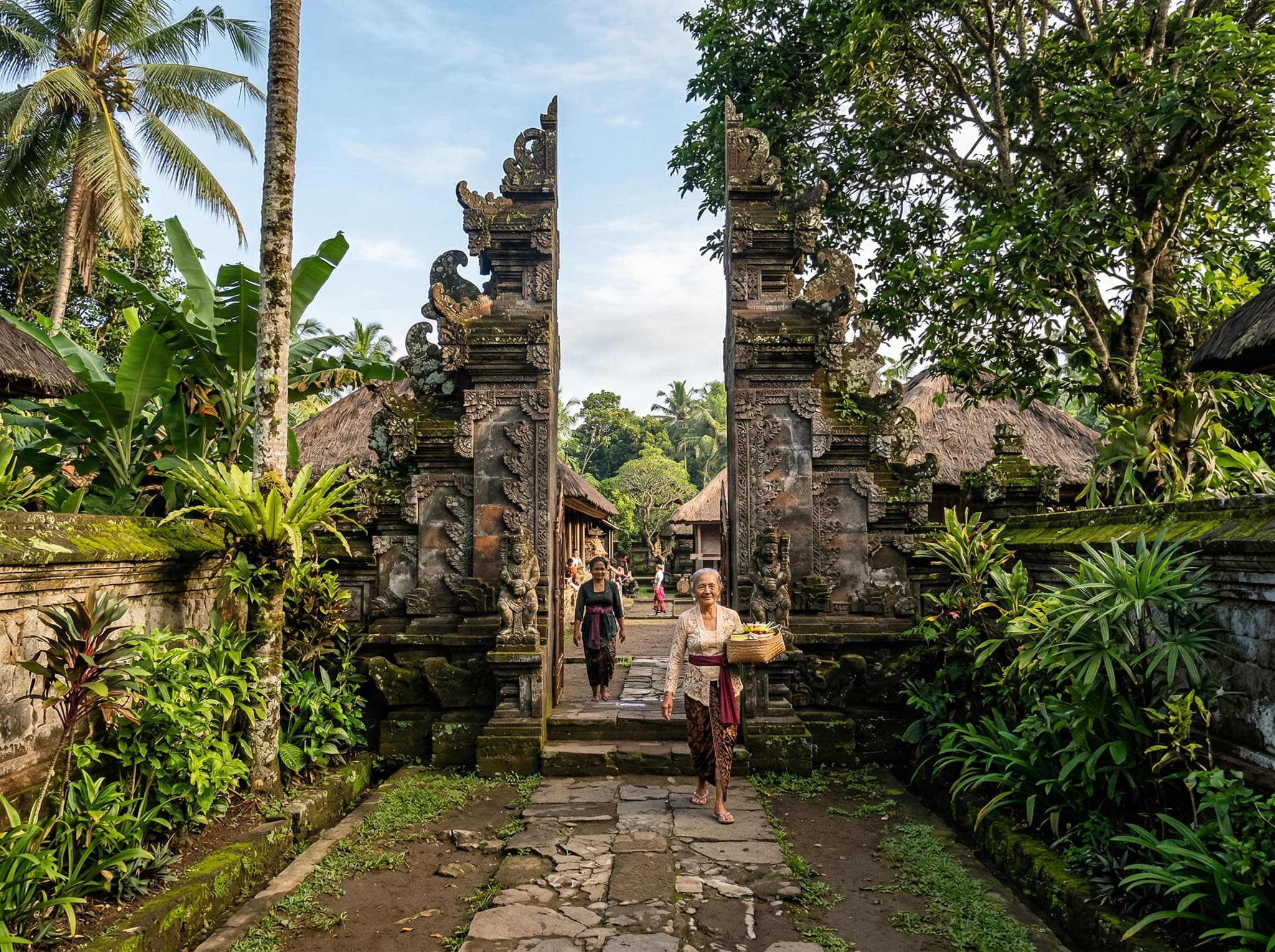
You enter through the southern gate and immediately notice the layout: a broad central avenue flanked by family compounds, running roughly north to south. The spatial organization is deliberate and ancient — academic research as recently as 2025 has examined how the Bali Aga settlement pattern has both shifted and persisted over centuries. The village is compact enough to walk end to end in twenty minutes, but the details slow you down.
Several households display weaving in progress. Whether this feels like a genuine window into the craft or a staged demonstration depends partly on timing and partly on your guide — a local guide will typically accompany you, and a tip of around IDR 50,000 is customary. Some visitors, particularly in recent reviews, have noted limited craft displays on quieter days. Mornings tend to offer more activity.
Beyond weaving, listen for the gamelan selunding — a traditional bronze percussion ensemble distinct from the gamelan styles heard elsewhere in Bali. You may hear it during ceremonies or rehearsals, though not on every visit.
The village also hosts the annual Usaba Sambah festival, which includes the mekare-kare — a ritualized pandanus leaf fight between young men. The festival typically falls between June and July, though exact dates follow the Balinese calendar. Attendance by outsiders is not guaranteed; visitors should confirm locally whether the ceremony is open to non-residents before planning a trip around it.
Getting There
Transport from Candidasa
Car / taxi
10–15 minutes
Scooter
~10 minutes
Bicycle
~30 minutes
On foot (via rice fields)
1–2 hours
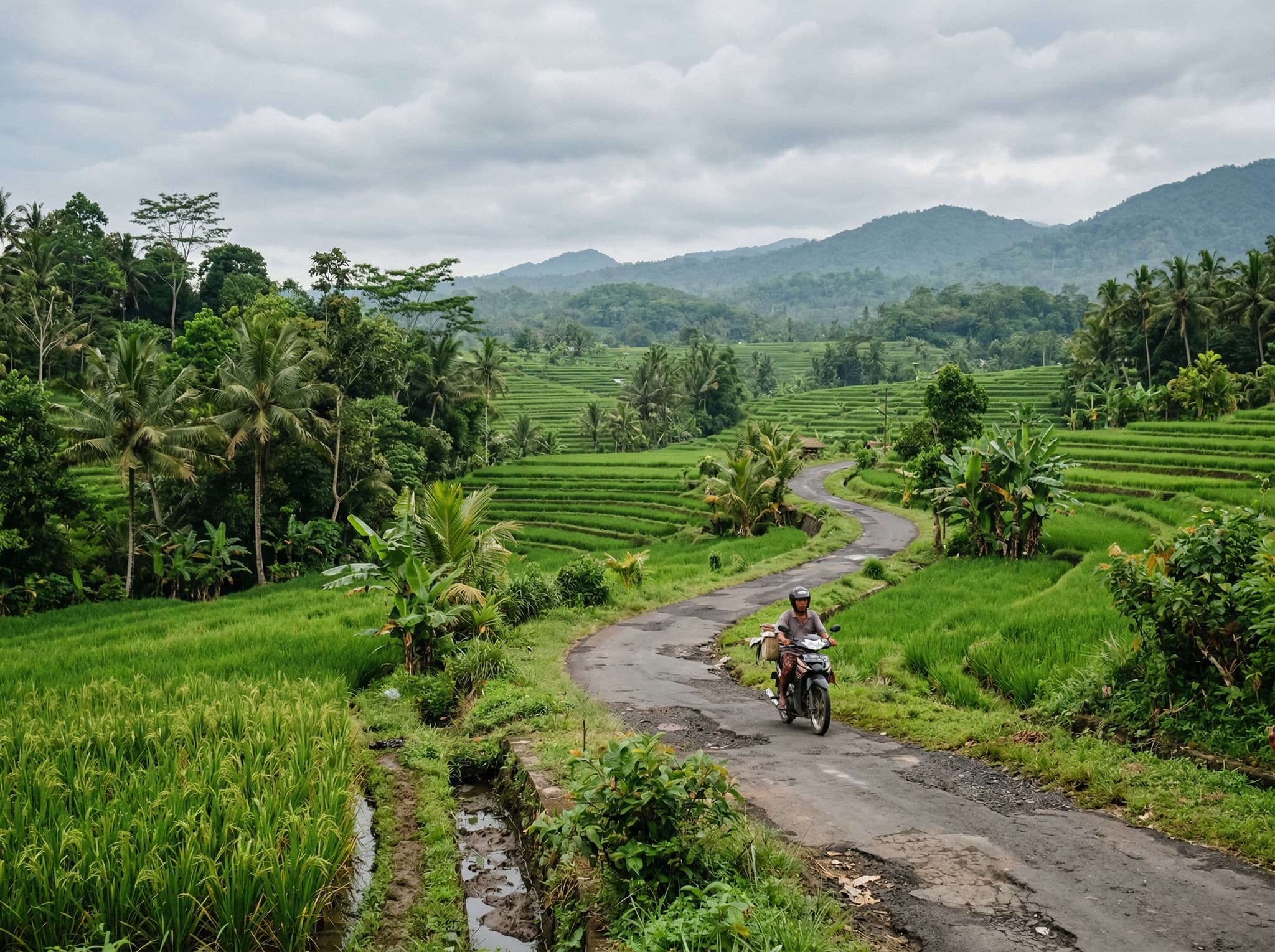
The road from Candidasa is roughly five kilometers, partly paved and partly dirt — conditions vary with weather, so check locally during the wet season. A spacious parking area sits near the entrance; a small parking fee may apply. Some Candidasa-area resorts offer guided cycling or trekking tours through the surrounding rice terraces, typically lasting 1.5 to 2 hours. Guided cycling tours have been listed at around IDR 370,000 per person with a two-person minimum, though pricing may shift — confirm directly with operators.
From south Bali or Ubud, the drive takes roughly 1.5 to 2 hours depending on traffic. Most visitors combine Tenganan with a day in the Candidasa area, which makes logistical sense and gives the trip breathing room.
What Tenganan Is and Isn't
This isn't a theme park. There are no ticket counters, no audio guides, no gift shops with refrigerator magnets. The donation you leave at the entrance — according to village leadership — supports community projects including education and temple maintenance. The village gives you exactly what it is: a quiet, self-governing community that has chosen to preserve its identity while adapting, carefully, to the reality that outsiders want to see it.
Recent visitor feedback suggests the experience is modest in scale. That's accurate. If you're expecting a spectacle, you'll be disappointed. If you're willing to slow down, pay attention to the textiles, and understand that a five-year cloth is not a souvenir but a statement about what a community values — Tenganan is one of the most quietly significant places on the island.