Ende Village offers traditional Sasak architecture and handloom weaving with a fraction of Sade's tourist traffic. Here's what to expect and how to visit.
Most travelers who want to see a traditional Sasak village on Lombok end up at Sade. It's well-known, easy to find, and covered in every guidebook. Ende offers essentially the same thing — traditional architecture, living Sasak culture, a window into how communities on this island have organized life for centuries — but with a fraction of the visitors. That trade-off comes with real differences worth understanding before you decide which village to visit, or whether to visit both.
What You'll Actually See

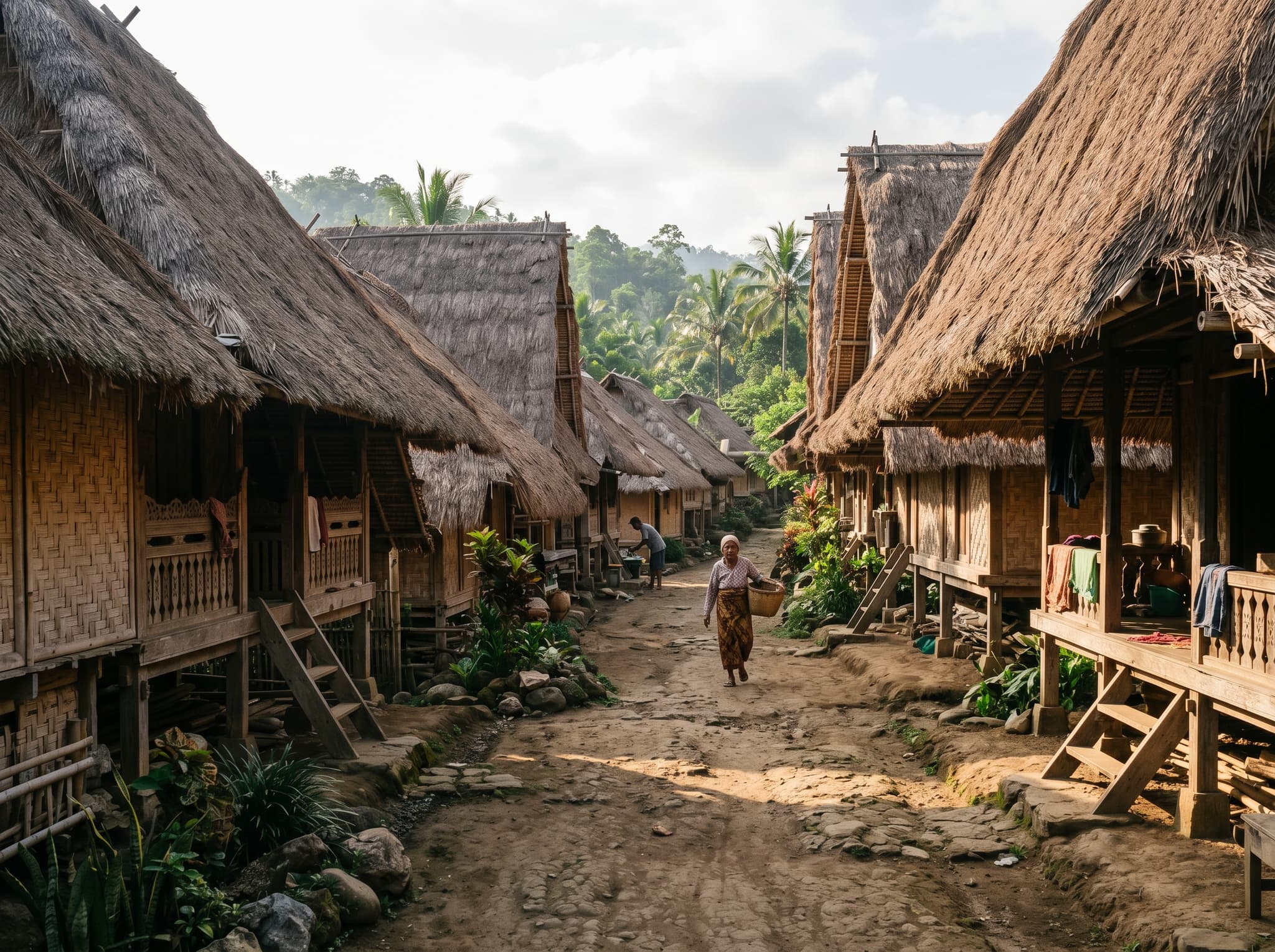
Ende is a small hilltop settlement of traditional Sasak houses arranged in tight rows along a central pathway. The houses themselves are the draw. They're built from bamboo walls and wooden frames, topped with thatched roofs made from alang-alang grass that slopes steeply downward, sometimes nearly touching the ground on the back side. The floors are raised on packed earth and finished with a mixture of clay, rice husks, and — this is the detail that catches every visitor — cow dung, which dries hard and smooth and functions as a natural sealant. It doesn't smell. It works remarkably well.
Each house is small by Western standards, typically a single main room with a loft used for sleeping or storage. Cooking happens in a separate structure or in a shared kitchen area. The layout of the village itself follows a traditional Sasak pattern: houses face each other across a communal space, with rice barns (lumbung) — distinctive structures with rounded, bulging roofs — positioned nearby. These barns are iconic in Lombok; you'll see their shape referenced in hotel architecture across the island. In Ende, they're still functional.

The village sits on a gentle rise, and the views toward the surrounding hills and farmland are quietly beautiful — not dramatic, but the kind of landscape that reminds you Lombok's interior is still overwhelmingly agricultural.
The Sade Comparison
Sade Village, about two kilometers north along the same road, is Ende's more famous neighbor. Both are living Sasak villages with traditional architecture. Both offer guided walks. Both sell handwoven textiles. The differences are in scale and atmosphere.
Sade receives significantly more visitors — it's a regular stop on organized day tours from Senggigi and the Gili Islands, and its proximity to the main road makes it the default choice. That volume has shaped the experience. Sade has more souvenir vendors, more structured interactions, and a more practiced rhythm to its tourism. Guides there are polished and accustomed to large groups.
Ende vs. Sade at a Glance
Tourist Volume
Ende: Low — Sade: Moderate to High
Guided Tours
Both offer village walks with local guides
Textile Selling
Present at both; more persistent at Sade
Architecture
Comparable traditional Sasak construction
Accessibility
Sade is easier to find; Ende requires a short detour
Ende is quieter. On a typical day, you might be the only visitor, or one of a handful. The guides are less rehearsed, which can mean a more genuine interaction or a less informative one, depending on the individual and any language barrier. There are fewer souvenir stalls, and the weaving demonstrations feel less performative — though textiles are still offered for sale, and you should expect some commercial interaction. This is a community that has opened itself to tourism as an income source, and that's a reasonable exchange.
What you give up at Ende is convenience and polish. It's slightly harder to find, the experience is less curated, and if you arrive without a driver who knows the area, you may need to ask for directions. There are no signs in English pointing the way.
The Weaving
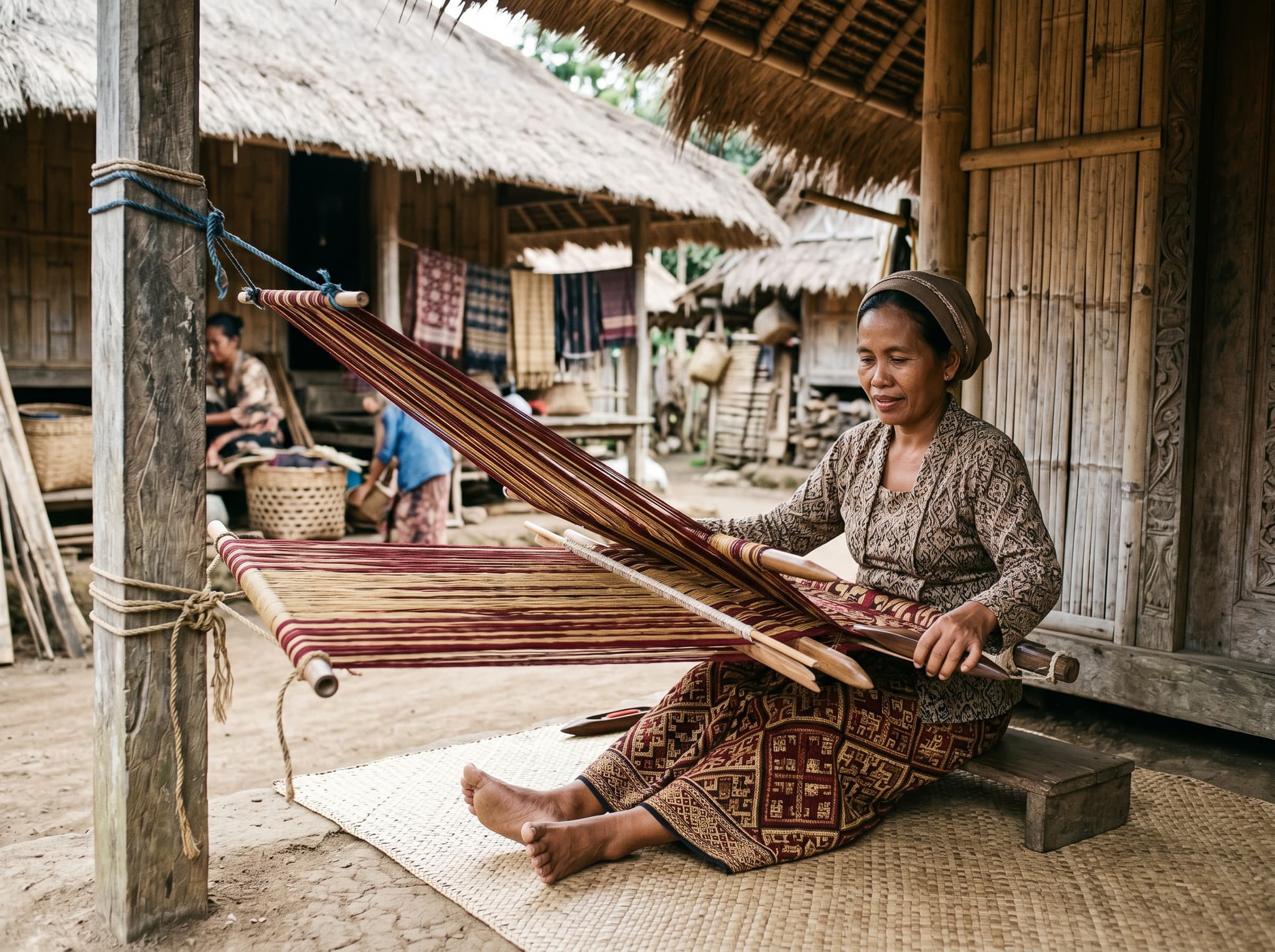
Sasak weaving is central to both villages, and in Ende you'll likely see women working on backstrap looms — a method where one end of the loom is tied to a post and the other wraps around the weaver's body, with tension controlled by leaning back. The textiles produced are songket and ikat — fabrics with geometric patterns that carry cultural meaning. Specific patterns historically indicated social status, marital availability, or clan affiliation.
The fabrics are genuinely handmade and the process is slow — a single piece can take weeks. Prices in Ende tend to be slightly lower than in Sade, though this varies. If you're interested in buying, take time to watch the process first. It contextualizes the price and makes the purchase feel less transactional.
Getting There and Practical Details
Ende is located along the road between Sengkol and Kuta Lombok, south of Sade. If you're coming from Kuta Lombok — the surf town on Lombok's south coast that has become the island's main independent-traveler hub — the village is roughly 15 to 20 minutes by motorbike or car heading north. From Mataram or Senggigi, it's about 45 minutes to an hour depending on traffic.
There's no formal ticket counter. A local guide will typically greet you and offer to walk you through the village, and a donation is expected at the end. IDR 20,000 to 50,000 is appropriate for a solo visitor or couple. The guide's knowledge varies — some speak decent English, others communicate mostly through gestures and a few key phrases. A Bahasa Indonesia phrasebook or translation app helps.
Dress modestly. Shoulders and knees covered is respectful and appreciated. Remove shoes if invited into a home.
Planning Essentials
From Kuta Lombok
15–20 minutes north by motorbike
From Mataram
45–60 minutes south
Combine With
Sade Village (2 km north), Kuta Lombok beaches
Time Needed
45 minutes for a walk-through; longer if watching weaving
Facilities
Minimal — no restaurants or ATMs nearby
Who This Is For
Ende is the better choice if you're an independent traveler who values atmosphere over information density, and if you're comfortable with a less structured experience. If you want a thorough, English-language explanation of Sasak culture and don't mind sharing the space with tour groups, Sade delivers that more reliably.
There's no wrong answer. Both villages are real communities where people live in traditional houses not as a museum exhibit but because this is how their families have lived. The architecture is the same. The culture is the same. The difference is how tourism has shaped the space around it — and at Ende, that shaping has been lighter.