Angel's Billabong: Beautiful, Dangerous, and Worth Understanding Before You Go
Angel's Billabong on Nusa Penida is stunning but genuinely dangerous. Here's what the swimming ban means, when to visit safely, and how to plan your trip.
Angel's Billabong is one of the most photographed spots on Nusa Penida, and one of the most misunderstood. Every travel feed shows the same image: a turquoise infinity pool carved into coastal rock, crystal-clear water, someone perched on the edge looking contemplative. What those photos don't show is the ocean swell that can fill that pool in seconds, the slippery rock surface, or the fact that swimming here is officially banned following a fatality in February 2023 and multiple rescue incidents.
So let's be clear about what Angel's Billabong actually is: a natural tidal rock pool on Nusa Penida's exposed western coast. At low tide, it's stunning — a shallow basin with a mosaic rock floor visible through impossibly clear water, opening directly to the Indian Ocean. At high tide, it's a violent churn of waves crashing over the rocks where people were standing an hour earlier.
Is Angel's Billabong dangerous? Yes, it genuinely can be. Is it still worth visiting? Also yes — if you understand the conditions and respect them.
What Makes It Dangerous

The hazard isn't complicated, but it's deceptive. At low tide, the pool looks like a swimming hole. Calm, shallow, inviting. The problem is that conditions change fast. Swells can surge without warning, and the rock edges are slick. Visitors have been knocked off balance and swept into open ocean. There are no lifeguards, limited signage, and the nearest medical facilities on Nusa Penida are basic at best.
After the 2023 fatality, Nusa Penida authorities — including the Regent of Klungkung and local police — imposed a swimming ban at Angel's Billabong alongside closures at Kelingking Beach and Diamond Beach. As of the most recent reports through 2026, that ban remains in force with no infrastructure upgrades or indication it will be lifted.
Swimming at Angel's Billabong is officially prohibited. Enforcement varies, but the risk is real. Waves can surge into the pool without warning, even on days that look calm. Wet season (November–April) makes conditions significantly worse.
You'll see people in the water in recent photos and videos. That doesn't mean it's allowed or safe — it means enforcement is inconsistent. A closed sign appears at the site when the tide is too high, but there's no permanent barrier.
How to Visit Safely

The goal is simple: see the pool at low tide, take your photos, stay dry, and leave with all the same limbs you arrived with.
Check the tide before you go. Use Tideschart.com or Magicseaweed for Nusa Penida tide predictions. Tides shift by roughly one hour each day, so what worked yesterday won't be the same today. You want a low tide reading — ideally below 0.5 meters.
Arrive early or late. Before 9 AM gives you the best combination of low-tide likelihood and minimal crowds. Late afternoon (3–5 PM) offers better photography light with the sun hitting the pool at a lower angle. The 10 AM–3 PM window is when Bali day-tour groups arrive en masse, and it's often the least pleasant time to be there regardless of tides.
Wear proper shoes. Not flip-flops. The rock surface is uneven and wet. Non-slip footwear isn't optional — it's the difference between a good visit and a bad one.
Getting There
From Banjar Nyuh port
~25 min by scooter
From Toyapakeh/Crystal Bay
~40 min by scooter or car
From Sampalan/Batununggul
~45 min by scooter
Scooter rental
50,000–100,000 IDR/day (~$3–6)
Private driver
~$50 USD/day (full island tour)
Parking
3,000–5,000 IDR for motorbike
Pair It With Broken Beach
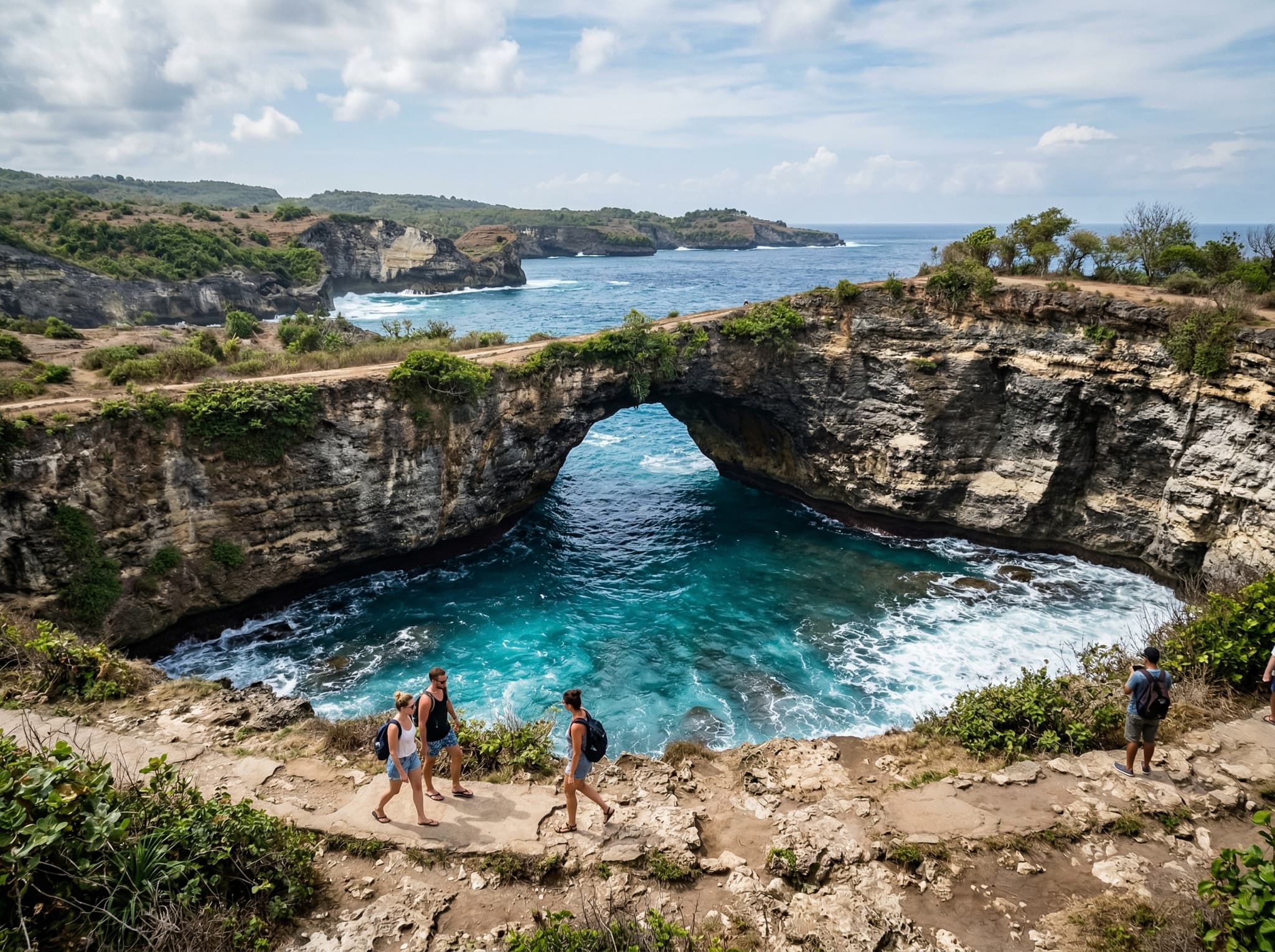
Angel's Billabong and Broken Beach are a five-minute walk apart and share the same parking area. There's no reason to visit one without the other. Broken Beach is a natural rock arch over a circular cove — dramatic, photogenic, and viewable entirely from the clifftop. No scrambling down to water level required.
One important note: Broken Beach has its own safety record. A fatal cliff-edge fall from a 45-meter drop was reported in 2023. Stay behind barriers and away from edges, especially for photos. The Instagram shot is not worth the risk at either site.
Budget 30–60 minutes total for both spots. If you're doing a west-coast Nusa Penida loop, these pair naturally with Kelingking Beach (about 20 minutes further by scooter), though Kelingking has its own access restrictions to check before you go.
The Honest Assessment
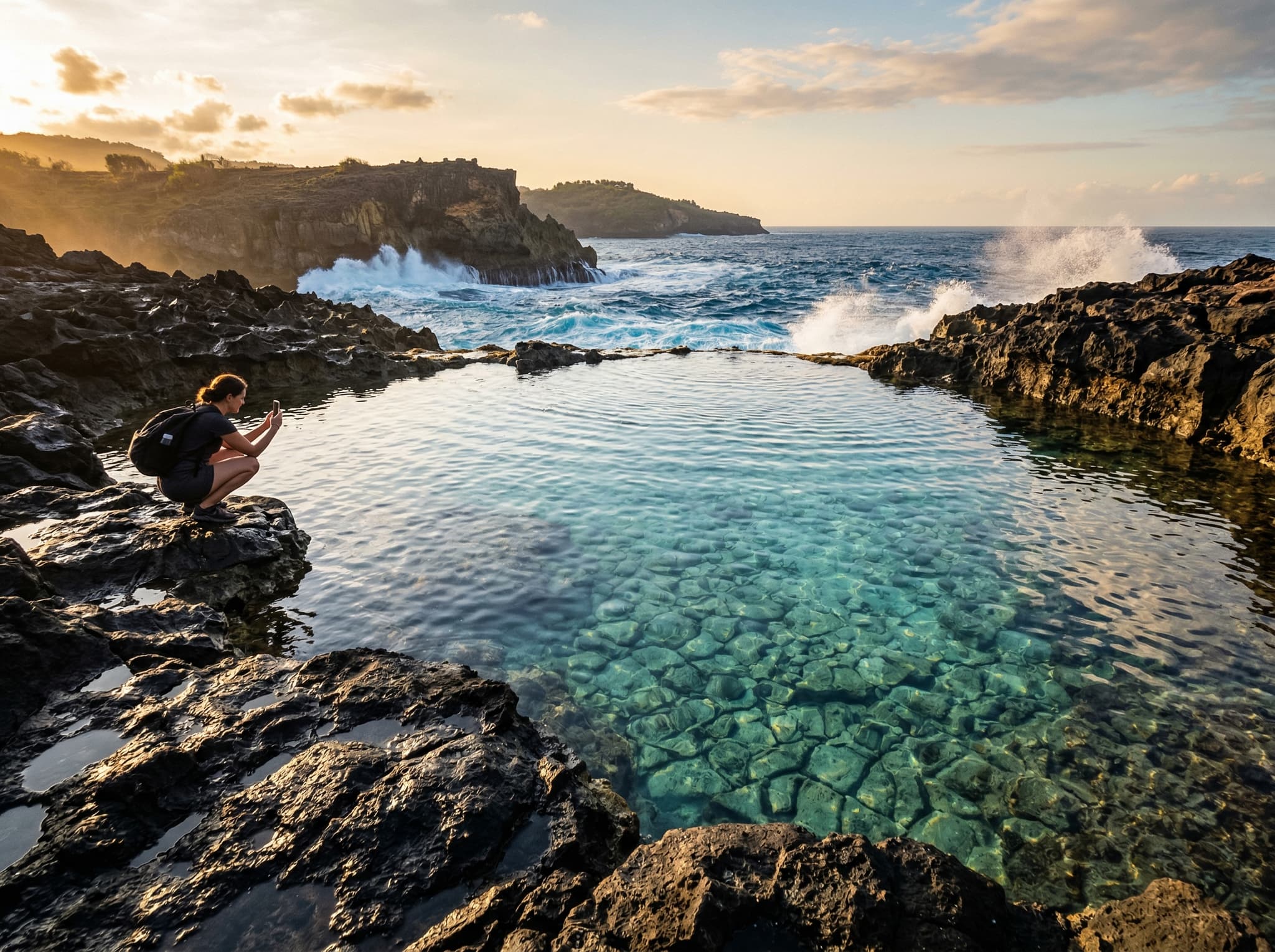
Angel's Billabong is genuinely beautiful. The rock formations and water clarity are not overhyped — this is one of those rare spots where the photos are more or less accurate. The turquoise pool against dark volcanic rock is striking even when you can't get in the water.
But it's a 30-minute stop, not a destination. The area around the pool is exposed rock with no shade, no facilities beyond a few warungs in the parking area, and not much to do once you've walked the perimeter and taken your shots. Visitors who overnight on Nusa Penida have a significant advantage — early morning access means smaller crowds and better tide alignment than anyone arriving on a day trip from Bali.
Staying overnight on Nusa Penida lets you reach Angel's Billabong before 8 AM, when day-trip boats haven't arrived yet. That early window typically offers the calmest pool conditions and the fewest people. It's the single best practical decision you can make for this visit.
What You're Actually Paying
The site itself is effectively free. Here's the full cost breakdown:
Cost Breakdown
Angel's Billabong entry
Free
Parking (motorbike)
5,000 IDR (~$0.30)
Nusa Penida island fee
25,000 IDR adult / 15,000 IDR child
Total out-of-pocket at site
Under $0.50
The island-wide tourism retribution fee (introduced January 2024) is collected at the port when you arrive on Nusa Penida, not at individual sites.