Broken Beach is a collapsed sea cave on Nusa Penida with a dramatic natural rock arch over turquoise water. Here's what to know before visiting this viewpoint-only landmark.
Broken Beach isn't a beach at all. There's no sand, no shoreline, no place to lay a towel. What you're looking at is a collapsed sea cave — a circular cove carved into Nusa Penida's limestone cliffs, open to the Indian Ocean through a natural rock archway that frames water so absurdly turquoise it looks digitally altered. The Indonesian name, Pasih Uug (roughly "broken water" in Balinese), is more honest about what this place actually is: a hole in the coastline where the earth gave way and the sea rushed in.
How the Arch Formed
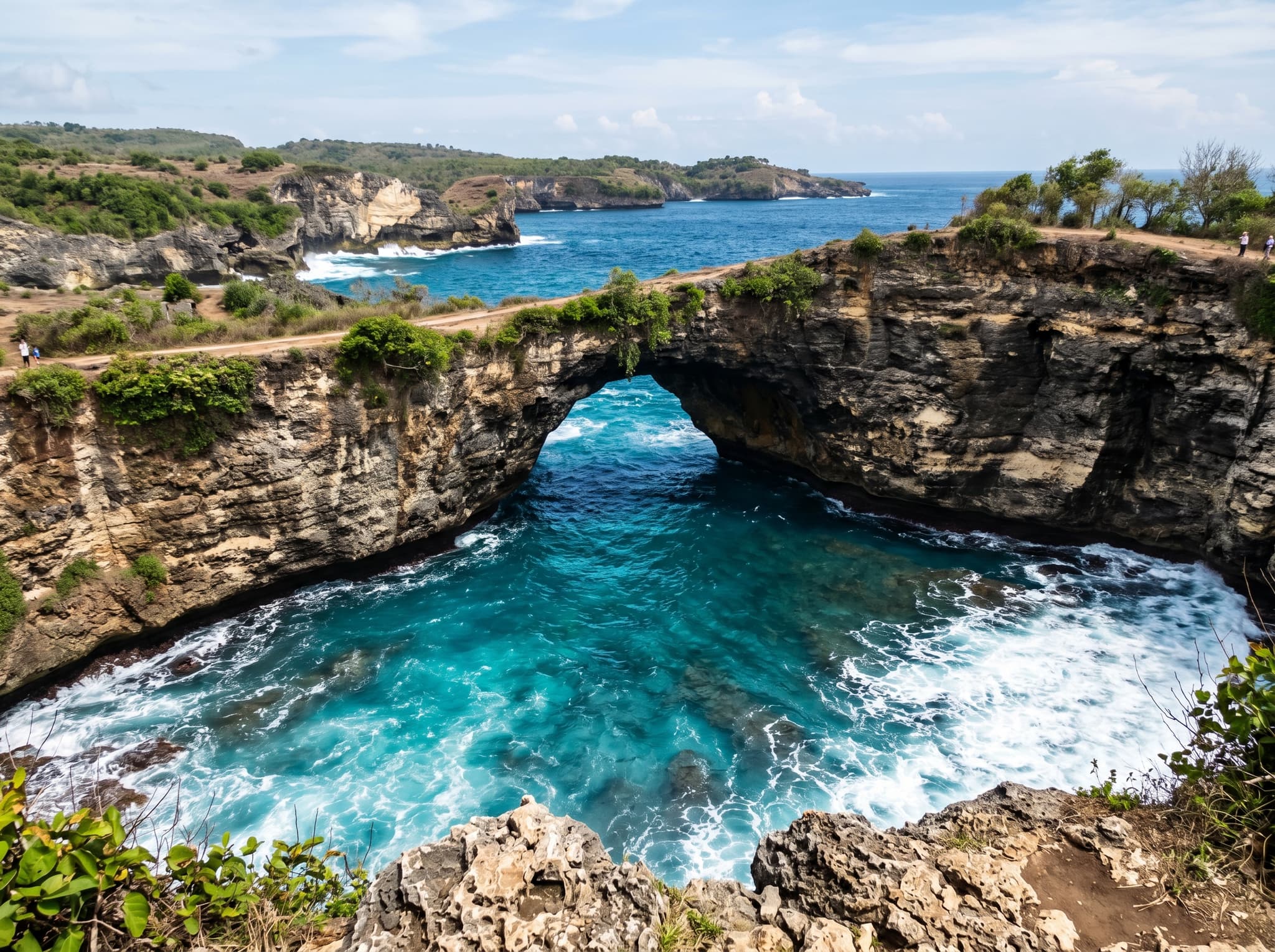
Nusa Penida is a raised limestone plateau — the same geological family as the cliffs at Uluwatu on mainland Bali, but older and more exposed. For thousands of years, waves battered the soft limestone from below, carving sea caves along the western coast. At Broken Beach, one of those caves grew large enough that its roof partially collapsed, creating the open-air cove. But a section of the ceiling held. That surviving strip of rock is the arch — roughly 50 meters across, maybe 20 meters above the water — connecting two cliff faces over a channel where the ocean surges in and out with each swell.
The result is a formation that looks engineered: a near-perfect oval of cliff walls surrounding a sheltered pool, with a single dramatic opening to the sea. It's the kind of thing that would seem implausible in a painting.
What You're Actually Visiting

The experience at Broken Beach is straightforward. You walk from the parking area along a clifftop path and look down. The cove sits roughly 20–30 meters below the rim, and the trail follows the edge in a loose loop, offering different vantage points of the arch, the cove, and the open ocean beyond.
That's it. There's no staircase to the water, no swimming, no snorkeling access. The currents inside the cove are strong and unpredictable — water funnels through the arch with real force — and the cliff walls are sheer. This is a place you observe, and it rewards observation. The water color shifts through the day as the sun angle changes. In early morning, the channel glows a deep emerald. By midday, when the sun is directly overhead, it turns that electric cyan that dominates every photo you've seen.
If you visit early enough — before 8 AM or toward dusk — dolphins are sometimes visible from the clifftop, moving through the channel or in the open water beyond the arch. Manta rays also frequent the waters below, and a signed viewpoint between Broken Beach and Angel's Billabong (look for the tree archway detour) is positioned specifically for spotting them.
Pairing with Angel's Billabong
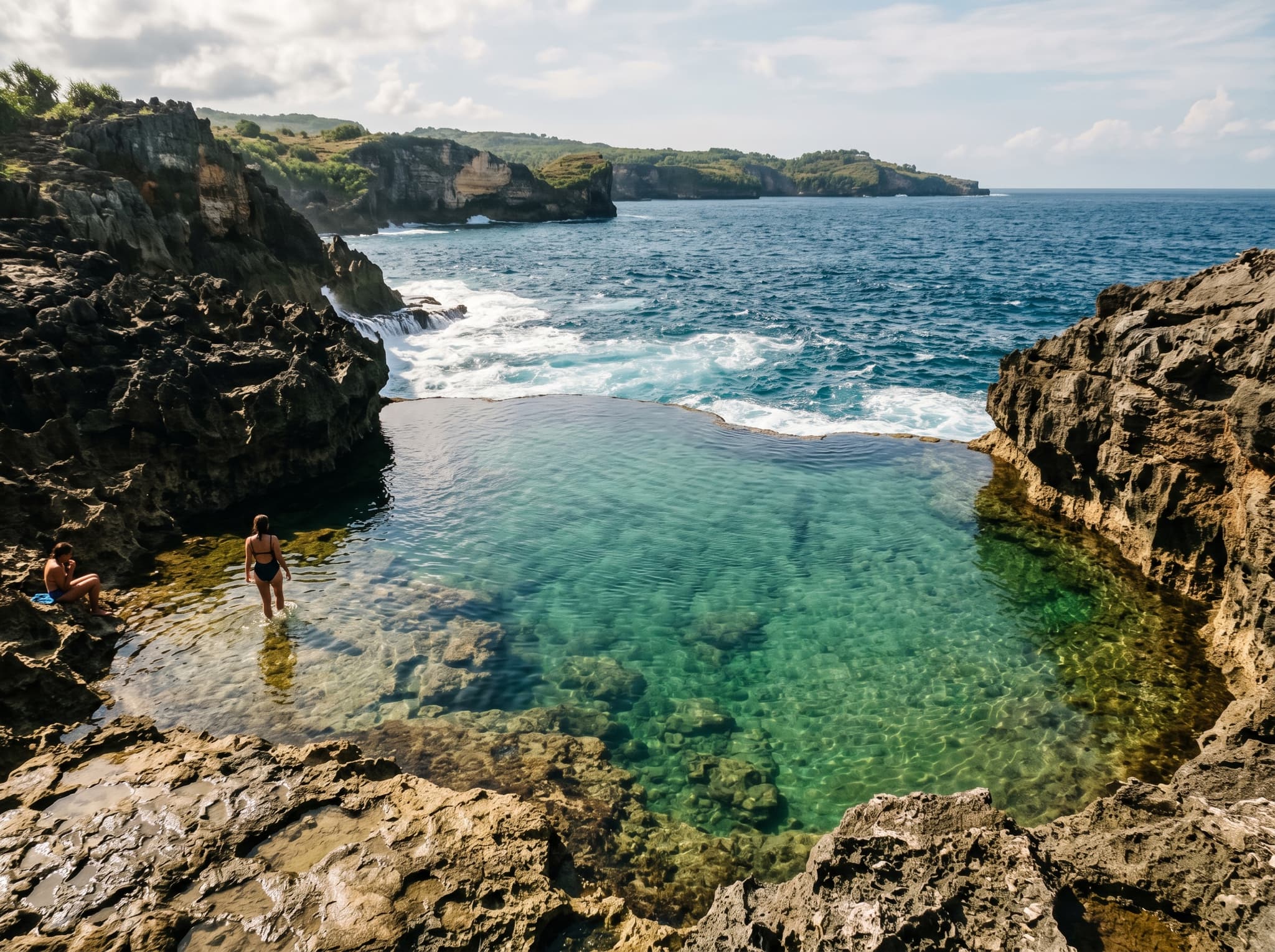
Angel's Billabong sits roughly five minutes on foot from Broken Beach along a coastal path — a natural infinity pool formed in the rock shelf where tidal water collects at low tide. Most visitors combine the two, and the logistics favor visiting Angel's Billabong first: the natural pool is only safe to approach (and photograph well) at low tide, while Broken Beach looks good regardless of tide level.
A new 1-kilometer road connecting the two sites was announced by Bali's governor in April 2025, with construction scheduled for early 2026. Until that's completed, the walking path remains the standard route between them.
Broken Beach + Angel's Billabong
Walk Between Sites
5 minutes via coastal path
Combined Visit Time
1–1.5 hours
Angel's Billabong Swimming
Low tide only; dangerous at high tide
Facilities
Warungs, snack stalls, toilets near parking
Getting There
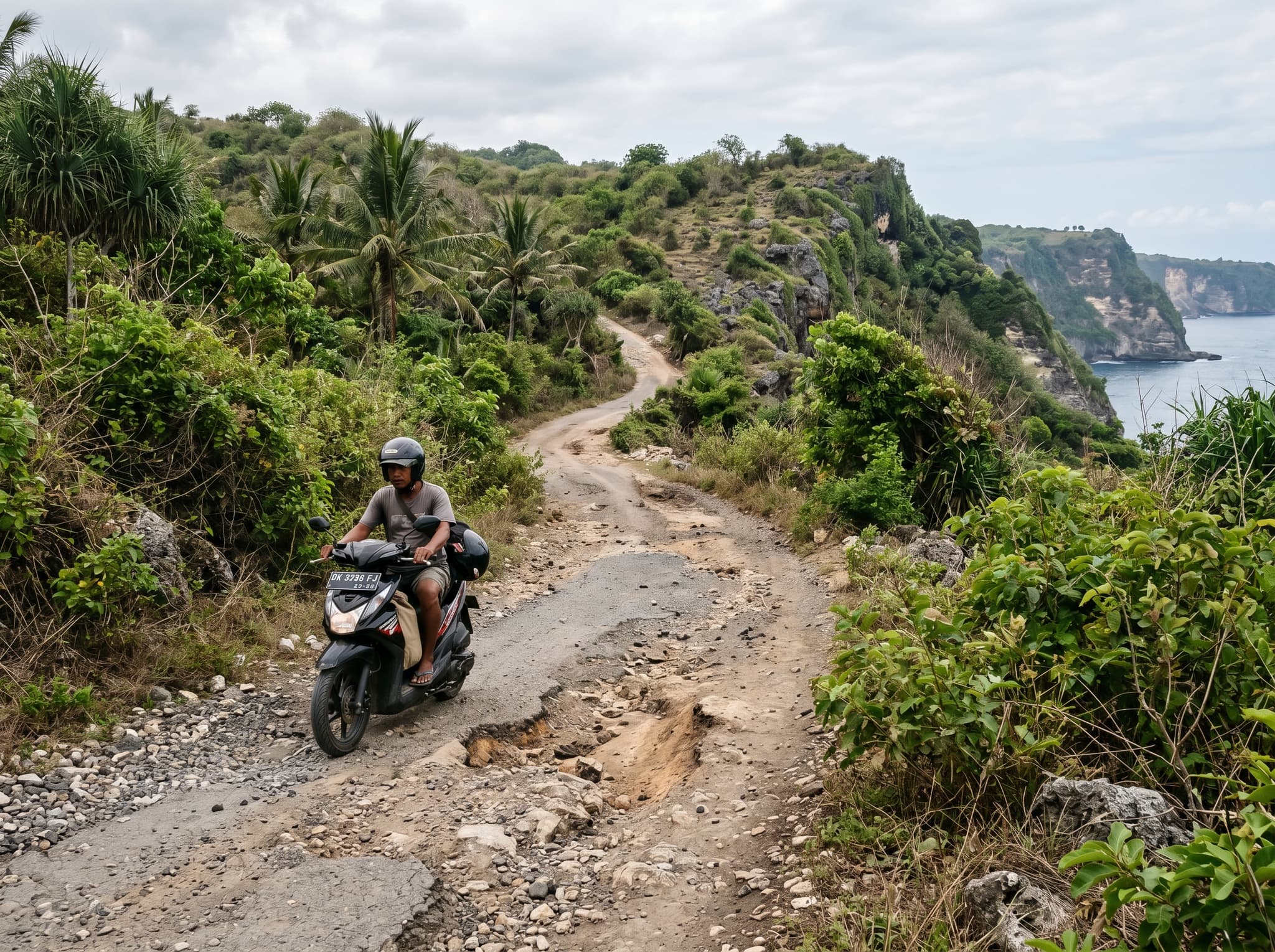
Broken Beach is on Nusa Penida's western coast, roughly 40 minutes by car from Toyapakeh or Crystal Bay, and closer to an hour from Sampalan port despite what the map suggests. The roads have been significantly upgraded in recent years, but the final stretch still has rough patches — narrow, occasionally unpaved, with enough potholes to make a scooter ride genuinely unpleasant.
Transport Options
Speedboat from Sanur
~45 min, IDR 150,000–250,000 one way
Private Car + Driver
IDR 600,000–800,000/day
Scooter Rental
IDR 75,000–100,000/day
Motorbike Parking
IDR 5,000 at Broken Beach
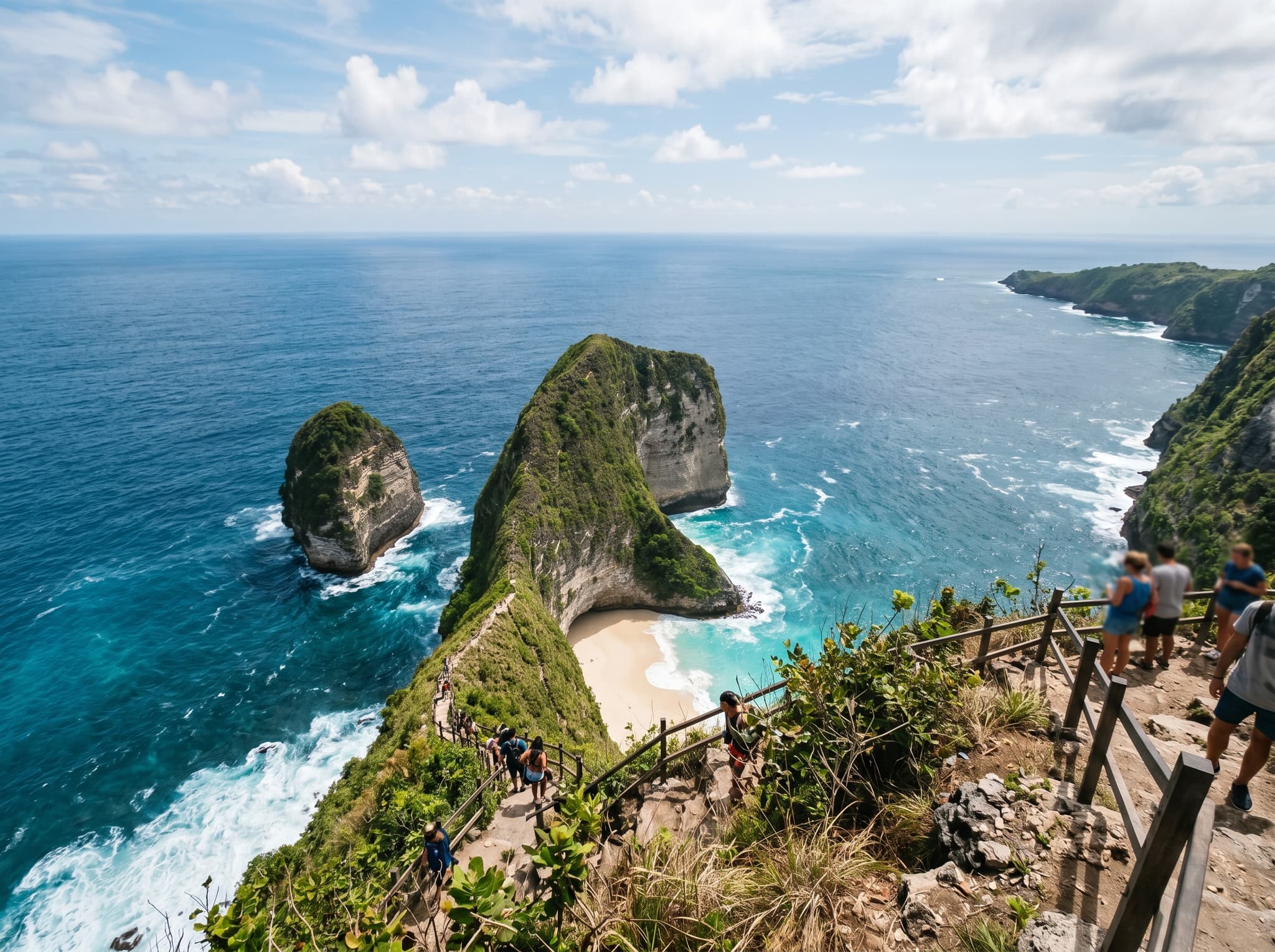
A private driver is the more practical option for most visitors. The cost is reasonable split between two people, and it eliminates the stress of navigating roads that are genuinely challenging on a scooter — particularly if you're not an experienced rider. Most west-coast day tours combine Broken Beach and Angel's Billabong with Kelingking Beach, which is about 20 minutes further south.
What to Know Before You Go
Bring sturdy shoes — the clifftop path is uneven limestone, and flip-flops are a poor choice near a sheer drop. Sunscreen and water are essential; the exposed clifftop offers no shade. Small warungs near the parking area sell drinks and snacks, but options are limited.
The entrance fee has historically been inconsistent — some visitors report paying nothing, others IDR 5,000 or IDR 10,000. Recent sources suggest IDR 10,000 is the current standard, though it's best confirmed on arrival. Separately, Nusa Penida charges an island-wide tourist levy of IDR 25,000 per adult (IDR 15,000 per child), collected in cash at the port when you arrive.