Antonio Blanco's hilltop estate above the Campuhan valley is part art gallery, part theatrical set piece. Here's who should visit and what you'll find inside.
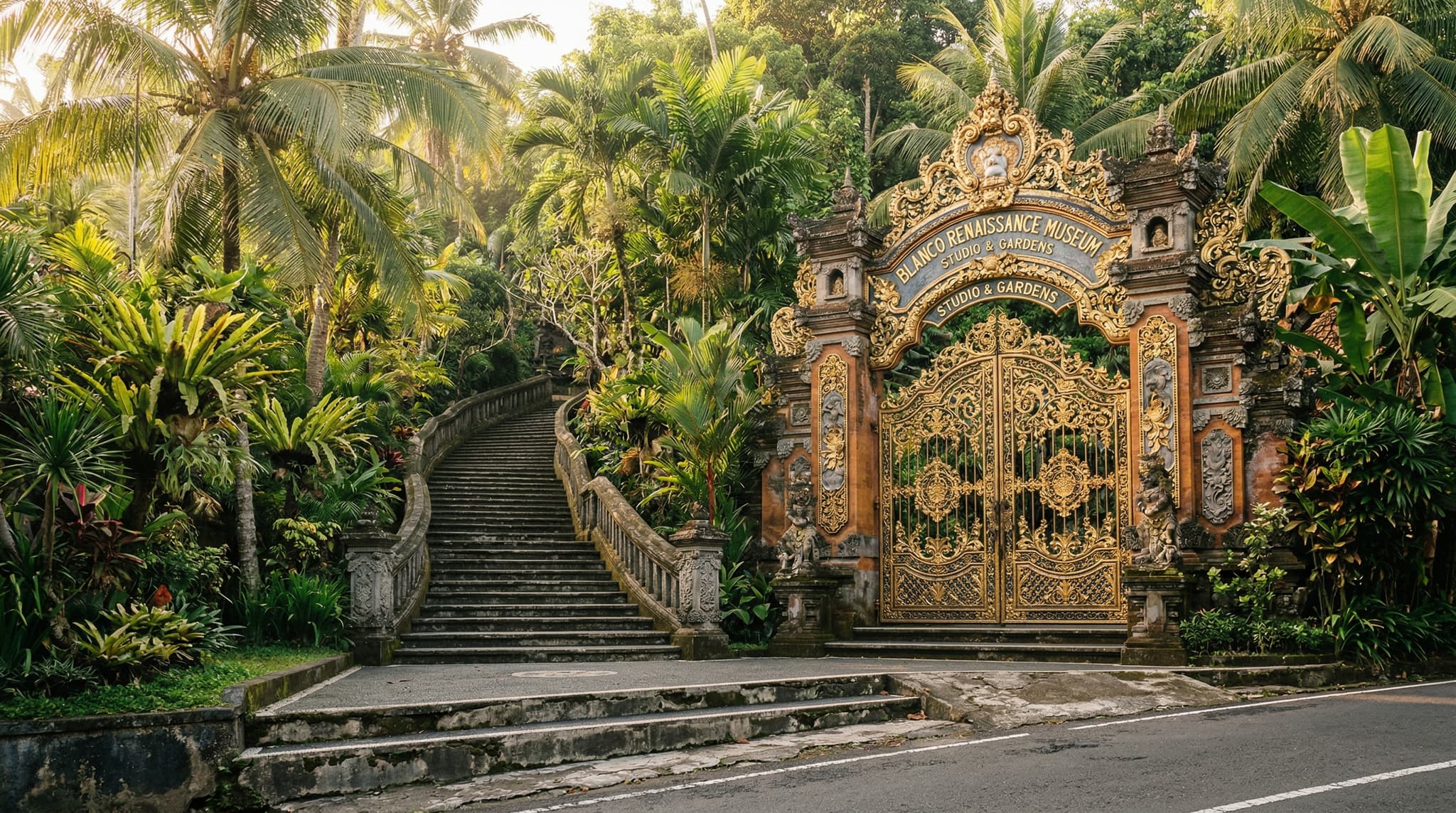
Most people encounter the Blanco Renaissance Museum as a landmark on their way somewhere else. It sits at the top of the Campuhan ridge in Ubud — right where the road forks toward the Campuhan Ridge Walk — and nearly every walking guide to the area mentions it as a reference point. Turn left at the Blanco Museum. You'll see the gate before the bridge. That kind of thing.
This undersells the place considerably. The museum is the former home and studio of Antonio Blanco, a Spanish-born, Philippines-raised painter who moved to Ubud in the 1950s and spent the rest of his life there, producing flamboyant figurative art, building an increasingly elaborate compound on a hilltop gifted to him by the local royal family, and becoming one of the most colorful characters in a town that has never been short on colorful characters. Whether or not his paintings are to your taste — and opinions vary sharply — the estate itself is one of Ubud's most distinctive spaces, and the story behind it is worth knowing.
Antonio Blanco: The Artist on the Hill

Antonio Maria Blanco was born in Manila in 1911 to a Spanish father and a Filipina mother. He trained as a painter in the Philippines and later in New York and Paris before arriving in Southeast Asia in the late 1940s. He came to Bali in 1952, during a period when the island was attracting a small but influential community of foreign artists — Walter Spies, Rudolf Bonnet, Arie Smit — who were drawn to Bali's artistic traditions and its landscape.
Blanco landed in Ubud, where the local ruling family, the Sukawati dynasty, had been actively supporting both Balinese and foreign artists for decades. The king at the time granted Blanco a hilltop property above the Campuhan River confluence — a site with commanding views of the river valley and the surrounding palm forest. Blanco built his home and studio there, married a Balinese Legong dancer named Ni Ronji, and essentially never left.
What he built over the following five decades was less a house than a theatrical set piece. The compound grew into a terraced estate filled with gilded frames, baroque flourishes, tropical gardens, exotic birds, and Blanco's own paintings — large-scale figurative works, many of them depicting Balinese women, often his wife, in various states of undress. He styled himself "Don Antonio Blanco" and cultivated an extravagant persona that made him a fixture of Ubud's cultural scene until his death in 1999.
His children converted the estate into a museum shortly after, and it has been open to the public since.
What You'll Find Inside

The museum preserves Blanco's compound more or less as he left it, which is both its appeal and its challenge. This is not a curated gallery with white walls and careful lighting. It is a maximalist environment — dense, ornate, and deeply personal.
Museum Layout
Main gallery
Blanco's large figurative paintings and lithographs
Upper studio
Smaller works, sketches, personal effects
Grounds
Terraced gardens, bird enclosures, viewpoints
Gift shop
Prints, postcards, books on Blanco's work
The main gallery houses Blanco's best-known works — large oil paintings and mixed-media pieces, many incorporating collage, poetry, and elaborate custom frames that Blanco designed himself. The paintings are technically skilled and intentionally provocative. Blanco's recurring subject was the female form, rendered with a sensuality that some visitors find captivating and others find dated. The accompanying poetry, handwritten on many of the works, ranges from romantic to bawdy.
Upstairs, a smaller studio space contains sketches, lithographs, and personal memorabilia, including photographs of Blanco with various visiting dignitaries and celebrities. The room gives a clearer sense of the man's daily working life than the grand gallery below.
The grounds are worth as much time as the art. The terraced gardens descend toward the river valley, with several viewpoints that look out over the same Campuhan landscape visible from the ridge walk but from a higher, more private vantage. Blanco kept birds — parrots, cockatoos, peacocks — and the museum still maintains aviaries on the grounds, though their condition varies.
Blanco's Place in Ubud's Art History
Ubud's identity as Bali's cultural capital is partly a product of the foreign artists who settled there in the early and mid-twentieth century. Walter Spies, the German painter and musician who arrived in the 1920s, and Rudolf Bonnet, the Dutch painter who followed, both collaborated closely with Balinese artists and helped establish the Pita Maha collective, which formalized and elevated local artistic traditions. Their influence shaped how Balinese art developed and how the outside world perceived it.
Blanco arrived a generation later and occupied a different niche. Where Spies and Bonnet engaged deeply with Balinese artistic traditions, Blanco was more self-contained — his work was rooted in European figurative painting, and his subject matter, while inspired by Bali, was filtered through his own flamboyant sensibility. He was less a collaborator with Balinese art than a Western artist who happened to work in Bali, and the museum reflects that distinction. It feels more like a European artist's villa than a Balinese cultural institution.
This is not a criticism — it is useful context for deciding whether the museum belongs on your itinerary. If you are interested in Balinese art specifically, the Agung Rai Museum of Art (ARMA) and the Neka Art Museum offer broader and more representative collections. If you are interested in the particular story of a flamboyant expatriate artist who built an eccentric estate on a Balinese hilltop and lived there for half a century, the Blanco Renaissance Museum is the only place that tells it.
Who Should Visit

The museum works best for visitors who are already in the Campuhan area — starting or finishing the ridge walk, for instance — and who have an hour to spare. It pairs naturally with a morning walk along the ridge, followed by a stop at the museum before the midday heat sets in.
For visitors with a specific interest in art, the museum is worth the stop for the estate and the story even if the paintings themselves don't resonate. The compound is architecturally unlike anything else in Ubud, and the hilltop setting is genuinely beautiful.
For visitors short on time who are choosing between Ubud's museums, the Blanco Renaissance Museum is the most niche of the options. ARMA and Neka cover more ground and offer a fuller picture of Balinese art across periods and styles. The Blanco museum offers something narrower but stranger — a single artist's vision, preserved in the space where he lived it.
Practical Details
Hours
Daily, 9 AM – 5 PM
Payment
Cash (IDR) preferred
Photography
Allowed throughout
Nearby
Campuhan Ridge Walk (adjacent), Pura Gunung Lebah (200m)
The admission price of IDR 80,000 is reasonable by Ubud museum standards and includes access to the full grounds. There is a small cafe on-site, though most visitors head into central Ubud for coffee afterward — the walk back takes about ten minutes on foot.