Bali's largest Buddhist monastery sits in the hills above Lovina. A guide to visiting Brahmavihara-Arama — its history, Borobudur replica, and meditation gardens.
Bali is a Hindu island. That fact is so fundamental to the place — woven into every temple gate, every morning offering, every gamelan procession — that encountering a Buddhist monastery in the northern hills feels like a glitch in the matrix. But Brahmavihara-Arama Buddhist Monastery is no anomaly. It's a deliberate, quiet assertion that Bali's spiritual landscape has always been more layered than the shorthand suggests.
Perched on a hillside above Banjar village, about 20 minutes inland from the Lovina coast, Brahmavihara-Arama is the largest Buddhist monastery in Bali. It's also one of the most architecturally surprising places on the island — a complex of orange-roofed pagodas, meditation gardens, and a miniature Borobudur replica set against a backdrop of jungle-covered hills and, on clear days, the Java Sea.
Why a Buddhist Monastery in Hindu Bali
Buddhism and Hinduism have coexisted on Bali for over a millennium. The island's dominant faith is technically Hindu-Dharma, a syncretic tradition that absorbed Buddhist elements centuries ago. Balinese temple ceremonies still reference Buddhist concepts. Priests from both traditions officiate at major rituals. The relationship isn't one of tension — it's one of deep, historical interweaving that predates the arrival of either religion in its modern form.
Brahmavihara-Arama was founded in 1970 by Bhikkhu Giri Raksito, a Theravada Buddhist monk, and formally opened in 1971. The timing matters. Indonesia's New Order government under Suharto required citizens to follow one of five recognized religions — and Buddhism was one of them. The monastery gave Bali's small Buddhist community an institutional home during a period when religious identity carried political weight.
A 1976 earthquake damaged the complex, particularly its stupa, but repairs were made and the monastery continued to grow. What stands today is a compact but richly layered site that reflects both Theravada Buddhist architecture and unmistakably Balinese decorative sensibilities — split gates alongside lotus ponds, naga carvings flanking meditation halls.
What the Grounds Look Like

The monastery is built on a hillside, so expect stairs. The complex unfolds across several terraced levels, each revealing a different section of the grounds.
The lower levels hold the main vihara (worship hall) and administrative buildings. Stone pathways lead upward through gardens planted with frangipani and bougainvillea, past bell-shaped stupas and seated Buddha statues in various mudras. The grounds are meticulously maintained — monks and volunteers keep the gardens trimmed and the stone walkways swept.
The standout architectural feature is a miniature replica of Borobudur, the 9th-century Buddhist temple in Central Java and one of the most significant Buddhist monuments in the world. The replica at Brahmavihara-Arama is modest in scale but detailed enough to give a sense of Borobudur's tiered mandala structure — concentric square platforms topped by circular terraces and a central stupa. For visitors who won't make it to the original in Yogyakarta, it's a useful reference point. For those who have, it's a reminder of how far Buddhism's architectural influence once reached across the archipelago.
The Uposatha Gara, a meditation hall in the western section of the complex, is the spiritual heart of the monastery. It's a calm, unadorned space compared to the ornamental gardens outside — designed for sitting, not sightseeing.
Meditation and Ceremonies

Brahmavihara-Arama is an active monastery, not a museum. Monks live and practice here, and the complex hosts meditation sessions in the Uposatha Gara. However, meditation class schedules are not publicly listed online — anyone interested in joining a session or attending a longer retreat should contact the monastery directly in advance.
The grounds are most active during Buddhist holy days, particularly Vesak (celebrating the birth, enlightenment, and death of the Buddha) and Asadha (marking the Buddha's first sermon). During these observances, monks process through the grounds in saffron robes, and the complex takes on a ceremonial energy that's absent on ordinary days. Access may be partially restricted during major ceremonies.
Visiting Practicalities
Entry and Access
Entry Fee
IDR 20,000 (donation)
Parking (motorbike)
IDR 1,000–2,000
Parking (car)
IDR 5,000
Dress Code
Shoulders and knees covered
Sarong/Sash
Loaned free at front office
Booking
None required
The entry fee is labeled as a donation but is effectively fixed at IDR 20,000. Some visitors report paying IDR 25,000–35,000 depending on what's included (sarong loan, access to additional shrine areas). The amounts are small — bring cash in small denominations.
Modest clothing is required. Shoulders and knees must be covered. Sarongs and sashes are available to borrow for free at the front office, so there's no need to bring one.
The site has restrooms and ample parking. The roads leading up from the coast are paved but hilly with turns — manageable on a scooter but take it easy if riding for the first time in Bali.
Getting There
From Lovina
10 km, ~20 minutes by road
From Singaraja
20 km, ~25 minutes
From South Bali
2.5–3.5 hours by car
Transport
Self-drive or private driver
There is no reliable public transport to the monastery. From Lovina, a scooter rental is the simplest option. From south Bali, a private driver for a full north Bali day trip runs IDR 800,000–1,000,000, and most itineraries combine Brahmavihara-Arama with other stops along the northern coast.
Combining with Banjar Hot Springs

Banjar Hot Springs (Air Panas Banjar) sits roughly 1.5 km from the monastery, and nearly everyone visits both in a single trip. The hot springs are a set of carved stone pools fed by natural sulfurous water — more local swimming hole than luxury spa, and better for it. The standard approach is to visit the monastery first (cooler morning hours, quieter grounds) and then head to the springs afterward.
The Bigger Picture
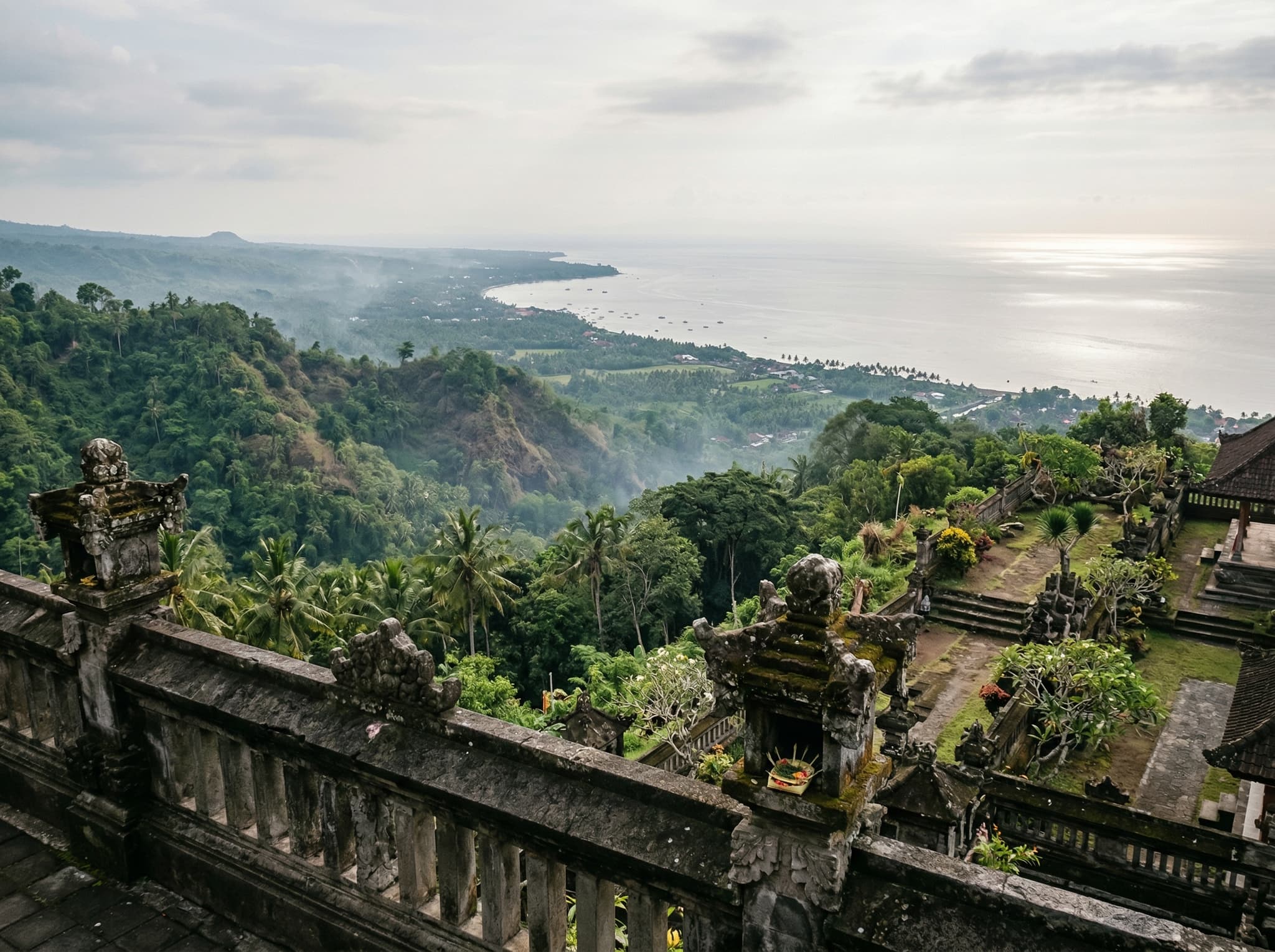
Brahmavihara-Arama doesn't compete with Bali's grand Hindu temple complexes for scale or spectacle. Besakih, Uluwatu, Tanah Lot — those are destinations built around drama. This monastery operates at a different register. The grounds are compact. The ornamentation is restrained by Balinese standards. The atmosphere is one of intentional stillness.
What makes it worth the drive from Lovina — or the longer haul from the south — is the way it complicates the easy narrative about Bali. This is a place where Buddhist monks maintain a Borobudur replica on a Hindu island, where split gates and lotus ponds coexist in the same garden, where the syncretic history that shaped Balinese spirituality is visible in stone and landscaping rather than explained in a textbook. For travelers spending time on the northern coast, it's one of the more rewarding stops in a region that already feels like a different island from the south.