Kajeng Street Market is a small, local morning food market on one of Ubud's oldest streets — nasi campur, jaje Bali, and fresh sambal before the town wakes up.
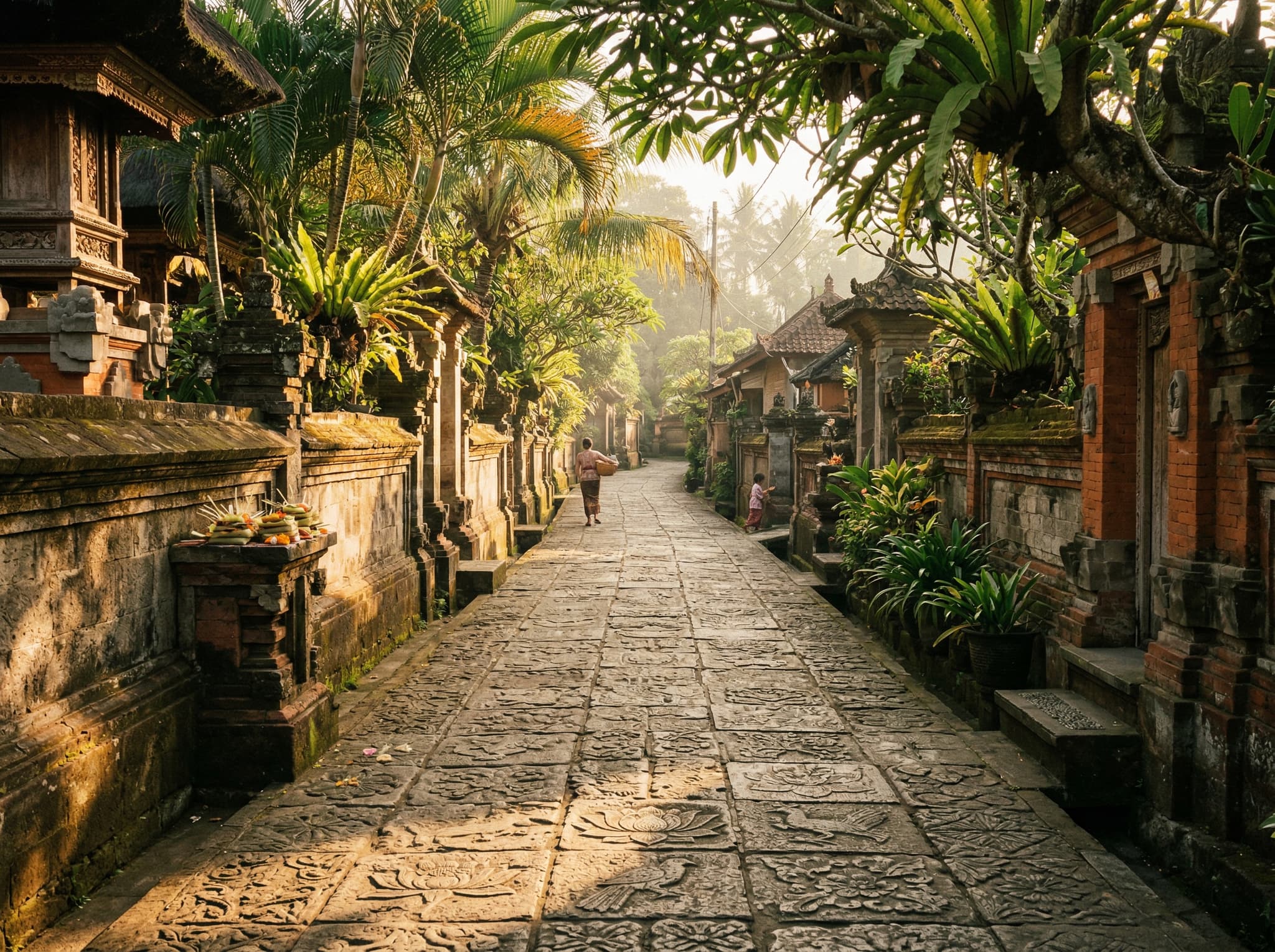
Jalan Kajeng is one of the narrowest streets leading off the center of Ubud, and one of the oldest. The pavement is carved with small reliefs — animals, lotus flowers, geometric patterns pressed into the stone by local artists years ago. Most visitors walk right over them on their way somewhere else. The Kajeng Street Market sits along this road, a handful of vendors setting up each morning before most of Ubud's cafés have turned on their espresso machines.
It's a small market. That's the first thing worth saying, because anyone expecting the scale of Ubud's main Art Market will recalibrate quickly. The Kajeng Street Market started as a nearby overflow during pandemic-era renovations of the Art Market — vendors who needed somewhere to sell, a street that had the space. When the Art Market reopened, the Kajeng market didn't disappear. It had found its own rhythm, its own regulars, its own reason to persist. That quiet stubbornness is part of what makes it worth visiting.
What You'll Find at Kajeng Street Market

The market is almost entirely food. No sarongs, no carved wooden cats, no "same same but different" t-shirts. Vendors arrive early and lay out what they've cooked that morning: nasi campur wrapped in banana leaf, jaje Bali (traditional rice cakes in bright colors), lawar, fried tempeh, fresh sambal being ground in stone mortars. The smell is pandan and coconut milk, layered over charcoal and clove cigarettes.
Most of what's sold here is made for Balinese mornings — food that's meant to be eaten quickly, standing or walking, before the day's work begins. A portion of nasi campur runs around IDR 20,000–30,000. Jaje Bali and small snacks are cheaper, often IDR 5,000–15,000 for a portion. These are approximate ranges and shift with ingredients and season, but the market stays firmly in local-price territory.
Look for canang sari (small woven offering baskets) placed among the food stalls. They're not decoration — they're daily offerings. Step around them, not over them.
The vendors are mostly women from the surrounding banjar (neighborhood community). Conversations are in Balinese and Indonesian. A smile and a point will get you fed. If you want to ask for something without meat, tanpa daging is the phrase that works — more reliably understood here than "vegetarian," which can be interpreted loosely.
How Kajeng Street Market Compares to Ubud Art Market
The Ubud Art Market — Pasar Seni Ubud — is a five-minute walk south. It's large, busy, tourist-facing, and sells everything from handwoven textiles to mass-produced magnets. It has its own value, especially for crafts and bargaining practice.
Kajeng Street Market is a different thing entirely. It's smaller, food-only, and oriented toward locals. There's no bargaining — prices are set and low. The energy is quieter. If the Art Market is the front room of Ubud's commercial life, Kajeng is the kitchen.
At a Glance: Kajeng vs. Art Market
Kajeng Street Market
Food only, local prices, no bargaining, done by 10 AM
Ubud Art Market
Crafts, textiles, souvenirs, bargaining expected, open all day
Practical Details

The market is at its best between 6:30 and 8:30 AM. By 9:00, most vendors are packing up. By 10:00, the street is just a street again. This isn't a destination market — it's a morning habit.
To get there, walk north from the Ubud Royal Palace along Jalan Kajeng. The carved stones in the pavement will confirm you're on the right road. The market clusters along the first 100 meters or so. There's no signage and no marked entrance. You'll know it by the steam and the banana leaves.
On ceremony days — and there are many in Bali — the market may be smaller or absent entirely. Galungan, Kuningan, and major temple ceremonies can shift the schedule. Vendors prioritize offerings and family obligations. If you arrive and the street is quiet, that's not a missed opportunity. That's Bali working as it should.
The sacred and the daily share the same table here. A vendor might arrange a canang sari beside her sambal, incense smoke drifting over banana-leaf packets of rice. This isn't performance — it's the texture of ordinary Balinese life.
Bring small bills. IDR 5,000 and 10,000 notes make transactions easier. Most vendors don't carry much change, and none accept digital payment.
Is Kajeng Street Market Worth Visiting?
If you want a curated food-hall experience with English menus and Instagram lighting, this isn't it. If you want to eat what Ubud eats before the yoga studios open, walk up Jalan Kajeng early and see who's cooking.
The market is small enough that you can see everything in fifteen minutes. But the best version of the visit is slower — buy a portion of nasi campur, find a spot on the low wall, and watch the street wake up. The light at that hour comes in sideways through the trees, and the carved stones in the pavement catch it in a way that makes the whole road feel deliberate, like someone thought carefully about what this street should be.