Puri Agung Buleleng was the seat of North Bali's most powerful kingdom. Here's the colonial-era history and practical details for visiting Singaraja's royal palace.
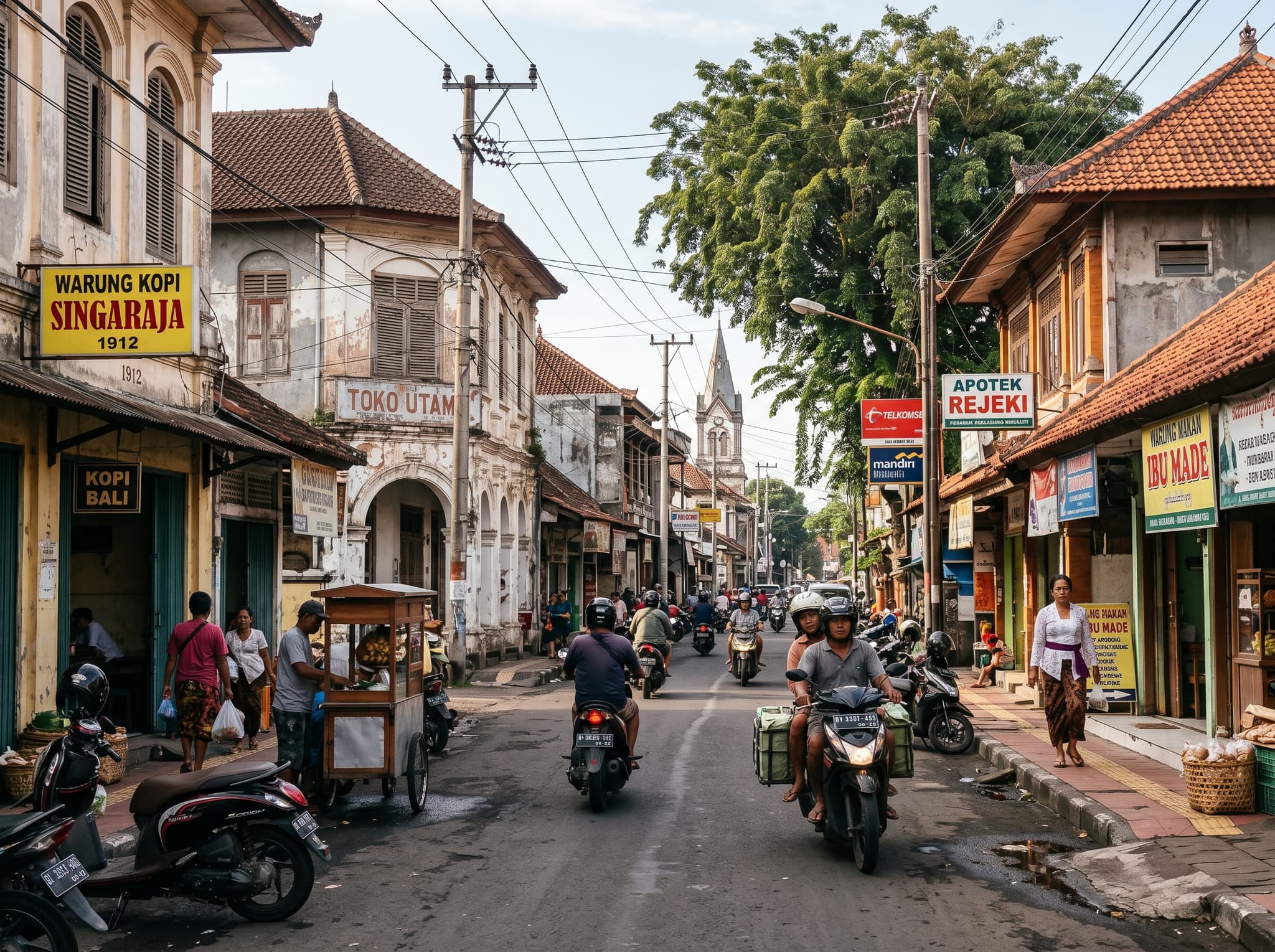
Most visitors to Bali never make it to Singaraja. The island's tourism center shifted south decades ago — to Kuta, Seminyak, and the airport corridor — and the old northern capital became a place people drive through on their way to waterfalls or dolphin tours. But for roughly three centuries, Singaraja was the center of power in Bali, and Puri Agung Buleleng was the seat of the kingdom that made it so. Walking through the palace gates without that context means missing most of what makes this place worth stopping for.
What the Palace Was
Puri Agung Buleleng was the royal court of the Buleleng kingdom, the most powerful of Bali's northern kingdoms and, for a time, one of the most strategically important polities in the Indonesian archipelago. The palace served as the administrative and ceremonial heart of a dynasty that controlled Bali's north coast — and with it, the trade routes connecting the island to Java, Lombok, and the wider Malay world.
The kingdom's power derived from geography. Singaraja's harbor was Bali's primary point of contact with the outside world, which meant the Buleleng rulers controlled what came in and what went out: textiles, rice, slaves, opium, and eventually the attention of the Dutch East Indies colonial government.
Historical Context
Kingdom
Buleleng (one of nine Balinese kingdoms)
Peak Influence
17th–19th centuries
Key Figure
Raja Gusti Ngurah Panji Sakti (founder)
Colonial Contact
Dutch military expeditions, 1846–1849
The palace's founding traces to the 17th century under Gusti Ngurah Panji Sakti, a figure who looms large in Balinese historical memory. He consolidated control over the north coast and established Singaraja as his capital. The dynasty he founded would rule Buleleng for generations — through periods of expansion, internal rivalry with southern Balinese kingdoms, and ultimately, confrontation with European colonial power.
The Dutch Wars and What They Changed
The building standing today cannot be separated from the events of the 1840s. The Dutch, who had been tightening their grip on the Indonesian archipelago for two centuries, turned their attention to Bali in earnest when disputes over shipwreck salvage rights — the Balinese custom of tawan karang, which claimed goods from ships wrecked on their shores — gave them a pretext for military intervention.
Three Dutch military expeditions hit Buleleng between 1846 and 1849. The first two were repelled or stalemated — a fact that tends to surprise people who assume colonial conquest was always swift. The Buleleng forces, allied at times with the neighboring kingdom of Karangasem, fought effectively enough to embarrass the Dutch military command. But the third expedition, in 1849, brought overwhelming force. Buleleng fell. The raja was killed or fled, depending on which account you follow, and the kingdom came under Dutch control.
This matters for understanding the palace because what stands today is largely a reconstruction. The original complex was damaged during the colonial wars and subsequent periods of upheaval. The palace was rebuilt and modified over the decades that followed, incorporating elements that reflect both traditional Balinese palace architecture and the colonial period that reshaped it.
What to See Today

The palace is modest by the standards of, say, the Ubud royal palace or the grand puri complexes of Klungkung. That modesty is itself part of the story — it reflects the diminished political role of the Buleleng royals after colonial subjugation and the later shift of Bali's center of gravity southward.
The compound follows the traditional Balinese puri layout: a series of courtyards (jaba, jaba tengah, jeroan) moving from public to increasingly private and sacred spaces. The main gate features carved stonework in the North Balinese style, which is notably different from what most visitors encounter in southern Bali — heavier, more ornate, with influences that reflect the north coast's longer history of contact with Javanese and Chinese artistic traditions.
Inside, the palace contains a small collection of royal artifacts, historical photographs, and remnants from the kingdom's history. The collection is not extensive or professionally curated in the way a museum would be, but it includes items that bring the history into focus: old royal portraits, colonial-era documents, and ceremonial objects.
Visiting Details
Layout
Traditional multi-courtyard Balinese puri
Notable Feature
North Balinese carved stone gate
Inside
Royal artifacts, historical photos, ceremonial items
Status
Still home to descendants of the royal family
The palace remains a living compound — descendants of the Buleleng royal family still reside here. This is common with Balinese puri and worth keeping in mind. Visitors are welcome, but this is someone's home and an active ceremonial space, not a ticketed museum. Dress respectfully, ask before photographing people or private areas, and treat the visit the way you would any invitation into someone's house.
Visiting Puri Agung Buleleng

The palace sits on Jalan Veteran in central Singaraja, within easy walking distance of Gedong Kirtya (the colonial-era lontar manuscript library) and the old Chinese temple Ling Gwan Kiong near the harbor. Together, these three sites form a natural walking loop that covers Singaraja's layered history — Balinese royal, Dutch colonial, and Chinese trading community — in a couple of hours.
There is no formal ticket counter. A small donation is customary and appreciated — IDR 10,000 to 20,000 is standard. Mornings tend to be quieter. If a ceremony or family event is underway, access to inner courtyards may be restricted; this is normal and should be respected without question.
The palace does not take long to visit — 30 to 45 minutes is typical. But the value of the stop scales directly with how much context you bring to it. Without the backstory, it is a modest courtyard with some old photographs. With it, it is the place where one of Bali's most consequential chapters — the collision between an independent Balinese kingdom and European colonialism — played out. That distinction is worth the short detour from the southern tourist corridor.