A 9th-century cave sanctuary near Ubud where Hindu and Buddhist traditions overlap — plus visiting tips, history, and what most tourists miss.
Most visitors to Bali's temples are looking at structures built upward — tiered shrines, split gates, pagoda-style meru towers. Goa Gajah asks you to look in the other direction. Carved directly into a rock face along the Petanu River valley sometime around the 9th century, this cave sanctuary is one of the island's oldest and strangest sacred sites — a place where Hindu and Buddhist elements overlap in ways that scholars are still sorting out a thousand years later.
The site is compact. You can walk the whole thing in under an hour. But there's more going on here than its size suggests, and understanding even a little of the context makes the visit significantly better.
The Cave and Its Famous Facade

The entrance to Goa Gajah is what everyone photographs — a gaping mouth carved into the rock, surrounded by a riot of demonic faces, animals, and vegetation rendered in high relief. The central figure's open mouth serves as the doorway itself. Whether this represents Bhoma (a protective earth spirit common in Balinese Hindu iconography) or something else entirely has been debated for decades. Dutch archaeologists who documented the site in the 1920s weren't sure. Modern scholars still aren't fully aligned.
Step inside and the cave is surprisingly modest: a narrow T-shaped corridor cut about 13 meters into the rock. To the left, you'll find a niche containing a statue of Ganesha, the elephant-headed Hindu deity. To the right, three lingam-yoni sets — abstract representations of Shiva and his consort — sit in carved niches. The air is cool and heavy with incense. The ceiling is low. It feels genuinely old in a way that Bali's more elaborately maintained temples sometimes don't.
The cave functioned as a meditation space — hermitage rather than congregation hall. Monks or priests would have retreated here for contemplation, not ceremony. That intimacy is still palpable.
The Bathing Pools
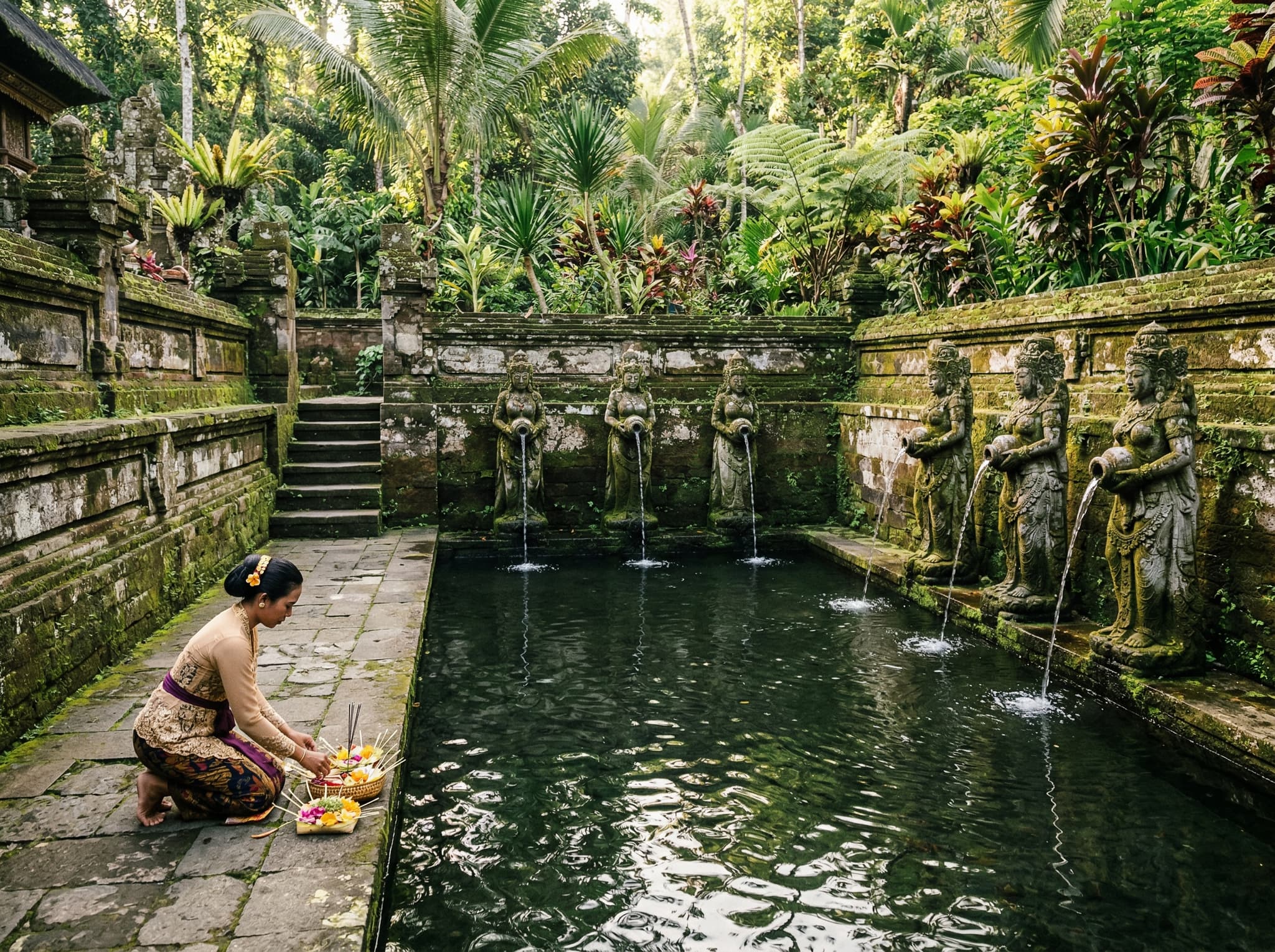
In front of the cave, a short flight of stone steps leads down to a courtyard dominated by a set of bathing fountains that were only rediscovered in 1954. They'd been buried under centuries of volcanic sediment and earth. Six female figures — three on each side — hold vessels from which water flows into a long rectangular pool. These are thought to represent Hindu river goddesses or celestial nymphs (widyadhari), and the pool likely served a ritual purification function similar to what you'll see at Tirta Empul, Bali's most famous water temple about 15 minutes north.
Site Details
Carved
Approximately 9th century CE
Rediscovered
1923 (cave); 1954 (bathing pools)
Religious Affiliation
Hindu-Buddhist hybrid
UNESCO Status
On Indonesia's tentative list
The fountains are still active — water still runs through the carved figures into the pool. Balinese worshippers still use the site for prayer and offerings. On any given morning, you'll see locals in ceremonial dress placing canang sari (small woven offering baskets) at the cave entrance and around the pools while tourists navigate around them. It's a working sacred site, not a museum.
The Grounds: What Most Visitors Miss
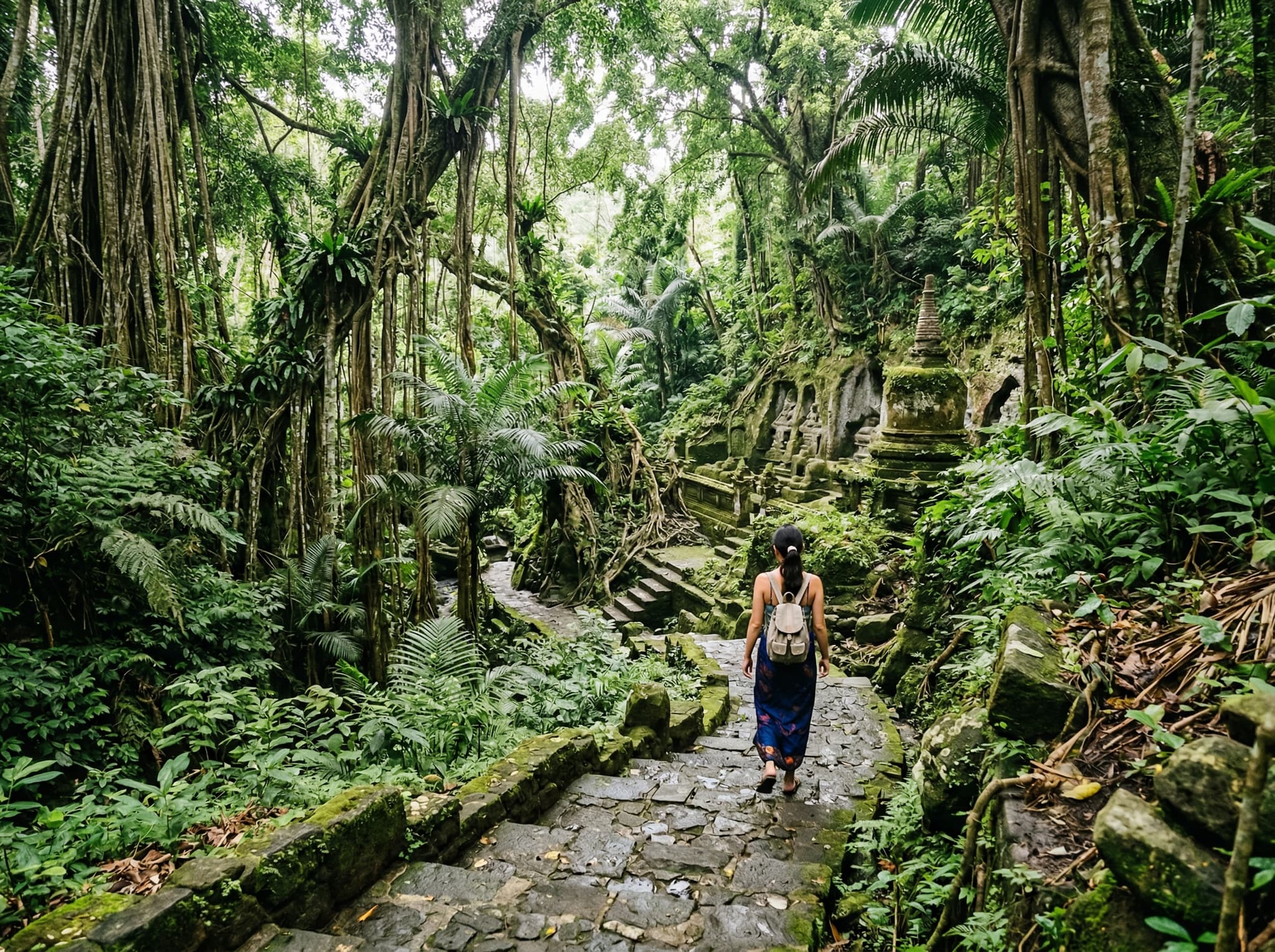
The majority of tour groups spend 15–20 minutes at Goa Gajah — photograph the cave mouth, glance at the pools, leave. This misses the best part. The site extends down into the Petanu River valley along a series of stone paths shaded by massive banyan and kapok trees. Down here you'll find Buddhist rock-cut reliefs, crumbling stupas, and additional carved niches that suggest the site was used by both Hindu and Buddhist practitioners — possibly simultaneously.
This coexistence isn't unusual in the context of 9th- to 11th-century Java and Bali. The Sailendra and Sanjaya dynasties that influenced Balinese culture during this period maintained both traditions, sometimes within the same royal court. Borobudur (Buddhist) and Prambanan (Hindu) were built within a few decades of each other in Central Java. Goa Gajah may represent a smaller, more integrated version of that same duality.
The river path takes an additional 15–20 minutes to explore and is significantly quieter than the main courtyard. The stone steps can be slippery, particularly after rain.
Visiting Practicalities
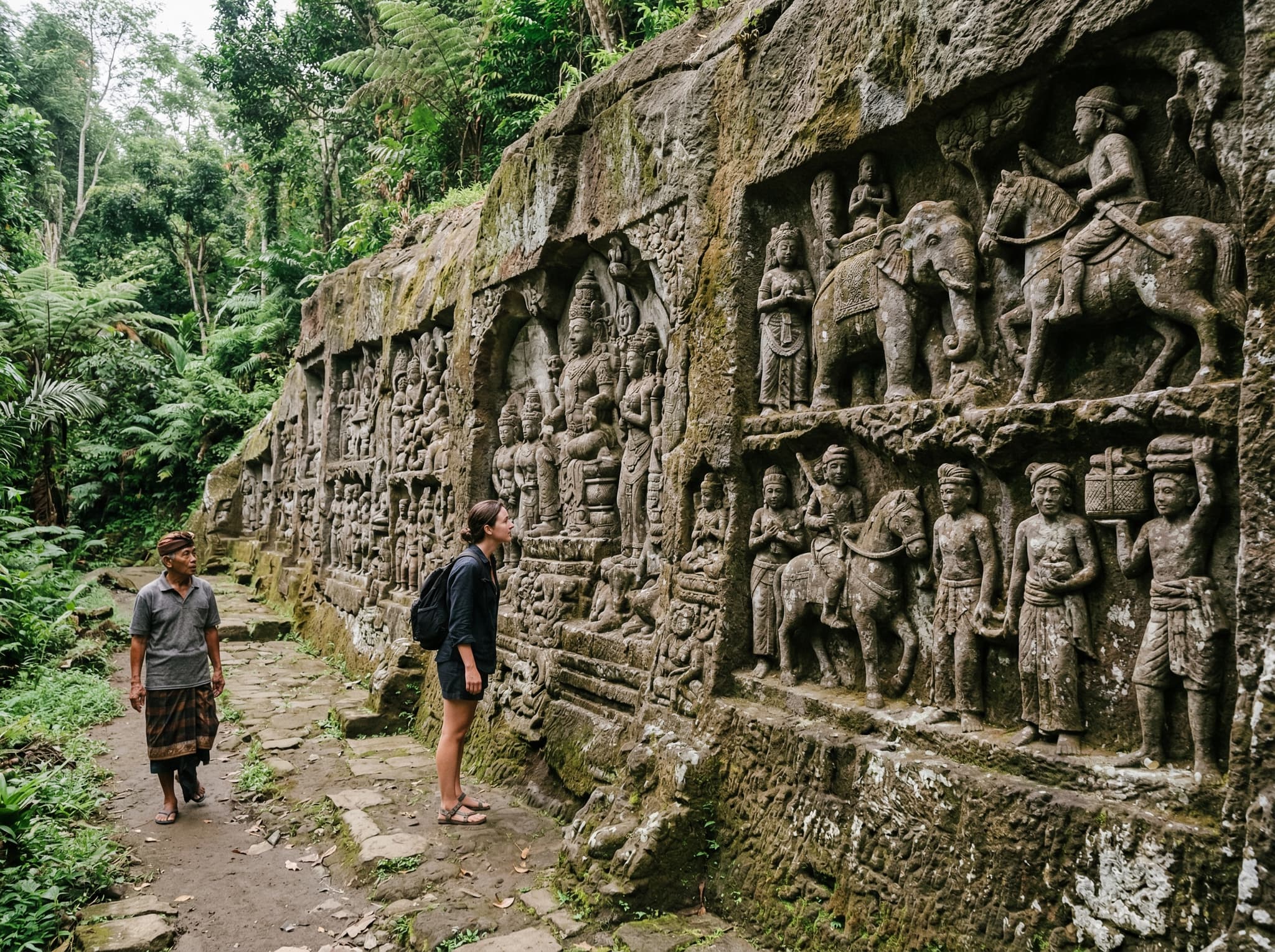
Goa Gajah sits along the main road between Ubud and the Gianyar regency, making it one of the easiest archaeological sites to reach from Bali's cultural center. Most visitors combine it with other nearby attractions.
Getting There
From Central Ubud
10-minute drive or 30-minute walk south
By Scooter
Parking available on-site (IDR 5,000)
By Rideshare
Grab/Gojek drop-off at the entrance
The site opens at 8 AM. Arriving before 9 AM means you'll share the cave with a handful of people rather than the shoulder-to-shoulder crowds that build by mid-morning when the tour buses from southern Bali arrive. Late afternoon (after 3 PM) is another good window.
Vendors and warungs line the path from the parking area to the entrance. Prices are tourist-adjusted but not unreasonable — expect to pay IDR 25,000–40,000 for nasi campur or a fresh coconut.
Why It Matters
Goa Gajah isn't Bali's most dramatic temple. It doesn't have the ocean backdrop of Tanah Lot, the mountain setting of Besakih, or the water rituals of Tirta Empul. What it has is age and ambiguity — the sense that you're standing in front of something that predates the neat categories we try to impose on Balinese culture. Hindu and Buddhist, sacred and practical, terrifying facade and quiet meditation chamber. The site holds contradictions comfortably, the way very old places tend to.
For anyone spending time in Ubud, it's one of the most rewarding short visits on the island — provided you go early, go past the main courtyard, and give it more than the 15 minutes most visitors allow.