Mount Batur volcano rising from its caldera with Lake Batur visible below, viewed from the Penelokan rim road in Kintamani, Bali — the defining landscape of the highland region this article explores

Kintamani: Bali's Highland Coffee Country and the Volcano Behind It

Bali, Indonesia
10 min read
Photo by Juan Cruz Mountford on Unsplash

Kintamani arabica coffee, Mount Batur sunrise treks, and caldera views — a practical guide to Bali's volcanic highlands beyond the day-trip circuit.

The road from Ubud climbs for an hour through monkey forest and terraced rice before the air changes. It gets cooler, thinner, faintly mineral. Then the trees break and there it is — Mount Batur, dark and ridged, sitting inside its own caldera with a crescent lake at its feet. This is Kintamani, and for most visitors it's a photo stop between temples. But the highlands deserve more time than that, particularly if you care about coffee.

The Coffee

Arabica coffee plants growing on volcanic hillside terrain in Kintamani, Bali, illustrating the shade-grown highland coffee origin discussed in the article's opening coffee section
Arabica coffee plants growing on volcanic hillside terrain in Kintamani, Bali, illustrating the shade-grown highland coffee origin discussed in the article's opening coffee sectionPhoto by Eyestetix Studio on Unsplash

Kintamani is one of Indonesia's designated geographic indication coffee origins — the only one in Bali. Arabica grows here between 900 and 1,500 meters on volcanic soil, shade-grown beneath tangerine and clove trees. The result is a clean, citrus-forward cup with low bitterness, distinct from the earthier robusta that dominates most of the island.

Several plantations along the Penelokan ridge road offer tastings, and the experience ranges from genuinely educational to tourist-circuit obligatory. The better ones walk you through wet-hull processing (the traditional Balinese method), let you see drying beds, and serve single-origin pour-overs alongside the inevitable luwak coffee pitch. A few things worth knowing:

Kintamani Coffee: What to Expect

Variety

Arabica, grown 900–1,500 m on volcanic soil

Flavor Profile

Citrus-forward, clean body, low bitterness

Processing

Wet-hulled (Giling Basah), traditional Balinese method

Tasting Cost

Often free at plantation stops; specialty pour-overs IDR 25,000–50,000

Luwak Coffee

Widely offered; ethical sourcing varies — ask whether civets are caged or wild-sourced

The plantation stops along the main road cater to tour buses and tend to push luwak coffee hard. If you're interested in Kintamani arabica on its own terms, look for smaller operations off the highway — Kintamani Eco Bike Coffee, for instance, pairs cycling with farm visits and has strong reviews. The best approach is to treat the coffee as a reason to linger in the highlands rather than a box to check on a day trip.

If you're buying beans to take home, look for single-origin Kintamani arabica with a roast date. The pre-packaged gift bags at tourist-facing plantations are often stale. Specialty roasters in Ubud and Seminyak also stock Kintamani-origin beans at better quality.

The Volcano and the View

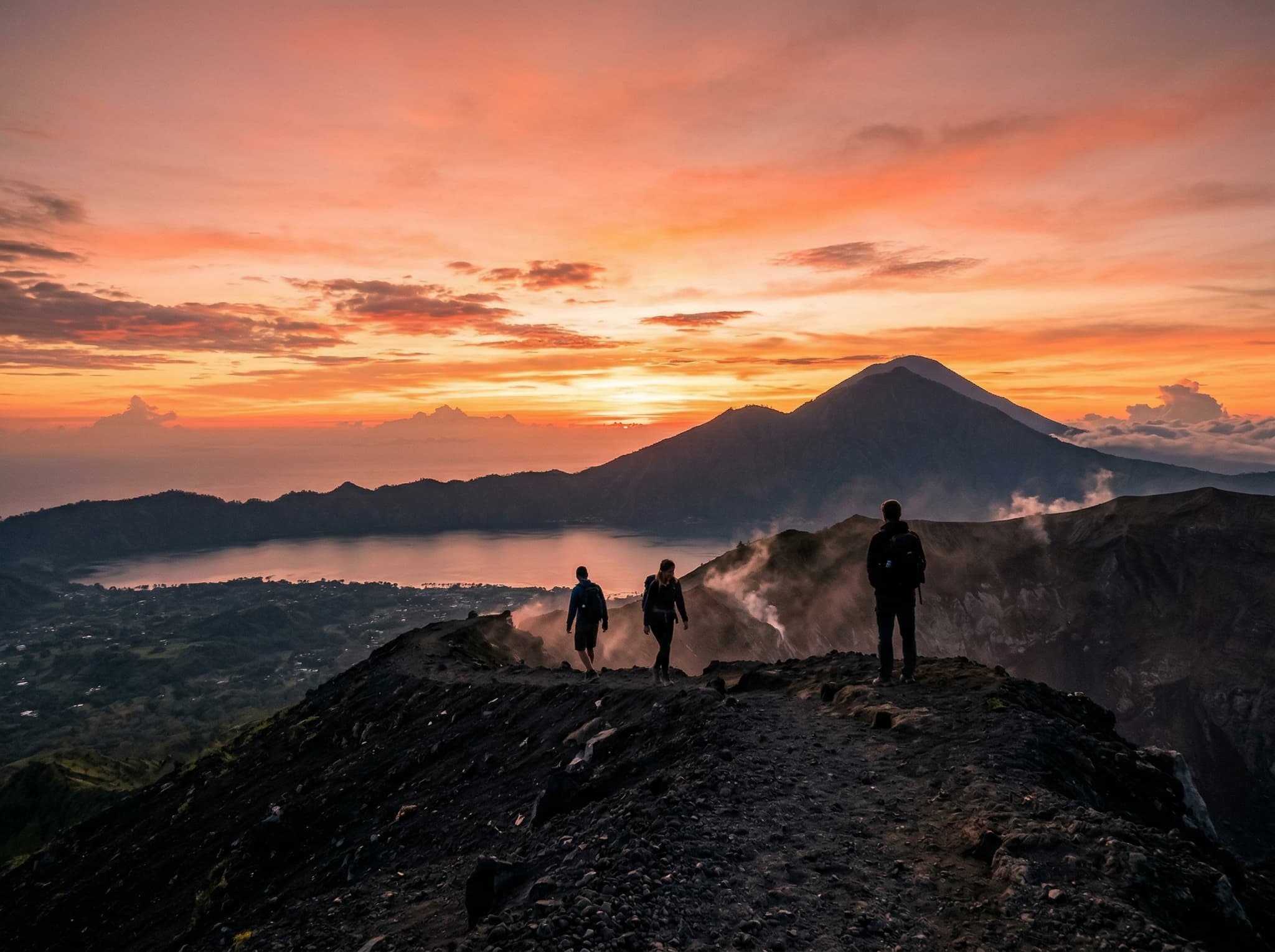
Mount Batur summit at sunrise with trekkers silhouetted against the orange and pink sky, Mount Agung visible in the distance — capturing the iconic sunrise trek experience that is the headline activity of a Kintamani visit
Mount Batur summit at sunrise with trekkers silhouetted against the orange and pink sky, Mount Agung visible in the distance — capturing the iconic sunrise trek experience that is the headline activity of a Kintamani visitAI-generated illustration

Mount Batur is 1,717 meters at the summit — an active volcano, last erupted in 2000, sitting inside a massive caldera alongside Lake Batur. The standard experience is the sunrise trek: a 2:00 AM departure, 1.5–2 hours of uphill hiking in the dark, then eggs and bananas cooked over volcanic steam vents at the top while the sun comes up behind Mount Agung.

Mount Batur Sunrise Trek

Group Trek

From IDR 550,000 (~$35) per person

Private Trek

IDR 350,000–1,380,000 (~$22–88) per person

Trek + Hot Springs

From IDR 750,000 (~$48) per person, includes Toya Devasya

Duration

6–7 hours total (standard); 8–10 hours with hot springs

Pickup

1:30–2:00 AM from South Bali hotels; base camp arrival ~3:30 AM

Guide

Licensed guide mandatory — included in all packages

Booking

1–4 weeks ahead recommended; sunrise slots sell out

A licensed guide is required by park rules, and booking through a reputable operator avoids the aggressive solicitation that happens at the base camp trailhead. Free cancellation up to 24 hours before is standard on most platforms. Tipping IDR 50,000–100,000 per guide is customary.
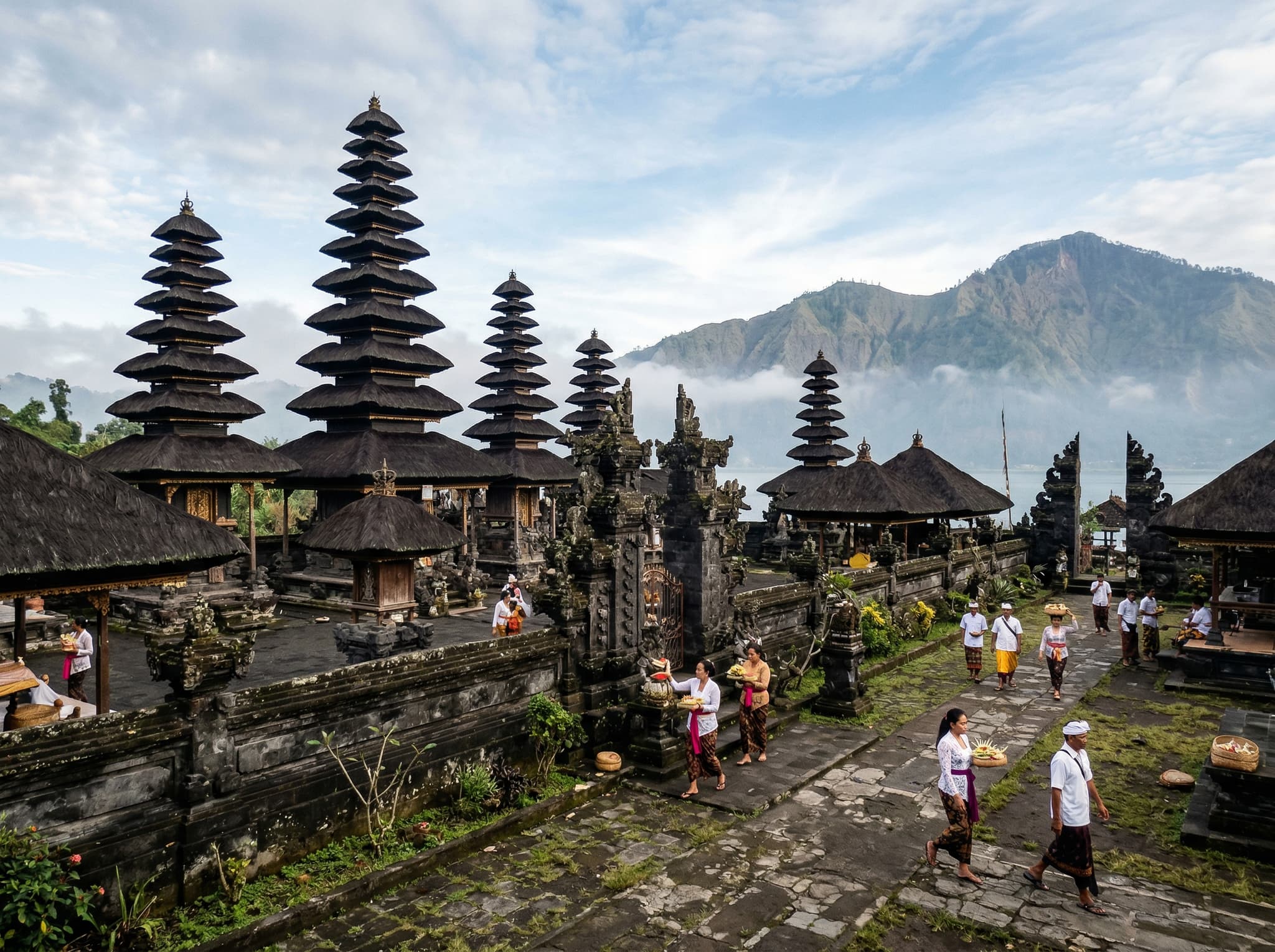
Pura Ulun Danu Batur temple in the Kintamani highlands, showing its tiered black-thatched meru shrines against the highland sky — one of the key cultural sites mentioned in the article alongside the volcano and coffee
Pura Ulun Danu Batur temple in the Kintamani highlands, showing its tiered black-thatched meru shrines against the highland sky — one of the key cultural sites mentioned in the article alongside the volcano and coffeeAI-generated illustration
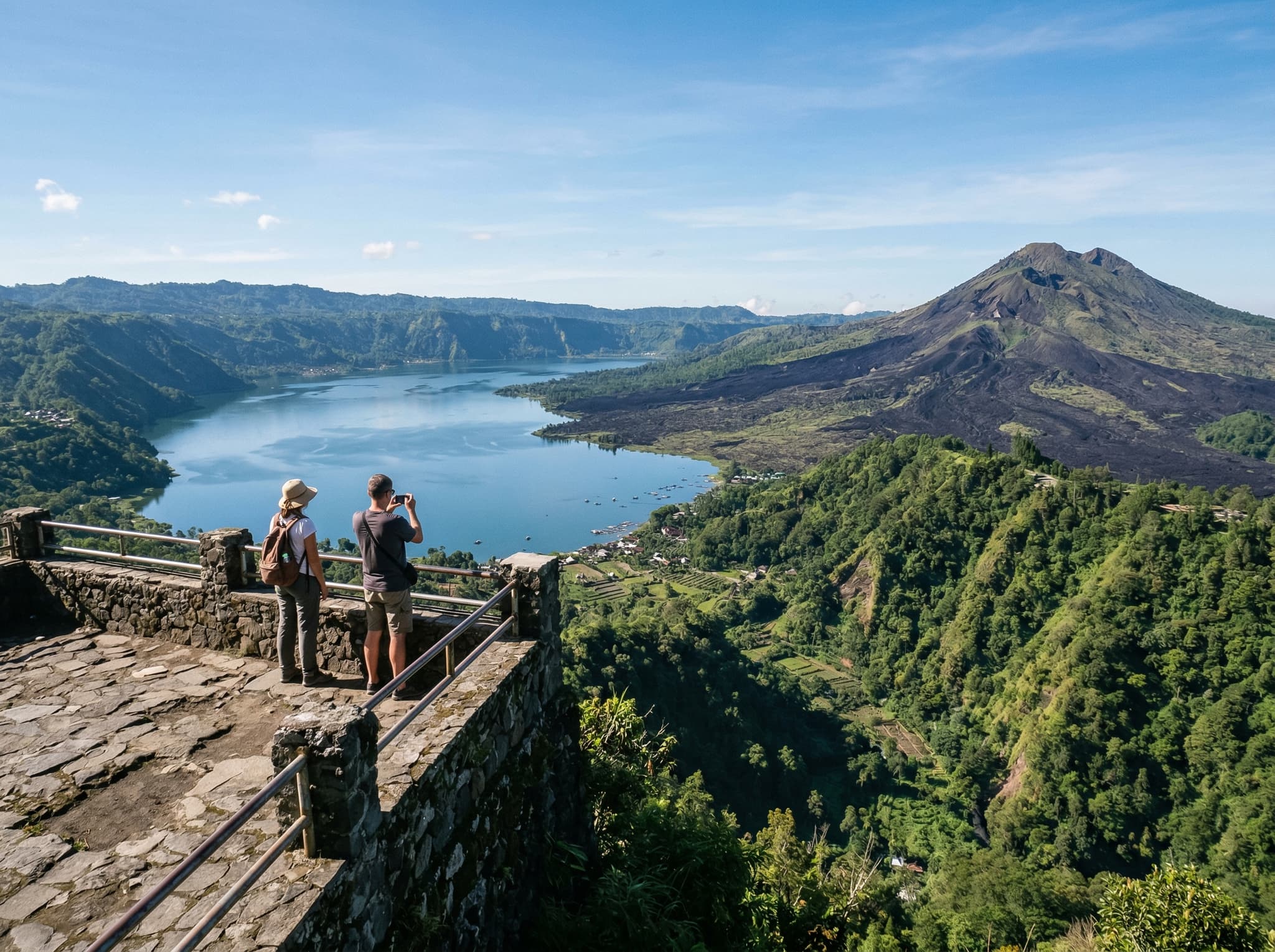
Penelokan viewpoint on the Kintamani caldera rim with the volcano and lake panorama spread below, showing the accessible daytime alternative to the sunrise trek described in the article
Penelokan viewpoint on the Kintamani caldera rim with the volcano and lake panorama spread below, showing the accessible daytime alternative to the sunrise trek described in the articleAI-generated illustration

For those who don't want a 2:00 AM alarm, the Penelokan viewpoint along the caldera rim offers the same panorama in daylight. It opens at 8:00 AM, and the window for clear views is narrow — fog typically rolls in between 10:30 and 11:30 AM. Arrive by 8:30 for the best conditions.

Wear sturdy shoes and bring a warm layer — it's genuinely cold at 4:00 AM at altitude. The trail is loose volcanic gravel in sections. The trek is not recommended for people with severe asthma, vertigo, or young children. Rainy season (November–March) increases cancellation risk due to weather.

Eating on the Rim

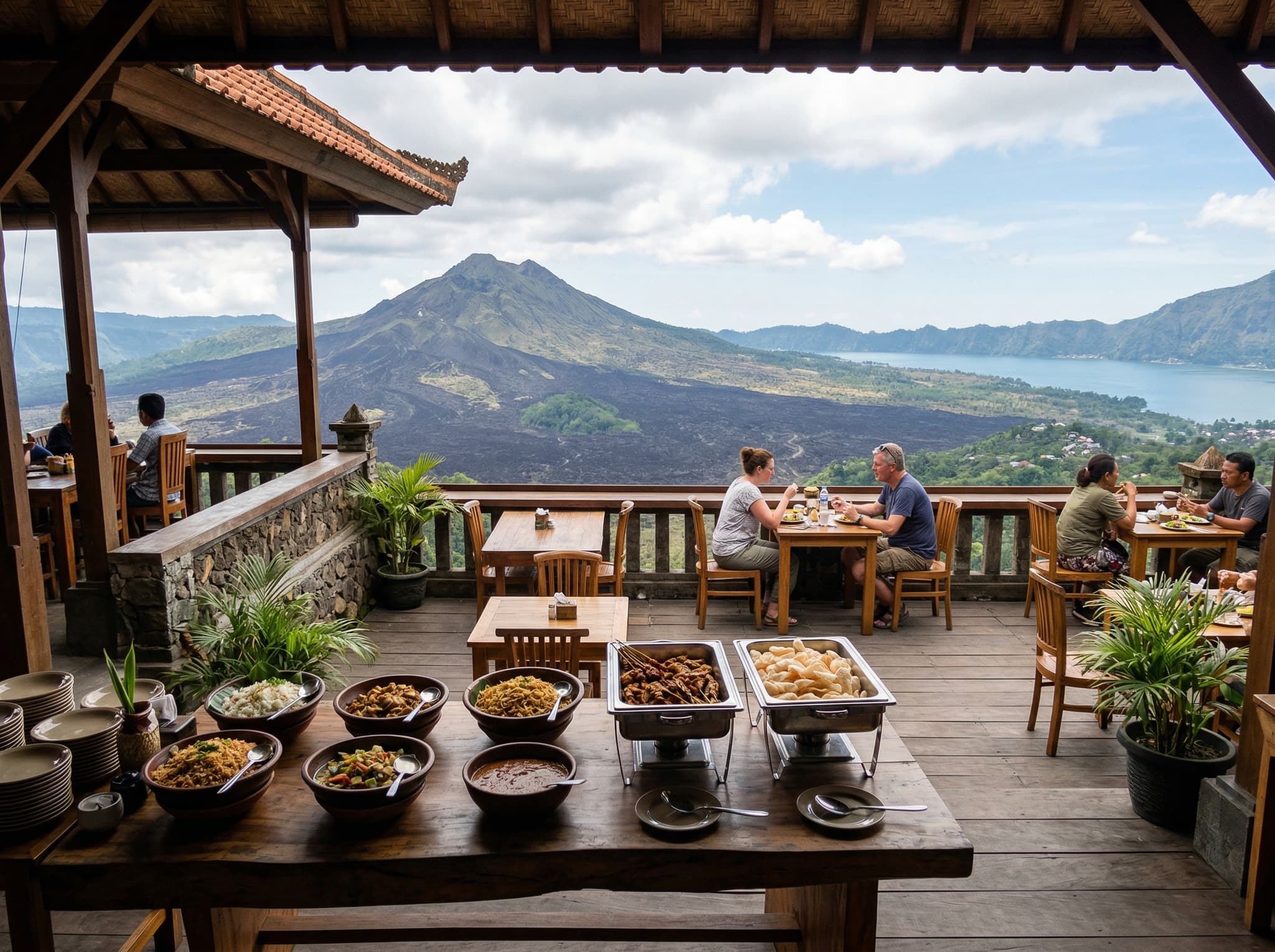
A caldera-rim restaurant dining terrace with Indonesian buffet dishes and Mount Batur visible through large windows or an open terrace — illustrating the rim-road dining experience at Lakeview or Gunung Sari restaurants where the view is the main attraction
A caldera-rim restaurant dining terrace with Indonesian buffet dishes and Mount Batur visible through large windows or an open terrace — illustrating the rim-road dining experience at Lakeview or Gunung Sari restaurants where the view is the main attractionAI-generated illustration

A string of restaurants lines the caldera rim road, all serving Indonesian buffet lunch with volcano views. Lakeview Restaurant is the most established, with buffet lunch at IDR 135,000–145,000++ per person or à la carte mains from IDR 36,000. Gunung Sari is a comparable alternative. The food at these places is decent, not exceptional — the view is the point. They open from around 8:00 AM to 9:00 PM.

Getting There
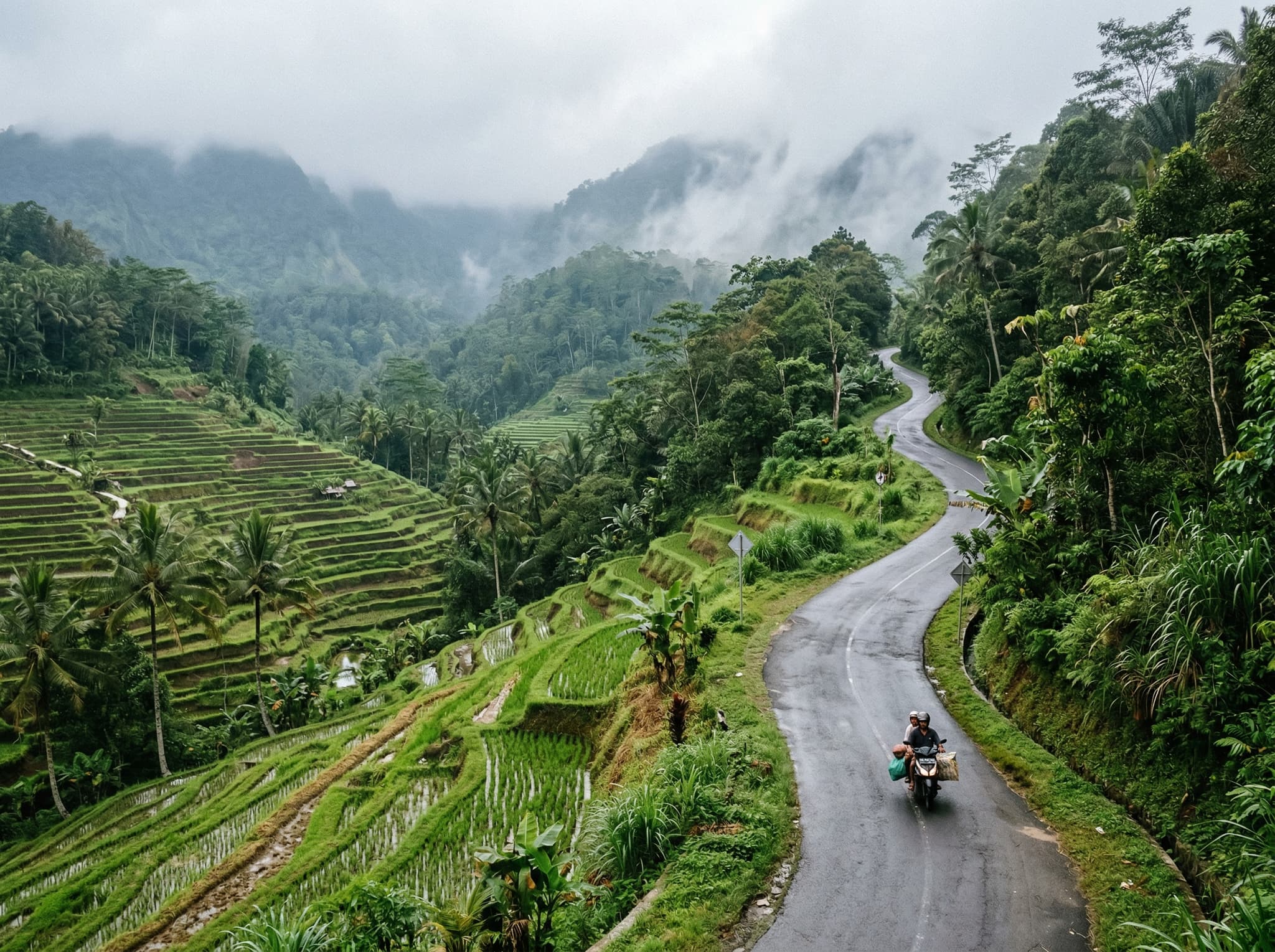
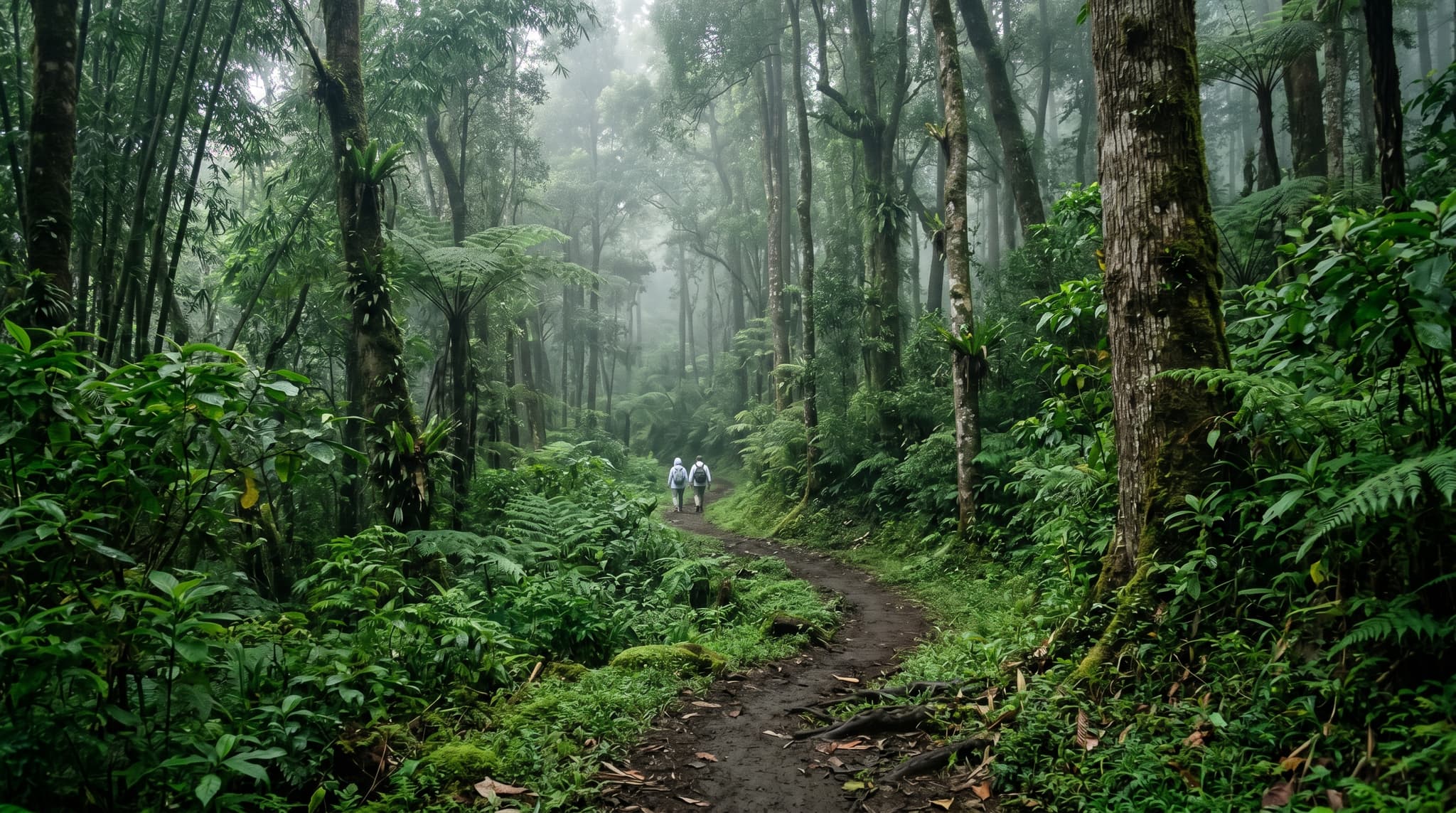
The winding highland road from Ubud climbing toward Kintamani through terraced rice fields and forest, conveying the journey and the gradual shift in landscape described in the article's opening
The winding highland road from Ubud climbing toward Kintamani through terraced rice fields and forest, conveying the journey and the gradual shift in landscape described in the article's openingAI-generated illustration

Transport from Ubud

Private Driver/Taxi

IDR 290,000–600,000 one-way (~$19–40); 1.5–2 hours

Scooter

~33 min via main roads; fuel IDR 60,000–90,000

Perama Shuttle

IDR 100,000–395,000; departs 11:30 AM daily; ~2 hours

From Seminyak or Canggu, add another hour and roughly IDR 600,000–1,000,000 for a private driver. Most sunrise trek operators include South Bali hotel pickup in the package price — confirm this when booking.

Beyond the Day Trip
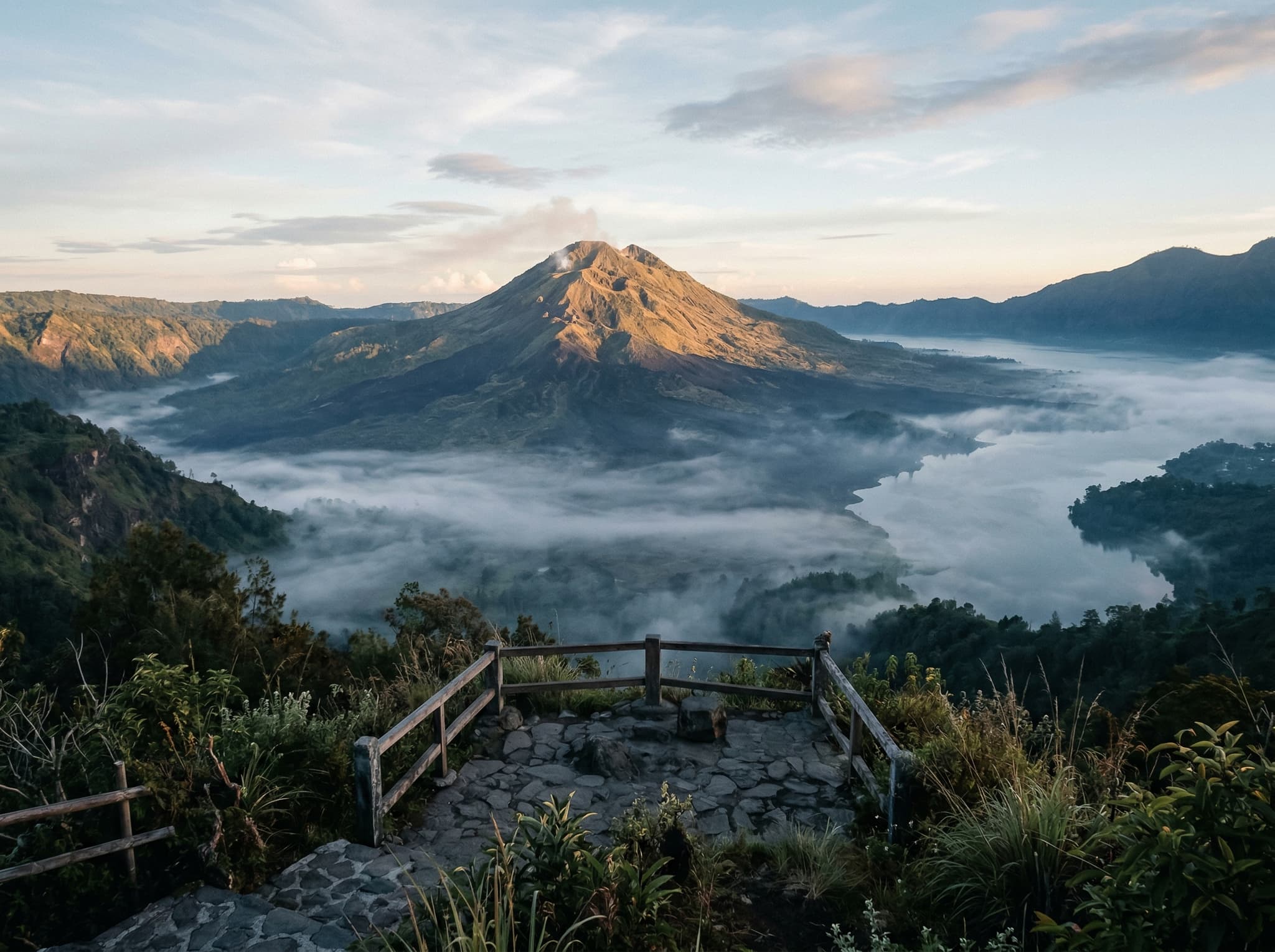
Early morning light on the Kintamani caldera with mist still in the valley and the volcano catching the first sun — evoking the overnight stay experience described in the article's closing section about the rewards of lingering in the highlands
Early morning light on the Kintamani caldera with mist still in the valley and the volcano catching the first sun — evoking the overnight stay experience described in the article's closing section about the rewards of lingering in the highlandsAI-generated illustration

Kintamani rewards an overnight stay. The morning light on the caldera is different from what you see at midday — quieter, less filtered through haze and tour-bus exhaust. A few guesthouses along the rim road offer rooms with direct volcano views for a fraction of what the same panorama would cost in a marketed destination. The coffee tastes better up here too, closer to where it grew, before it was packaged for the gift shop.
Frequently Asked Questions

No. Kintamani refers to the geographic origin — arabica grown on volcanic soil in Bali's highlands. Luwak coffee is a separate product made from beans eaten and excreted by civets. Both are sold in Kintamani, but they are distinct. The region's reputation rests on its arabica, not luwak.
Fees are collected at official posts on roads entering the designated tourism zone. If you're passing through on a main road, you may still be charged. Bring IDR 50,000 per adult in cash.
Park rules require a licensed guide. Independent hiking is technically not permitted and attempting it often leads to confrontations with local guide associations at the trailhead. Book through a reputable operator in advance.
Arrive before 9:00 AM. Fog typically rolls in between 10:30 and 11:30 AM, obscuring the caldera. Dry season (April–October) offers the clearest skies. July and August mornings are the coolest.
Yes. The Penelokan viewpoint, coffee plantations, Pura Ulun Danu Batur temple, and rim-road restaurants make a full morning. The trek is the headline experience, but the highlands have enough texture for a visit on their own terms.
A reasonable estimate: IDR 290,000–600,000 for a return driver, IDR 50,000 entrance fee, IDR 135,000–150,000 for a buffet lunch, and IDR 25,000–50,000 for coffee tastings. Total roughly IDR 500,000–850,000 (~$32–55) per person without the trek.
Share

Related Articles