Penglipuran Village in central Bali maintains centuries-old architecture and communal governance. Here's what to expect and how to visit.
Most Balinese villages are beautiful in a sprawling, organic way — paths curve around temples, compounds spill into rice fields, roosters set the schedule. Penglipuran is different. Walk through its main gate and you're looking at a single wide stone pathway, flanked on both sides by identically structured family compounds, each fronted by the same style of angkul-angkul (traditional Balinese gate). The symmetry is immediate and striking, and it raises an obvious question: why does this village look like this when nothing else on the island does?
The answer has less to do with aesthetics and more to do with a social philosophy that predates tourism by centuries.
What Makes Penglipuran Unusual

Penglipuran sits at around 700 meters elevation in Bangli Regency, one of the less-visited parts of central Bali. The village is home to roughly 226 families, and its layout follows the Balinese spatial concept of tri mandala — the division of space into three zones of sacredness. The most sacred zone (the village temple) sits at the high, uphill end. The middle zone is where people live. The lowest zone, downhill, is reserved for the cemetery and areas considered spiritually impure.
This isn't unique to Penglipuran — most traditional Balinese villages follow some version of tri mandala. What's unusual is how rigorously Penglipuran maintains it. Every family compound follows the same architectural template. Building materials are regulated: bamboo walls, clay tile roofs, stone bases. No family builds higher or grander than their neighbors. The result is a village that looks planned, almost curated — but it wasn't designed for visitors. It was designed around the principle that no household should visually or materially elevate itself above the community.
The village also prohibits polygamy — a detail that often appears in tourist literature without much context. In broader Balinese Hindu tradition, polygamy is technically permitted though uncommon. Penglipuran's ban is part of its awig-awig and reflects the village's particular emphasis on social equality within the community.
Walking the Village

The main pathway — a broad, immaculate stone walkway running roughly north to south — is the spine of the experience. On either side, 76 family compounds line up in neat rows. Each gate opens onto a private courtyard containing a family temple, living quarters, and a kitchen area, all arranged according to the same spatial rules.
Village Layout
Family Compounds
76 along the main path
Total Families
~226
Elevation
~700 meters
Bamboo Forest
Accessible at the southern end
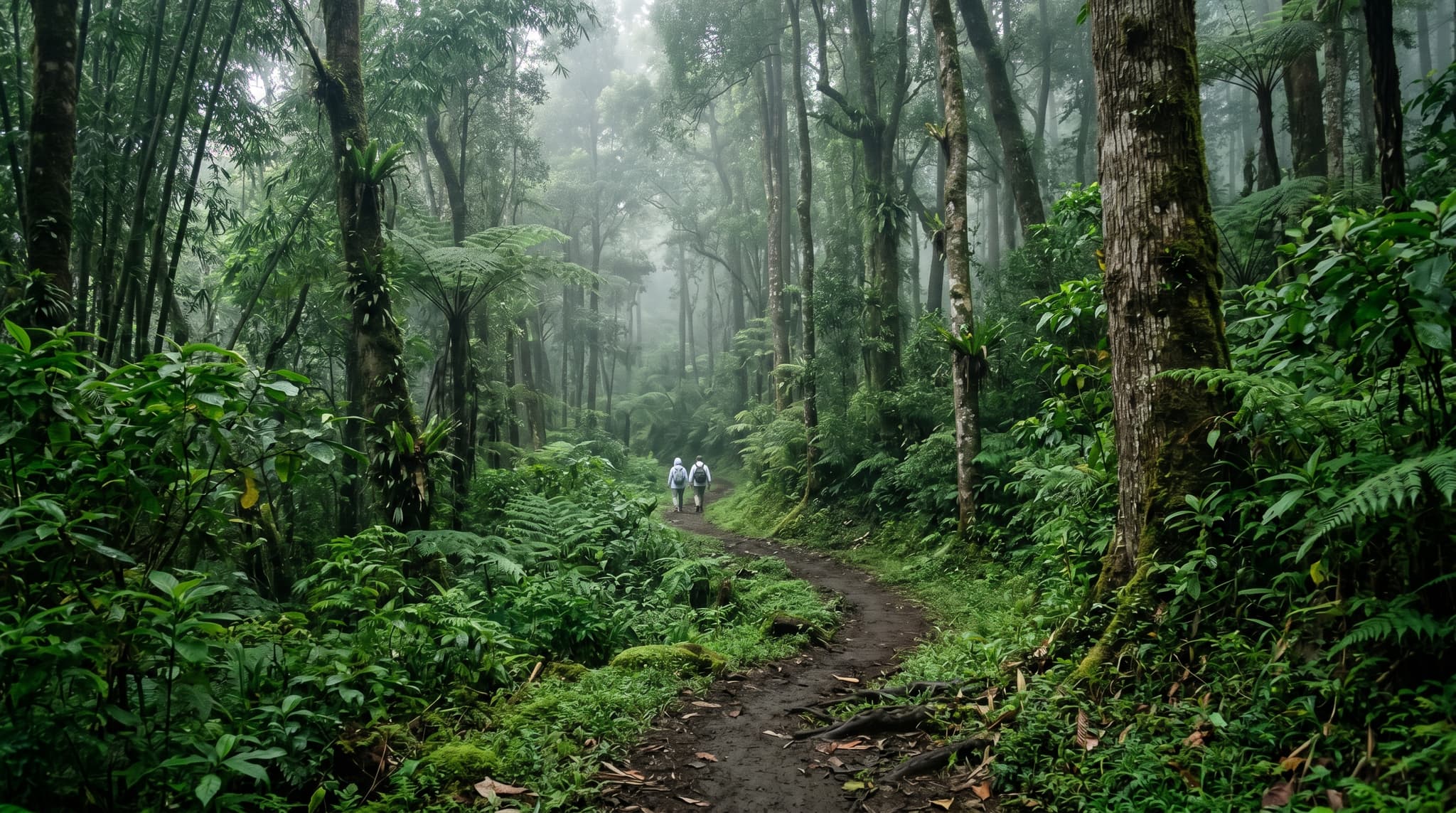
At the southern (downhill) end, the village opens into a bamboo forest with walking paths. It's a pleasant 15-minute loop — cool, shaded, and quiet even when the main village path is busy. The bamboo here is significant: the village has long been known for bamboo craftsmanship, and several compounds along the main path sell bamboo souvenirs and woven goods.
At the northern (uphill) end sits Pura Penataran, the village's main temple. Like most Balinese temples, it's closed to visitors during ceremonies and requires respectful dress (a sarong and sash) if you enter the outer courtyard. The temple isn't architecturally extraordinary by Bali standards, but its position — at the highest, most sacred point of this meticulously ordered village — completes the spatial logic that makes the whole place coherent.
The Tourism Question

Penglipuran was named one of the world's cleanest villages by various outlets over the past decade, and that recognition brought tour buses. On a busy day — particularly between 11 AM and 2 PM — the main path can feel crowded, with large groups moving through at the same pace. The village manages this reasonably well: entry fees go directly to the community, several families operate small warungs and craft stalls, and there's a genuine sense that tourism revenue is distributed rather than concentrated.
Still, it's worth being honest about what the experience is. Penglipuran is a living village, not a museum, but the main pathway has an undeniable theme-park quality during peak hours. The compounds are real homes, but many of the ones facing the main path double as souvenir shops. This doesn't make it inauthentic — the community has chosen to engage with tourism on its own terms, and the economic model is more equitable than what you'll find in most tourist-facing villages in Southeast Asia. But if you're expecting to stumble onto some untouched cultural secret, recalibrate.
Getting There and Practical Details

Penglipuran is about 50 kilometers northeast of Denpasar and roughly 45 minutes by car from Ubud, depending on traffic. There's no convenient public transport option — most visitors arrive by hired car or as part of a day trip that combines the village with other central Bali stops.
Visiting Practicalities
From Ubud
~45 min by car
From Denpasar
~1.5 hours by car
Entry Fee
IDR 50,000 (~$3.15) adult
Sarong Required
Provided at entrance if needed
Parking
Available on-site, included in fee
Common pairings include Kintamani (the volcanic caldera viewpoint, about 30 minutes further north) and Tirta Empul (the holy spring temple near Tampaksiring, roughly 25 minutes west). A driver for a full-day central Bali loop covering all three typically runs IDR 500,000–700,000 (~$31–$44).
There are no hotels or guesthouses within the village itself. The nearest accommodation options are in Bangli town or back toward Ubud.
Why It's Worth the Detour
Penglipuran isn't Bali's most dramatic sight. It doesn't have the vertiginous rice terraces of Tegallalang or the spiritual weight of Besakih. What it offers is something harder to find on an island increasingly shaped by outside investment and rapid development: a community that decided what it wanted to look like and then held the line. The uniformity of the architecture isn't conformity — it's a collective agreement, maintained across generations, that the village matters more than any individual household's desire to stand out.
That idea — quiet, principled, visible in every identical gate and roofline — is worth the 45-minute drive from Ubud.