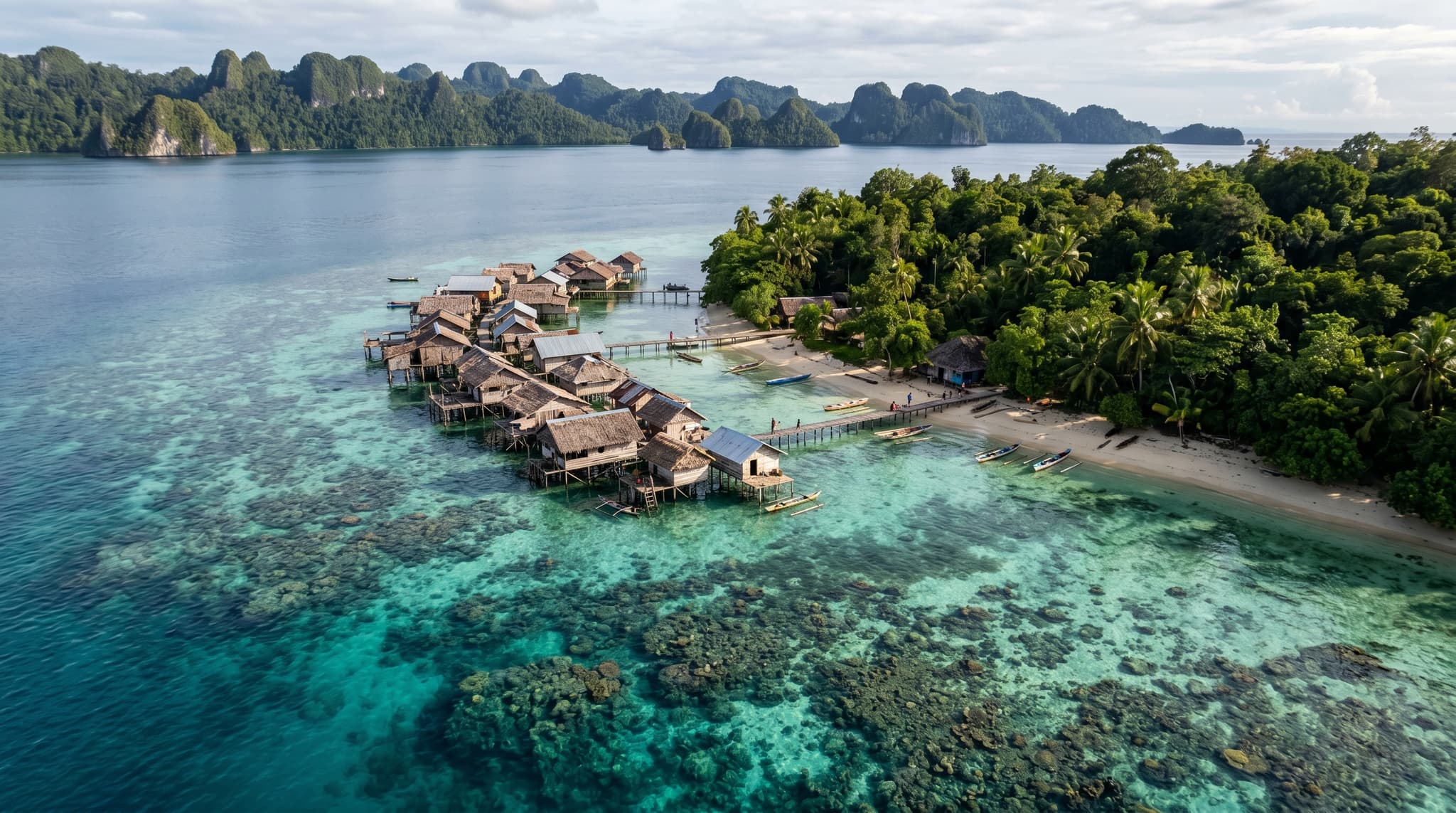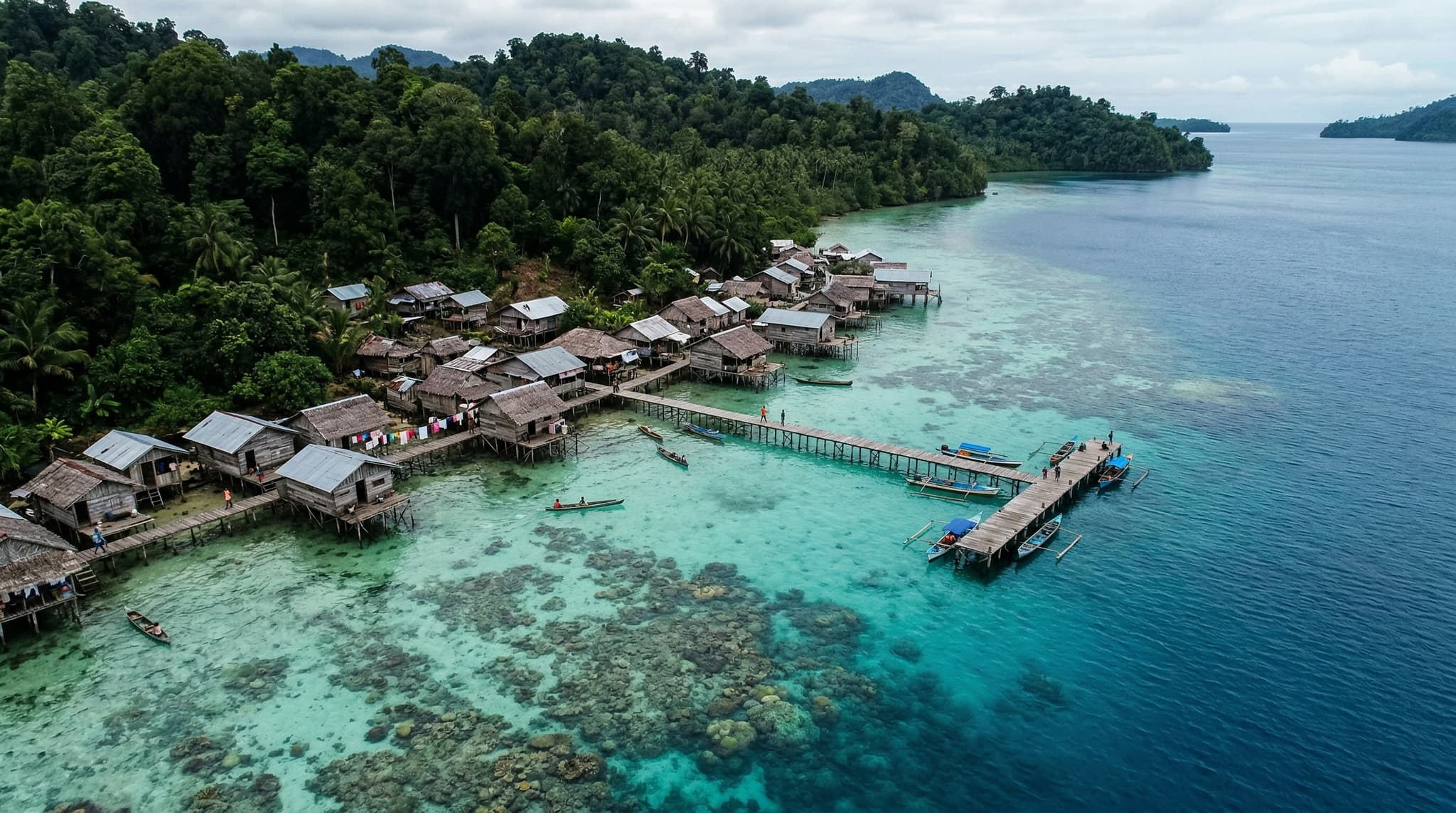
Sawandarek on Mansuar Island offers Raja Ampat's most accessible house reef and a working model of community-led marine conservation.
Most visitors arrive in Raja Ampat for the water. That's the right instinct — the marine biodiversity here is among the highest recorded anywhere on earth. But the reefs don't exist in isolation. They're tended, in a real and legal sense, by the communities who live alongside them. Sawandarek is one of those communities, and it's worth understanding what that means before you get in the water.
A Village Built Around the Reef

Sawandarek sits on the northwest coast of Mansuar Island, facing a house reef that drops off just meters from shore. The village is small — a few dozen families, wooden houses on stilts, a church, a jetty. It's the kind of place where chickens outnumber motorbikes and the loudest sound most afternoons is the wind through the trees or a boat engine approaching from the strait.
What makes Sawandarek distinct from many other villages in Raja Ampat is its early and deliberate turn toward marine conservation and community-managed tourism. The village declared its surrounding waters a no-take zone years before the broader Raja Ampat Marine Protected Area formalized similar protections across the archipelago. Fishing with nets and destructive methods — cyanide, dynamite — was banned by community agreement. The reef responded.
Sawandarek at a Glance
Village size
~30–40 families
House reef depth
1–18 meters
Snorkeling access
Directly from shore or jetty
Homestay options
Several family-run guesthouses
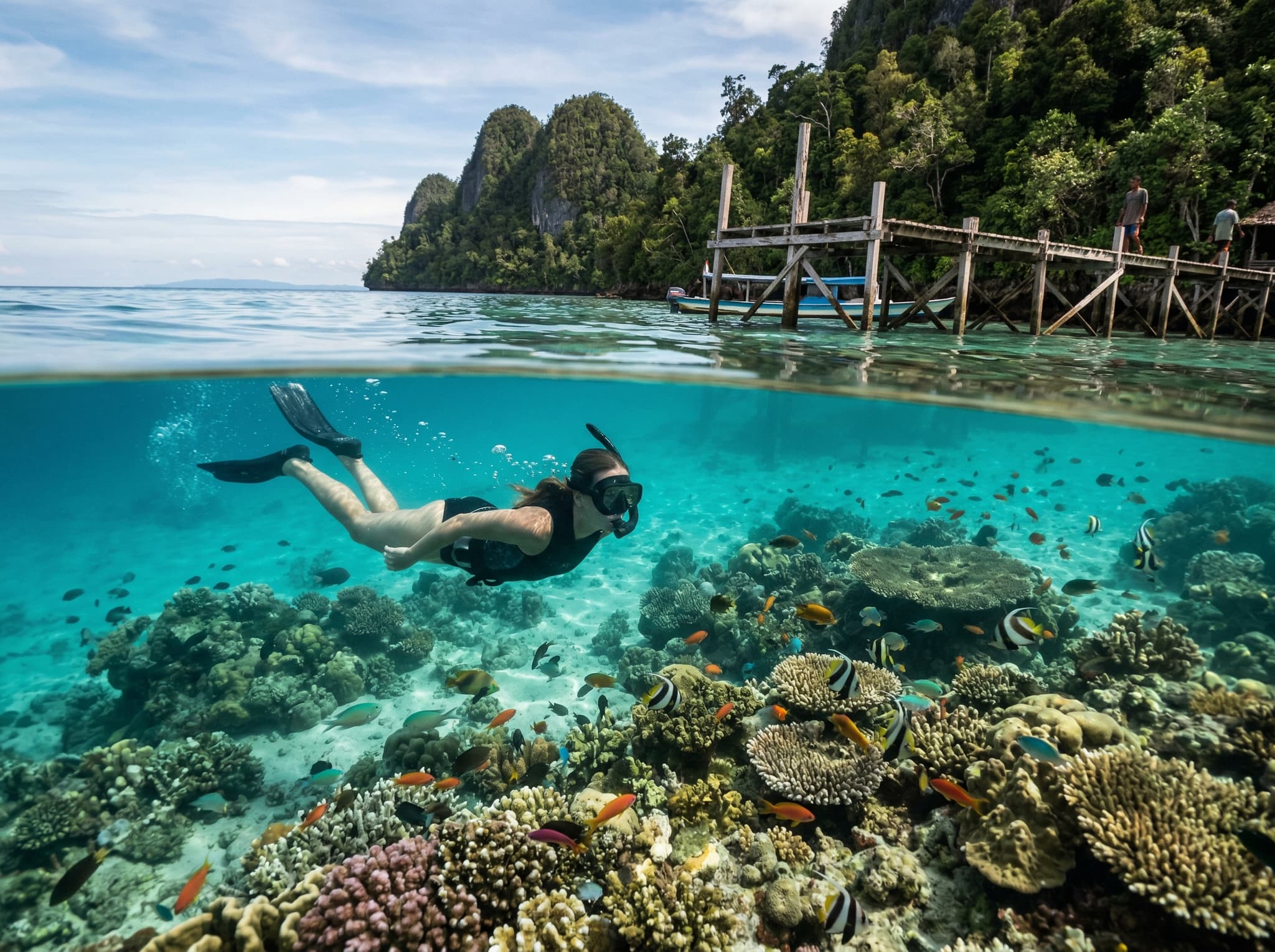
Today, the house reef at Sawandarek is one of the most frequently cited snorkeling sites in Raja Ampat — not because it's the most dramatic, but because it's immediately accessible and remarkably healthy. Hard corals in dense formations, schools of fusiliers, parrotfish, the occasional reef shark in the shallows. Divers who've been to more remote sites in the archipelago sometimes describe Sawandarek's reef as "what a healthy baseline looks like." That's not a small thing.
What Visiting Looks Like

Most travelers reach Sawandarek by boat from Waisai, the administrative capital of Raja Ampat on Waigeo Island. The ride takes roughly 30 to 45 minutes depending on conditions and the type of boat. Some visitors come on day trips arranged through dive operators or homestays elsewhere in the archipelago. Others stay in the village itself.
Staying in Sawandarek means a homestay — a room in or adjacent to a family's house, typically with basic but clean accommodations. Expect a mattress, a mosquito net, shared bathrooms with a mandi (water scoop) for bathing, and three meals a day prepared by your host family. The food is simple: rice, fish, vegetables, sometimes papaya or banana from the trees outside.
Homestay Practicalities
Typical cost
350,000–500,000 IDR/night including meals [VERIFY]
Booking
Often arranged via WhatsApp or through Waisai-based operators
Electricity
Generator or solar; limited hours in some homes
Phone signal
Weak to nonexistent; some spots get intermittent data
There's no resort infrastructure here. No dive shop on-site, no restaurant menu, no Wi-Fi lounge. That's the point, and it's also the limitation. Travelers who need reliable connectivity or a degree of comfort beyond the basics should plan accordingly — or stay at a nearby resort or liveaboard and visit Sawandarek as a day stop.
The Conservation Context
Raja Ampat's marine park tag — the entry permit purchased in Waisai — funds conservation and community programs across the archipelago. A portion of that fee flows back to villages like Sawandarek. This is the mechanism that makes community-based marine protection financially viable: when the reef has economic value alive, there's a structural incentive to keep it that way.
Sawandarek's no-take zone is enforced by the community itself. Villagers monitor the waters and report violations. The system isn't perfect — enforcement across Raja Ampat's vast and remote waters remains a challenge — but in the immediate vicinity of the village, it works. The reef's condition is the evidence.
For travelers interested in the intersection of conservation and community, Sawandarek is one of the more legible examples in Southeast Asia. It's not a curated eco-tourism experience with interpretive signage and guided talks — it's a working village that made a collective decision about its reef and now hosts visitors as part of the economic model that sustains that decision.
Snorkeling the House Reef

The house reef is the main draw, and it delivers without requiring a boat, a guide, or any particular expertise beyond basic swimming ability. Entry is from the jetty or the shallows near shore. Within minutes you're over dense coral gardens — table corals, staghorn formations, brain corals — in water ranging from waist-deep to several meters.
Marine life is abundant and varied. Expect to see anemonefish, damselfish, wrasses, butterflyfish, and larger species like parrotfish and grouper. Blacktip reef sharks are occasionally spotted in the shallows, particularly in the early morning. Turtles pass through. The visibility is generally strong during the dry season, sometimes exceeding 20 meters.
Who Sawandarek Is For
This isn't a place for travelers who want activities scheduled or comfort guaranteed. It's for people who are comfortable with quiet, with simplicity, with the mild uncertainty of a place that doesn't cater to visitors so much as accommodate them. The reward is proximity — to the reef, to the village, to a version of Raja Ampat that predates the dive resorts and liveaboards.
A night or two is enough for most visitors. Enough to snorkel the reef at different hours, to eat with your hosts, to sit on the jetty at dusk and watch the light do what it does across the strait. Then you move on — to Arborek, to Pianemo, to the dive sites further south. But Sawandarek stays with you as a reference point: this is what it looks like when a community and its reef are still on the same side.