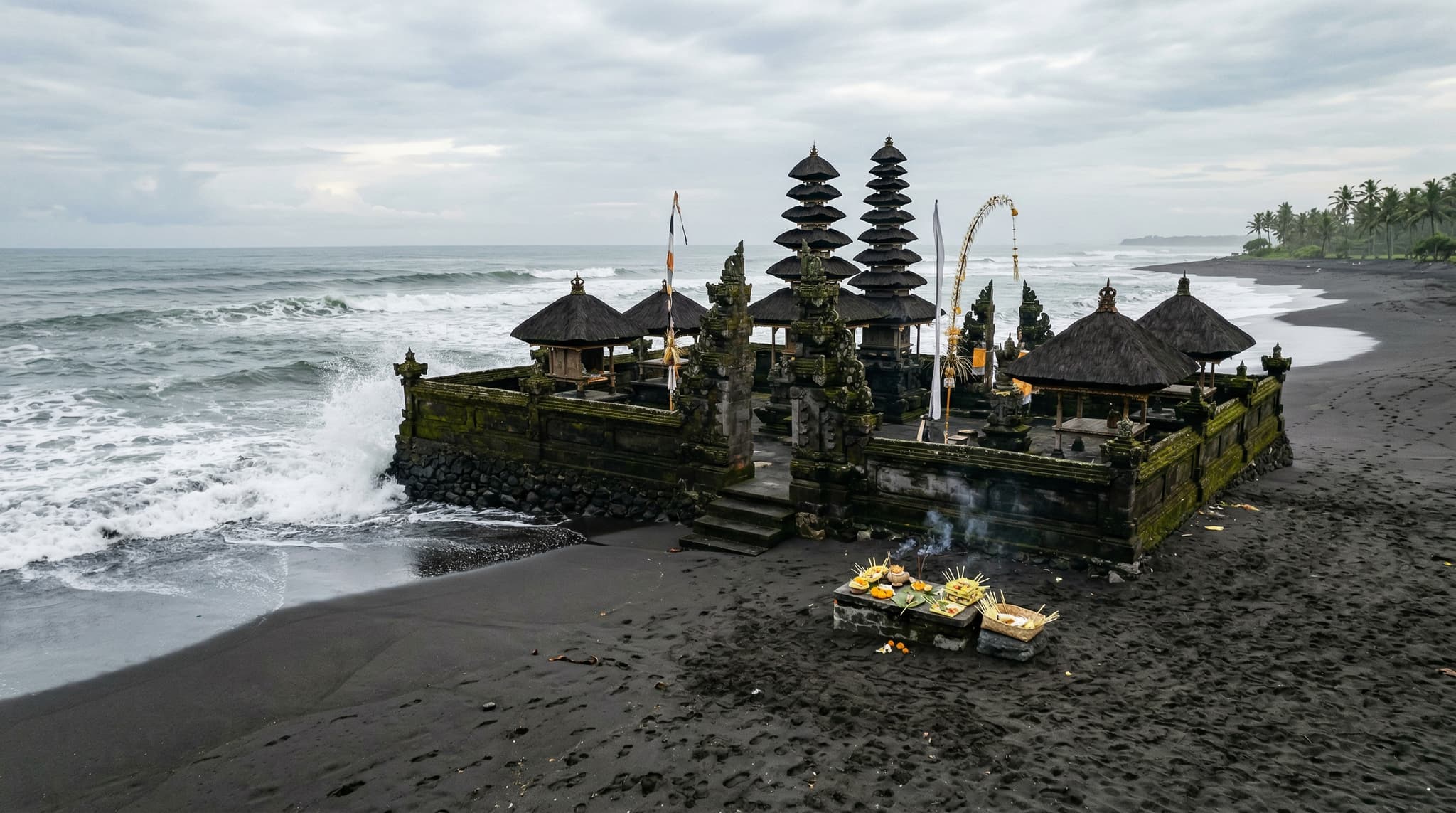
Pura Masceti is one of Bali's six holiest directional temples, guarding the south from Gianyar's black-sand coast — sacred, quiet, and crowd-free.
Most visitors to Bali have heard of Tanah Lot and Uluwatu — the island's dramatic cliff-top and ocean-perched temples that draw thousands of camera-wielding tourists daily. Far fewer have heard of Pura Masceti, a sea temple on Gianyar's black-sand coast that carries equal spiritual significance in Balinese Hinduism but attracts a fraction of the crowds. That imbalance says more about tourism patterns than it does about the temple's importance.
Pura Masceti is one of Bali's Sad Kahyangan Jagat — the six directional temples that form a spiritual compass across the island, each positioned to protect Bali from a cardinal or intercardinal point. This isn't a minor designation. These six temples are considered the holiest sites in Balinese Hinduism, foundational to the island's cosmological framework. Pura Masceti guards the south, facing the Indian Ocean from a stretch of quiet shoreline between Sanur and the Gianyar coast.
The Spiritual Framework
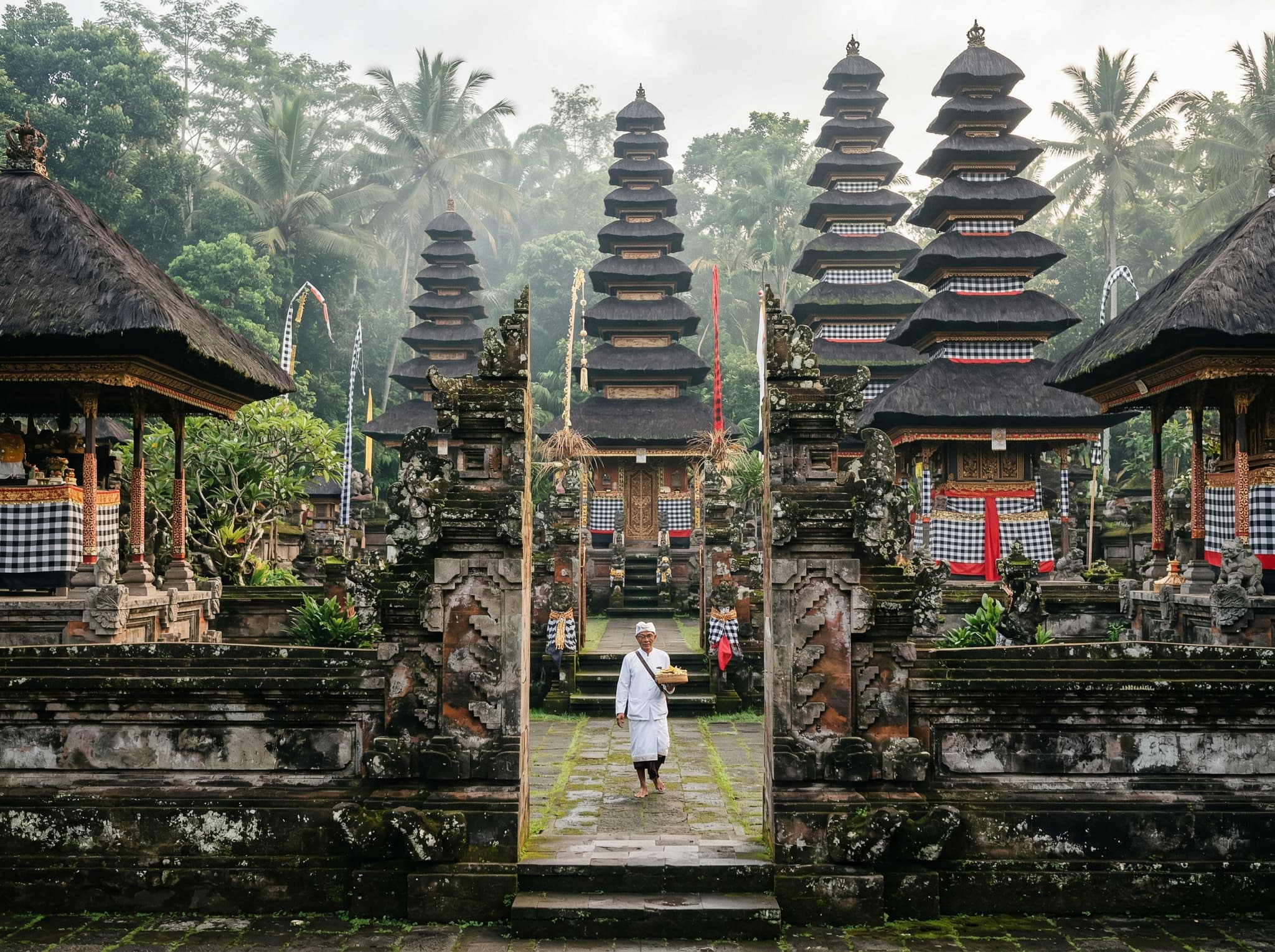
To understand why Pura Masceti matters, you need to understand how Balinese Hinduism organizes sacred space. The island's temple system isn't random — it's architectural theology. The Sad Kahyangan Jagat temples are positioned to create a protective spiritual perimeter around Bali, with each temple corresponding to a direction and a deity. Pura Besakih anchors the system from Mount Agung in the center-east. Pura Masceti holds the southern shore.
The temple is dedicated to Dewa Masceti, a manifestation associated with the sea and agricultural fertility — which makes geographic sense when you consider its position where rice paddies meet the ocean. In Balinese cosmology, the sea represents both danger and purification, and temples along the coast serve as mediators between the human world and the powerful forces of the ocean.
Pura Masceti at a Glance
Temple Classification
Sad Kahyangan Jagat (one of six directional temples)
Direction Protected
South
Primary Deity
Dewa Masceti
Associated Element
Sea and agricultural fertility
Historical records on Pura Masceti's founding are limited compared to better-documented temples like Besakih or Ulun Danu Batur. What's clear is that the temple predates the tourist era by centuries and has been a site of continuous worship and ceremony. The structures visible today reflect ongoing renovation and maintenance by the local Balinese community — temple architecture in Bali is living architecture, rebuilt and restored across generations rather than preserved as static monuments.
What You'll Find

Pura Masceti sits directly on Masceti Beach, a stretch of volcanic black sand that feels worlds away from the manicured beaches of southern Bali. The temple compound follows traditional Balinese temple layout: split gates (candi bentar), a middle courtyard, and an inner sanctum (jeroan) containing the primary shrines. The scale is modest compared to Besakih's sprawling complex, but the setting — shrines against dark sand, the ocean immediately behind — gives it a stark, elemental quality.
The surrounding beach is used for ceremonies, particularly purification rituals (melasti) in which temple artifacts and community members are brought to the sea for spiritual cleansing. During major Balinese holidays, especially in the days leading up to Nyepi (the Balinese New Year), Masceti Beach becomes a significant ceremonial site.
Pura Masceti's inner sanctum is generally closed to non-worshippers. Visitors can explore the outer courtyards and the beach. During active ceremonies, access may be further restricted — this is a working temple, not a tourist attraction. Respectful observation from a distance is always appropriate.

Outside of ceremony days, the temple grounds are often quiet. A few local vendors may be present, but there's no tourist infrastructure to speak of — no ticket counters, no parking attendants waving you into paid lots, no souvenir shops. This is part of what makes the visit worthwhile: you experience the temple as a community sacred site rather than a managed attraction.
Visiting Pura Masceti

The temple is located in Medahan Village, in the Blahbatuh district of Gianyar Regency. It's roughly 30 minutes from Ubud by car and about 20 minutes from Sanur, making it an easy addition to a day exploring the Gianyar coast or the eastern rice terrace areas.
Getting There
From Ubud
~30 minutes by car via Jl. Prof. Dr. Ida Bagus Mantra
From Sanur
~20 minutes east along the coastal road
From Seminyak/Kuta
~50–60 minutes depending on traffic
Transport
Hire a driver or rent a scooter; no public transit
There's no formal entrance fee, but visitors should wear a sarong and sash — standard protocol at any Balinese temple. If you don't have one, it's worth keeping a sarong in your day bag whenever you're temple-hopping in Bali. Shoulders should be covered as well.
Combine a Pura Masceti visit with nearby Masceti Beach for a short walk along the black sand, then continue east to Sidan or Klungkung for more temple and cultural sites. The coastal road between Sanur and Gianyar passes through several villages worth stopping in.
Why It's Worth the Detour

Pura Masceti won't give you the sunset drama of Tanah Lot or the cliff-edge theatrics of Uluwatu. What it offers is something increasingly rare in Bali's most-visited areas: an encounter with Balinese spiritual life that hasn't been reshaped for tourist consumption. The temple exists for the community that maintains it, and visiting it means meeting Balinese Hinduism on its own terms rather than through a curated experience.
For travelers building a deeper understanding of Bali's temple system — especially those interested in how the Sad Kahyangan Jagat network maps spiritual geography onto the physical island — Pura Masceti is essential context. You can't understand the system without seeing all its parts, and the southern anchor is one of the most accessible yet least visited.
It's also a reminder that significance and popularity are different things. The temples that draw the biggest crowds aren't necessarily the most important ones. Sometimes the most sacred sites are the quietest.