A spring-fed royal water palace in Karangasem, Tirta Gangga offers tiered gardens, koi-filled pools, and a window into Bali's fading kingdoms.
Most visitors to Bali never make it east of Ubud. The gravity of the island's tourism pulls south and central — Seminyak's beach clubs, Canggu's co-working cafés, the rice terraces of Tegallalang. But drive ninety minutes northeast from Ubud, past the shadow of Mount Agung, and the island changes character. The roads narrow. The tourist infrastructure thins out. And in the village of Ababi, set against the green slopes of Karangasem, you find one of Bali's most beautiful and historically layered sites: Tirta Gangga.
The name translates roughly to "water from the Ganges" — a reference to the sacred river in Hindu tradition rather than a geographic claim. It's a water palace, built in 1946 by Anak Agung Anglurah Ketut Karangasem, the last raja of the Karangasem kingdom. And understanding who he was helps explain why this place exists at all.
A King's Garden in a Changing World
By the mid-twentieth century, Bali's traditional kingdoms were losing their political power. The Dutch colonial administration had already restructured the island's governance, and Indonesian independence in 1945 would soon dissolve what remained of royal authority. The raja of Karangasem — a man known for his appreciation of art, architecture, and water engineering — built Tirta Gangga during this transitional period. It was simultaneously a royal retreat, a public garden, and a statement of cultural identity.
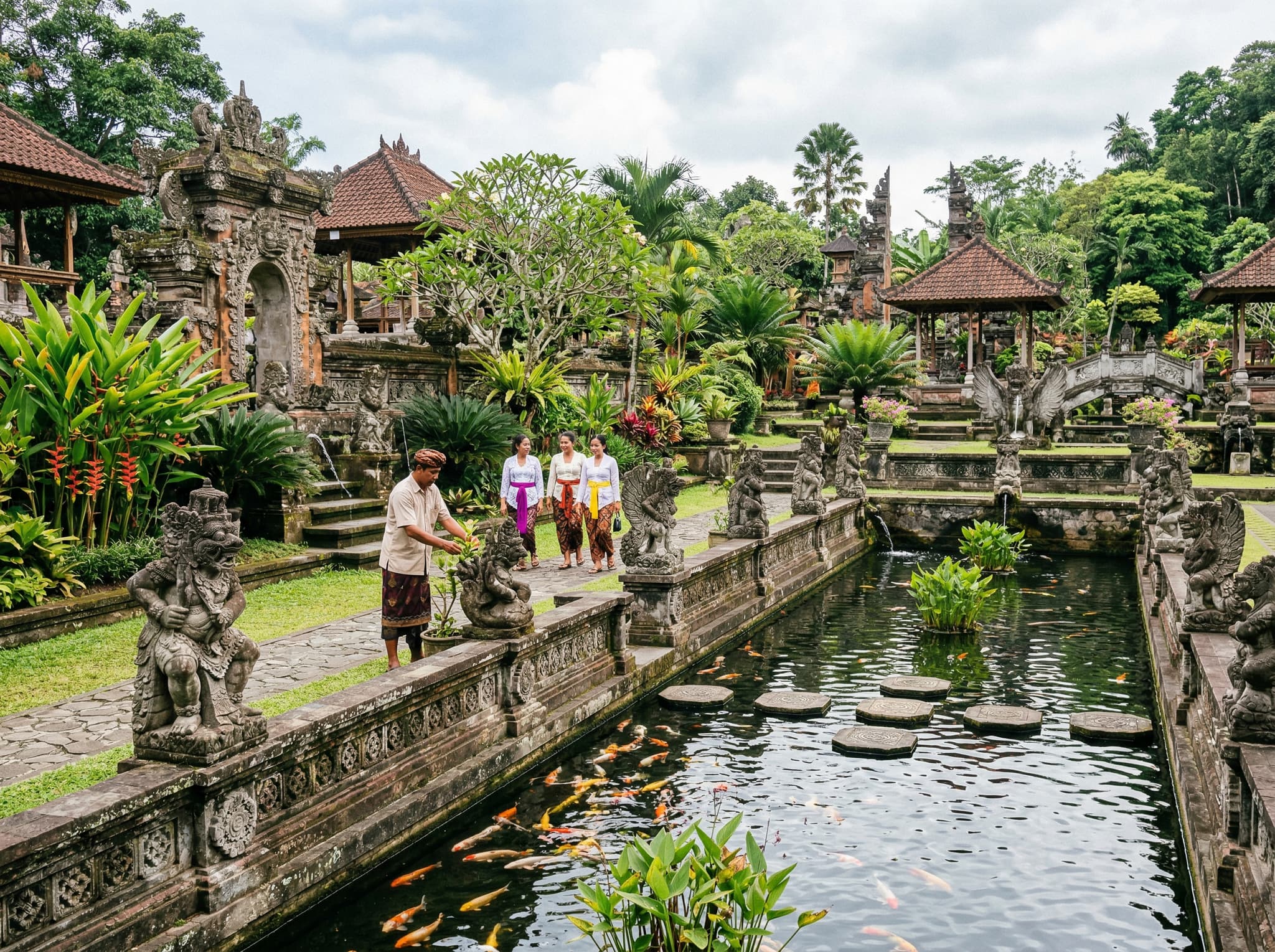
The palace drew on a natural spring that local communities had considered sacred for generations. The raja's architects channeled that spring into an elaborate system of pools, fountains, and gardens spread across roughly 1.2 hectares. The design blends Balinese and Chinese architectural influences — ornamental koi ponds alongside Hindu stone carvings, geometric stepping stones next to tropical landscaping.
The 1963 eruption of Mount Agung devastated much of eastern Bali and severely damaged Tirta Gangga. The palace was gradually restored over the following decades, though some original structures were lost permanently. What visitors see today is a reconstruction that remains faithful to the original layout, fed by the same spring that has flowed here for centuries.
What You'll Find Inside
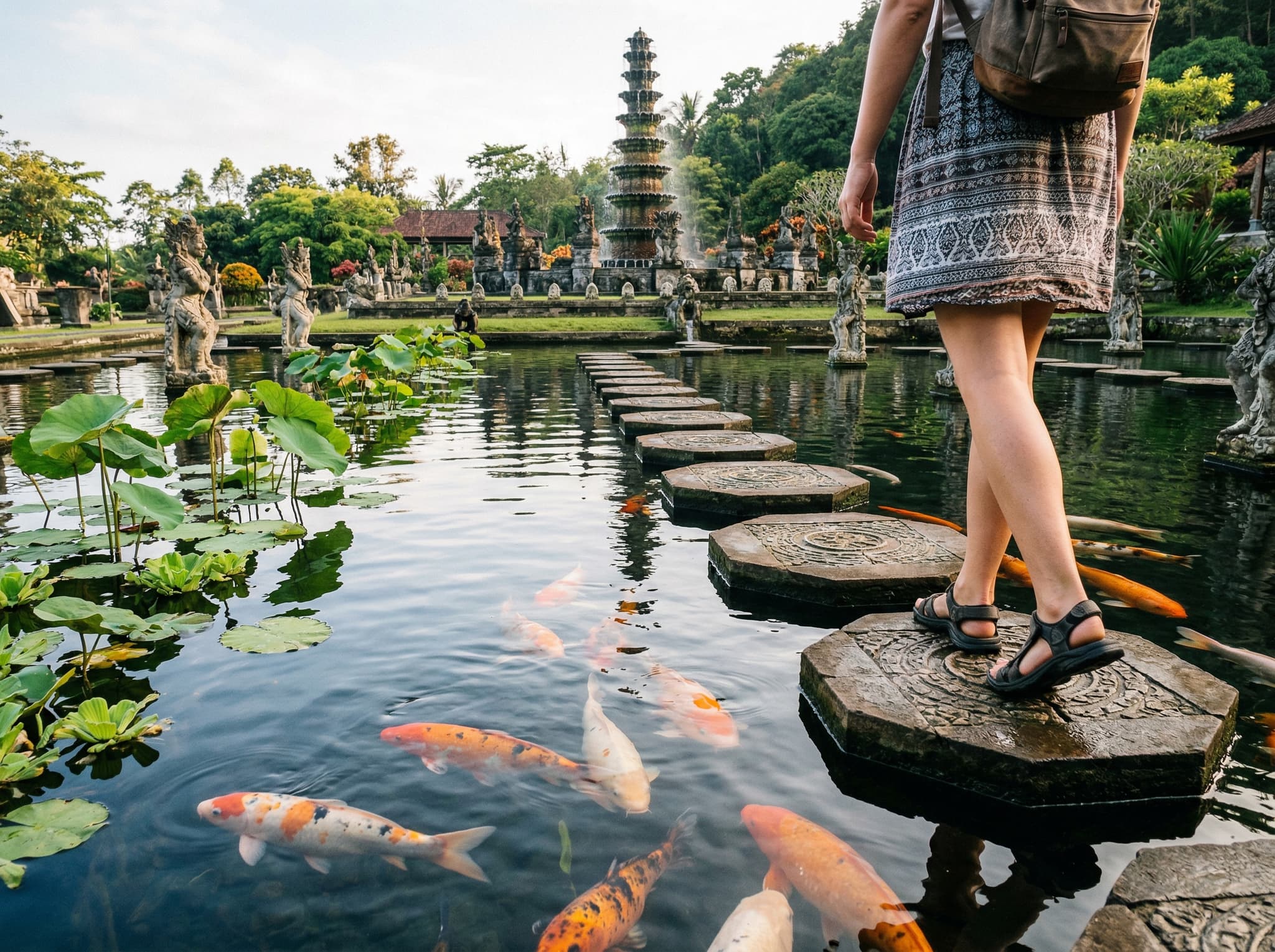
Tirta Gangga is organized across three tiers, each representing a different level of the Balinese Hindu cosmological universe — a design principle shared with many Balinese temples.
The Three Tiers
Lower Level
Koi ponds and gardens — the most photographed area
Middle Level
Fountains and the iconic stepping-stone path across the water
Upper Level
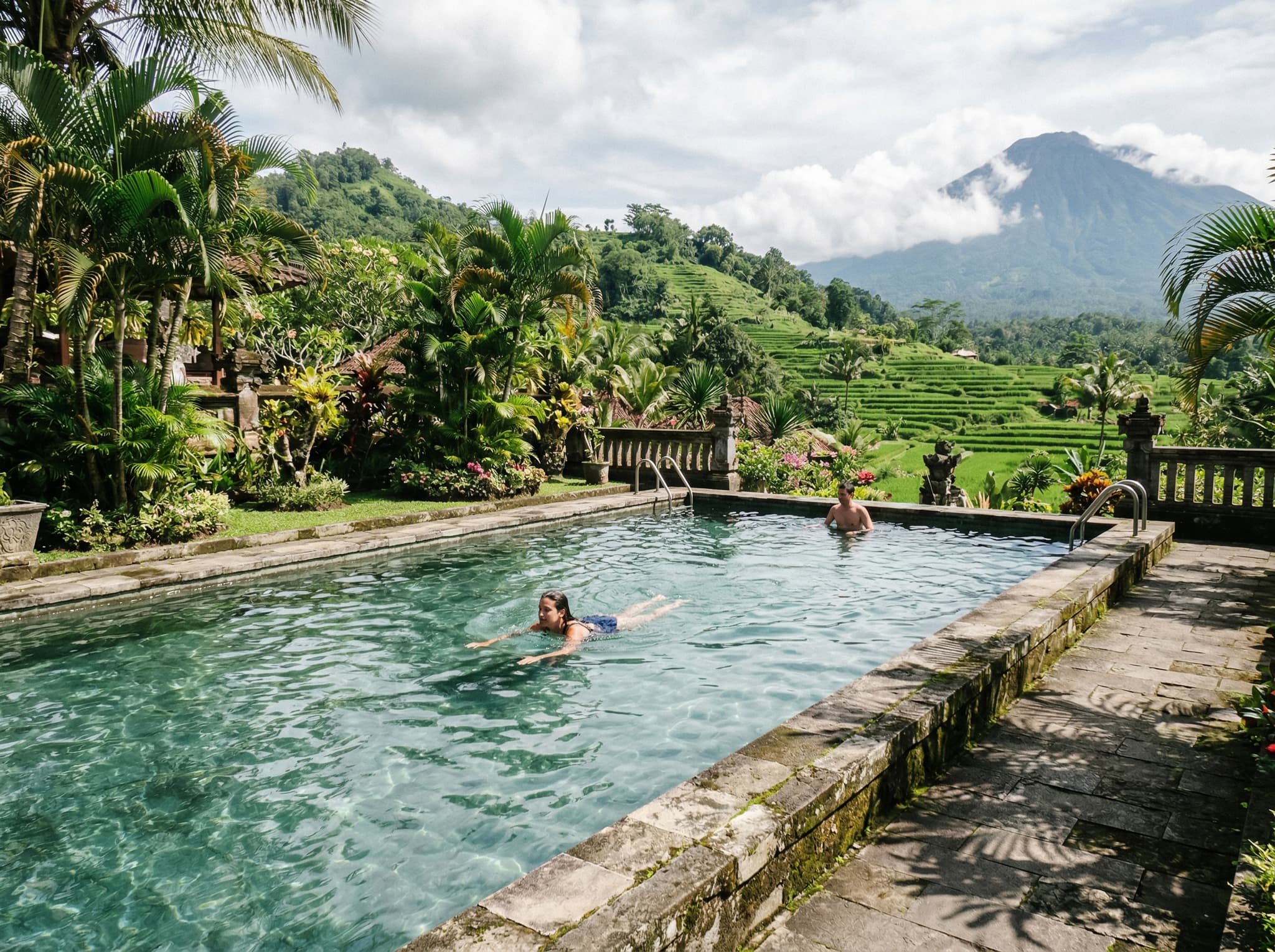
Sacred spring source and a large swimming pool open to visitors
The stepping stones are the signature feature. A series of raised platforms cross a shallow pool filled with koi and lotus, with an eleven-tiered fountain — a demon-guardian figure spouting water — at the center. It's genuinely photogenic, but it's also functional: the design reflects the Balinese concept of water as purifier, flowing downward through increasingly public spaces.
The upper pool is an unexpected bonus. For an additional small fee (around IDR 10,000), visitors can swim in a spring-fed pool with views of the surrounding gardens and, on clear days, the slopes of Mount Agung. The water is noticeably cool — a welcome contrast to the coastal humidity.
Visiting Practicalities
Tirta Gangga sits about 80 kilometers northeast of Ubud and roughly 5 kilometers from the town of Amlapura, the Karangasem regency capital. There's no convenient public transport — most visitors either hire a driver for the day, rent a scooter, or include the palace as part of a broader East Bali itinerary.
Getting There
From Ubud
~1.5–2 hours by car
From Amed
~30 minutes by car
From Candidasa
~45 minutes by car
From Seminyak/Kuta
~2.5–3 hours by car
The drive itself is worth noting. The road from Ubud to Karangasem passes through some of Bali's most striking rice terrace landscapes, particularly around Sidemen — a valley that many travelers consider more beautiful (and far less crowded) than Tegallalang.
Combining Tirta Gangga with East Bali
Tirta Gangga works best as part of a full day exploring Karangasem. The region is one of the least-touristed parts of Bali despite having some of the island's most compelling sites.
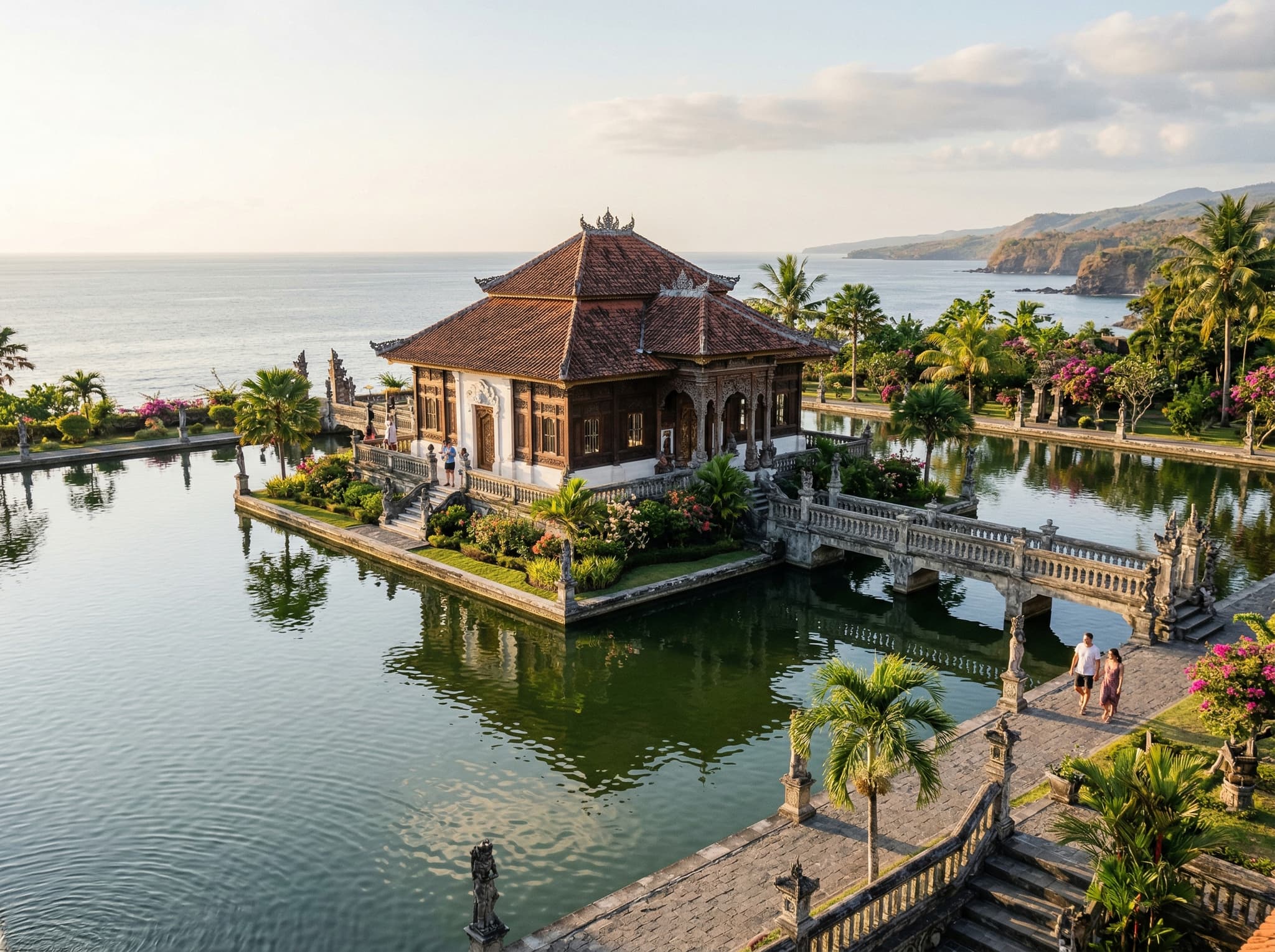
Taman Ujung Water Palace, about 6 kilometers south, is Tirta Gangga's sibling — built by the same raja in 1919 and set on a promontory with ocean views. Where Tirta Gangga is intimate and garden-like, Taman Ujung is grand and architectural. Visiting both gives a fuller picture of the Karangasem kingdom's ambitions.
Lempuyang Temple, roughly 10 kilometers northeast, has become famous for its "Gates of Heaven" photo opportunity — though the reality involves long queues and a mirror-reflection trick. The temple complex itself, which predates the photo trend by centuries, is genuinely worth the steep climb to the upper shrines if you're interested in Balinese Hindu architecture beyond the Instagram frame.
Amed and the northeast coast offer black-sand beaches, coral reefs for snorkeling, and a quieter pace than anywhere in southern Bali. Staying overnight in Amed or Sidemen turns the East Bali circuit from a rushed day trip into something more rewarding.
Why It Matters
Tirta Gangga is a small site — you can walk the entire grounds in an hour. It doesn't have the spiritual weight of Besakih Temple or the dramatic setting of Uluwatu. But it captures something specific about Bali that the major attractions often don't: the island's long tradition of water architecture, the interplay between sacred springs and human design, and the story of a kingdom trying to preserve its identity in a world that was moving on.
The spring still flows. Local villagers still use the water for irrigation and ceremonies. The koi still circle the fountains. For a place that was nearly destroyed by a volcano sixty years ago, Tirta Gangga carries its history lightly.