Mawun Beach offers Lombok's calmest swimming water in a stunning crescent bay. Here's what it costs, how to get there, and when to visit.
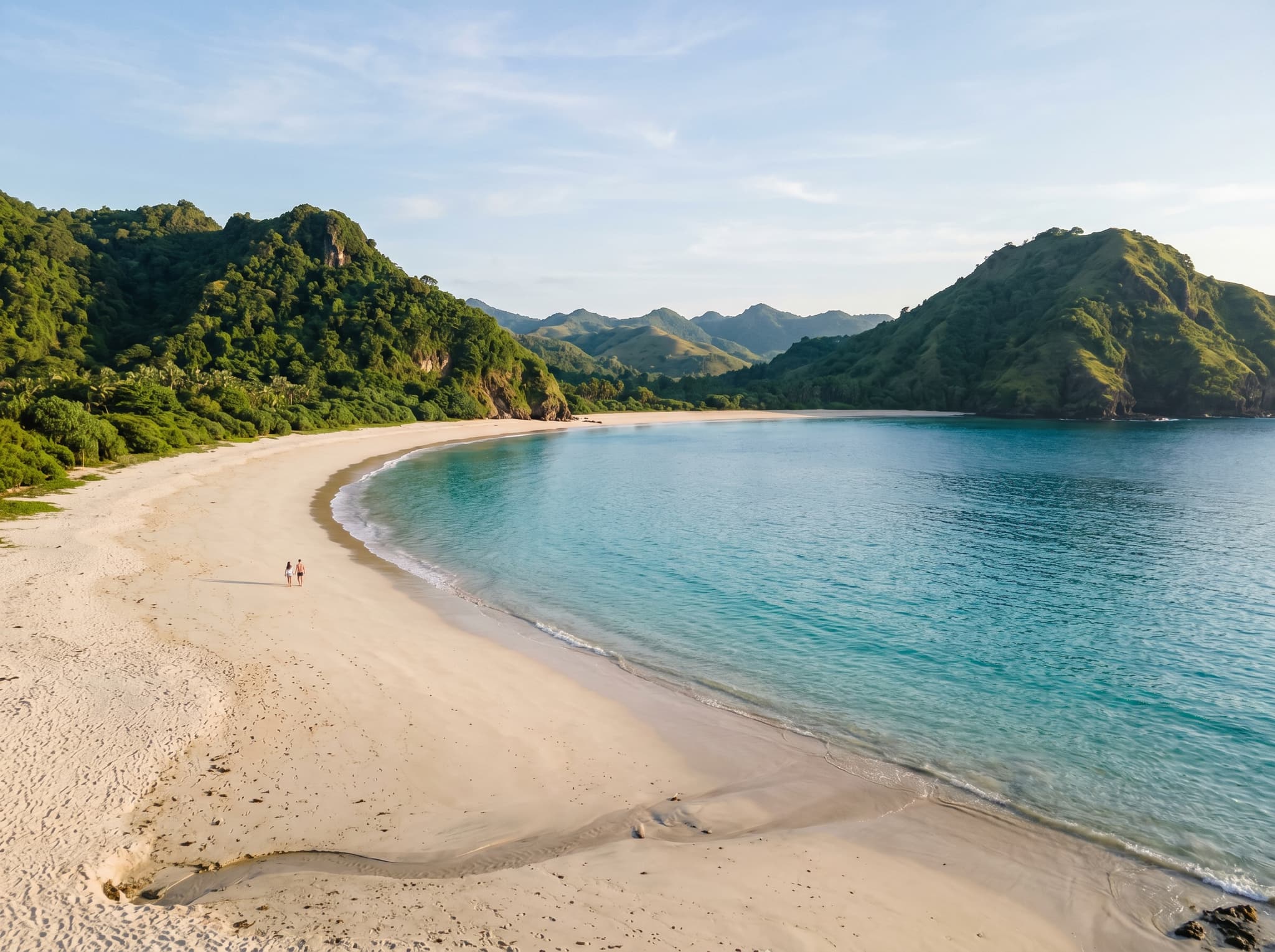
Mawun Beach is the bay that makes people reconsider their entire Bali itinerary. A crescent of white sand pinched between two green headlands, water that stays waist-to-chest deep for 20-30 meters out, and — on most days — a fraction of the crowd you'd find at any comparable beach across the strait.
That's the pitch, and it's largely accurate. But there are a few things worth knowing before you ride a scooter over a mountain road to get here.
What You're Actually Getting

Mawun is a sheltered horseshoe bay. The two hills that frame it block most of the open-ocean swell, which means the center of the beach stays remarkably calm during dry season. For families, nervous swimmers, or anyone who just wants to float without checking over their shoulder for waves, this is arguably the best beach in South Lombok.
The sand is fine and pale — some visitors describe it as having a peppery quality up close. The water shifts from turquoise to deep blue depending on the time of day and cloud cover. It's genuinely beautiful, and it photographs even better than it looks in person, which is saying something.
Strong currents develop during wet season (October-April), particularly near the eastern point. Sharp reef sections are exposed at low tide, and rip currents can appear without warning. Dry season swimming in the bay's center is a different experience entirely from wet season conditions at the edges.
The Surf Situation
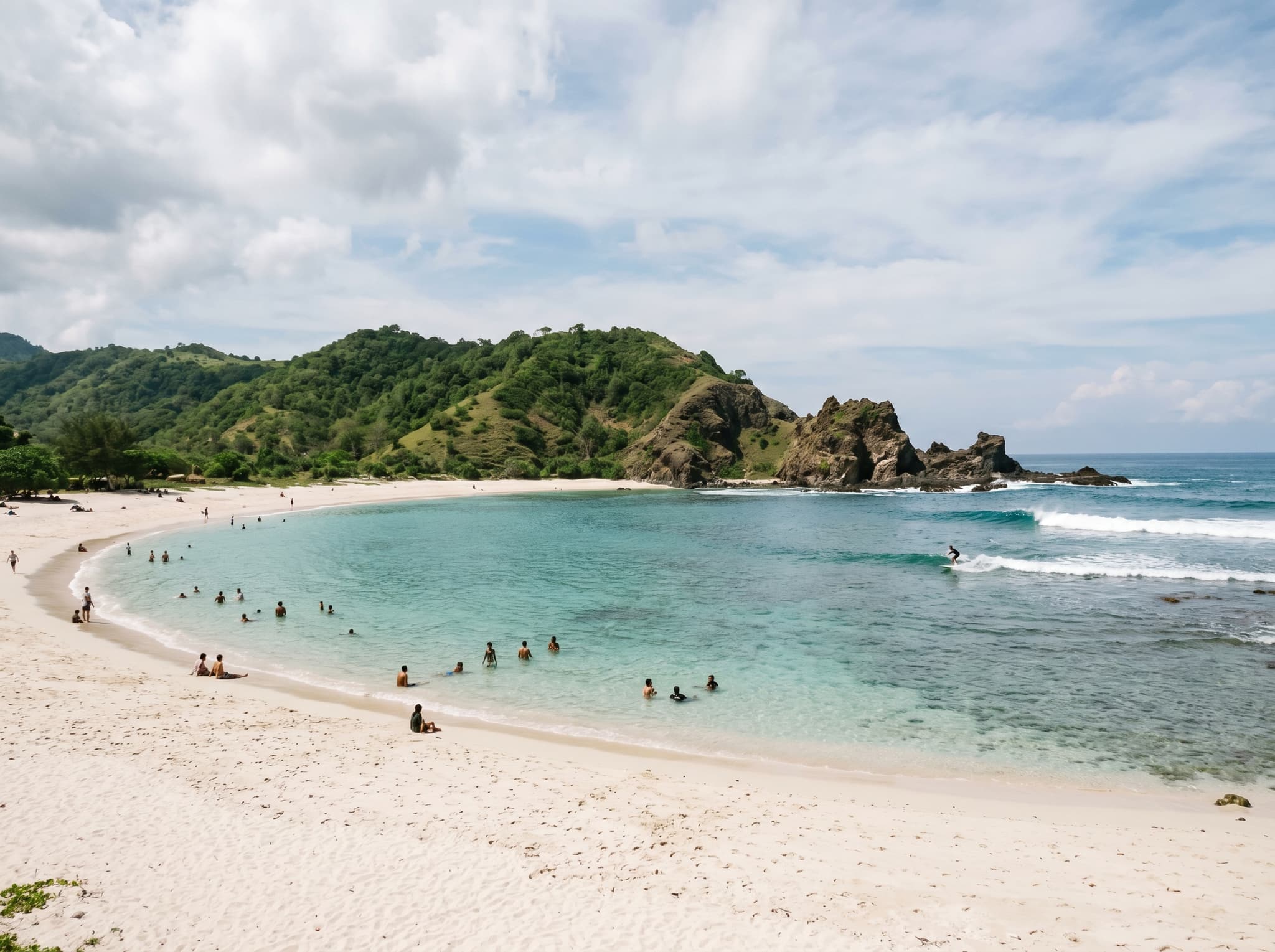
Surfers know Mawun for its right-hand reef break off the eastern point. It picks up SSW swells in the 2-6 foot range and works best at mid-to-high tide with northerly offshore winds — which means wet season is prime time. The wave is knee-to-head high on a good day, and the reef bottom means this isn't a beginner spot. Risk factor sits around 5/10, which in surf terms means "you should know what you're doing."
If you're learning to surf, Gerupuk Bay — about 20 minutes east toward Kuta — is a better call. Mawun's reef doesn't forgive positioning mistakes the way a sandy bottom does.
Getting There from Kuta Lombok

The route follows Jl. Mawun west out of Kuta town, past The Living Room Hostel on the main strip. Search "Pantai Mawun" in Google Maps and you're set.
The road is mostly paved but curvy — it winds through hills with a few viewpoints worth a stop and passes Bangkang Cave (the local bat cave, mildly interesting if you've never seen one). Expect minor potholes and a rough stretch near the end. On a scooter, it's a pleasant 20-minute ride. In a car, closer to 30.
Transport Options
Scooter rental
~IDR 100,000/day from Kuta
Private driver round trip
~IDR 280,000 ($18 USD)
Car parking
IDR 10,000
Motorbike parking
IDR 5,000
The Fee Situation (Read This)
There is no standardized official entry fee for Mawun Beach. What exists is an informal collection system — someone at the entrance collects a fee that nominally covers parking and access. Most travelers report paying IDR 5,000-10,000 for a motorbike. However, at least one recent visitor reported being asked for IDR 100,000.
The discrepancy is real and worth acknowledging. Fees vary by who's collecting, what vehicle you arrive in, and — frankly — whether you look like you'll negotiate. If someone quotes you IDR 100,000, it's reasonable to push back politely. The going rate for motorbike parking across South Lombok's beaches is IDR 5,000-10,000. Know that number going in.
Some warungs on the beach offer free parking if you buy food or drinks. Since a young coconut or a Bintang runs IDR 25,000-35,000, this can be a better deal than paying parking separately — and you were probably going to eat anyway.
Facilities: Keep Expectations Honest
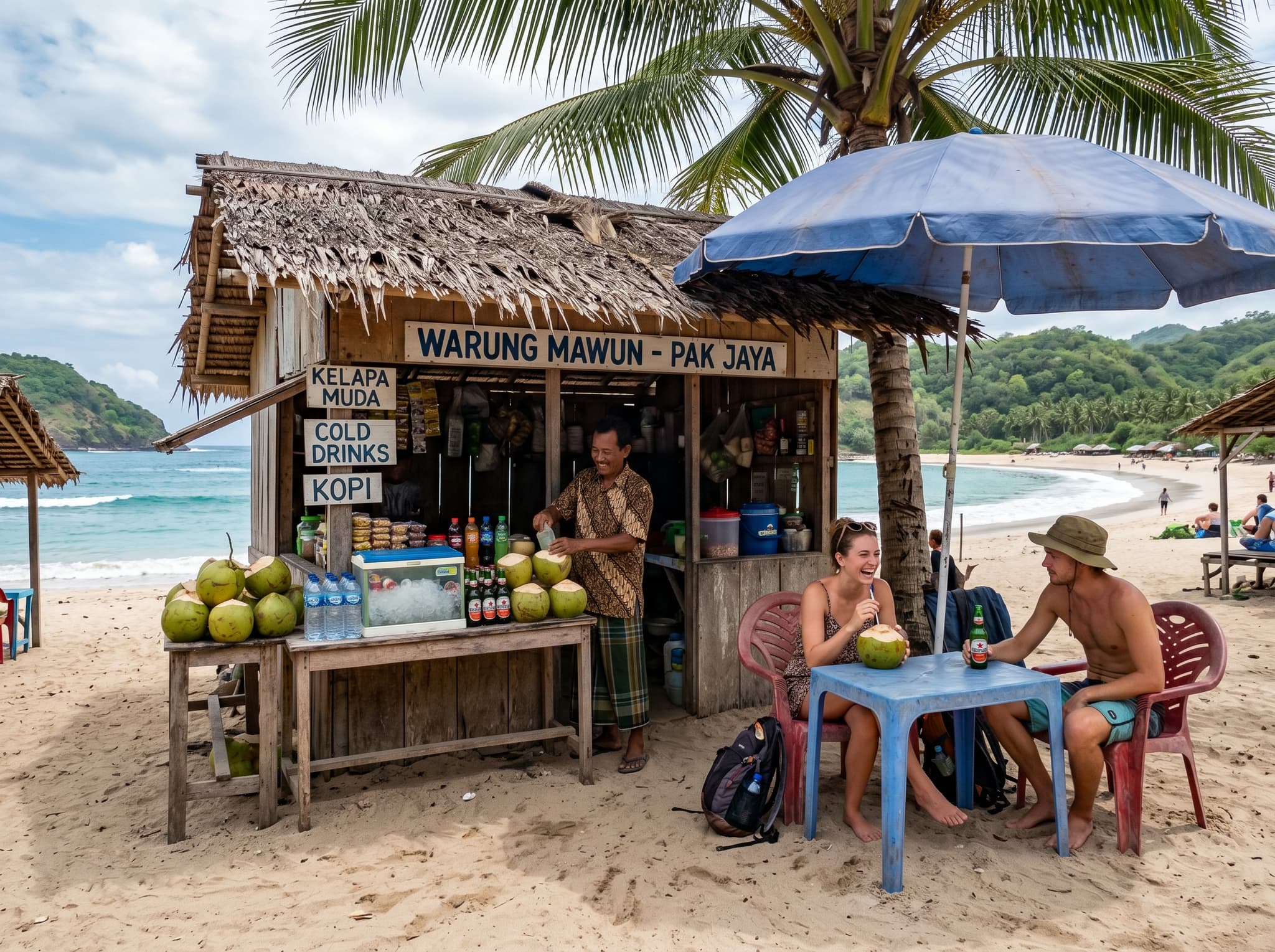
Mawun has two small warungs selling food, drinks, young coconuts, beer, and snacks. Sunbed and umbrella rental runs about IDR 50,000 each. Toilet facilities are unconfirmed — plan accordingly before you leave Kuta. There's no ATM, no convenience store, and phone signal can be spotty.
This is part of the appeal. It's also why you should bring water, sunscreen, and cash in small denominations.
When to Go
For swimming: May through September. The bay is calm, the water is clear, and the air temperature hovers around 30-31°C. This is Mawun at its most postcard-perfect.
For surfing: October through April. North winds groom the SSW swells that light up the eastern reef break. The trade-off is rain — 95-317mm per month versus 34-101mm in dry season.
For fewer crowds: April and September-October sit in a sweet spot between seasons. Weather is cooperative, tourist numbers are lower, and you might have long stretches of beach to yourself.
For snorkeling: September through November offers the clearest water, though Mawun isn't a snorkeling destination in the way the Gilis are. It's more of a bonus if conditions align.
The Bigger Picture
Mawun sits in a corridor of South Lombok beaches that are collectively some of the best in Indonesia. If you're based in Kuta Lombok — which most visitors to this coast are — Mawun fits naturally into a day that might also include Tanjung Aan to the east or Selong Belanak to the west. For travelers heading further east toward Flores, Komodo, or Raja Ampat, Kuta Lombok and its surrounding beaches make a logical stop before the journey gets more remote.
Development pressure is building across South Lombok. The Mandalika tourism zone, anchored by its MotoGP circuit, has already displaced local vendors at nearby Tanjung Aan Beach. Mawun remains relatively untouched for now, but the trajectory of the region is clear. Lombok welcomed over 6.3 million tourists in 2024, with projections climbing for 2025.
Visit while the warungs still outnumber the hotels.