Seventy shirtless men sit in concentric circles on a stone amphitheater carved into a cliff edge. The Indian Ocean stretches behind them, the sun dropping toward it. They begin chanting — cak-cak-cak-cak-cak — and the sound builds into something that feels ancient, primal, like it has been happening on this cliff for centuries.
It hasn't. The Kecak dance at Uluwatu Temple was invented in the 1930s, co-created by a Balinese dancer named I Wayan Limbak and a German painter named Walter Spies. That fact doesn't diminish what happens on this cliff every evening. It makes it more remarkable — a performance form less than a century old that has become so embedded in Balinese cultural identity that most visitors assume they're watching something timeless. Understanding the real story changes how the performance lands.
What Happens at the Uluwatu Kecak Performance
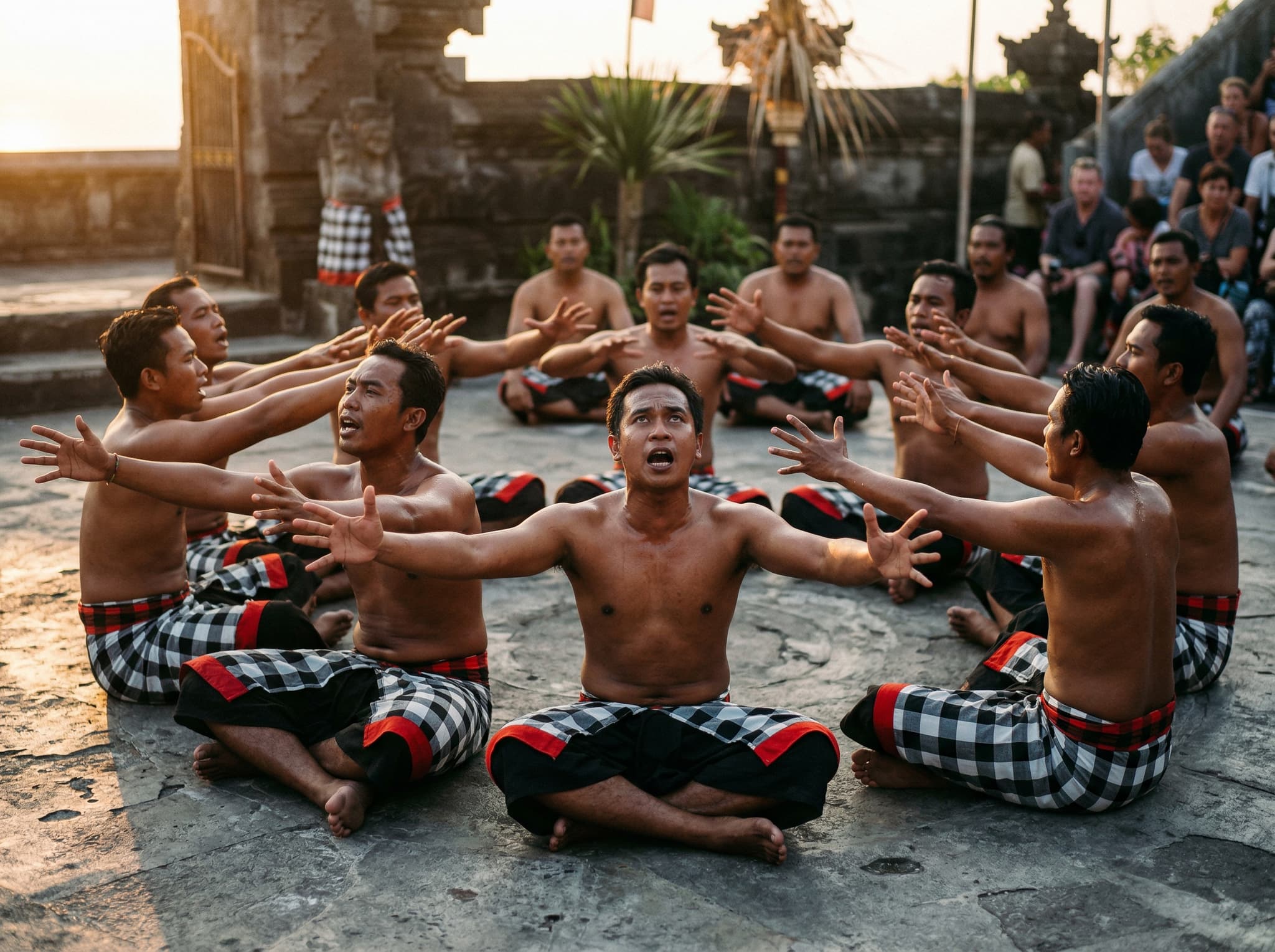
The open-air amphitheater sits on the cliff edge within the Uluwatu Temple complex, with the ocean as its backdrop. Seating is stone terraces arranged in a semicircle, holding roughly 200 to 250 audience members per show. There are no microphones, no amplifiers, no instruments of any kind. The human voice is the entire orchestra.
Between 50 and 70 male performers sit in tight concentric circles at the center of the stage. They wear checkered sarongs and nothing else. The performance runs approximately 60 minutes, timed so that the sun sets during the middle acts — a piece of staging that never quite stops working, even when the audience knows it's deliberate.
Performance Details
Duration
Approximately 60 minutes
Performers
50–70 male chorus, plus principal dancers
Instruments
None — voices only
Schedule
Daily, ~6:00 PM (varies slightly by season)
The chorus chants interlocking rhythmic patterns — cak-cak-cak — that shift in tempo, volume, and texture throughout the performance. They sway in unison, raise their arms, lean back, surge forward. The effect is hypnotic and genuinely unlike anything else in Balinese performing arts, because the cak chorus replaces the gamelan orchestra entirely. Every rhythm, every crescendo, every moment of tension comes from synchronized human voices.
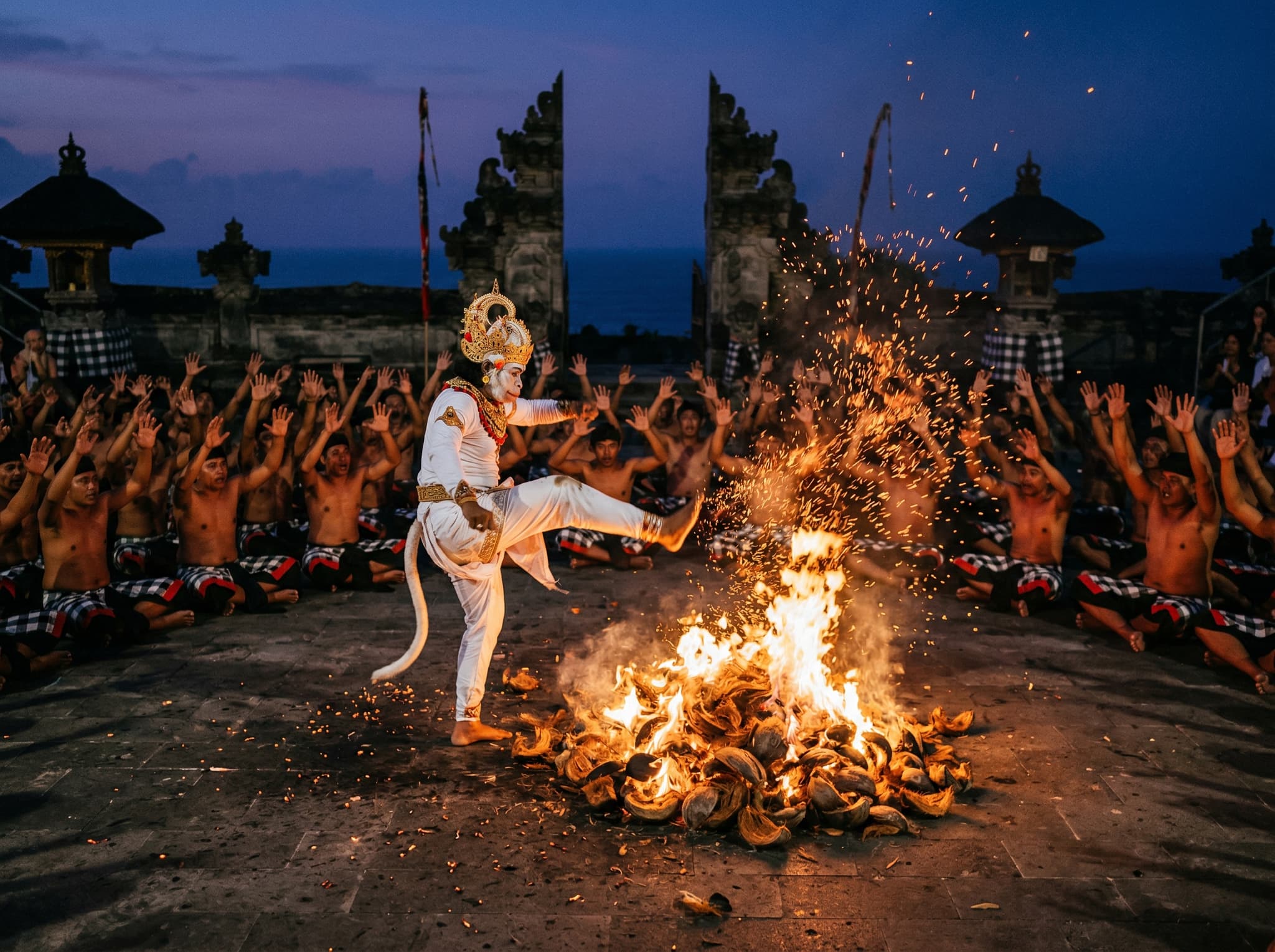
Within and around the chorus, costumed dancers enact episodes from the Ramayana — the Hindu epic that is foundational to Balinese culture. The performance closes with a fire element: a performer in trance kicks through a pile of burning coconut husks, scattering embers across the stage. It is exactly as dramatic as it sounds.
A 1930s Invention, Not an Ancient Ritual
The story of the Kecak begins not with the Ramayana but with a different kind of Balinese ceremony altogether. The Sanghyang is an exorcism ritual in which a chorus of men chants interlocking vocal patterns to induce trance in one or two dancers, who are believed to become vessels for protective spirits. The chanting is the mechanism — rhythmic, repetitive, building in intensity until the trance takes hold. The Sanghyang is sacred, performed in temples for spiritual purposes, and it remains a living practice in Balinese villages today.
Walter Spies arrived in Bali in 1927. He was a German painter and musician who had already spent several years in Java, and he settled in Ubud under the patronage of the local royal family, the Sukawati court. Spies became the center of a small circle of Western artists and intellectuals drawn to Bali during the Dutch colonial period — a time when the island was already being marketed as a cultural destination, and when both Balinese and foreign artists were actively interested in how traditional forms could reach new audiences.
Spies saw the Sanghyang chorus and recognized its theatrical power. The chanting was extraordinary on its own terms — complex, physical, emotionally intense. He proposed isolating that choral element from its ritual context and pairing it with narrative from the Ramayana, creating a performance that could communicate to audiences who didn't share the spiritual framework of the Sanghyang but could follow a story.
The person who made this work was I Wayan Limbak, a Balinese dancer and choreographer from Bedulu village in Gianyar. Limbak choreographed the movement, adapted the chanting patterns for dramatic structure, and performed principal roles. The collaboration produced, around 1930 to 1933, what became known as the Kecak — named for the dominant syllable of the chant.
The tension that visitors sometimes feel — is this "authentic" if it was invented for audiences? — misses how art actually works. The chanting technique comes from genuine sacred practice. The Ramayana is foundational Balinese mythology, told and retold for centuries. What Spies and Limbak created was a new container for existing elements. The gamelan orchestra has evolved over centuries. The Legong dance has been refined and restaged for generations. The Kecak is younger, but the process is the same: artists shaping tradition into new forms.
Spies, it's worth noting, influenced the development of several Balinese performance forms for broader audiences, including refinements to Legong and Barong stagings. His role in shaping how the outside world perceived Bali was significant — and complicated. But the Kecak outlived him because Limbak and the Balinese performers who followed made it theirs.
The Ramayana Episodes in the Performance
Following the narrative helps. The Uluwatu Kecak dramatizes a compressed sequence from the Ramayana, and knowing the arc means the difference between watching a spectacle and watching a story.
Sita's abduction. The demon king Rawana (sometimes spelled Ravana) kidnaps Sita, wife of Prince Rama, and takes her to his kingdom of Lanka. Rawana is identifiable by his elaborate mask and aggressive, wide-legged stance. Sita wears gold and moves with restrained, precise gestures that contrast sharply with Rawana's expansiveness.
Rama and Laksmana search. Rama (gold-toned costume, refined movement) and his brother Laksmana set out to rescue Sita. They encounter Hanuman, the white monkey general — the most physically dynamic character in the performance, identifiable by his white fur costume and acrobatic movement.
Hanuman's mission. Rama sends Hanuman to Lanka as an emissary. Hanuman finds Sita, is captured by Rawana's forces, and is sentenced to death by fire. This is where the fire element enters — Hanuman escapes and, in the Uluwatu staging, the performer kicks through burning coconut husks.
The battle. The chorus shifts from atmospheric backdrop to active participant, representing Hanuman's monkey army in the final battle against Rawana. The chanting reaches its highest intensity here — the cak patterns accelerate, the performers surge and sway, and the narrative resolves with Rama and Sita reunited.
Throughout, the chorus is not background. The men shift roles constantly — they are the forest, the ocean, the monkey army, the sound of fire. Their arms become waves, trees, flames. Watching the chorus rather than only the principal dancers reveals the performance's real craft.
Pura Luhur Uluwatu: The Temple on the Cliff

The Kecak is what draws most visitors in the late afternoon, but the temple itself is the reason this cliff is sacred.
Pura Luhur Uluwatu is one of Bali's nine kayangan jagat — directional temples believed to protect the island from evil spirits at its cardinal points. Uluwatu guards the southwest. The system reflects a core principle of Balinese Hinduism: the island is a spiritual entity that requires protection at its edges, and each directional temple serves as a kind of sentinel.
Temple History
Founded
10th century, attributed to Mpu Kuturan
Expanded
16th century, by priest Dang Hyang Nirartha
Cliff Height
Approximately 70 meters above sea level
Spiritual Role
One of nine directional temples protecting Bali
The temple sits on a limestone cliff roughly 70 meters above the Indian Ocean. The setting is genuinely dramatic — this is not a case where the photos oversell it. The cliff drops sheer to the water, and the temple structures perch at the edge in a way that feels precarious even though they've been there for centuries.
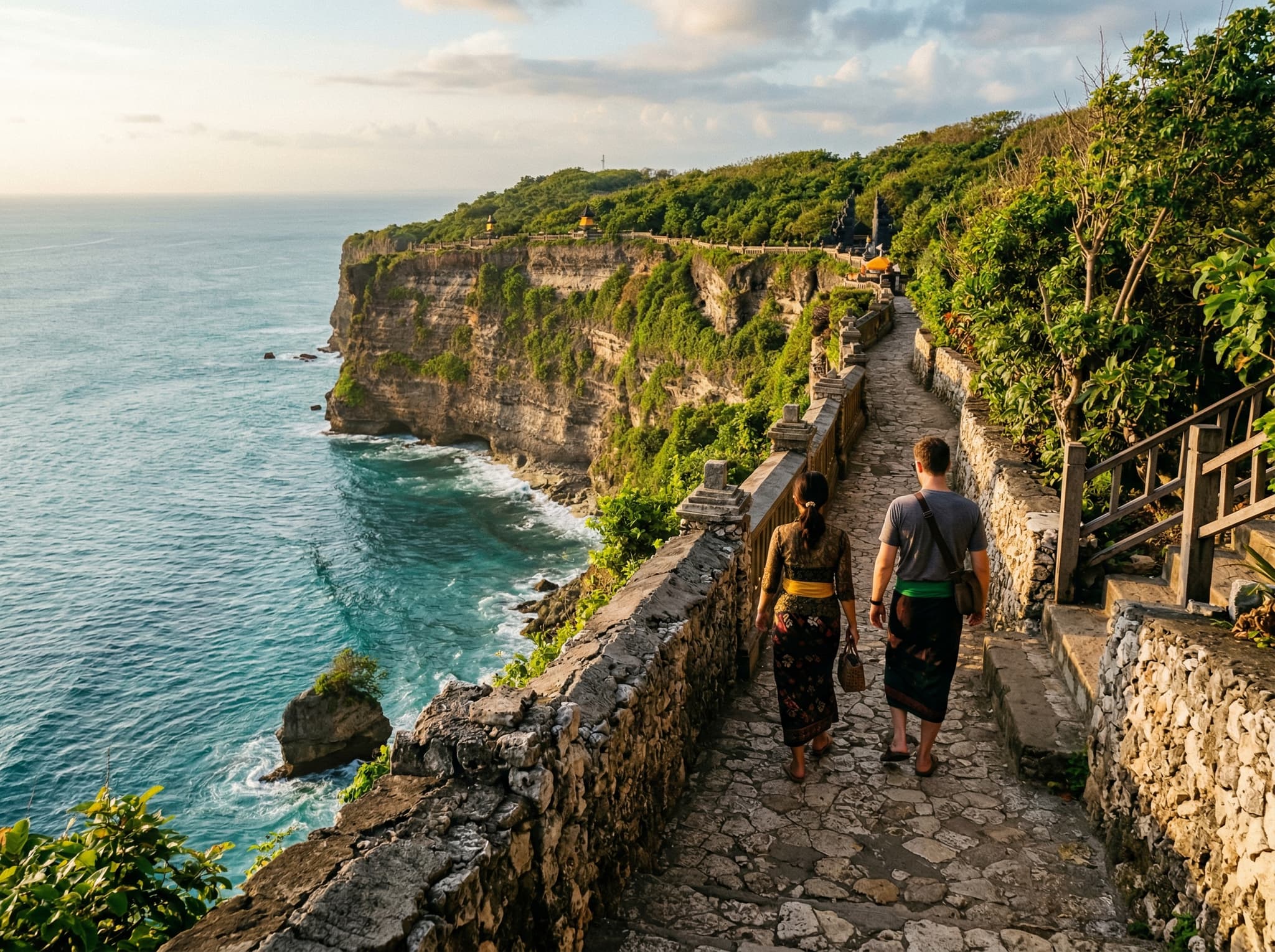
That said, expectations should be calibrated. Pura Luhur Uluwatu is not a sprawling complex like Pura Besakih on Mount Agung. The temple structures are relatively modest, and the inner sanctum is closed to non-worshippers. The visitor experience is a cliff-edge path through the outer grounds — forested, with ocean views opening up at several points — rather than a walk through monumental architecture. There is no single dramatic staircase; the path from the entrance to the amphitheater involves a moderate walk with some stepped sections, manageable for most fitness levels. It is not a climb.
The experience is the setting more than the structures. And at sunset, with the sky doing what Bali skies do, the setting earns its reputation entirely.
The Monkeys Are Not Your Friends
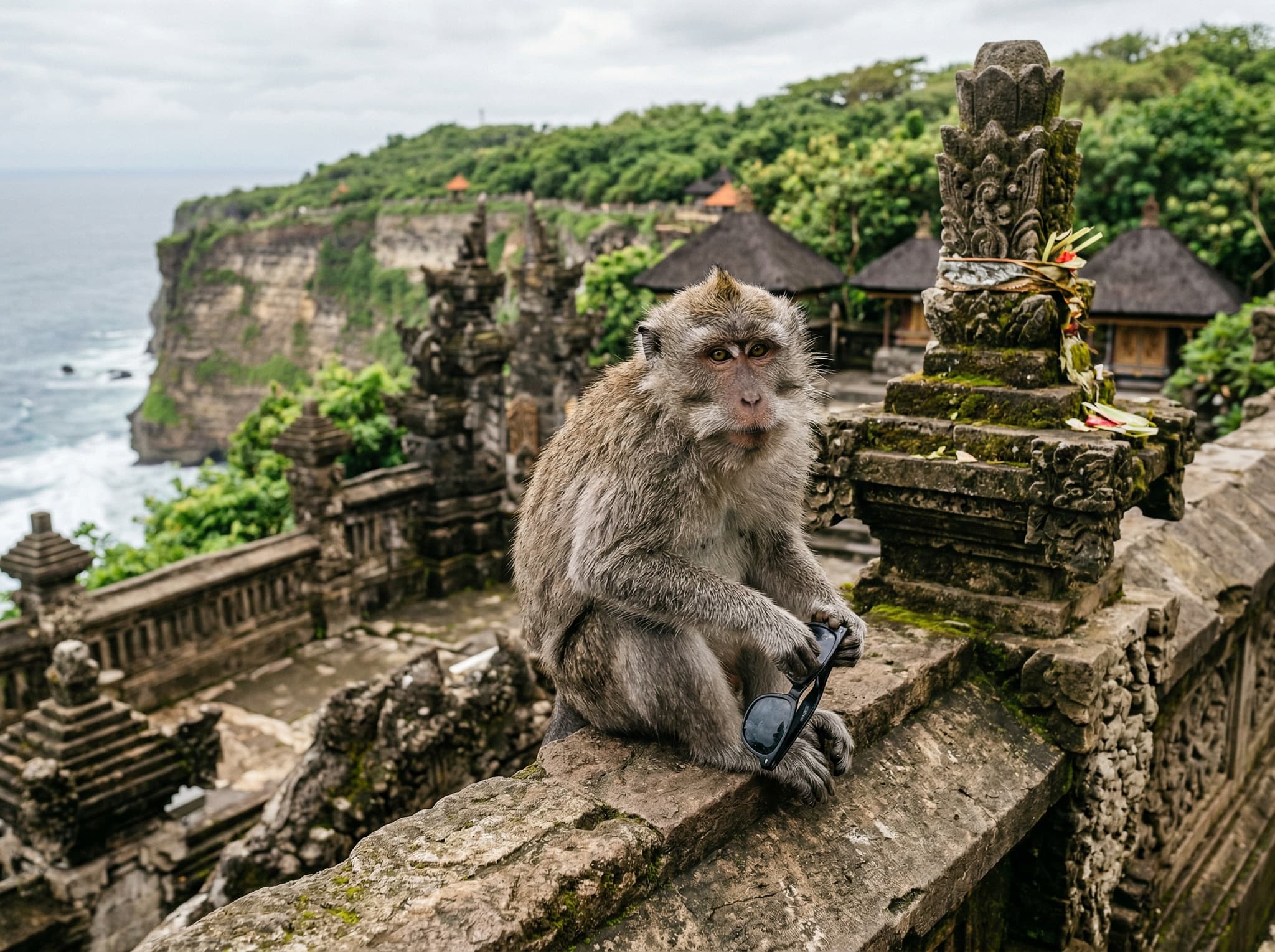
The long-tailed macaques that live on the temple grounds are not decorative. They are organized, strategic, and very interested in personal belongings.
Sunglasses are the most common target. Hats, phones, water bottles, earrings, and hair clips are also fair game. The monkeys have learned — and this is not an exaggeration — to steal items and then wait for food to be offered in exchange. A 2021 study published in Philosophical Transactions of the Royal Society B documented this behavior specifically at Uluwatu, finding that the macaques had developed learned bartering strategies: they preferentially target items they've learned humans will pay to recover, and they wait for higher-value food offers before releasing them.
Visiting Uluwatu Temple: Tickets, Dress Code, and Timing
Admission is not free. Temple entry costs IDR 50,000 for foreign adults, with a reduced rate for children. The Kecak performance is a separate ticket at IDR 150,000. Both are purchased at the temple entrance. Cash in Indonesian rupiah has historically been the standard payment method; some visitors have reported QRIS (Indonesia's digital payment system) availability at the ticket counter, but carrying cash remains the reliable option.
A sarong and sash are required. This is a functioning Hindu temple, not a historical ruin, and the dress code applies to all visitors regardless of whether they enter the inner temple grounds. Shoulders and knees must be covered, and a sarong and sash must be worn. If you don't have your own, they are provided at the entrance — included with the admission ticket, not an additional charge.
A note on a question that comes up frequently: the "Gates of Heaven" dress code that appears in many Bali searches refers to Pura Lempuyang, a different temple in eastern Bali. The dress code principle, however, is the same across all Balinese Hindu temples — sarong, sash, covered shoulders and knees.
Practical Details
Temple Hours
7:00 AM – 7:00 PM daily
Temple Admission
IDR 50,000 (foreign adult)
Kecak Ticket
IDR 150,000 (foreign adult)
Payment
Cash recommended; QRIS sometimes available
Sarong Provided
Yes, at entrance
Time for Temple Grounds
30–60 minutes
The timing strategy that works: arrive by 4:00 to 4:30 PM. Walk the temple grounds and cliff path in daylight — this takes 30 to 60 minutes at a comfortable pace. Then head to the amphitheater before 5:30 PM to get a seat with a clear sightline for the 6:00 PM Kecak. The full visit takes two to three hours.
For visitors who want the temple without the crowds, morning visits are an option. The grounds are significantly quieter before 10:00 AM, and the cliff views are just as striking in morning light. The trade-off is no Kecak performance and no sunset.
Getting to Uluwatu and the Logistics Around It
Uluwatu sits at the southwestern tip of the Bukit Peninsula, which means it's at the far end of Bali from most tourist bases. Travel times depend heavily on traffic, which gets worse on the Bukit roads in late afternoon — precisely when most visitors are heading to Uluwatu for sunset.
Drive Times to Uluwatu
From Kuta / Seminyak
1–1.5 hours
From Canggu
1–1.5 hours
From Ubud
1.5–2 hours
From Nusa Dua / Jimbaran
30–45 minutes
Private driver is the most common and practical option. Arranged through accommodation, a half-day hire (4–5 hours covering the drive, wait time, and return) typically costs IDR 300,000 to IDR 500,000. The driver waits while you visit and drives you back after the Kecak — which matters, because the alternative has a significant flaw.
Ride-hail apps (Grab, Gojek) work for getting to Uluwatu but are unreliable for the return. After the Kecak ends around 7:00 PM, 200-plus audience members are simultaneously trying to leave a remote clifftop temple. Available drivers in the area are scarce. Waits of 30 minutes or more are common, and surge pricing applies. A pre-arranged driver eliminates this problem entirely.
Scooter is an option for experienced riders who are comfortable with Bukit Peninsula roads — narrow in places, with traffic that gets dense near the temple in late afternoon. Parking is available at the temple entrance.
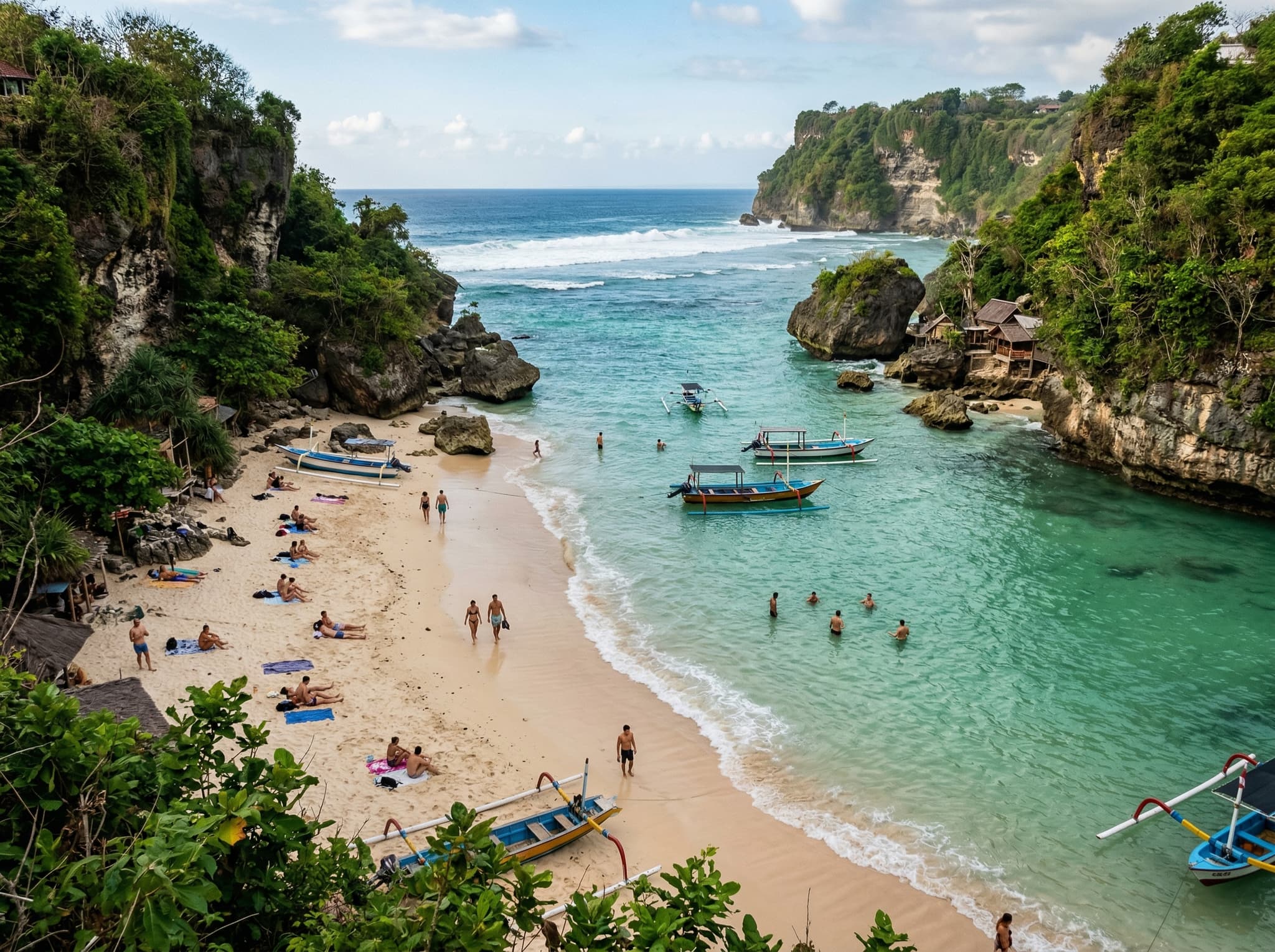
Uluwatu combines naturally with an afternoon on the Bukit Peninsula. Padang Padang Beach is a 10-minute drive away — the small cove made famous by Eat Pray Love, worth a stop despite the association. Suluban Beach (also called Blue Point) is slightly closer, known for its cave entrance and consistent surf break. A common itinerary: beach in the early afternoon, Uluwatu temple grounds by 4:00 PM, Kecak at 6:00 PM, dinner in Jimbaran or back in Seminyak.
Is Uluwatu Temple Worth It
Yes — with the right expectations.
The temple grounds alone are modest. The cliff views are spectacular. The Kecak performance is the main event, and it delivers. Even in a crowd of tourists, even knowing the 1930s origin, the sound of 70 synchronized voices building on a cliff above the ocean at sunset is genuinely arresting. The combination of setting, performance, and timing is what makes Uluwatu work — any single element in isolation might not justify a two-hour round trip from Ubud.
When it's less worthwhile: visiting midday without the Kecak, or arriving too late to walk the temple grounds before the performance. The temple without the sunset context and the dance is a nice cliff walk with monkeys. Fine, but not essential.
This is one of the most-visited sites in Bali, and it feels like it. The experience is managed, ticketed, and crowded at peak hours. That doesn't make it inauthentic — the Kecak troupes are real performers from local villages, and the temple is a functioning place of worship. But this is not a hidden discovery. It is a well-known thing that happens to be genuinely good.
The most interesting thing about the Kecak isn't that it feels ancient. It's that it's alive — a form less than a century old, born from a collaboration between a Balinese choreographer and a German painter, now performed every evening on a sacred cliff by men from the surrounding villages. It is still being shaped. It is still becoming what it is.