Every ATV operator in Bali advertises a "2-hour jungle adventure." Here's what that actually means: 45 minutes in a van, 15 minutes for a safety briefing and helmet fitting, 45–75 minutes of actual riding, and 15–30 minutes of showering, changing, and eating a banana. The ATV ride in Bali is fun. It's also roughly half as long as you think it is when you book it.
This guide exists because the rest of the internet won't tell you that. What you'll find below is a direct comparison of ATV operators in Bali — what the terrain actually looks like, how long you're genuinely on the quad bike, what the safety standards are, and what you should pay. No affiliate rankings. No "top 10 best ATV Bali experiences" where every entry is equally amazing. Just the trade-offs, laid out so you can pick the right one.
What ATV Riding in Bali Actually Involves
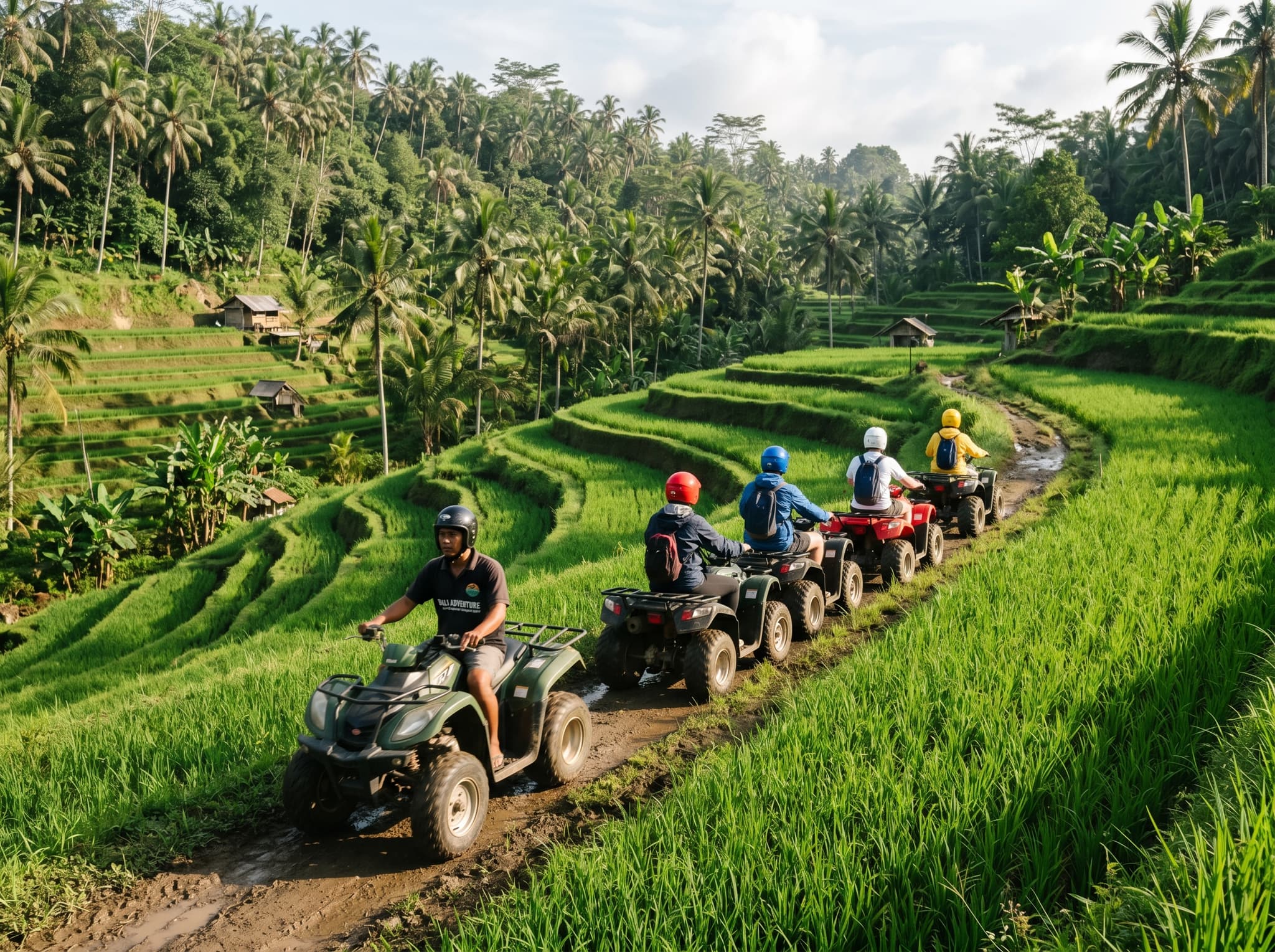
First, a terminology note: "ATV" and "quad bike" mean the same thing in Bali. Operators use both interchangeably, and so does Google. If you searched "quad biking Bali," you're in the right place.
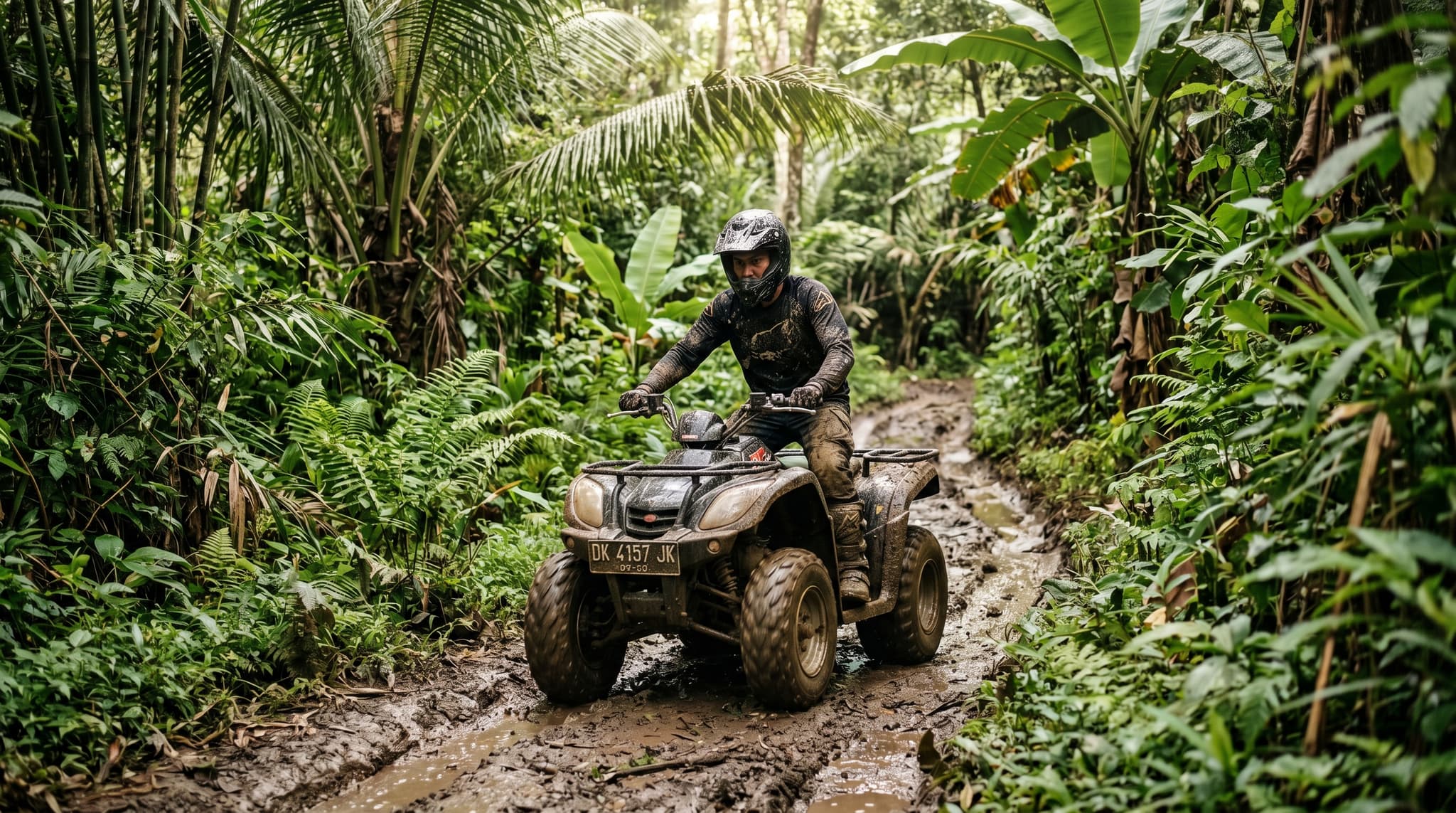
The standard ATV experience follows a fixed structure. You don't show up, hop on a quad, and explore freely. You ride single-file behind a guide on a predetermined route. Think of it as a guided trail ride, not off-road exploration. The guide sets the pace, stops the group for photos at scenic points, and keeps everyone on the path.
A typical session looks like this:
Typical ATV Experience Breakdown
Hotel pickup + transfer
30–60 min each way
Check-in + safety briefing
15–20 min
Actual ride time
45–90 min depending on operator
Post-ride shower + snack/lunch
15–30 min
Total door-to-door
3–5 hours
The terrain varies meaningfully depending on where the operator is based. Routes around Ubud and Tegallalang run through rice paddies, jungle trails, and river crossings. Some operators near Tegallalang include a ride through a cave or tunnel — this is the route you've seen on Instagram. Operators closer to Kintamani offer volcanic black-sand terrain with views of Mount Batur, a completely different feel from the jungle routes.
The gap between "advertised experience" and "actual saddle time" is the single most important thing to understand before booking. When an operator says "2-hour ATV adventure," they mean the entire experience from briefing to shower. Your actual time riding is typically 1 to 1.5 hours. Some operators are honest about this distinction. Many are not.
Best ATV Operators in Bali: How They Compare
This is where most guides fail you — they list five operators, call them all great, and move on. The reality is that these are genuinely different experiences at different price points, and the right choice depends on what you want.
Kuber Bali ATV — Tegallalang
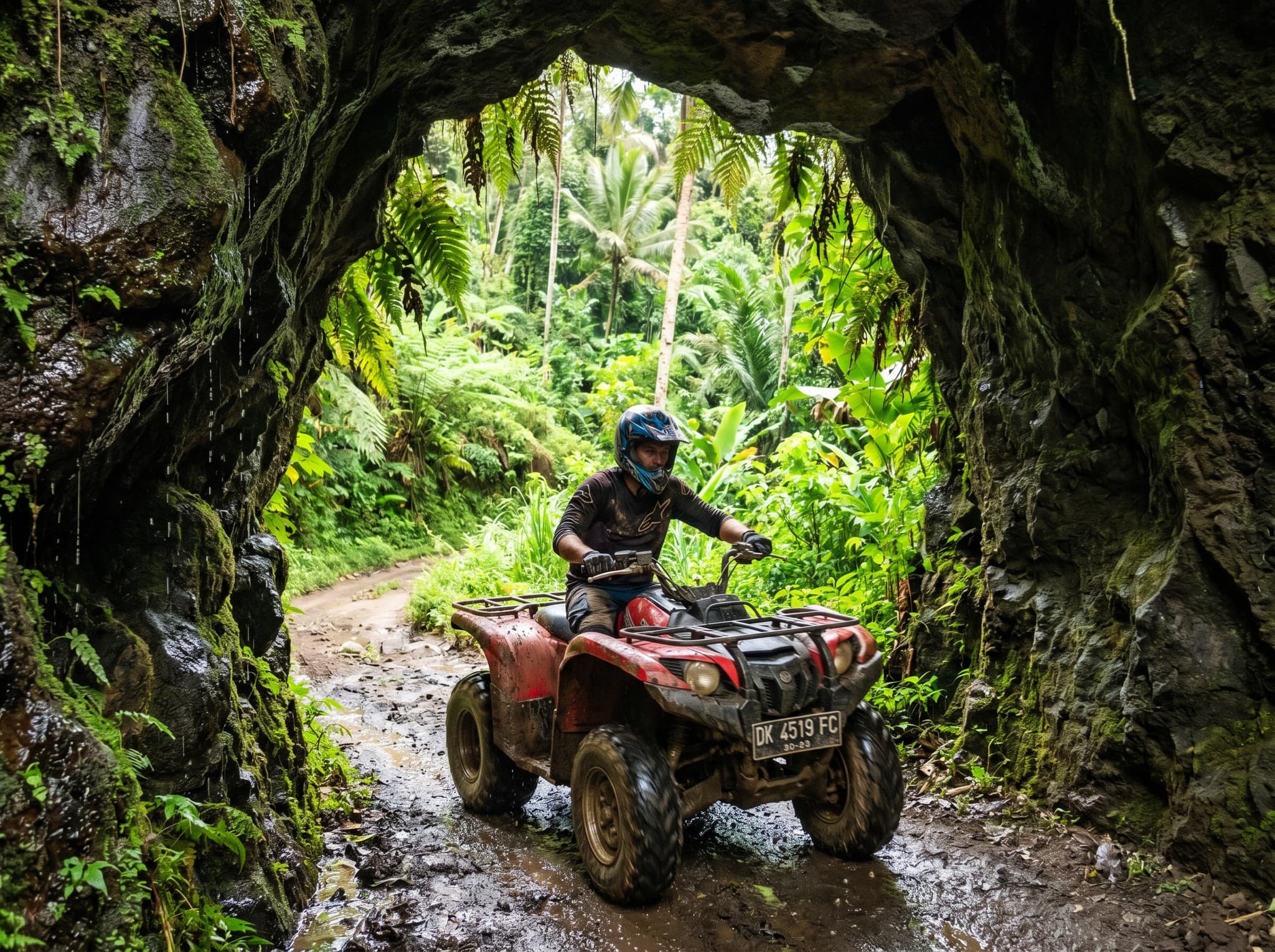
This is the operator behind the famous cave and waterfall tunnel route that dominates Instagram. The route runs through rice terraces, a long cave passage, a waterfall, and jungle trails. It's the most visually dramatic ATV ride available in Bali, and the cave section genuinely delivers — you're riding through a dark, narrow tunnel with water dripping overhead.
Kuber Bali ATV
Location
Tegallalang, north of Ubud
Route type
Cave, waterfall, rice terraces, jungle
Advertised duration
2 hours
Estimated ride time
60–80 min
Single rider price
$35–55 USD (IDR 550K–880K)
Tandem price
$45–70 USD (IDR 720K–1.1M)
Vehicles
Automatic, mostly 250cc
Includes
Lunch, shower, basic insurance
The cave route is the main draw, and it's worth it if you want the most photogenic ride. The downside: this operator gets heavy traffic, especially mid-morning. Groups can back up at the cave entrance. Book the earliest morning slot if you can.
Mason Adventures — Gianyar
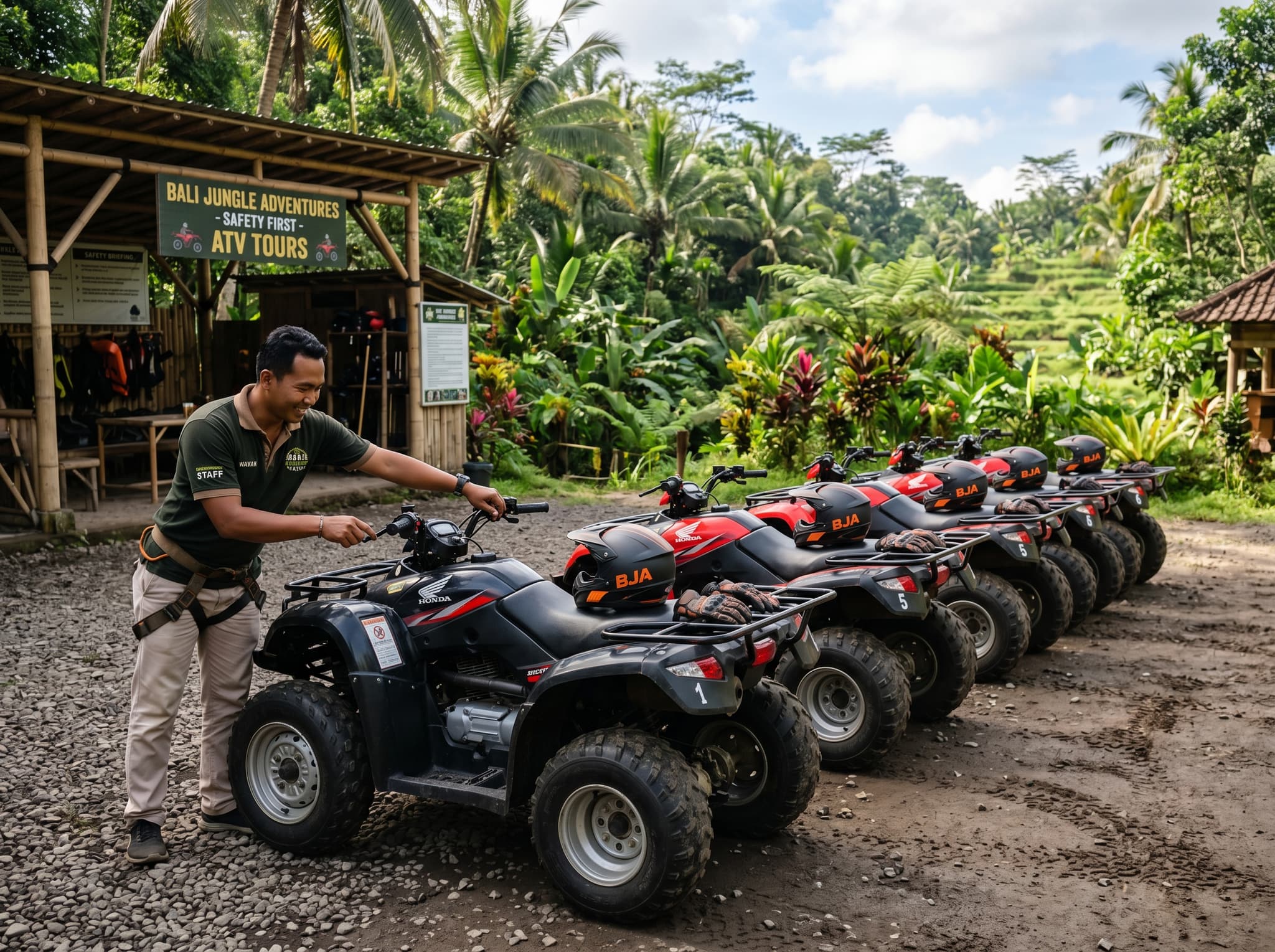
Mason Adventures (formerly Mason Elephant Lodge, which also runs the elephant park) is the most established operator and charges accordingly. They run newer vehicles, have better-maintained equipment, and their safety briefing is more thorough than most. The route goes through jungle, river gorges, and rice paddies — no cave, but the terrain variety is solid.
Mason Adventures
Location
Gianyar, east of Ubud
Route type
Jungle, river gorge, rice paddies
Advertised duration
2 hours
Estimated ride time
60–75 min
Single rider price
$55–80 USD (IDR 880K–1.3M)
Tandem price
$65–90 USD (IDR 1M–1.4M)
Vehicles
Automatic, 250cc–350cc, newer fleet
Includes
Lunch, shower, insurance, hotel transfers from select areas
This is the premium option. You're paying 30–50% more than mid-range operators, and what you get for that is better equipment, smaller group sizes (typically 4–6 riders per guide vs. 6–8 elsewhere), and a more professional operation overall. If safety and vehicle quality are your top priorities, or if you're bringing kids, Mason is the safest bet. They also run ATV + white water rafting combos on the Ayung River — more on that below.
Bali Quad Discovery — Ubud Area
A mid-range operator running routes through rice paddies, bamboo forests, and river crossings near Ubud. Less dramatic than the Kuber cave route, but a more relaxed ride with fewer crowds. The terrain is gentler, making it a reasonable choice for nervous first-timers.
Bali Quad Discovery
Location
Ubud area
Route type
Rice paddies, bamboo forest, river crossings
Advertised duration
2 hours
Estimated ride time
50–70 min
Single rider price
$30–45 USD (IDR 480K–720K)
Tandem price
$40–55 USD (IDR 640K–880K)
Vehicles
Automatic, 250cc
Includes
Lunch, shower, basic insurance
Solid value for the price. The ride isn't as long or dramatic as Kuber or Mason, but if you want a fun ATV experience without paying premium prices, this does the job. Vehicle condition varies — check your quad's tires and brakes before heading out.
Pertiwi Quad — Ubud
Another mid-range option near Ubud. Pertiwi runs through rice terraces and jungle with some water crossings. They've been around for years and have a consistent operation, though their equipment tends to be older than Mason's fleet.
Pertiwi Quad
Location
Ubud area
Route type
Rice terraces, jungle, water crossings
Advertised duration
2 hours
Estimated ride time
50–70 min
Single rider price
$30–50 USD (IDR 480K–800K)
Vehicles
Automatic, 250cc
Includes
Lunch, shower, basic insurance
Kintamani Operators — Volcanic Terrain
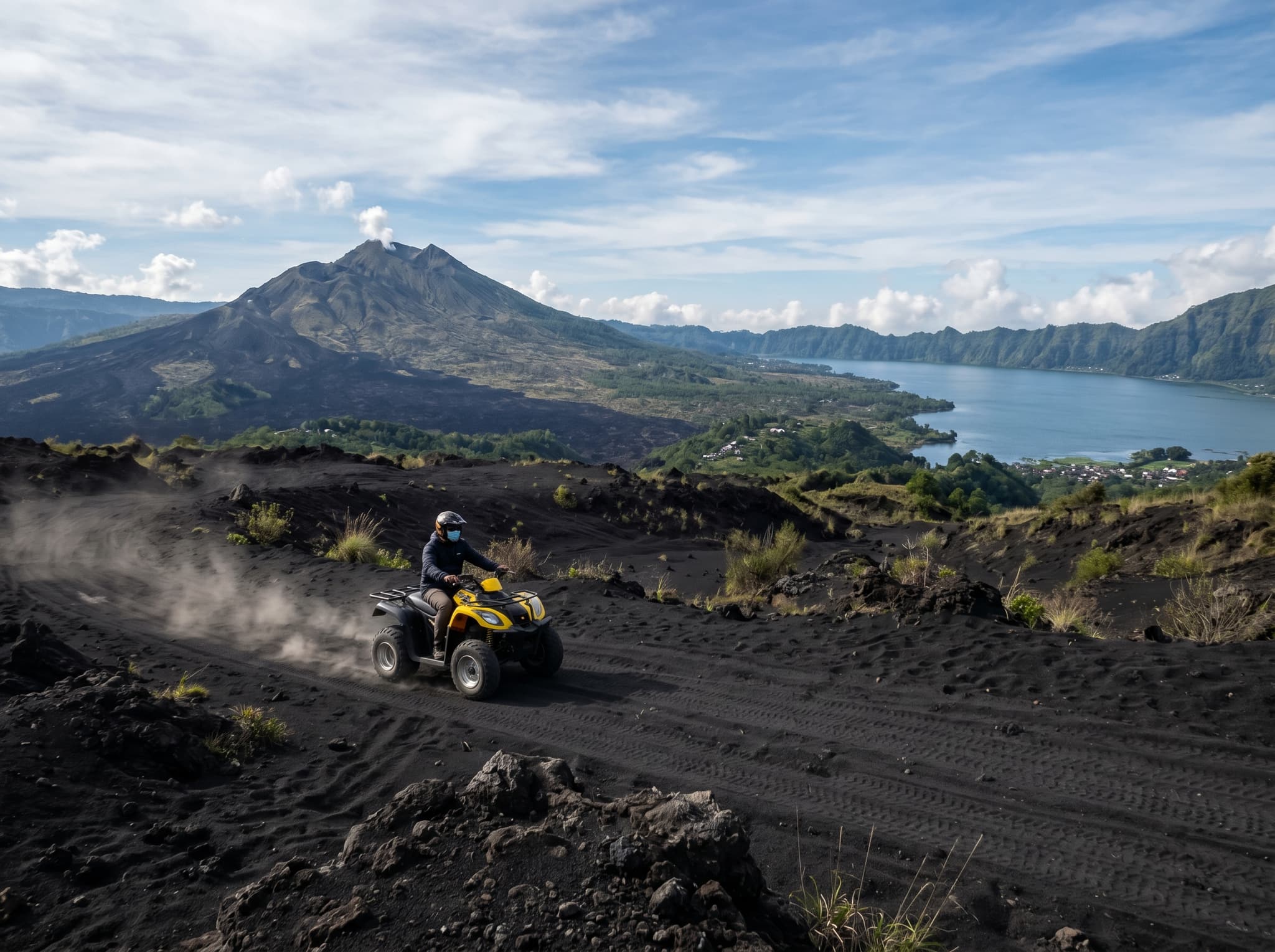
Several smaller operators run ATV routes near Kintamani, north of Ubud, on volcanic black-sand terrain with views of Mount Batur and Lake Batur. This is a fundamentally different experience from the jungle and rice paddy routes — more open landscape, less vegetation, a lunar quality to the terrain. The trade-off: the ride can feel more exposed and dusty in dry season, and these operators tend to be smaller with less standardized equipment.
Prices for Kintamani ATV rides typically run $25–45 USD (IDR 400K–720K). The transfer from Seminyak or Kuta is longer — 90 minutes or more each way — so factor that into your day.
The Comparison at a Glance
Here's how to think about the decision:
Best terrain and photos: Kuber Bali ATV (the cave route wins on drama) Best equipment and safety: Mason Adventures (you pay for it, but the gap is real) Best value for a straightforward ride: Bali Quad Discovery or Pertiwi Quad Most unique landscape: Kintamani operators (volcanic terrain, Mount Batur views)
Tandem Rides, Kids, and Who This Is (and Isn't) For
Tandem Quad Bikes
Most operators offer tandem ATVs — a larger quad with a driver and a passenger seat. The passenger sits behind the driver and holds on. Whether this is fun depends on your tolerance for being a passenger on a bumpy trail with no control over the vehicle. Some people love it. Others spend the ride white-knuckling the grab bar and wondering why they didn't book their own quad.
Tandem pricing is typically 25–40% more than a single rider, not double. So for a couple, one tandem is cheaper than two singles. The math works. The experience is a trade-off.
Families with Kids
Minimum age policies vary:
Age Requirements (Approximate)
Passenger on tandem
5–7 years minimum (varies by operator)
Solo rider
12–16 years minimum
Mason Adventures
Generally stricter age/weight requirements
Mid-range operators
More flexible, but confirm directly
For family quad biking in Bali, Mason Adventures is the most reliable choice. Their equipment is better maintained, their safety briefing is more thorough, and they're more accustomed to handling families. That said, "family-friendly" in the Bali ATV context means "they'll let your 7-year-old ride as a passenger on a tandem." It doesn't mean the trail is smooth or the experience is gentle. The terrain is genuinely bumpy. Small kids need to be able to hold on.
Who Should Skip It
This is an honest list, not a liability disclaimer:
- Back or neck problems: The terrain involves constant jolting over uneven ground, roots, and rocks. An hour of this will aggravate existing issues.
- Pregnant travelers: No reputable operator should allow this, but enforcement is inconsistent. Don't risk it.
- Anyone expecting a quiet nature experience: ATVs are loud. You're in a group. The guide is shouting directions. You will be covered in mud. This is fun in the way a roller coaster is fun, not in the way a rice terrace walk is fun.
- People uncomfortable with a throttle: You don't need motorcycle experience, but you do need to be comfortable controlling speed with your right thumb. The briefing covers this, but if you're genuinely nervous about operating a motorized vehicle, the ride will be stressful rather than enjoyable.
Solo travelers: you'll be grouped with other riders, which is standard and fine. The group dynamic is usually good — shared mud and shared laughs.
Safety: What to Ask and What to Watch For
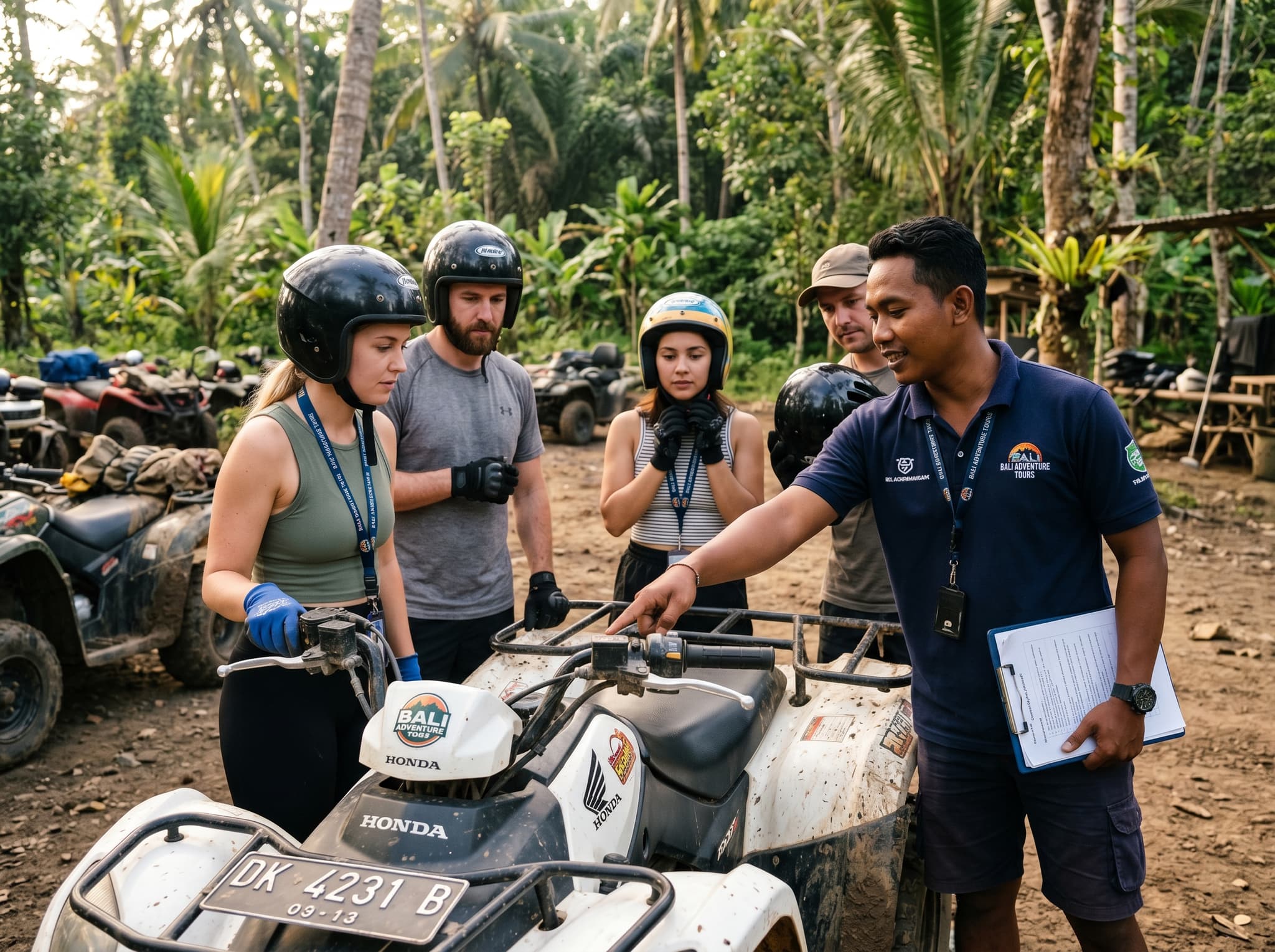
ATV operations in Bali are not uniformly regulated. The difference between a well-run operator and a careless one is significant, and it's not always reflected in the price.
What a good safety briefing looks like: 10–15 minutes minimum. Covers throttle control, braking, body position on turns, what to do if you get stuck, hand signals the guide will use. The guide demonstrates on the ATV, then watches each rider practice in a flat area before hitting the trail.
What a bad safety briefing looks like: "This is the gas, this is the brake, follow me." Three minutes, no practice run.
Helmets: Full-face helmets with visors are the standard you want. Some operators provide open-face helmets with no eye protection — this is a problem on trails where mud, water, and branches are flying. Ask before you book, or at minimum before you ride. Goggles and gloves should be provided.
Guide-to-rider ratio: One guide per four riders is solid. One guide per six is acceptable. If you see one guide leading eight or more ATVs, the guide cannot effectively monitor everyone, and response time if someone crashes or gets stuck is too slow.
Before you ride, check your vehicle: Look at the tires (worn tread means less grip on wet terrain), test the brakes before leaving the staging area, and make sure the throttle returns to idle when you release it. If any of these feel off, ask for a different quad. A good operator will swap it without argument. A bad operator will tell you it's fine.
Common injuries: Scrapes and minor bruises from low-hanging branches and mud splatter are normal. More serious incidents — flips, collisions, mechanical failures — are less common but do happen, usually when riders go too fast on wet downhill sections or when equipment is poorly maintained. Bali's medical facilities in Ubud and Gianyar are adequate for minor injuries. For anything serious, you'd be transferred to a hospital in Denpasar, which is 60–90 minutes from most ATV locations.
When to Go and What to Wear
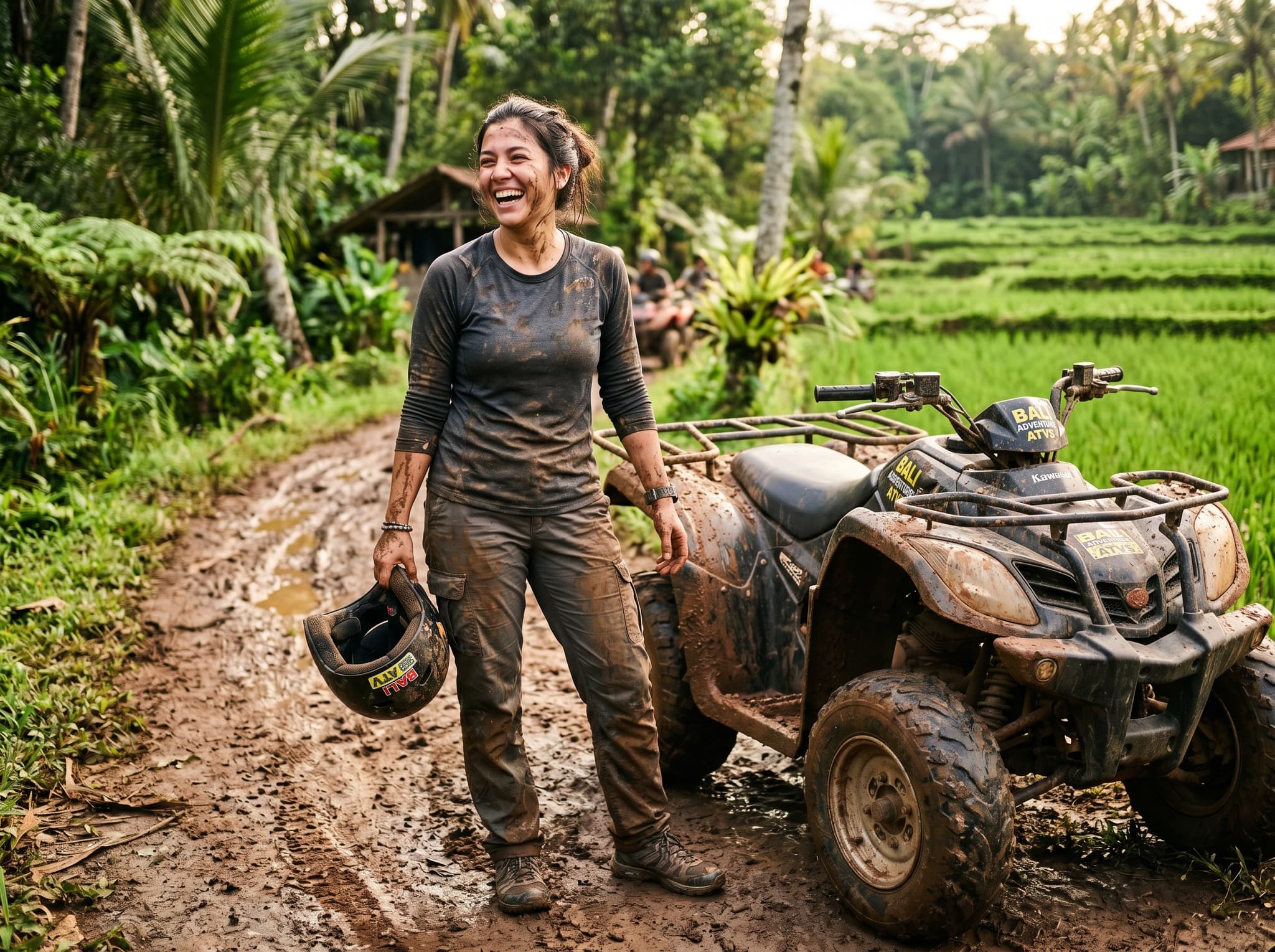
Best Time of Day
Book the morning slot — 8:00 or 9:00 AM start. Three reasons: the temperature is cooler (it gets hot and humid by midday), afternoon rainstorms are common year-round but especially November through March, and the morning light is better for photos.
Most operators offer three windows:
Typical Time Slots
Morning
8:00–8:30 AM start (recommended)
Midday
10:30–11:00 AM start
Afternoon
1:00–2:00 PM start (highest rain risk)
Dry Season vs. Wet Season
Dry season (April–October): More predictable conditions. Trails are firmer and dustier. Less dramatic visually — the jungle is less lush, the mud crossings are shallower. Lower chance of a ride being cut short by heavy rain.
Wet season (November–March): Muddier trails, deeper water crossings, more dramatic riding. Also higher chance of heavy downpours that reduce visibility and can make steep sections genuinely dangerous. Some operators shorten rides or cancel in heavy rain. If you're visiting in wet season, the morning slot is even more important — rain typically hits in the afternoon.
What to Wear
- Closed-toe shoes. Operators list this as a requirement but rarely enforce it. People show up in flip-flops. Those people spend the ride with mud between their toes and no ankle protection. Wear sneakers or hiking sandals with a back strap at minimum.
- Clothes you will throw away. Not clothes you "don't mind getting dirty." Clothes you are prepared to never wear again. The mud doesn't wash out of everything.
- Bring a change of clothes in a plastic bag. Every operator has showers, but putting muddy clothes back on for the ride home defeats the purpose.
- Waterproof phone case if you want photos while riding. Most operators don't allow you to stop and take your own photos mid-ride (the guide controls stops), but some riders manage quick shots.
ATV Ride Photos
Most operators station photographers at scenic points along the route. They'll take photos of each rider and offer a package at the end. Typical cost: IDR 100K–200K ($6–13 USD) for a digital photo set. Quality varies from decent action shots to blurry messes. Know this exists before you ride so you're not surprised by the sales pitch at the end — and so you can decide in advance whether you want to tip the photographer or buy the package.
How to Book and What to Pay
The price you pay for the same ATV ride can vary by 30–40% depending on how you book.
Booking platforms (Klook, GetYourGuide, Viator): Almost always cheaper than booking direct or through your hotel. These platforms negotiate bulk rates with operators. For a ride that costs $55 direct, you might pay $35–40 on Klook. The experience is identical — same operator, same route, same guide.
Direct booking (operator website or WhatsApp): Full price, but you can sometimes negotiate, especially for groups of four or more, or during low season (February–March, September–October). Worth trying if you want to customize timing or have specific requests.
Hotel front desk: The most expensive option. Hotels take a 20–40% commission. The only advantage is convenience — they handle everything. If your time is worth more than $15–20, this might make sense. Otherwise, spend five minutes on Klook.
Price Comparison Example (Approximate)
Kuber ATV via Klook
$35–45 USD
Kuber ATV direct booking
$45–55 USD
Kuber ATV via hotel desk
$55–70 USD
Mason Adventures via GetYourGuide
$50–65 USD
Mason Adventures direct
$65–80 USD
Tipping: Not required, but appreciated. IDR 50K–100K ($3–6 USD) per rider for the guide is standard if you had a good experience. The photographer is separate — you either buy the photo package or you don't. Tipping the photographer on top of the package isn't expected.
Booking timing: In high season (July–August, Christmas through New Year), book 2–3 days ahead for morning slots. The rest of the year, day-before booking is usually fine. Same-day is possible but you risk getting stuck with an afternoon slot.
Combining ATV with Rafting, Tubing, or Other Activities
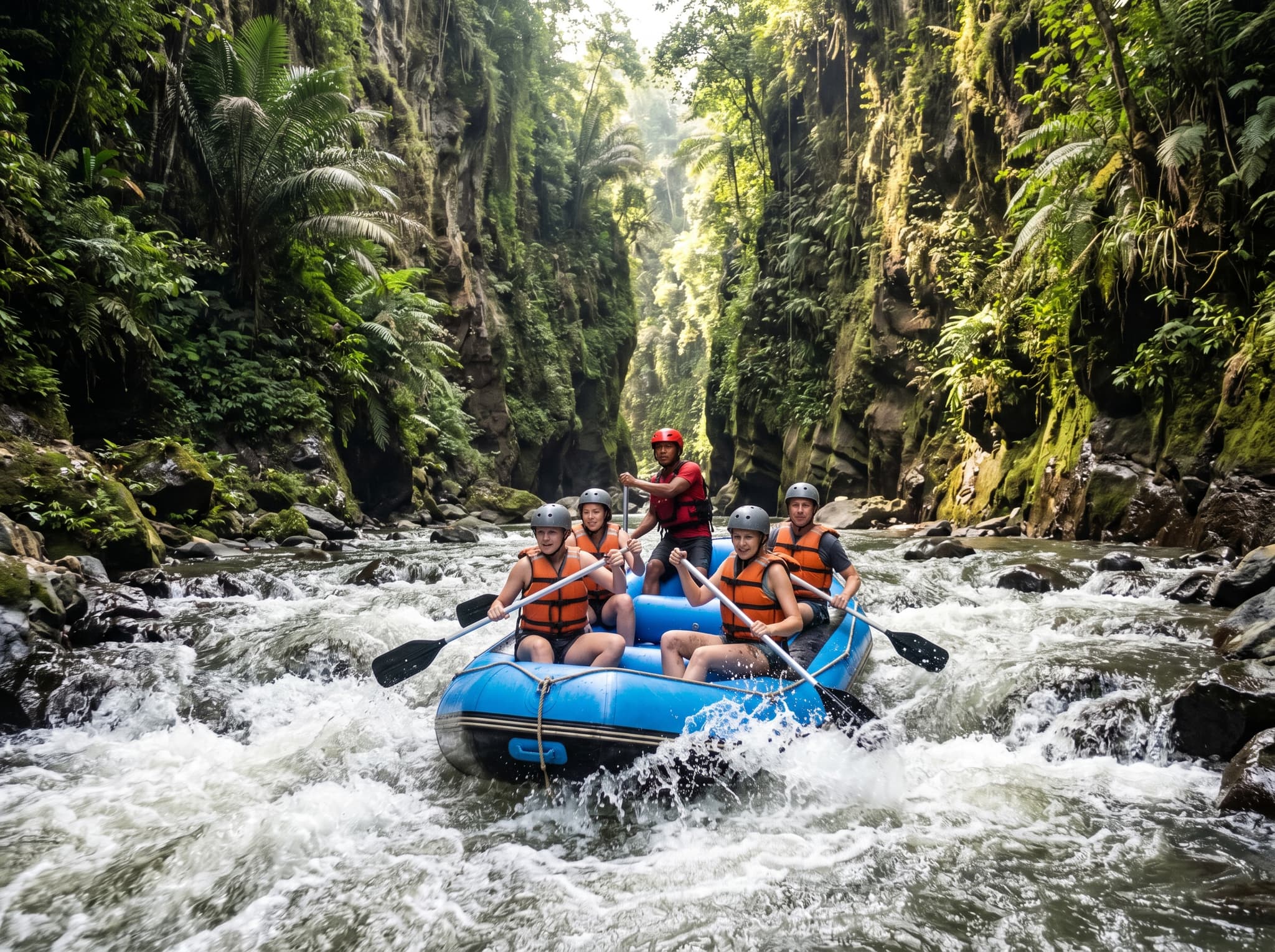
The most common combo package in Bali is ATV + white water rafting, usually on the Ayung River near Ubud. Several operators run both activities, and the combo pricing saves 15–25% over booking each separately.
Common Combo Packages
ATV + Ayung River rafting
$65–110 USD per person
ATV + river tubing
$50–85 USD per person
Total time commitment
6–8 hours including transfers
Physical demand
High — two strenuous activities in one day
Mason Adventures runs both their own ATV and rafting operations, which means tighter logistics and consistent quality across both activities. Most other operators subcontract one half of the combo — they run the ATV and partner with a rafting company, or vice versa. This isn't necessarily bad, but the handoff between operators can add 30–45 minutes of waiting.
Is the combo worth it? On price, yes. On experience, it depends on your fitness level and heat tolerance. Doing both in a single Bali day — especially in the heat — is genuinely tiring. You'll spend 6–8 hours on activities and transfers. If your trip allows it, booking ATV and rafting on separate days means you'll enjoy both more and won't spend the evening too exhausted to eat dinner.
ATV + river tubing is a lighter combo. Tubing is less physically demanding than rafting, so the total energy expenditure is more manageable. It's a growing option but fewer operators offer it as a package.
Where Each Operator Is and How Location Affects the Ride
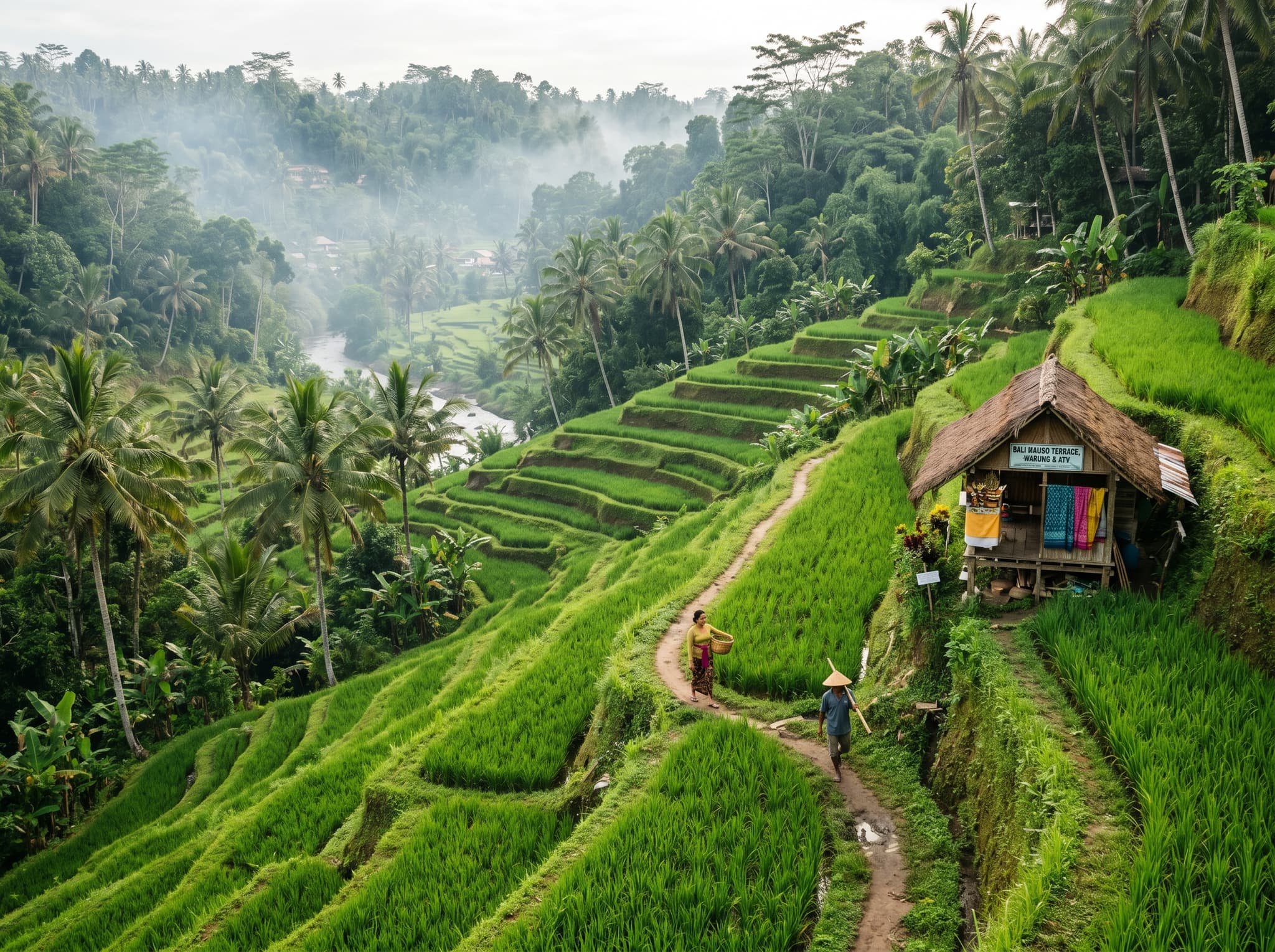
Location is the variable that determines everything else — the terrain you ride through, how long you spend in a van, and which operators are practical options from where you're staying.
Transfer Times to ATV Areas
From Ubud to Tegallalang operators
15–25 min
From Ubud to Gianyar (Mason)
20–35 min
From Seminyak/Kuta to Ubud-area operators
60–90 min
From Canggu to Ubud-area operators
45–75 min
From Nusa Dua to Ubud-area operators
75–100 min
From Ubud to Kintamani operators
40–60 min
From Seminyak/Kuta to Kintamani
90–120 min
If you're staying in Ubud: You have the most options and the shortest transfers. Any operator works. Tegallalang is 15–25 minutes away, Gianyar is 20–35 minutes. You could book a morning ATV ride and be back for a late lunch.
If you're staying in Seminyak, Kuta, or Canggu: Budget 60–90 minutes each way to Ubud-area operators. This turns a 2-hour ATV experience into a 5-hour commitment minimum. Some operators include hotel transfers from these areas; others charge extra or don't offer them at all. If transfers aren't included, arrange a Grab or private driver — it's cheaper than the operator's transfer surcharge.
If you're staying in Nusa Dua or Uluwatu: The transfer to any ATV operator is 75 minutes at best, often closer to two hours with traffic. Consider whether a 2+ hour round-trip drive is worth it for a 1-hour ride. If you're set on doing it, plan it on a day when you're heading north anyway — combine it with a Ubud visit or Tegallalang rice terraces.
Terrain by area:
- Tegallalang (Kuber, etc.): Rice terraces, caves, waterfalls, jungle — the most varied and photogenic routes
- Greater Ubud (Bali Quad Discovery, Pertiwi): Rice paddies, bamboo forest, river crossings — gentler, greener
- Gianyar (Mason Adventures): Jungle, river gorges, rice paddies — well-maintained trails, more elevation change
- Kintamani: Volcanic black sand, open terrain, Mount Batur views — completely different character, less vegetation
Making the Decision
Skip the deliberation. Here's the framework:
You want the best photos and most dramatic route: Kuber Bali ATV. Book the earliest morning slot to avoid crowds at the cave.
You want the safest, most professional operation: Mason Adventures. Worth the premium if you're traveling with kids or if equipment quality matters to you.
You want good value without overthinking it: Bali Quad Discovery or Pertiwi Quad. Solid mid-range rides at fair prices.
You want something different from the standard jungle ride: Kintamani. Volcanic terrain, Mount Batur views, a landscape most ATV riders in Bali never see.
You're on a tight budget: Book any mid-range operator through Klook or GetYourGuide. The platform discount is the single biggest lever on price.
You want ATV + rafting in one day: Mason Adventures runs both in-house. Cleanest logistics, no subcontractor handoff.
Whatever you book, remember: the advertised time is not the ride time. You're paying for 1 to 1.5 hours on the quad. If that sounds like enough, you'll have a great time. If it doesn't, now you know before you're standing in the mud wondering where the other hour went.