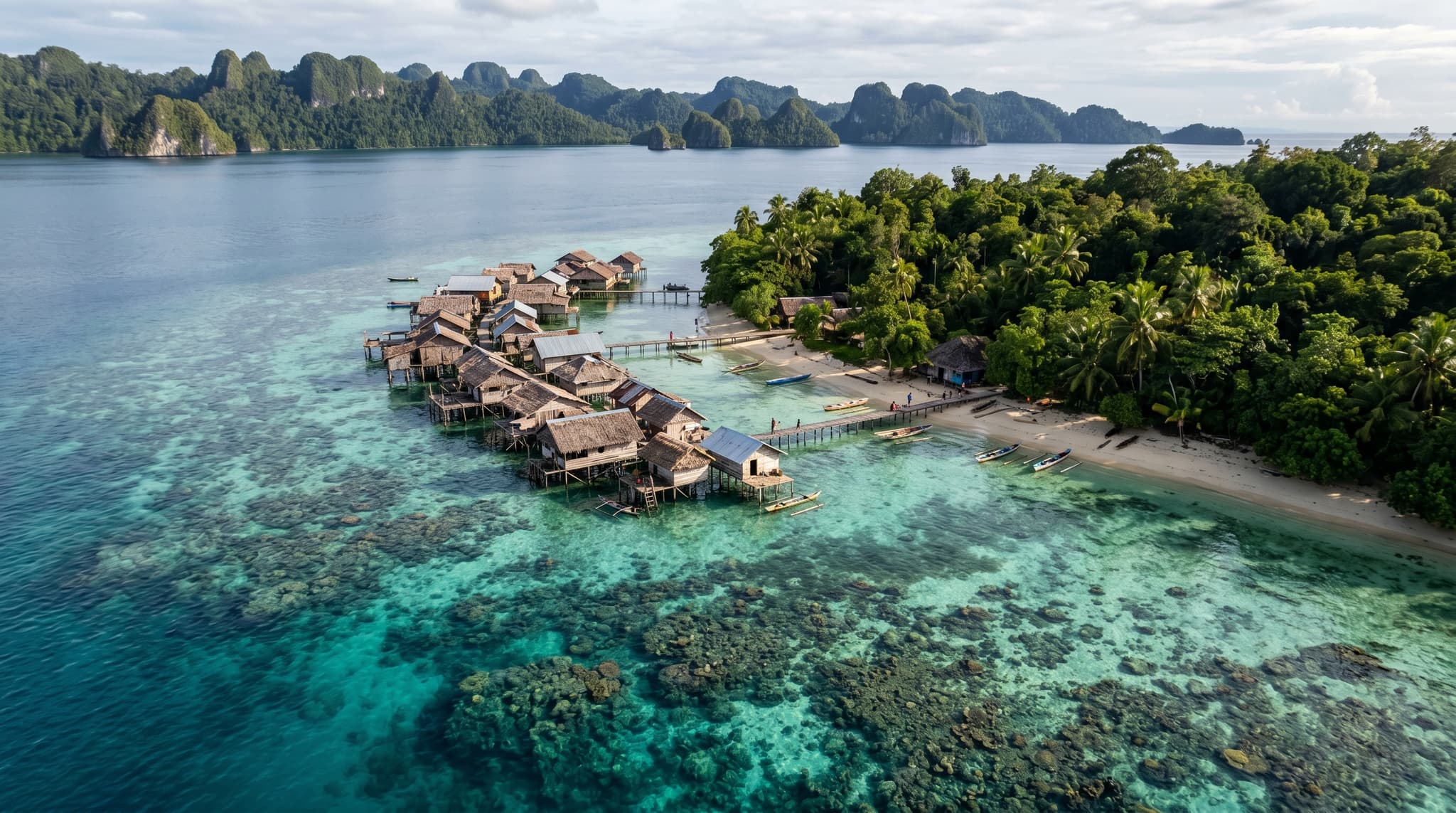
Nudi Rock in Misool, Raja Ampat is a shallow macro diving site known for nudibranch diversity, pygmy seahorses, and slow, observant diving on coral rubble.
Most dive sites in Raja Ampat are famous for scale — enormous schools of fusiliers, manta rays wheeling through cleaning stations, coral walls that drop into deep blue. Nudi Rock asks you to forget all of that. It asks you to slow down, hover close to the substrate, and look at things no bigger than your thumbnail. For divers who respond to that request, it's one of the most rewarding sites in the Misool region.
I should be honest: I haven't dived Nudi Rock myself. What follows draws on dive operator briefings, underwater photographer accounts, and marine life databases. But the creatures that live here are well documented, and the site's reputation among macro specialists is specific enough to write about with confidence.
What Makes Nudi Rock a Macro Diving Site

Nudi Rock is a small rocky outcrop in the Misool area of southern Raja Ampat, surrounded by coral rubble, sponge gardens, and patches of soft coral. The topography isn't dramatic — no sheer walls, no swim-throughs. The rock itself rises modestly from a sandy slope, and the surrounding reef is shallow enough that most of the action happens between 5 and 20 meters.
That's the point. The site isn't built for wide-angle photography or adrenaline. It's built for patience.
Dive Profile
Depth Range
5–22 meters
Current
Mild to none
Visibility
10–20 meters
Skill Level
All levels (Open Water and up)
Bottom Type
Coral rubble, sponge gardens, sandy slope
Best For
Macro photography, nudibranch spotting, slow diving
The conditions — gentle current, shallow depth, long bottom times — make it possible to spend an entire dive on a patch of reef the size of a dining table. Divers with macro lenses regularly burn through a full hour here without covering more than 30 meters of ground.
Nudi Rock: What Lives on the Reef

The name is earned. Nudibranchs are the primary draw, and the diversity is dense. Dive guides in Misool report regularly finding 15 to 25 species on a single dive, depending on season and how carefully you look.
A few species show up consistently:
- Chromodoris annae — electric blue with black lines and an orange margin. One of the more photogenic Indo-Pacific nudibranchs, and common enough here that you'll likely see several.
- Nembrotha kubaryana — green and black, larger than most, often found feeding on tunicates. Distinctive and easy to spot.
- Halgerda batangas — cream-colored with orange ridges, slow-moving, usually on hard coral or rubble.
- Flabellina species — translucent, delicate, with cerata that look like clusters of tiny fingers. These are harder to find and smaller, often requiring a guide's trained eye.
Beyond nudibranchs, the site supports a broader community of macro life. Pygmy seahorses — most commonly Hippocampus bargibanti — have been documented on gorgonian sea fans here. They're extraordinarily small, rarely exceeding two centimeters, and their camouflage is so effective that spotting one without a guide is unlikely. Even experienced divers can stare directly at a sea fan hosting a pygmy seahorse and see nothing until someone points it out.
Other residents include ornate ghost pipefish, various species of commensal shrimp living inside anemones and barrel sponges, flatworms that mimic nudibranchs, and the occasional blue-ringed octopus tucked into a crevice. The sandy patches around the rock hold mantis shrimp and gobies sharing burrows with alpheid shrimp — small partnerships playing out in the sediment.
If you're diving with a macro lens, bring a 60mm or 100mm setup. A diopter or wet lens for super macro will open up subjects like flatworms and juvenile nudibranchs that are otherwise too small to frame. Dive guides at Misool-area resorts and liveaboards know the site well — let them lead. Their eyes are calibrated for this.
What It Feels Like Down There
Accounts from divers and underwater photographers describe a particular quality to Nudi Rock that's worth noting: it's quiet. Not just in the absence of current or other divers, but in the way the site demands a different kind of attention.
Wide-angle diving in Raja Ampat can feel cinematic — you're swept along by current, surrounded by movement, reacting to things that are bigger and faster than you. Nudi Rock inverts that. You descend, settle your buoyancy, and begin scanning. The reef doesn't reveal itself immediately. It asks you to adjust your sense of scale.
The colors are there, but they're concentrated into centimeter-wide bursts — the violet gills of a nudibranch, the yellow polyps of a soft coral, the red lattice of a sea fan hosting something nearly invisible. Photographers describe a kind of tunnel vision that sets in after twenty minutes: the rest of the ocean falls away, and your world narrows to whatever is directly in front of your lens port.
There's a meditative quality to it that some divers find deeply satisfying and others find maddening. If you need movement and spectacle, this isn't your site. If you're the kind of person who can spend ten minutes watching a nudibranch cross a piece of coral rubble, Nudi Rock will hold your attention for the entire dive.
How to Get to Nudi Rock

There's no way to sugarcoat the logistics. Nudi Rock sits in the Misool region of southern Raja Ampat, which is remote even by Raja Ampat standards.
Getting There
Nearest Hub
Sorong, West Papua
Access
Liveaboard or Misool-area dive resort
Transit Time
10–14 hours by boat from Sorong to Misool area
Liveaboard Duration
7–12 night itineraries typically
Raja Ampat Entry Permit
IDR 1,000,000 (~USD $65) for international visitors
Most divers reach the site via liveaboard — operators like Damai, Coralia, and Papua Explorers run itineraries through southern Raja Ampat that include Misool sites. Some Misool-based dive resorts, including Misool Resort, can arrange boat trips to Nudi Rock as part of their daily dive schedule, though availability depends on sea conditions and distance.
Flights into Sorong connect through Jakarta, Makassar, or Manado. From Sorong, everything is by boat. Plan for at least a full travel day each way.
The Raja Ampat Marine Park entry permit (known locally as the PIN) must be purchased before diving. As of recent reports, it's available at the tourism office in Waisai or through your liveaboard operator. Keep the card — you may be asked to show it at checkpoints.
Who Should Dive Nudi Rock

This is not a site for every diver, and that's not a criticism — it's a description. Nudi Rock rewards a specific temperament: patience, buoyancy control, and genuine interest in marine life that doesn't perform for an audience. The creatures here don't school, don't swoop, don't pose. They creep along rubble, hide inside sponges, and blend into backgrounds.
For underwater photographers working on macro portfolios, it's a serious site. For marine biology enthusiasts, the density of nudibranch species alone justifies the dive. For new divers looking for the Raja Ampat experience they've seen in documentaries — sweeping reefs, big pelagics — this will feel like a different ocean entirely.
It is a different ocean. That's the whole point.