Saporkren Village: Raja Ampat's Window to the Wilson's Bird of Paradise
Saporkren Village on Waigeo Island is one of only two places on Earth to see Wilson's Bird of Paradise. Here's how to visit, trek, and stay.
There are only two islands where you can see Wilson's Bird of Paradise — Waigeo and Batanta, both in Raja Ampat. Of the two, Waigeo is far more accessible, and the trail that most birders and travelers use to reach the bird's display grounds starts from a single place: Saporkren Village.
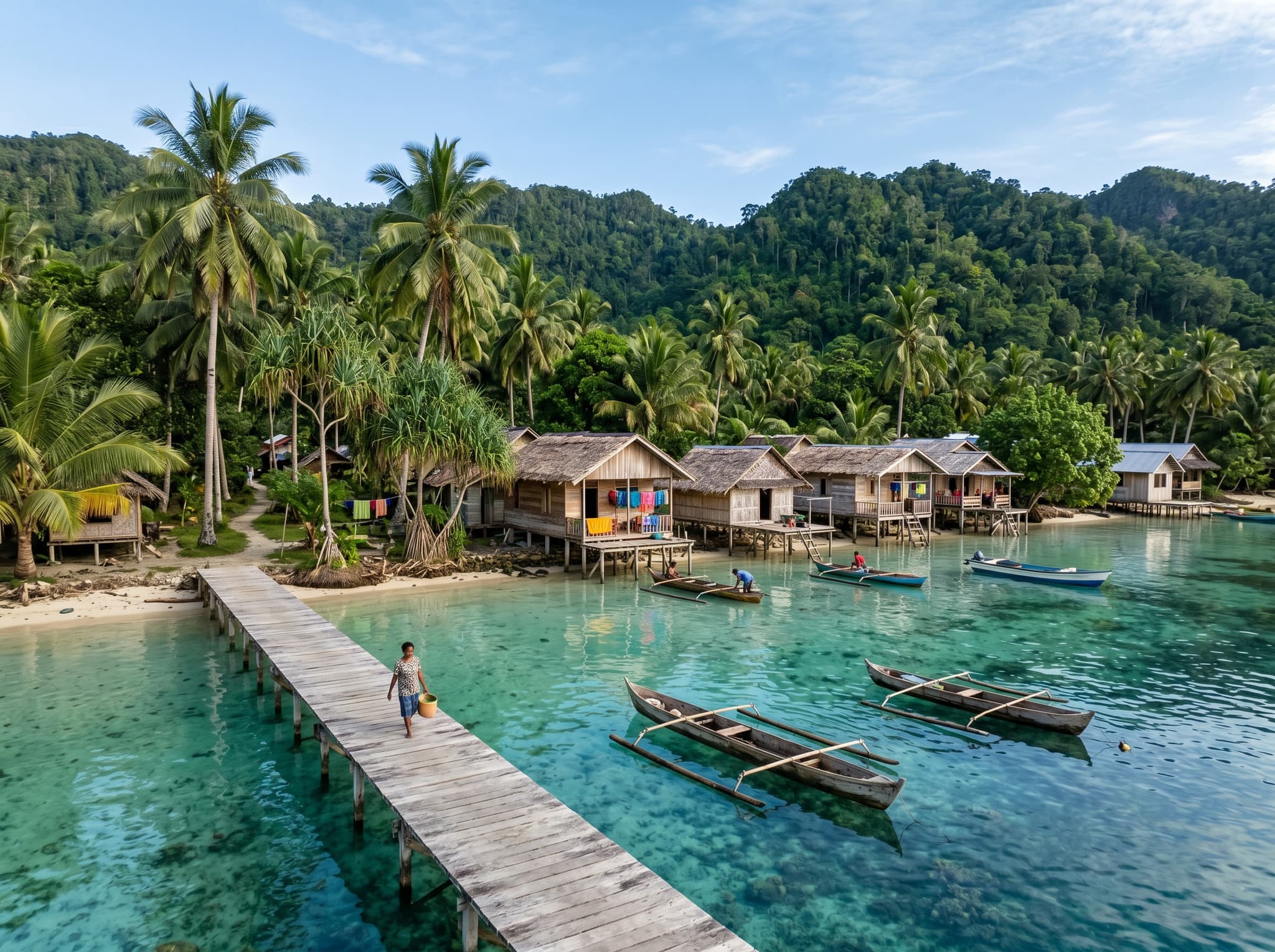
That fact alone would make Saporkren worth knowing about. But the village itself — a tidy Papuan settlement on Waigeo's coast, roughly 20–30 minutes by road or boat from the regency capital of Waisai — has become something more interesting than a trailhead. It's one of Raja Ampat's designated cultural tourism villages, a place where conservation and community economics have found a working relationship, and where the experience of seeing one of the world's rarest birds is inseparable from the people who protect its habitat.
The Bird That Draws the World
Wilson's Bird of Paradise (Cicinnurus respublicana) is small — roughly the size of a starling — and almost absurdly colorful. The male has a scarlet back, yellow cape, iridescent blue feet, and two curling violet tail wires. It performs its courtship display on a carefully cleared patch of forest floor, and that display is what visitors come to Saporkren to witness.
The species inhabits dense lowland rainforest below 300 meters elevation. It's endemic to Waigeo and Batanta, which means its entire global range is contained within Raja Ampat. The Red Bird of Paradise (Paradisaea rubra), another Waigeo endemic, shares the same forest and can often be spotted on the same morning trek.
In total, Waigeo hosts five endemic bird species. Other sightings along the Saporkren trail include the Raja Ampat pitohui, brown-hooded crow, spice imperial pigeon, hornbills, cockatoos, and parrots — enough to fill a morning even if the star performer doesn't cooperate.
The Trek

The trail begins at the edge of the village and climbs through humid tropical forest for approximately 45 minutes to a wooden viewing platform. The difficulty is moderate — some steep sections, uneven footing, and the kind of equatorial humidity that makes you reconsider your clothing choices. It's not technical, but it's not a boardwalk either. Sturdy shoes and water are essential.
Local guides from Saporkren lead the treks. This isn't optional in any practical sense — the viewing platforms are on community-managed land, the guides know exactly where the display courts are, and their knowledge of bird behavior and calls is what separates a successful morning from a quiet walk in the forest. Arrange guiding through your homestay reception or directly with villagers.
The Village Itself

Saporkren is frequently described as one of the cleaner, more organized villages in Raja Ampat — a detail that comes up in nearly every visitor account. The settlement is small: traditional houses shaded by coconut palms and pine trees, a school, a church, a cemetery, and a small library where travelers can trade books. There's even an indoor football center, which says something about community priorities.
The village sits within the Dampier Strait Area III Marine Protected Area, a 353,440-hectare conservation zone. The tourism model here is community-based — homestays are locally built and operated, guides are village residents, and the income from birdwatching treks feeds directly back into the families managing the forest.
Village Activities
Birdwatching trek
45 min hike, dawn departure
Snorkeling
Table corals at ~3m depth off the jetty
Village tour
Guided walks, betel nut preparation
Batu Pensil
Iconic karst rock formation, by boat
Sunset viewpoint
IDR 10,000 entry
Beyond the birds, the waters off Saporkren's jetty offer surprisingly good snorkeling — table corals and reef fish visible at around three meters depth in calm, beginner-friendly conditions. Snorkel gear can be rented locally for IDR 100,000–200,000, though bringing your own saves the cost and the negotiation. Boats can be hired for day trips to Batu Pensil, the pencil-shaped karst formation that's become one of Waigeo's most photographed landmarks (viewing and photography only — climbing is prohibited).
Meals at homestays lean on local staples: papeda (a sago-based porridge) served with papaya flower buds or stir-fried water spinach, and fresh coconut water that tastes better than anything you'll find in a bottle.
Staying in Saporkren

Accommodation is homestay-only, which is the norm across Raja Ampat's village tourism network. Expect simple beachside bungalows or private rooms — basic but comfortable, with beach access, a shared restaurant, and the kind of hospitality that makes the simplicity feel intentional rather than lacking. Rates start from approximately USD 23 per night, typically including meals.
Getting There

Fly to Domine Eduard Osok Airport in Sorong (4–5 hours from Jakarta or Bali via Garuda Indonesia, Lion Air, or Batik Air). From Sorong, take the ferry to Waisai — approximately 2–3 hours, departing roughly twice daily, at around IDR 135,000 per person. From Waisai, Saporkren is reachable by car, scooter, or boat in 20–30 minutes. Your homestay can typically arrange the final transfer.