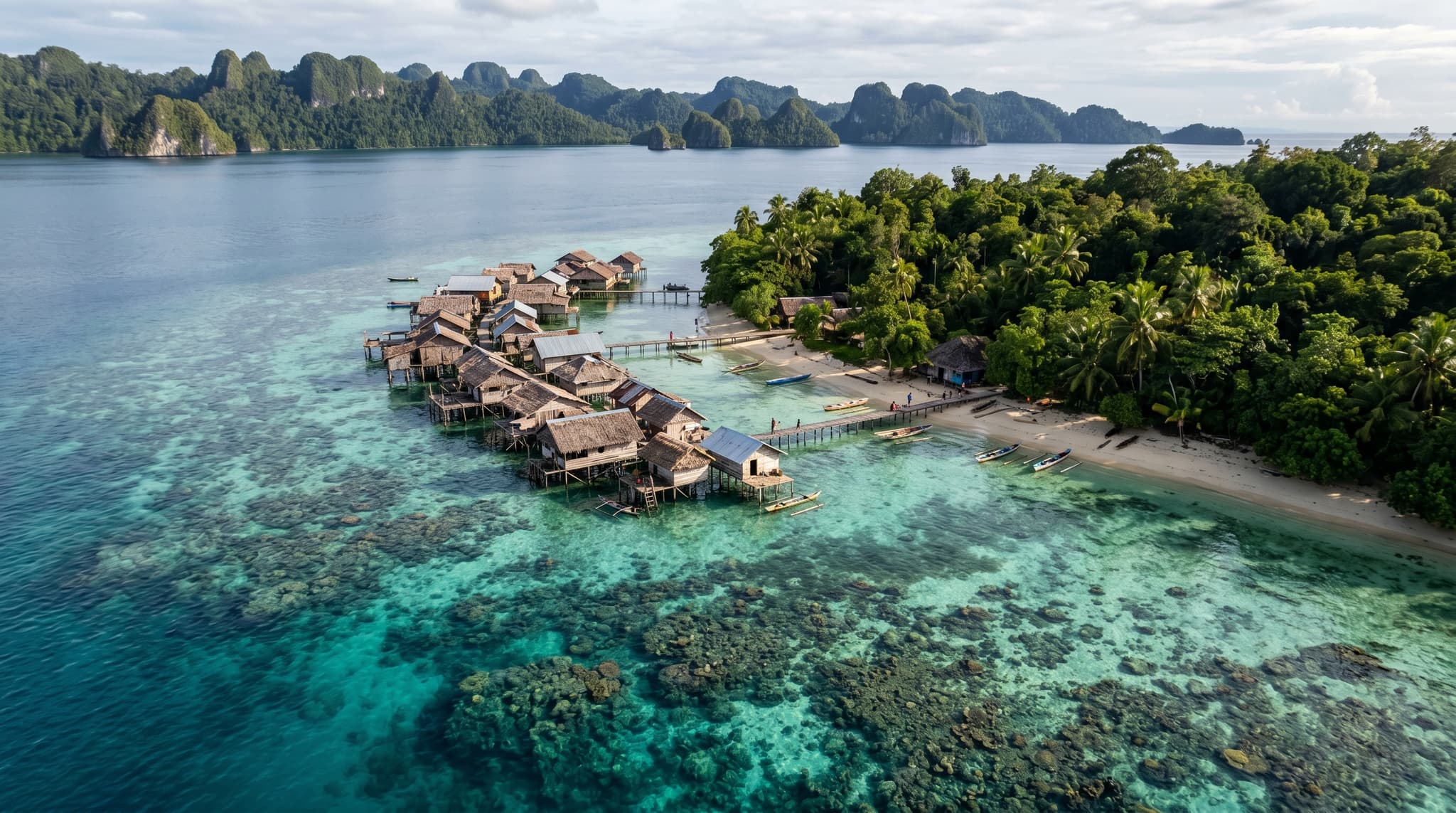
Batu Lima's five rock formations hide Raja Ampat's best night dive, walking sharks, and world-class macro life — without the crowds of marquee sites.
Everyone who dives Raja Ampat talks about Cape Kri. They talk about Manta Sandy, Blue Magic, the greatest-hits reel. And those sites deserve the attention — they're world-class for a reason. But Batu Lima, five rock formations jutting out of the Dampier Strait like a geological afterthought, rarely makes anyone's top-five list. That's exactly why it should be on yours.
What You're Actually Looking At
Five large rock formations break the surface on the eastern side of Gam Island, marking the channel into Kabui Bay. Underwater, they're connected — forming walls, groove-like caves, and swim-throughs that you can navigate between at high tide. The topography ranges from shallow coral gardens at 3–5 meters down to walls dropping to around 24–25 meters.
It's not the dramatic vertical drop of a Misool wall dive. It's more intimate than that. The rocks create a series of sheltered pockets where marine life concentrates, and the coral coverage is dense and vivid. Think of it as Raja Ampat's version of a neighborhood dive — compact, rich, and rewarding if you pay attention to the details.
Dive Profile
Depth Range
3–25 meters
Current
Mild to medium; stronger on tide changes
Best Tide
Rising tide for drift dives
Dive Types
Wall, night dive, macro photography
Snorkeling
Yes — shallow areas with little current
The Marine Life Case
Here's where Batu Lima punches above its weight class. The site is a macro photographer's playground: four species of pygmy seahorses, ghost pipefish, nudibranchs in absurd variety, peacock mantis shrimp, cuttlefish, and octopuses tucked into every crevice. If you're the kind of diver who spends 10 minutes on a single coral head with a macro lens, this is your site.
But the headliner — the reason dive guides get genuinely excited about this spot — is the epaulette shark. These small, endemic sharks don't swim so much as walk, shuffling across the reef floor on their pectoral fins. They're most active after sunset, which makes Batu Lima one of Raja Ampat's best night dive locations. Watching a shark literally stroll past your torch beam is the kind of thing that recalibrates your understanding of what sharks can be.
During daylight hours, blacktip and whitetip reef sharks patrol the deeper sections. Napoleon wrasses cruise by with that trademark slow-motion arrogance. Schools of trevallies, barracudas, and snappers work the water column, while parrotfish and rabbitfish keep busy along the walls.
Who Should Dive Here
The skill-level question is more nuanced than most sites in the Dampier Strait. The shallow coral gardens — 3 to 5 meters, mild current, sheltered by the rock formations — are genuinely beginner-friendly and excellent for snorkeling. Deeper sections along the walls and swim-throughs at around 5 meters of depth can see stronger flows on tide changes, making them better suited for divers with some current experience.
The general recommendation for Raja Ampat is 50+ logged dives, and that holds for the region's more exposed sites. At Batu Lima specifically, conditions are often calmer than the Dampier Strait average. Guides assess currents on-site before entry — defer to their call.
Skill Suitability
Snorkelers
Shallow lagoon, minimal current
Beginners
Sheltered areas at 3–5m
Intermediate
Wall dives, swim-throughs
Advanced
Drift dives on tide changes, night dives
How to Get There

Two options: resort-based or liveaboard.
From Gam Island resorts: Raja Ampat Biodiversity Eco Resort and other properties near Yenbeser village on Gam Island reach Batu Lima in roughly 5–15 minutes by boat. It's one of their closest sites, which means it often gets scheduled as a second or third dive of the day — or as a night dive.
From a liveaboard: Operators like La Galigo access the site by backrolling from a tender, with entry depth near the rocky outcrops at approximately 18 meters. Most Dampier Strait itineraries pass through this area, but not all include Batu Lima by name — ask before booking.
Liveaboard Pricing (as of March 2026)
Budget Tier
$1,700–$2,800 per trip
Mid-Range
$2,900–$4,500 per trip
Luxury
$5,000–$7,000+
Example: Neptune One
7 nights from $3,650
Example: Calico Jack
11 nights from $4,365
Example: La Galigo
11 nights from $5,567
When to Go
October to April is peak diving season for Raja Ampat — calmer seas, better visibility, lower rain probability. March sits at the tail end of the dry-to-wet transition, with visibility typically running 18–20 meters and water temperatures around 28°C. Visibility can reach 30 meters on good days.
Batu Lima's position on the southern side of the Dampier Strait means it's less affected by the tidal and spawning-related visibility drops that can hit northern sites. It's one of the more reliable options when conditions elsewhere are marginal.
The Bottom Line
Batu Lima won't give you the manta encounter you'll post on Instagram. It won't give you the species-count record that Cape Kri holds. What it gives you is a concentrated, detailed, endlessly interesting dive on a site that most visitors pass over for louder options. The walking sharks alone justify the stop. The macro life justifies a second dive. And the fact that you'll likely have the site to yourself — in a region that's getting busier every year — justifies rearranging your itinerary to make it happen.