What to Expect — Food Reality in a Remote Archipelago
There are no destination restaurants in Raja Ampat. No tasting menus, no craft cocktail bars, no chef doing interesting things with local ingredients in a converted boathouse. This is not Bali. It is not even close to Bali.
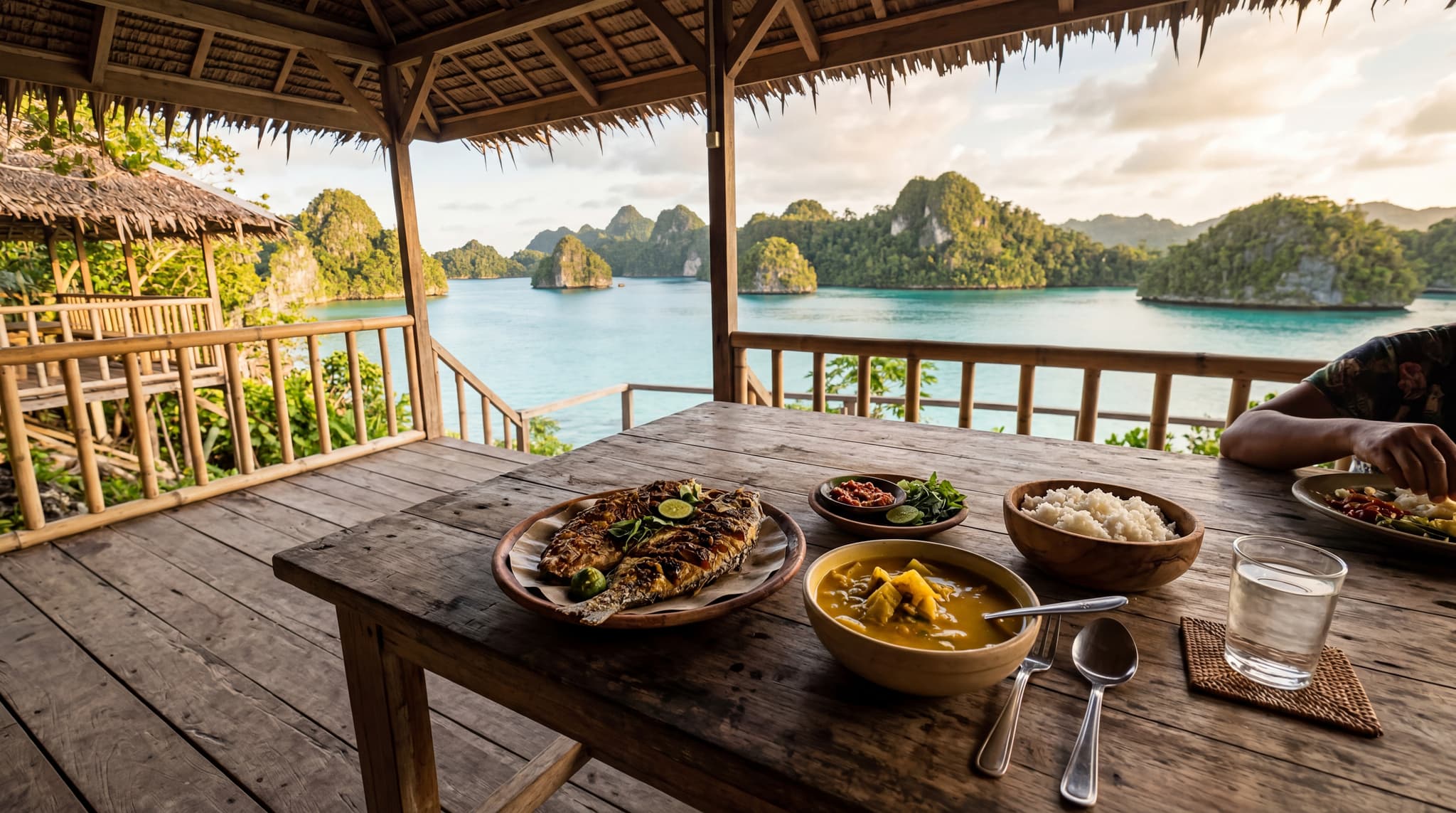
Most visitors eat every meal at their homestay or dive resort, because on the outer islands there are no alternatives. Your host family cooks for you from their kitchen. That's the arrangement. On some islands, the nearest warung is a two-hour boat ride away.
Food in Raja Ampat exists in three contexts: homestay meals (the core experience for budget and mid-range travelers), Waisai town warungs (your only real restaurant options, and only if you're passing through the administrative hub), and dive resort dining (a different price universe entirely). Understanding which one applies to your trip shapes everything — what you'll eat, what you'll spend, and what you need to bring with you.
A few realities to absorb before you go:
- Tap water is not safe to drink. Homestay-provided water is typically boiled or filtered and is generally fine. Ice at Waisai warungs should be assessed case by case — if it looks industrially produced (hollow cylinders), it's usually safe; irregular chunks, less so. Bring purification tablets for outer islands as backup.
- Drinks are often served warm. Power is intermittent across the islands. Cold beer exists at shops in Waisai but not at warungs.
- Fresh fruit is limited beyond bananas. Don't expect the tropical abundance of Java or Bali.
- Cash only, everywhere. IDR in small bills. No cards accepted at warungs or homestays. No ATMs on outer islands.
The food is simple. It is often repetitive. And it is sometimes extraordinary. Those three things are not contradictions.
Homestay Meals — The Core Food Experience
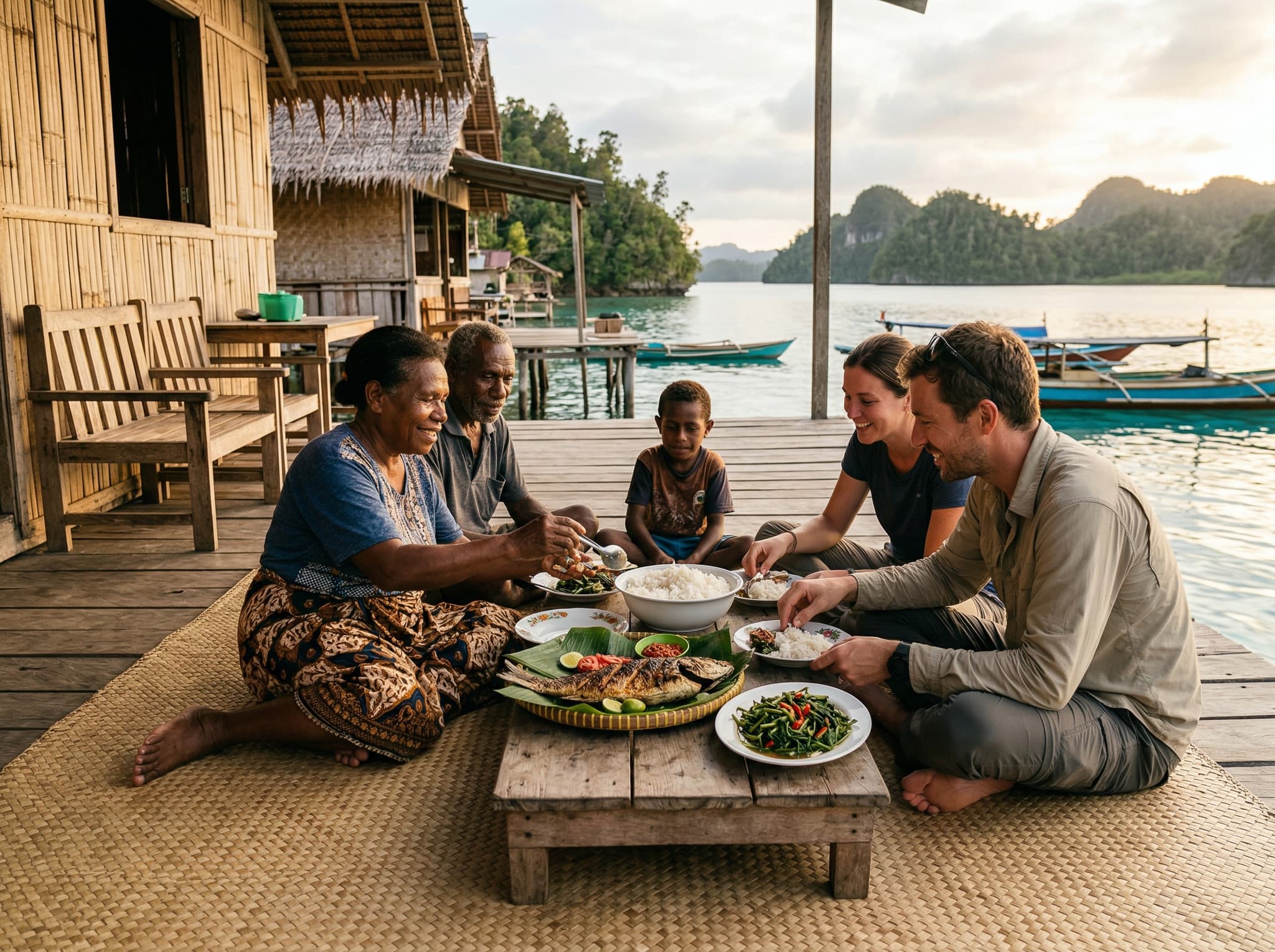
Most homestays charge IDR 300,000–500,000 per night ($19–$31) all-inclusive — three meals a day, a room, and the quiet company of a Papuan family who has opened their home to you. Food is not a separate line item. It's part of the hospitality. On Arborek, Yenbuba Homestay charges IDR 400,000 per day ($25) for the full package.
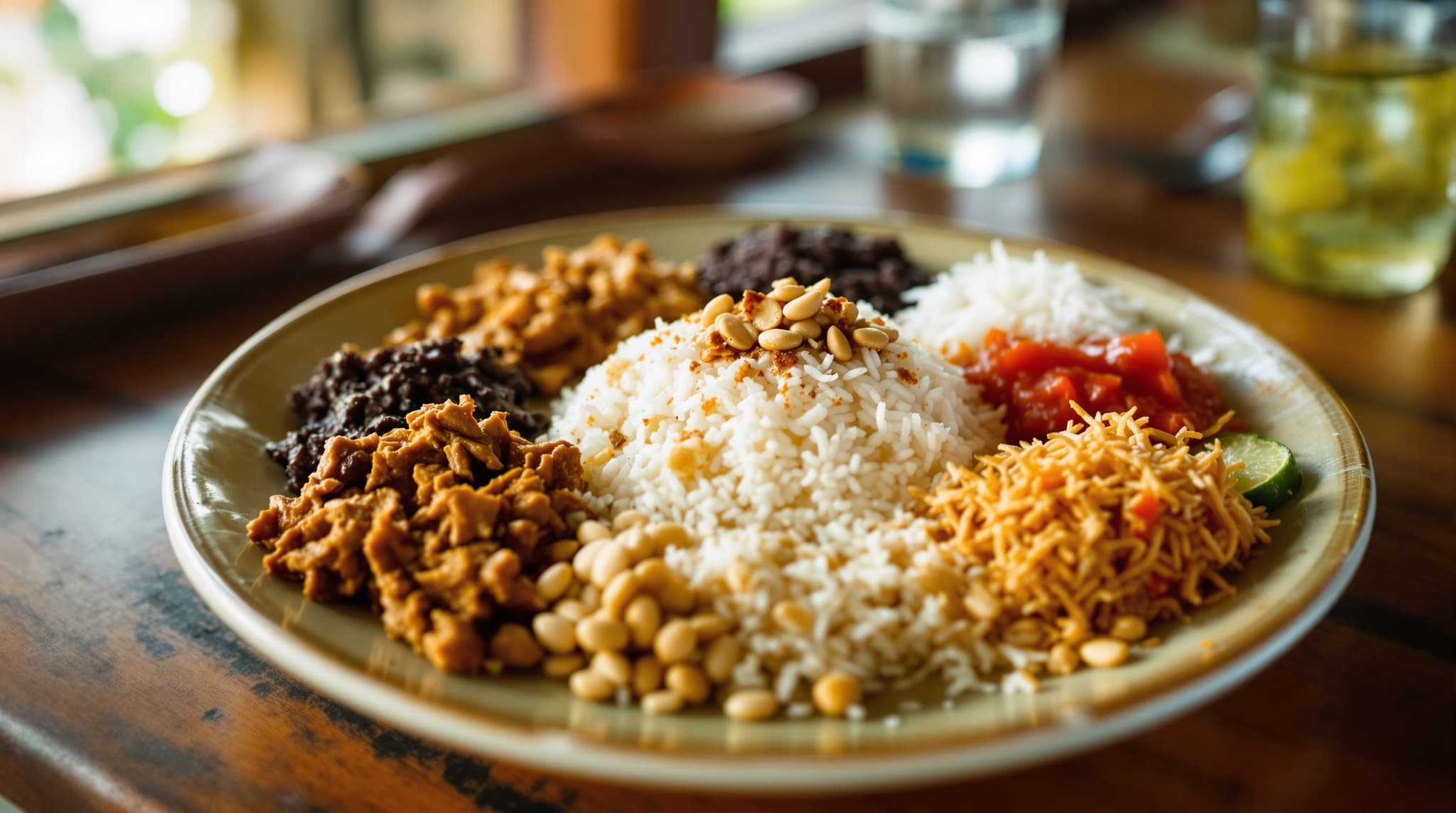
The rhythm settles in quickly. Breakfast is simple: eggs, bananas, instant coffee, sometimes pancakes or fried cassava. Lunch and dinner center on whatever was caught that morning. Fish is the constant — grilled whole over coals, fried crisp, or simmered in a turmeric broth. Rice accompanies nearly everything. Vegetables are limited to what grows locally or arrives by supply boat, which means you'll see kangkung (water spinach) and the occasional eggplant more than anything else.
Portions are generous. The cooking is home cooking — not restaurant cooking. Some homestays cook beautifully, with a practiced hand for spice and timing. Others are more basic, and the fish comes a little dry, the rice a little sticky. This is not something you can reliably research in advance. Reviews, where they exist, rarely mention food in useful detail.
What matters more than the cooking is the context. Meals are often served communally, on a shared mat or at a small table near the water. Your host family is feeding you from their own kitchen, with ingredients from their own sea. In Papuan culture, this is an expression of welcome, not a transaction. Adjust your expectations accordingly — not downward, just sideways.
What You'll Actually Eat — Papuan and Indonesian Dishes
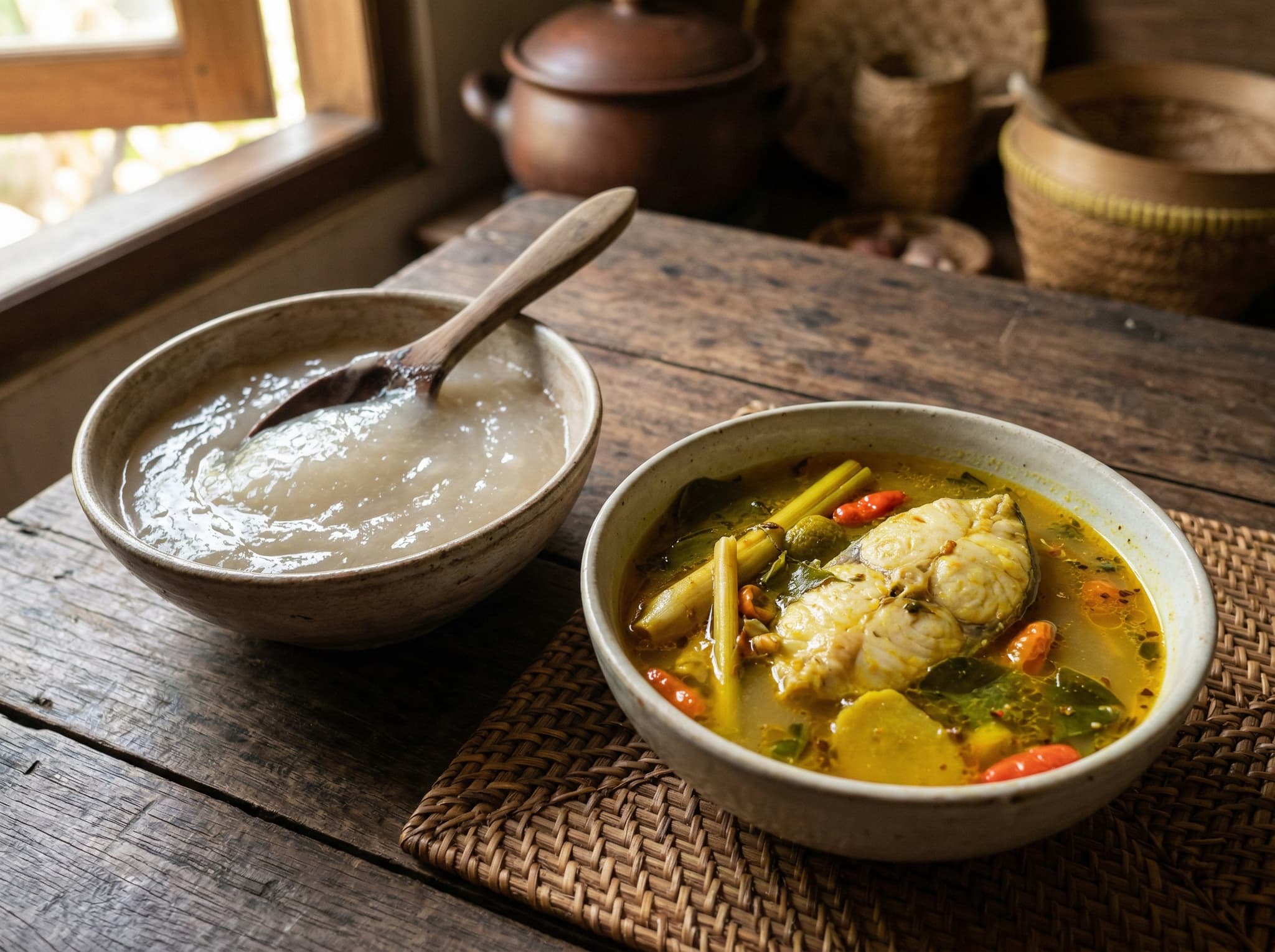
The dish that defines Raja Ampat isn't grilled fish. It's papeda — a sticky, translucent porridge made from sago flour boiled with water until it reaches an elastic, almost gelatinous consistency. It's the traditional Papuan staple, a symbol of cultural identity, and it takes some getting used to. You eat it communally, pulling strands from a shared bowl with chopstick-like utensils, dipping each bite into the broth of the dish beside it.
That dish beside it is almost always ikan kuah kuning: fresh fish — tuna or reef catch — simmered in turmeric, lime, and lemongrass. The broth is light, fragrant, and golden. Together, papeda and kuah kuning are arguably the best single meal you'll eat in Raja Ampat, and the one you'll remember longest.
Traditional Papuan Dishes to Know
Papeda
Sago porridge — elastic, translucent, eaten communally with fish soup
Ikan Kuah Kuning
Fish in turmeric-lime-lemongrass broth — papeda's essential pairing
Ikan Bakar
Spice-marinated grilled fish — the most common meal across homestays
Sate Ulat Sagu
Roasted sago grubs — nutty, crispy, traditional forest delicacy
Norohombi
Sago-wrapped preparation — worth trying if your host offers it
Ubi & Singkong
Boiled or roasted sweet potatoes and cassava — common sides
Sago, not rice, is the traditional primary carbohydrate in Papuan cuisine — high-fiber, nutrient-dense, and harvested from the pith of sago palms that grow across the lowlands. You'll also encounter taro pounded with smoked fish and ferns, a preparation that predates any Indonesian influence.
Sate ulat sagu — roasted sago grubs skewered and cooked over flame — is the dish that appears in every travel article about Papua. The honest version: they taste nutty and crispy, somewhere between a soft-shell shrimp and a roasted nut. Most visitors won't encounter them unless they specifically seek them out or their homestay host offers them as a local specialty.
On the Indonesian side, the standards appear everywhere: nasi goreng, nasi campur, bakso, mie ayam, sate. On outer islands, these arrive in Papuan-inflected versions — the sambal a little different, the fish replacing chicken. In Waisai, you'll eat standard Indonesian warung food that could be from any town in the archipelago.
Eating in Waisai — Your Best Restaurant Options
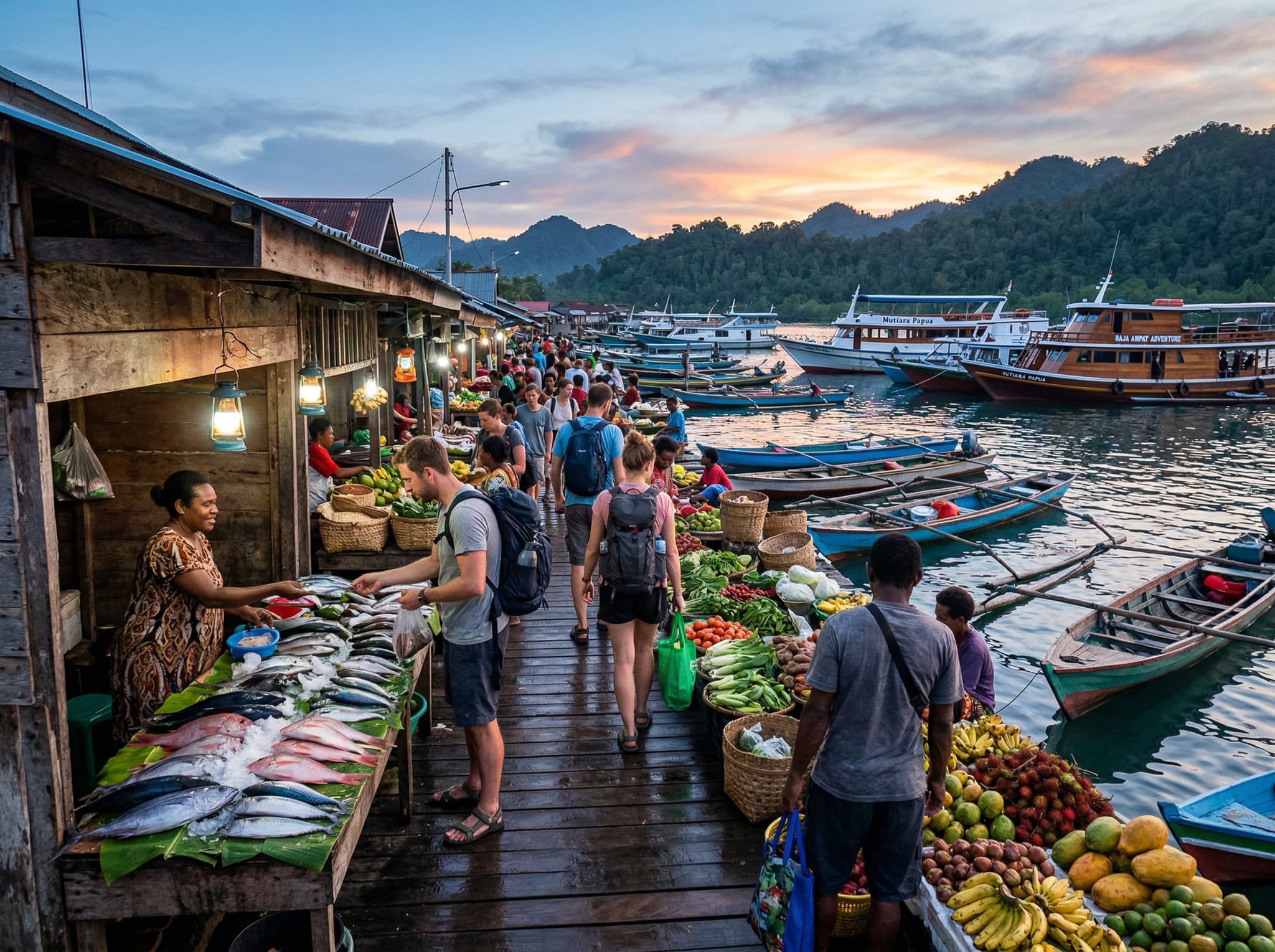
Waisai is the administrative capital of Raja Ampat regency, the place where ferries dock and permits get stamped. Most travelers pass through in a day. But if you're here overnight — or provisioning before heading to the islands — these are your options.
Warung Pondok Lesehan is the closest thing to a reliable recommendation. Indonesian and seafood dishes, rice plates, ikan bakar. It's resort-recommended, which in this context means the dive operators trust it. Open Monday–Saturday 10am–10pm, Sunday 1pm–10pm. Contact: +62 853-9657-4477.
Warung Ikan Bakar 46 does what the name promises — grilled fish with local sambals. Jl. Fundar Sakela. Open Monday–Friday and Sunday 11:15am–10pm.
Warung Prasmanan serves nasi goreng with local seafood and daily lunch specials. Jln. Waigeo, Kel. Saporcando. Open Monday–Saturday 9:30am–9pm. Contact: +62 812-2325-3934.
Warung Cahaya Bone offers seafood capcay, grilled shrimp and tuna, and fresh tangerine juice. A caveat worth noting: traveler reports mention grilled items sometimes arrive overcooked.
For something familiar and reliably halal, RM Bassmallah and Rumah Makan Rizky are Padang-style restaurants with the classic self-serve format — rice with rendang, curry chicken, spicy vegetables. You point, they plate, you pay for what you've taken.
Bakso and mie ayam spots — Bakso Perum 100, Bakso & Mie Ayam HD, Warung Mie Ayam Bakso — serve cheap, filling comfort food. Sate and soto from RM Sate Madura or Sate & Soto Mas Edi round out the options.
Logband Cozy Resto & Bakery is the closest thing to a "restaurant experience" in Waisai — seafood and pastries in a space that has menus and tables and something approaching ambiance. Set your expectations to "small-town Indonesian eatery" rather than anything the word "resto" might imply.
Waisai Meal Costs
Breakfast
IDR 15,000–25,000 ($0.95–$1.55)
Lunch / Dinner
IDR 25,000–40,000 ($1.55–$2.50)
Snacks
IDR 10,000–20,000 ($0.65–$1.25)
Full day (3 meals)
IDR 60,000–120,000 ($3.75–$7.50)
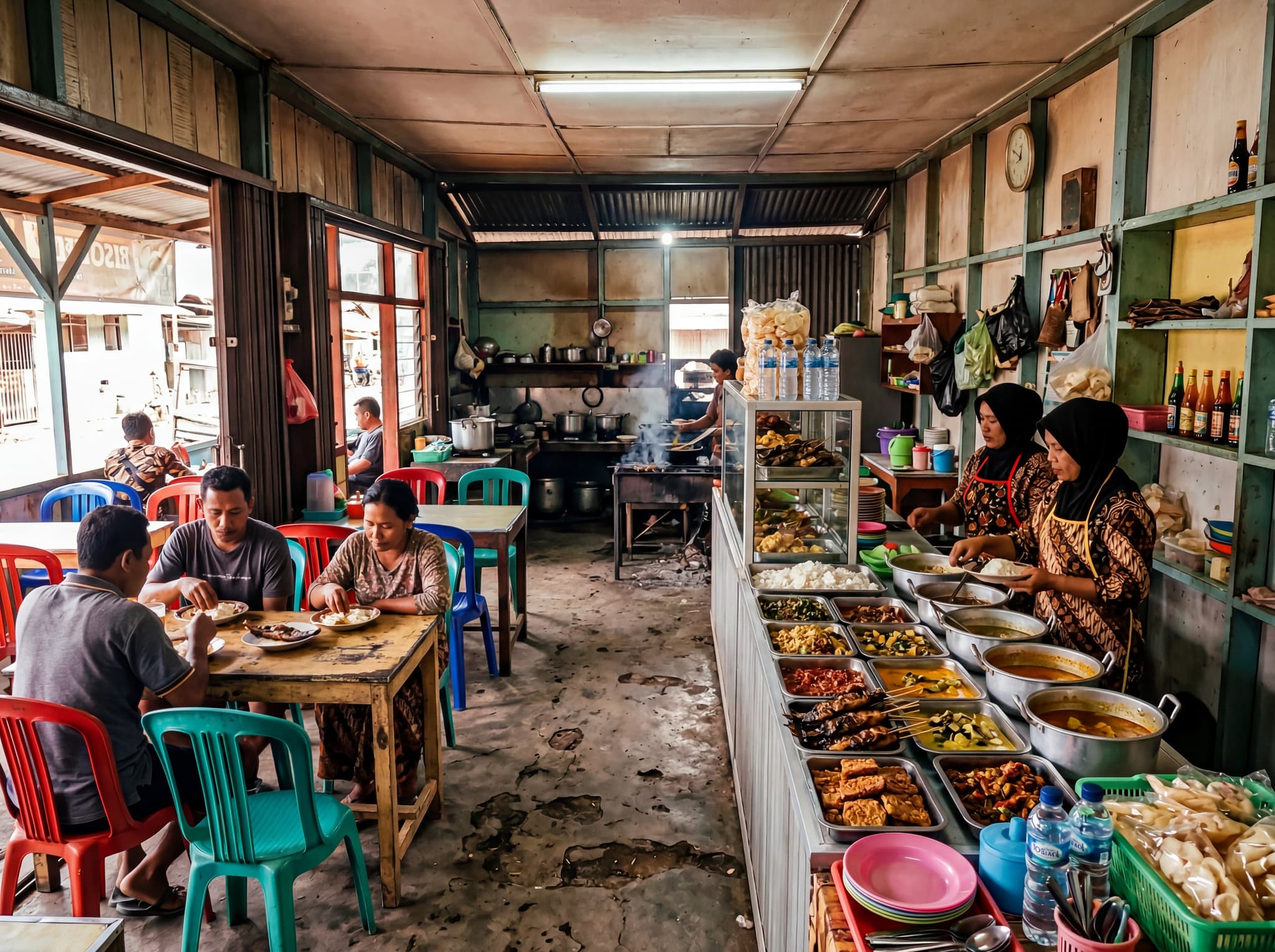
For provisioning, Toko Gubuk Tani is a grocery store with snacks and essentials. Open Monday–Thursday and Saturday–Sunday 8am–9pm, Friday 2pm–9pm. Cash only. Contact: +62 813-4311-1508. The Waisai market along the eastern creek is worth a dawn visit for fresh produce — arrive early for the best selection.
Food at Dive Resorts vs. Homestays
The price gap is the starkest illustration of Raja Ampat's two-tier tourism economy. Budget roughly IDR 80,000 per day ($5) for food at a homestay. Budget roughly IDR 800,000 per day ($50) at a resort. Over a seven-day solo trip, that's approximately IDR 700,000 total ($44) versus IDR 5,000,000 total ($313).
To give a sense of the resort market:
- Misool Eco Resort (Misool island): approximately IDR 400,000 ($25) per meal, all-inclusive packages with a sustainable seafood focus. Notable for capping price increases as a sustainability commitment despite broader market inflation.
- Raja Ampat Biodiversity Eco Resort (Gam Island): IDR 300,000–500,000 ($19–$31) per meal, fusion menu blending Indonesian and international dishes.
- Seven Seas Resort (Kri Island): IDR 250,000+ ($15.65+) per meal, à la carte with fresh catches.
Resort Meal Ranges
Breakfast buffet
IDR 100,000–200,000 ($6.25–$12.50)
Lunch
IDR 200,000–350,000 ($12.50–$21.90)
Dinner
IDR 300,000–600,000 ($18.75–$37.50)
Drinks
IDR 50,000–150,000 ($3.15–$9.40)
Service tax
10–21%, plus tips
Liveaboard operators include all-inclusive chef-prepared meals — typically seafood buffets with Papuan and Indonesian fusion, ingredients sourced locally. Menus vary by operator and season; contact them directly for current offerings.
The honest assessment: resort food is competent and sometimes genuinely good, with more variety and international options than you'll find anywhere else in the archipelago. But it's not why anyone comes to Raja Ampat. The fish your homestay host grills over coconut husks, still smelling of the morning's catch — that's the meal that stays with you.
Dietary Restrictions — Vegetarian, Vegan, Halal, Allergies
Halal food is available in Waisai — the Padang restaurants are reliably halal, and several warungs cater to Muslim travelers. On the outer islands, communities are predominantly Christian, and halal preparation is not standard. Homestays can accommodate halal requests if you communicate the need when booking.
Vegetarian and vegan diets are genuinely difficult on the outer islands. Fish is the default protein and often the only protein. Rice, cassava, sweet potatoes, and bananas are available, but vegetable variety is limited. Bring supplementary protein — nuts, protein bars, peanut butter — and be specific with your homestay host about what you can and cannot eat.
Allergies require early, clear communication. Language barriers exist, and ingredient lists don't. Shellfish cross-contamination is a real concern in kitchens where everything comes from the sea. If you have a serious allergy, write it down in Bahasa Indonesia and show it to your host on arrival.
The practical rule: the more restrictive your diet, the more you need to self-provision before leaving Waisai or Sorong.
What to Bring — The Packing List That Actually Matters
This is the section I wish someone had written for me. Raja Ampat's remoteness means the nearest convenience store is a boat ride and a prayer away. Pack food supplies the way you'd pack dive gear — deliberately.
Snacks: Protein bars, nuts, peanut butter, dried fruit, instant oatmeal, crackers. After five days of fish and rice, these become genuinely important for morale and nutrition.
Condiments: A small bottle of hot sauce, soy sauce packets, salt. They take up no space and transform simple food.
Supplements: Electrolyte packets for long dive days in tropical heat. A multivitamin if you're spending seven or more days on outer islands with limited vegetable variety.
Coffee and tea: If you care about your morning coffee, bring your own. Homestay coffee is instant Nescafé, served sweet and warm. This is not a criticism — it's a fact.
Alcohol: Buy in Waisai or Sorong before heading to the islands. Limit of one litre per person. Warungs don't serve it. Some homestays prefer you don't drink it on their property — ask first.
Water: Don't plan around bottled water availability. Homestay-provided or boiled water is the standard. Bring a reusable bottle and purification tablets as backup for outer islands.
Cash: IDR in small bills. There are no ATMs on outer islands and no way to top up. Budget more than you think you'll need, then add 20%.