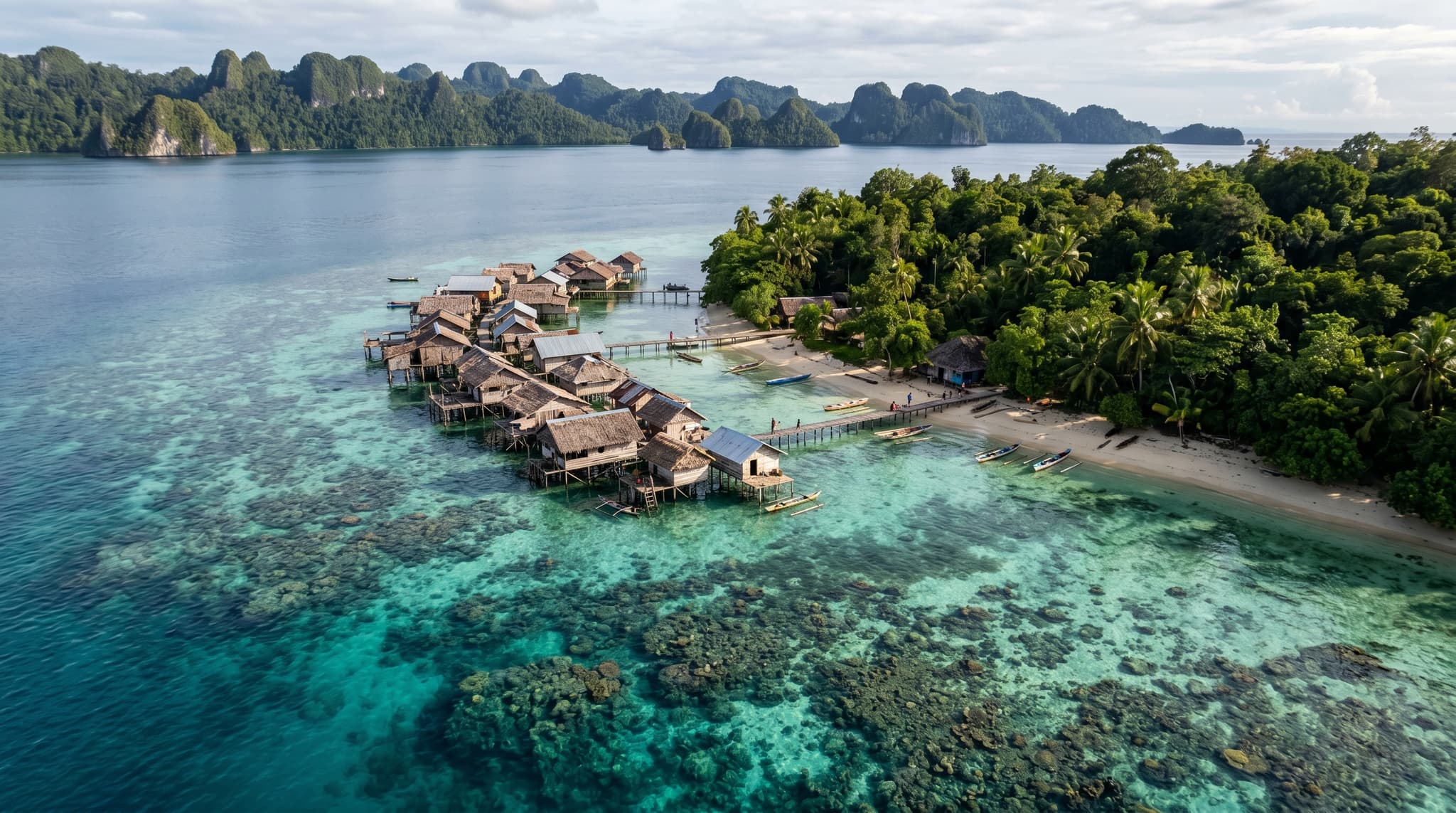
Raja Ampat contains roughly 75 percent of the world's known coral species. Over 1,700 fish species have been recorded across its reefs. These numbers get repeated so often they start to feel abstract, but underwater they translate into something concrete: density. A single dive here can reveal more variety — in color, in movement, in the sheer layering of life on a reef wall — than most divers encounter across an entire trip elsewhere in Southeast Asia.
The area is enormous. Four main island groups — Waigeo, Batanta, Salawati, and Misool — spread across a stretch of ocean roughly the size of Belgium. Each zone has its own character, its own seasonal rhythms, its own relationship with current and visibility. Choosing when, where, and with whom to dive Raja Ampat is the real decision, and it shapes the experience more than most guides acknowledge.
This is a guide to that decision. Site by site, season by season, with honest notes on what different skill levels and budgets will actually encounter.
Why Raja Ampat Diving Stands Apart
The biodiversity numbers matter, but what they mean in practice is this: Raja Ampat sits at the heart of the Coral Triangle, the most biologically concentrated marine region on earth. The density isn't just about species counts. It's about what happens on a single dive — the way a reef wall transitions from hard coral to soft coral to sponge garden within a few meters, with schools of fusiliers parting around you and a wobbegong shark resting on a ledge below.
The conservation framework is part of why the reefs look like this. Raja Ampat operates as a marine protected area with active management. In July 2025, Blue Magic — one of the archipelago's most famous dive sites — introduced a cap of 10 divers per hour to reduce pressure on the cleaning station where mantas aggregate. It's a meaningful restriction, and it signals the direction conservation is heading here: access is not unlimited.
Raja Ampat is diveable year-round thanks to its equatorial position, but conditions shift meaningfully by month. The experience you have in January is different from the one you have in July — not better or worse in absolute terms, but different in character. This guide breaks that down.
Raja Ampat Dive Sites by Area
Rather than a flat list, it helps to think of Raja Ampat's dive sites in geographic zones. Each area has a distinct personality — different corals, different currents, different energy.
Dampier Strait

The Dampier Strait between Waigeo and Batanta is the workhorse zone of Raja Ampat diving. It's sheltered enough to remain diveable year-round, including during the rougher off-peak months when southern sites become inaccessible. The diving here is current-driven and high-energy — these are not gentle reef drifts.
Key Dampier Strait Sites
Blue Magic
Manta cleaning station, strong currents, 10-diver/hour cap. Advanced divers.
Manta Sandy
Shallower manta encounters on a sandy bottom. Peak sightings October–April.
Sardine Reef
Wall dive with massive schools of fusiliers and jacks. Strong currents.
Cape Kri
Current-swept ridge famous for record fish counts on a single dive.
Blue Magic deserves a specific note. The site is a submerged pinnacle where mantas come to be cleaned by smaller fish. The currents can be serious — this is not an intermediate dive, regardless of what your divemaster's briefing implies. The new diver cap means you'll need to plan around it, especially during peak season when multiple boats converge on the site. Your operator should be coordinating time slots in advance.
Misool

Southern Raja Ampat — Misool — is the soft coral capital. The karst topography that defines Misool above water — limestone islands eroded into mushroom shapes, lagoons hidden behind rock walls — continues below the surface in the form of swim-throughs, overhangs, and walls draped in color.
Misool is best accessed between October and April, when the southern seas calm enough for comfortable diving. During the May–September off-peak, swells and wind make the crossing from northern bases unreliable.
Key Misool Sites
Boo Windows
Swim-throughs framed by soft coral. Iconic for photography.
Magic Mountain
Submerged seamount where mantas and reef sharks patrol.
Fiabacet
Walls with pelagic encounters — barracuda, trevally, occasional eagle rays.
The character here is different from Dampier Strait. Misool dives tend to feel more cinematic and less kinetic — the drama is in the landscape and the color saturation rather than in fighting current alongside a thousand fish.
Wayag and Northern Waigeo

Wayag is the image most people associate with Raja Ampat — the aerial shot of karst islands in a turquoise lagoon. There are fewer dedicated dive sites here compared to Dampier Strait or Misool, but the topside scenery is extraordinary, and occasional shark encounters reward divers who make the journey north. Most liveaboard itineraries of 10 nights or more include Wayag.
Arborek and Friwen
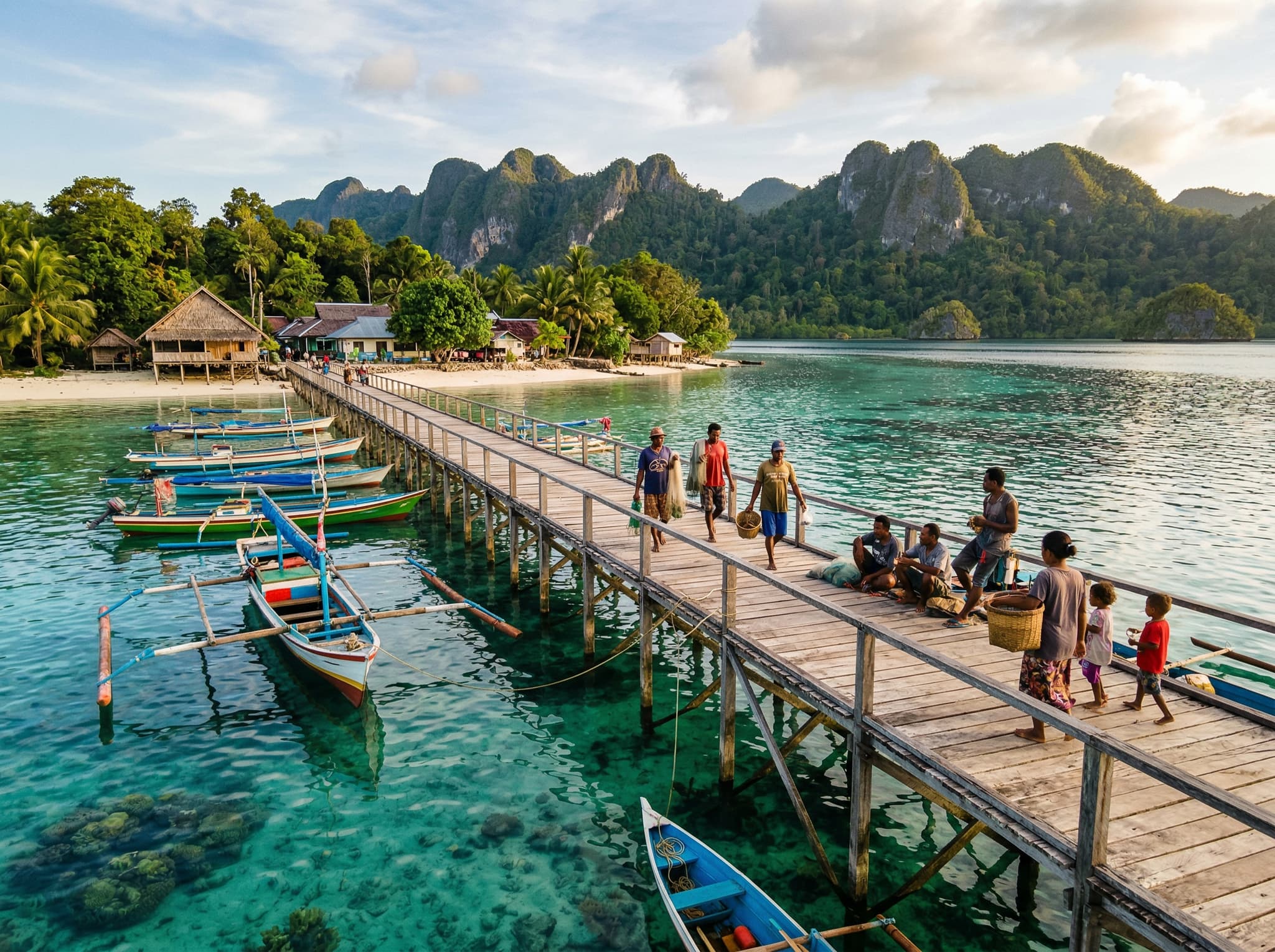
These central islands, accessible from Waisai and nearby resort bases, offer solid day diving without the long boat transfers. Arborek's jetty is known for manta sightings — mantas sometimes cruise within meters of the pier. Friwen Island has healthy reef walls suited to a range of skill levels. For divers based at shore resorts, these sites form the backbone of daily diving.
When to Dive Raja Ampat: Season by Season

Raja Ampat's equatorial position means diving is viable in every month. But the conditions — visibility, sea state, marine life patterns — shift enough to make timing a real variable in what you'll experience.
October–November: The Transition In
Seas calm after the off-peak months. Visibility climbs to 20–30 meters. Early October is a sweet spot: conditions are approaching peak quality, but the boats haven't arrived in full force yet. November brings increasing manta sightings at Dampier Strait sites and sporadic whale shark appearances — rare, unpredictable, but this is the window where they've been reported.
December–February: Peak Season
Water temperature holds at 28–30°C. Visibility reaches 20–30+ meters, sometimes exceeding 30 at sheltered sites. This is the peak window for manta ray encounters — January and February are prime months for large aggregations at Blue Magic and Manta Sandy, with both reef and oceanic mantas present. Reef sharks are most abundant November through March.
The trade-off is crowds. December brings holiday divers, and the most popular sites see multiple boats per day. The Blue Magic diver cap helps, but expect scheduling constraints.
March–April: Late Peak
Still excellent diving. March often has the calmest seas of the entire year. Manta sightings begin declining toward April as the season transitions. April is a good window for divers who want peak-adjacent conditions with fewer people on the water.
May–September: Off-Peak
Water temperature drops slightly to 27–28°C. Visibility narrows to 10–20 meters. Seas are rougher, especially in the south — Misool becomes difficult or impossible to access from northern bases. But the Dampier Strait remains sheltered and diveable, and the reefs don't stop being extraordinary because fewer people are looking at them.
The Photographer's Season: June–September
This is counterintuitive but well-documented. The off-peak months bring lower plankton density, which means less backscatter — the suspended particles that ruin wide-angle shots. For underwater photographers, June through September can produce cleaner images than the nominally better-visibility peak months. If you're shooting rather than just looking, this matters.
Seasonal Summary
Peak Conditions
November–March: 28–30°C, 20–30m+ visibility, peak mantas and sharks
Shoulder Months
April and October: good conditions, fewer crowds
Off-Peak
May–September: 27–28°C, 10–20m visibility, Dampier Strait still diveable
Photography
June–September: low plankton, minimal backscatter
Manta Peak
January–February for large aggregations
Liveaboard vs. Resort-Based Raja Ampat Diving
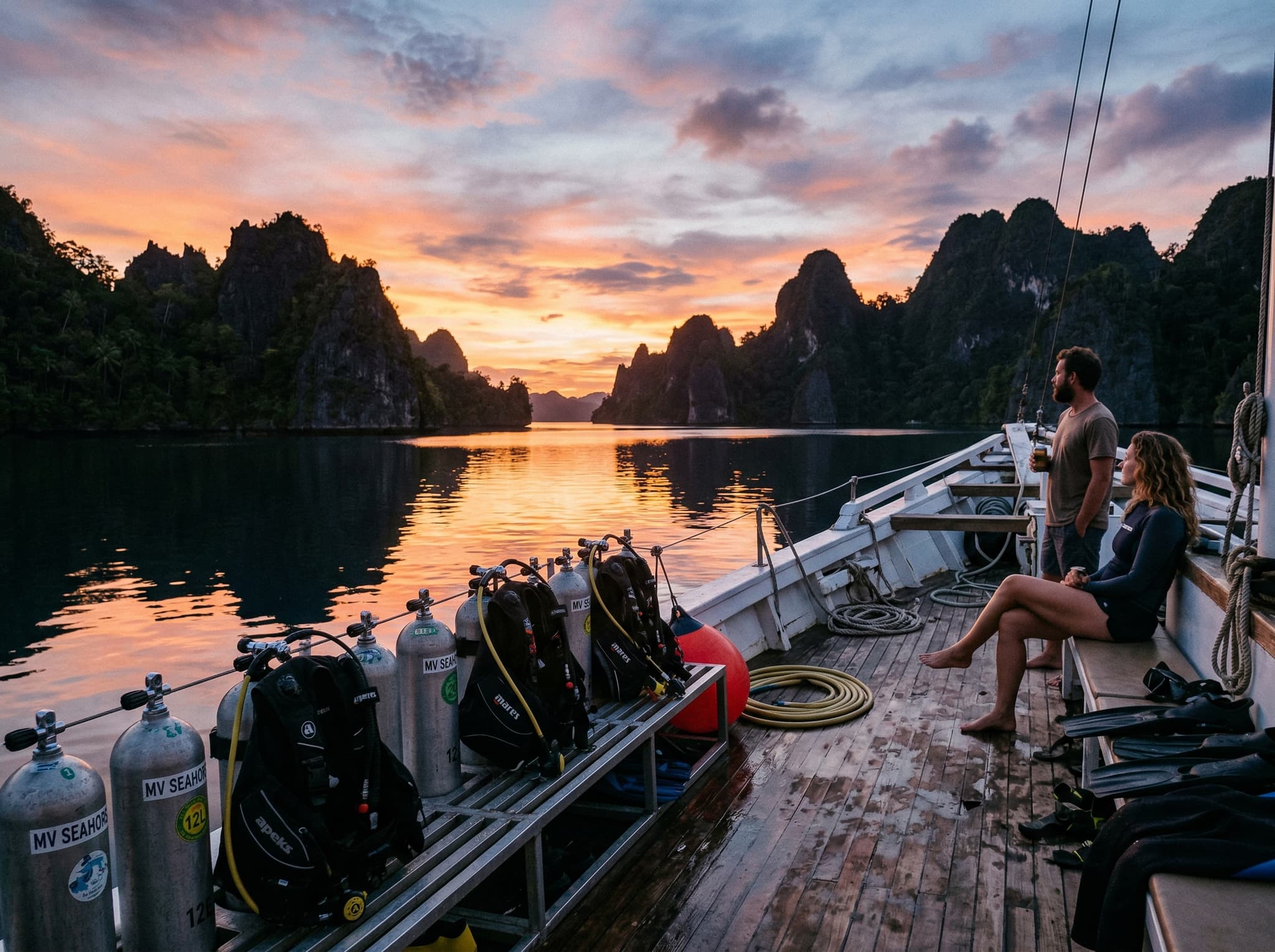
This is a structural decision, not a quality ranking. Each model suits different divers and different trip goals.
Liveaboards
Liveaboards depart directly from Sorong harbor, bypassing the ferry to Waisai entirely. Multi-day itineraries of 7–11 nights cover the widest range of sites, including remote Misool and Wayag — areas that are impractical to reach from a fixed base on day trips. If your priority is maximizing site variety and reaching the southern and northern extremes of the archipelago, a liveaboard is the most efficient way to do it.
The distances involved make this important to understand: prime dive sites are 50–100+ kilometers from Sorong, with roundtrip travel times of 4–6 hours or more. Direct day trips from Sorong to remote sites are not realistic.
Resort-Based Diving
Resorts on Waigeo (near Waisai) and the central islands offer day diving from a fixed base — overwater bungalows or beachside operations with speedboat access to Dampier Strait sites and nearby areas. This model works well for longer stays, mixed diving and non-diving days, and divers who prefer returning to the same bed each night. Minimum stays of 7–8 nights are typical at most resort-based operations.
Village-Based Day Trips
Local guides in Arborek and Gam villages arrange impromptu dive and snorkel trips after you've arrived on the islands. This is the lowest-cost option and the least predictable — but it's flexible, authentic, and puts money directly into local communities. Groups of four or more can often arrange custom itineraries with operators.
Raja Ampat Dive Operators: What to Look For
Operator pricing shifts seasonally and with promotions. The ranges below are drawn from early 2026 availability — confirm directly with operators before booking. What's more durable than pricing is vessel character: the kind of trip each operator runs, what's included, and who it's suited for.
Budget Tier
Sea Safari ships and SMY Ondina (recommended by PADI Travel) offer functional liveaboard experiences at the lower end of the price range. Scuba Republic's Epica provides in-room air conditioning and sails year-round with seasonal itineraries. Expect to pay under $3,500 for 7+ nights at this tier.
Mid-Range Tier
This is where most divers land. Neptune One, Scuba Republic's Jaya (an expedition vessel that's beginner-friendly and offers a fourth dive on select days, sailing year-round), and Mermaid Liveaboards (Mermaid I and II — voted among DIVE Magazine's Top Ten World Best Liveaboards for the past decade) all operate in the $3,500–$5,000 range for 7–11 night itineraries. Discounts appear periodically — it's worth checking current availability directly.
Premium Tier
Emperor Raja Laut and Ambai (which runs 11-night itineraries covering the full north-to-south range) sit at the top, generally $5,000–$7,000+. At this level you're paying for longer itineraries, smaller group sizes, and more refined onboard amenities.
Resort-Based Operators
Wicked Diving operates Marley Beach Resort in central Raja Ampat with speedboat transfers from Sorong. Papua Diving runs day trips to Fam Islands and Manta Sandy from their Raja Ampat base. Pioneer and Beautiful Dive Resorts offer packages at USD 2,220–2,490 for 7–8 night minimum stays including Sorong transfers and access to 50+ dive sites.
Typical Inclusions & Exclusions
Usually Included
Meals, tanks, weights, experienced divemasters
Usually Excluded
National park entry fees, full equipment rental, nitrox
Pricing Note
Ranges reflect early 2026 availability — confirm with operators
Permits, Fees, and Gear Essentials
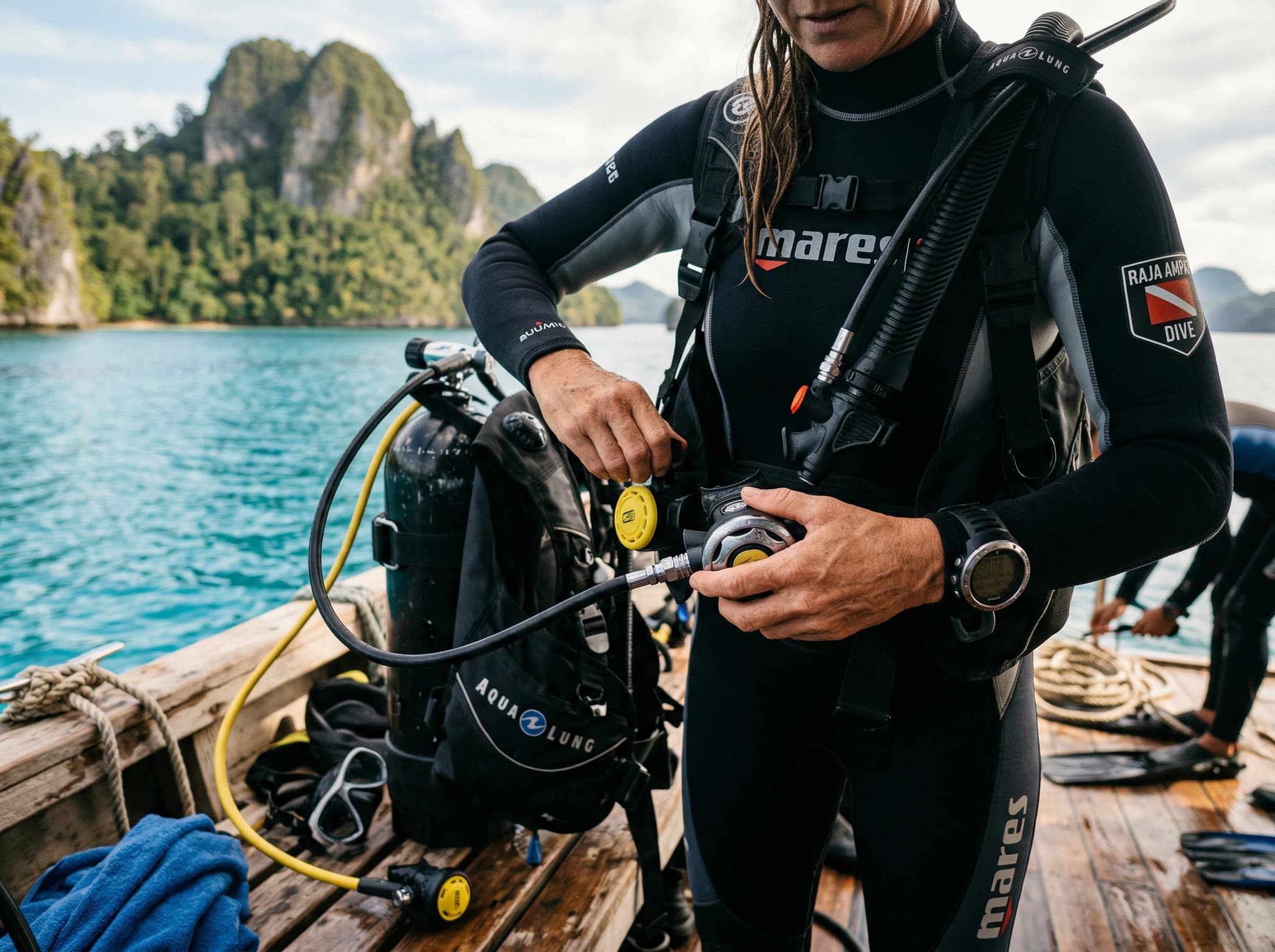
Two separate fees are required for legal access to Raja Ampat's marine areas, including day trips. Both apply to every visitor.
Required Permits
Conservation Permit
IDR 700,000 (international) / IDR 425,000 (Indonesian). Valid 12 months.
Visitor Entry Ticket
IDR 1,000,000 (international) / IDR 300,000 (Indonesian). Per entry.
Total (International)
~IDR 1,700,000 (~USD 95–105)
Children Under 12
Exempt from conservation permit fee
Purchase the Conservation Permit online at kkprajaampat.com before arrival. The Visitor Entry Ticket is available at sipari-rajaampat.id or in person at Waisai port. Buying both in advance saves time — the Waisai port office can be slow when a ferry has just arrived.
For gear: a 3–5mm wetsuit is recommended. Water temperatures are warm, but thermoclines exist, especially on deeper dives and at sites like Magic Mountain where cold upwellings are common. Most liveaboards provide tanks and weights as standard; full equipment rental is typically an additional cost.
For certification: Advanced Open Water or equivalent is recommended for the current-heavy sites that define Raja Ampat's best diving — Blue Magic, Sardine Reef, Manta Ridge, Cape Kri. Some operators, like Scuba Republic's Jaya, are explicitly beginner-friendly, but site access will be restricted to calmer locations.
What Raja Ampat Diving Actually Feels Like
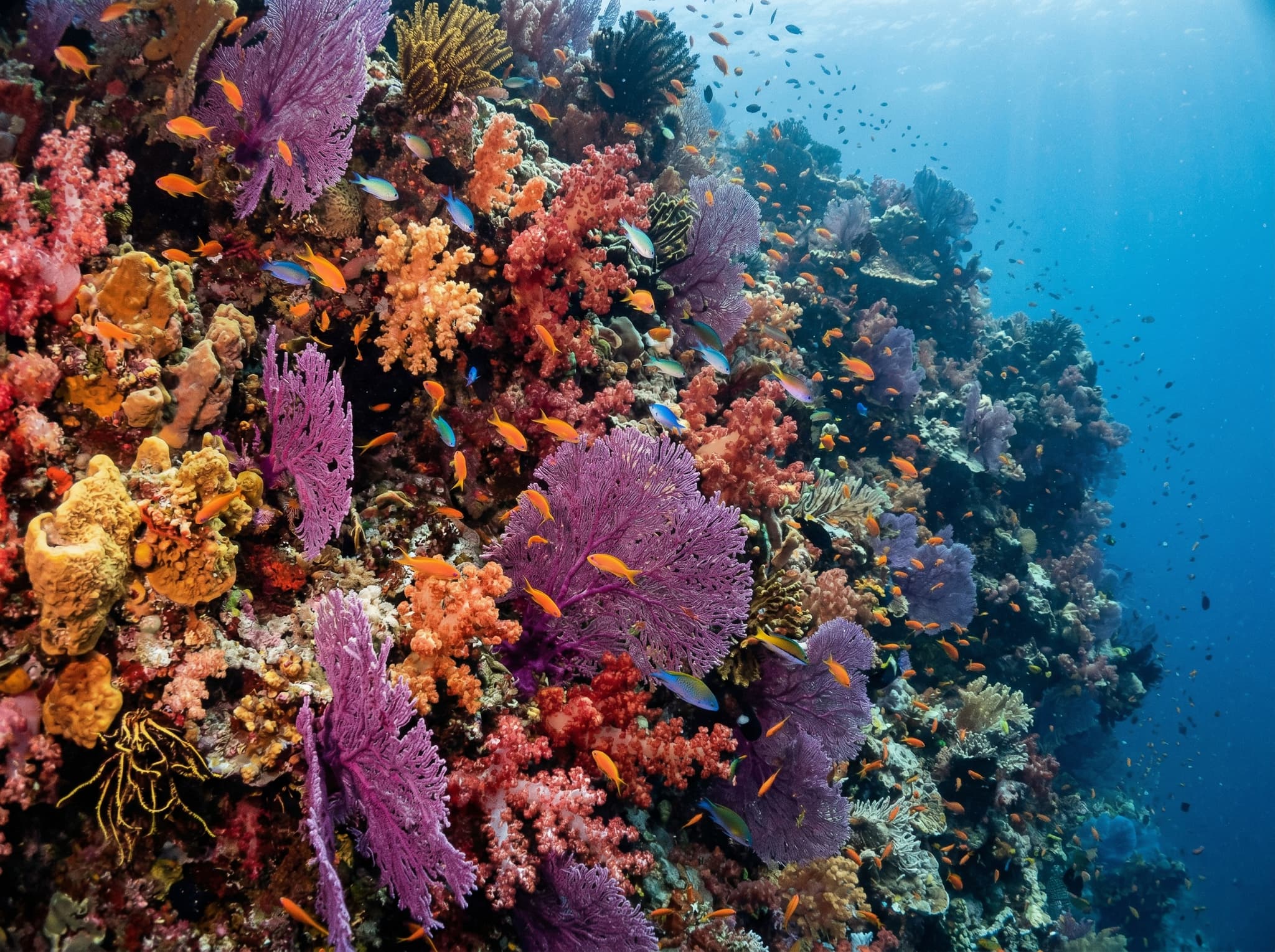
The species lists and operator tiers are necessary information, but they don't capture what makes divers return to Raja Ampat — sometimes three or four times, at considerable expense, to a place that is genuinely difficult to reach.
What distinguishes the diving here is saturation. Not just color, though the soft coral walls of Misool produce a density of purple, orange, and red that looks oversaturated even to the naked eye. It's the saturation of life at every scale — the macro critters tucked into crevices, the mid-water schools that darken the blue above you, the mantas that materialize from the edge of visibility with a wingspan wider than you are tall.
The zones feel different from each other in ways that go beyond species lists. Dampier Strait dives are kinetic — you're working with current, reading the water, holding position on a ridge while fish pour past in a river of silver. Misool is quieter, more contemplative. The swim-throughs at Boo Windows frame soft coral gardens like stained glass, and the light shifts as you move through them.
Above the surface, the karst landscape is its own experience: limestone islands that look sculpted, lagoons glowing an impossible blue-green, bioluminescence trailing from your hand when you dip it over the side of the boat at night.
The honest notes: the currents at sites like Blue Magic and Sardine Reef are genuinely challenging, not just "exciting" in the way dive marketing uses that word. Visibility can change within a single dive as thermoclines shift. The remoteness is real — if something goes wrong, the nearest hyperbaric chamber is far away. This is not a casual destination, and treating it as one diminishes both the experience and the risk.
What you feel underwater, though, is the accumulated result of decades of conservation in a place where the reefs have not been bombed, bleached, or stripped. The difference from degraded sites elsewhere in Southeast Asia is visible within the first five minutes of your first dive. It's not a superlative. It's just what a healthy reef looks like when you've spent years diving ones that aren't.
The core decision matrix for Raja Ampat diving is straightforward. When you go determines what you'll see: peak season for mantas and maximum visibility, off-peak for photography and solitude, shoulder months for the balance. How you dive — liveaboard, resort, or village-based — determines what you can reach: the full archipelago, the Dampier Strait core, or the accessible sites near Waisai.
Both decisions matter more than most guides suggest. Raja Ampat rewards planning not because it's fragile or exclusive, but because it's vast. The divers who get the most from it are the ones who understand that the place is not a single experience but a collection of very different ones, spread across an area that no single trip can cover entirely. That's not a limitation. It's the reason people come back.